What Is a UCC-1 Filing?
A UCC-1 financing statement is a one-page notice a lender files with a state office to perfect a security interest in a borrower's personal property. It does not create the security interest — the security agreement between lender and borrower does that. The UCC-1 makes the interest public, and public notice is what establishes priority against creditors who come later.
Filings are governed by Article 9 of the Uniform Commercial Code, adopted in some form by every US state. Article 9 covers personal property and fixtures: equipment, inventory, accounts receivable, intellectual property, and investment property. Real property is handled separately, through mortgages and deeds of trust recorded at the county level.
The practical effect is a timestamp. Article 9's general rule is first to file or perfect. A lender who signs a security agreement on Monday and files on Friday sits behind a lender who filed on Wednesday against the same collateral.
This is part of a series of articles about loan processing
Analyze your first UCC filing in minutes with AI
Why Do UCC-1 Filings Matter for Lenders?
They Establish Priority Against Other Creditors
A perfected security interest determines who gets paid first if the borrower defaults or files for bankruptcy. An unperfected interest may be subordinated to perfected creditors and, in bankruptcy, can be avoided entirely by the trustee — leaving a lender who believed it was secured standing with unsecured claimants.
They Reveal What Is Already Encumbered
Before extending credit, a lender searches UCC records to find existing liens on the collateral it intends to take. A prior blanket filing covering all assets changes the deal: the new lender is taking a junior position, needs a subordination agreement, or needs different collateral.
They Create an Auditable Record
Filings and their amendments form a public chain showing who claimed what, when, and whether that claim was continued, assigned, or released. Examiners, auditors, and counsel rely on that chain, which is why gaps and errors in it carry consequences well beyond the original transaction.
What Information Goes on a UCC-1 Financing Statement?
The form is short, which is part of why errors on it are costly. Three elements carry the weight:
Debtor name. For a registered organization, this must match the name on the public organic record — the articles of incorporation or equivalent filed with the state. Not the trade name, not the DBA, not the name on the invoice.
Secured party name. The lender, or a representative of the lender.
Collateral description. Either a specific description or a blanket statement covering all assets. "All assets" is sufficient on a financing statement, though not in the underlying security agreement.
The debtor name is where most filings fail. Article 9 applies a "seriously misleading" standard: a name error voids the filing unless a search of the filing office's records under the correct name, using that office's standard search logic, would still disclose it. Standard search logic varies by state and is generally unforgiving. "Acme Holdings, LLC" and "Acme Holding LLC" are not reliably the same debtor.
Where Do You File a UCC-1?
Filings go to the state where the debtor is located — not where the collateral sits, and not where the lender is. For a registered organization, the debtor's location is its state of organization. A Delaware LLC operating entirely in Texas files in Delaware.
For an individual debtor, location is the principal residence. For organizations that are not registered, such as a general partnership, location is the place of business, or the chief executive office where there is more than one.
Fixture filings are the exception. A security interest in goods that will become fixtures is filed in the county real estate records where the property sits, so it surfaces in a title search.
Learn more about loan underwriting software.
How Long Is a UCC-1 Effective?
A UCC-1 is effective for five years from the filing date. It lapses automatically unless a continuation statement is filed, and the window for that continuation is narrow: within the six months before the lapse date. File earlier and it is rejected. File later and the original has already lapsed, taking its priority date with it.
A lapsed filing cannot be revived. Re-filing creates a new financing statement with a new priority date, which may now sit behind filings made in the interim. On a long-term facility, the continuation calendar matters as much as the original filing.
What Is a UCC-3 Amendment?
Changes to an existing filing go on a UCC-3, which references the original filing number. The common uses:
Continuation — extends the filing another five years.
Termination — releases the security interest, typically at payoff.
Assignment — transfers the secured party's interest to another lender.
Amendment — changes the debtor name, secured party name, or collateral description.
Terminations deserve attention from both sides. A borrower who pays off a facility and never obtains the termination carries a lien of record that surfaces in the next lender's search. A secured party who files a termination in error can find its interest unperfected.
Common Challenges with Manual UCC Review
Assembling the Amendment Chain
A search on a mid-size borrower can return dozens of filings across several states and multiple corporate entities. Each filing may carry a string of UCC-3 amendments, and the current status of a lien is only visible once those amendments are read in order. A filing that looks active may have been terminated three amendments ago.
Partial Terminations and Collateral Overlap
A termination may release only part of the collateral, leaving other liens intact. Determining whether a prior filing actually overlaps the collateral being taken requires reading each description rather than scanning filing dates, and "all assets" filings overlap with everything.
Entity Disambiguation
Borrowers with layered structures produce searches returning similarly named entities — an operating company, several single-purpose entities, and occasionally a misspelling. Deciding which results concern the actual counterparty is judgment work performed one filing at a time.
Review Volume at Closing Speed
UCC review typically happens under deadline, late in a transaction. The work is mechanical but voluminous, and errors concentrate where attention thins out — around the fortieth filing rather than the fourth.
How AI Can Automate UCC Filing Review
Here are the ways lenders can use AI to compress UCC search and review work.
1. Extract Filing Data from Search Results
AI can read a UCC search result set and extract the structured fields from each filing: filing number, filing date, debtor name and address, secured party, and collateral description. Search results arrive in formats that vary by state office, and much of the effort in manual review is simply normalizing them into a comparable shape.
The resulting structured data becomes the input for every downstream check, replacing the step where a reviewer retypes filing details into a spreadsheet.
Key actions:
Extract filing number, dates, parties, and collateral text from each result.
Normalize results from different state filing offices into one schema.
Validate extracted values against the source document before use.
2. Assemble the Amendment Chain per Filing
AI can link each UCC-3 amendment to its original financing statement and order them by date, producing a current-state view of each lien rather than a list of disconnected documents.
This is the step that determines whether a filing is live, lapsed, continued, assigned, or terminated — and it is the step most likely to be rushed when the chain runs to several amendments.
Key actions:
Match each amendment to its originating filing number.
Order amendments chronologically and resolve the current status.
Flag filings whose chain is incomplete or internally inconsistent.
3. Classify and Compare Collateral Descriptions
Collateral descriptions range from precise equipment schedules to blanket "all assets" language. AI can classify each description into collateral categories and compare it against the collateral contemplated in the current transaction.
Automated comparison surfaces overlap that a date-ordered review would miss, including the case where an older, narrower filing still covers a specific asset the new facility depends on.
Key actions:
Classify each collateral description into standard categories.
Compare prior filings against the proposed collateral package.
Flag blanket filings and partial releases that affect priority.
4. Resolve Debtor Entity Identity
AI can group search results by entity, reconciling name variants, suffix differences, and address changes, then separate filings against the counterparty from filings against similarly named affiliates.
Because the "seriously misleading" standard turns on exact names, surfacing near-matches is as valuable as surfacing exact ones — a near-match may be a defective filing by a competing lender, or a defect in your own.
Key actions:
Group filings by debtor entity across name and address variants.
Separate counterparty filings from affiliate filings.
Flag name variants that may render a filing seriously misleading.
5. Track Lapse and Continuation Dates
AI can calculate the lapse date for every active filing and identify which ones fall inside the six-month continuation window, producing a calendar rather than a list.
Applied to a lender's own portfolio of filings, this converts a diary task that depends on individual memory into a scheduled report.
Key actions:
Calculate lapse dates from filing and continuation history.
Identify filings inside or approaching the continuation window.
Flag lapsed filings and the priority consequences of re-filing.
6. Produce a Cited Lien Position Summary
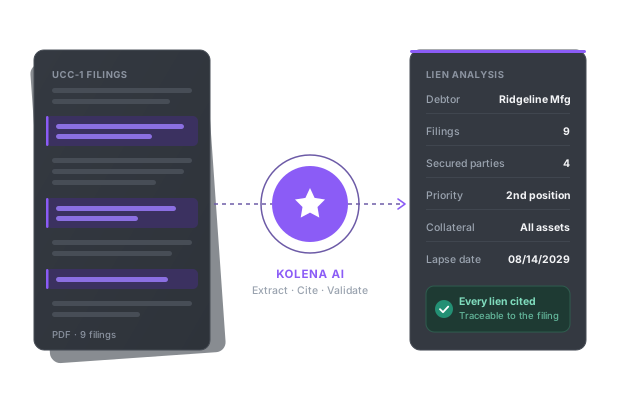
AI can generate the output a credit officer actually needs: a current lien position by collateral category, ordered by priority, with each conclusion linked to the filing and page it came from.
The citation is what makes the summary usable. A lien position that cannot be traced to a specific filing is a conclusion nobody can act on or defend.
Key actions:
Rank liens by priority within each collateral category.
Cite the filing and page supporting every conclusion.
Route ambiguous or conflicting filings to a human reviewer.
Related content: Read our article about loan processing
Automating UCC Analysis with Kolena
Kolena is an AI platform for lending document workflows that reads UCC search results, assembles the amendment chain for every filing, classifies collateral, and returns a current lien position by priority. Kolena agents read and classify every page, resolve debtor entities across name variants, compare collateral descriptions against the proposed package, and flag the filings that change the deal. Every value carries a page citation and a reasoning log, so credit, legal, and operations teams can defend each result to an examiner, an auditor, or counsel on the other side.
Key capabilities of Kolena:
Full search-set review: Reads every filing in a search result rather than a sample, so blanket liens and partial releases are found rather than assumed.
Amendment chain resolution: Links each UCC-3 to its originating filing and resolves current status — live, lapsed, continued, assigned, or terminated.
Collateral classification: Classifies descriptions into standard categories and compares them against the collateral contemplated in the transaction.
Entity disambiguation: Groups filings by debtor across name and address variants, separating counterparty filings from affiliate filings.
Cited lien positions: Cites the exact filing and page behind every priority conclusion, producing a reasoning log a reviewer can follow.
Lapse and continuation tracking: Calculates lapse dates across a filing portfolio and surfaces the six-month continuation window before it closes.
High-volume parallel processing: Processes hundreds of filings at a time, routes exceptions to reviewers, and delivers output to your loan origination or credit system.
Enterprise security and governance: PCI, SOC 2, and HIPAA compliant, with no training on customer data, encryption in transit and at rest, role-based access control, and a complete audit trail.
Kolena's UCC Analysis agent is pre-built for this workflow. The agent library page shows the fields it extracts, the documents it reads, and where it sits in a lending workflow.
Learn more about Kolena for banking