AI automates the document-heavy work that slows down lending — loan file assembly and review, UCC filing review, mortgage document processing, KYC document review, and bank statement analysis — by reading documents of any format, extracting structured data with field-level citations, and returning it to the systems lenders already use. The effect is days of analyst work compressed into hours, with every figure traceable to the exact document it came from.
This guide is a reference for private lenders, CRE lenders, community banks, credit unions, and mortgage originators — anyone running a manual loan-file review process. Each section below covers one lending document workflow: the pain that makes it slow, what AI does, and what changes. The throughline is consistent — AI handles the reading and cross-referencing at volume, and your credit team keeps the decision.
This is part of a series of articles about Loan Processing.
Why Lending Still Runs on Manual Document Review
Every loan is a stack of documents that someone has to read, reconcile, and verify before a decision: tax returns, rent rolls, T12s, bank statements, entity documents, appraisals, UCC and lien searches, KYC files. The traditional options are manual review (accurate but slow, and a drag on the analysts you most want to retain) or offshore outsourcing (cheaper per file but slower to turn around and inconsistent). Offshore cost also moves the wrong way over time: India median salaries rose about 9.5% in 2024 and 2025, and non-voice BPO attrition of 15–30% turns over knowledge of your credit templates roughly quarterly. AI restructures the problem — it reads at machine speed, applies the same rubric every time, and cites each value to its source. MIT's Project NANDA study (Aug 2025) found firms eliminating $2–10M in annual BPO spend after deploying AI; one saved about $8M a year after spending roughly $8,000 on a tool.
Analyze your first UCC filing in minutes with AI
Loan File Assembly and Review
Before credit committee, someone has to turn a pile of borrower documents into an underwriter-ready package: pulling the numbers from tax returns, rent rolls, T12s, and bank statements, and reconciling them against each other — the rent roll against the T12, the appraisal against the actuals. Done manually, or through an offshore queue that processes each document in isolation, this takes days, and the cross-checks that catch problems happen late.
AI reads the entire loan file as one connected package, extracts and cross-references the key data across every document, and returns an underwriter-ready output with each figure cited to its source. One private-lending customer cut loan-file turnaround from about five days to hours this way. The credit decision stays with the underwriters; AI just hands them a clean, sourced file faster. The compounding benefit is throughput: a team that previously cleared a fixed number of files per week can take on surges — a busy origination month, a rate-driven wave — without temporary headcount, because AI has no fixed ceiling on how many files it reads in parallel.
UCC Filing Review
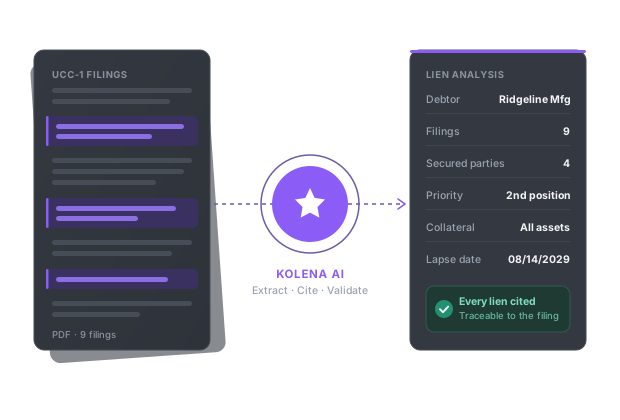
UCC filing review — verifying lien searches, checking collateral descriptions, validating entity documents, and confirming tax liens — is high-volume, pattern-matching work that consumes analyst time on every deal. It means cross-referencing multiple document types across jurisdictions, each formatted differently, looking for the discrepancy that matters.
AI reads across the document types and jurisdictions at once, matches collateral and entity details, and flags discrepancies — no manual side-by-side. One private-lending customer cut UCC filing review labor by 96%. Because the check is consistent and every flag is cited to its source, what was a bottleneck on every deal becomes a fast, auditable step.
Mortgage Document Processing
A mortgage file — 1003 application, income documentation, tax returns, bank statements, appraisal, title commitment — is a large, multi-document package, and manual review creates processing delays and compliance risk. RESPA and TRID impose hard timelines, so slow review isn't just inconvenient, it's a regulatory exposure. And these files are dense with PII — SSNs, income, financial data — which makes offshore processing a data-residency concern.
AI reads the full package, extracts structured data, and flags missing items and inconsistencies, accelerating time to clear-to-close while keeping PII onshore with a documented audit trail. That makes TRID deadlines easier to hold and removes the offshore exposure that comes with outsourcing sensitive borrower data.
KYC Document Review
KYC document review — identity documents, beneficial-ownership certifications, entity-structure documents, and OFAC screening support — is a compliance requirement with hard deadlines and audit-trail obligations. Manual review is slow and produces inconsistent documentation, and offshore processing tends to deliver an output without a traceable basis for each decision — a problem when BSA/AML supervision asks why a customer was cleared or escalated.
AI reads the KYC package, extracts structured data, and produces a documented review record with every field cited to its source — the documented decision logic that BSA/AML compliance requires, natively. The same rubric applied to every customer also removes the analyst-to-analyst variance a rotating manual or offshore team introduces.
Bank Statement Analysis
Bank statement analysis — extracting revenue, cash-flow patterns, average daily balances, NSF frequency, and large deposits and withdrawals across 12–24 months of statements — is manual, time-consuming, and format-inconsistent, because every bank produces statements differently. An offshore team calibrated to common layouts slows or errs on the rest.
AI reads any statement format, normalizes the data, and returns a structured cash-flow summary with every line item cited to the source statement. That makes statement spreading fast and consistent for SBA and commercial loan underwriting, and for any lender using bank statements as primary income documentation. Because the signals are extracted the same way across every account and every bank, the underwriter compares like with like instead of reconciling a stack of mismatched layouts.
Across all five workflows, the common thread is that the document is the bottleneck, not the decision. Underwriters and compliance officers are not slow because they think slowly — they are slow because reading, keying, and reconciling documents by hand is slow. AI removes that constraint without touching the judgment layer, which is why the same platform pays off across loan files, liens, mortgages, KYC, and statements rather than solving just one of them.
Where to Start: Sequencing an AI Rollout
Lenders rarely automate every workflow at once, and they don't need to. The pattern that works is to start where the pain is sharpest and the documents are most repeatable, prove the workflow, then expand. For most lenders that first step is loan file review or UCC filing review — high-volume, deadline-bound, and pattern-heavy, so the time savings are immediate and easy to measure. KYC and bank statement analysis follow naturally because they reuse the same extraction-and-citation foundation. Because the same platform handles every document type, each new workflow is a configuration rather than a new vendor: you define the rubric and the output template once and reuse the underlying engine. That keeps the rollout incremental and lets the credit and compliance teams build trust in the output one workflow at a time, verifying against the citations before they lean on the speed.
What Makes AI Trustworthy on Lending Documents
Speed only matters if the output holds up, and three things separate production-grade AI from a demo. The first is field-level citation: every value links back to the exact line or clause it came from, so verification is a glance and examiners and credit committees get a defensible source for each number. The second is cross-document reasoning — reading the loan file as one connected package rather than a stack of isolated documents, which is where reconciliation errors hide. The third is human-in-the-loop by design: ambiguous or unusual items are flagged for review rather than silently guessed, so your team spends its attention where judgment matters. Underpinning all of it: data stays onshore, the platform is SOC 2 Type II certified, and customer data is never used to train models.
Manual vs. Offshore vs. AI for Lending Documents
The trade-offs are consistent across every workflow above.
| Factor | Manual in-house | Offshore outsourcing | AI (Kolena) |
|---|---|---|---|
| Turnaround | Days per file | 24–48 hour queue, longer at peak | Hours |
| Cost trajectory | Analyst time; scales with headcount | Per-file; rises ~9.5%/yr with wages | Software cost; flat as volume scales |
| Cross-referencing | Manual, late in the process | Documents handled in isolation | Whole file read as one package |
| Citations / audit trail | Manual, if any | Outputs without traceable sourcing | Field-level citation to each source |
| Data residency | Onshore | Offshore | Onshore, SOC 2 Type II |
Manual and offshore review still fit genuinely low, sporadic volume or one-off files needing deep judgment. For recurring loan volume on a deadline, AI wins on speed, consistency, and auditability — without moving sensitive borrower data offshore.
How Kolena Works
Kolena is an AI document automation platform built for banks, credit unions, and private lenders. Loan files, UCC and lien searches, mortgage packages, KYC documents, and bank statements go in; structured, cross-referenced data — with missing items and discrepancies flagged — comes out in hours.
It reads any format — PDFs, scans, statements, entity docs — and pushes structured output into your loan-origination, core banking, and spreading systems, keeping sensitive borrower data onshore. Every run produces a full audit trail: not just what was extracted, but the specific line, field, or clause that justified each data point. SOC 2 Type II certified, onshore processing, no training on customer data.