TL;DR: Loan processing software manages applications from submission through approval, closing, and funding. Best for document-heavy loan file review: Kolena; document data capture: Ocrolus; mortgage origination at scale: Encompass; end-to-end lending automation: TurnKey Lender.
What Is Loan Processing Software?
Loan processing software, also known as a loan origination system (LOS), automates the entire lending lifecycle from initial application intake to underwriting, document generation, and funding. It centralizes borrower information, documents, credit data, and application status so lending teams can process loans through a consistent workflow.
Key features:
- Intelligent document processing: Classifies loan documents and identifies relevant fields, tables, and sections across varying layouts.
- Automated data extraction and validation: Converts document data into structured fields and checks it against application details and other sources.
- Loan file completeness checks: Verifies that required documents, fields, signatures, approvals, and conditions are present before the application advances.
- Rules-based eligibility and pre-screening: Applies predefined lending criteria to determine whether applications can proceed automatically or require review.
- AI-assisted underwriting: Uses AI models to summarize financial information, identify risk indicators, analyze cash flow, and support underwriting decisions.
- Exception and anomaly detection: Flags mismatched, duplicate, unusual, or out-of-range information for targeted investigation.
- Automated report and credit memo generation: Creates standardized underwriting summaries, credit memos, approval packages, and reports from application data.
Analyze your first UCC filing in minutes with AI
Loan Processing Software at a Glance
The table below summarizes the key differences between the platforms covered in this guide. Each one is explored in more detail in the sections that follow.
How Does Loan Processing Software Work?
Step 1: Loan Application and Data Collection
Loan processing starts when a borrower submits an application through one of the following:
- Website
- Mobile app
- Branch
- Broker
- Loan officer
The system captures information such as contact details, employment, income, assets, debts, requested loan amount, loan purpose, and collateral. The exact fields depend on the loan product and lender requirements.
The software validates data as it is entered. For example, it can check whether required fields are complete, dates use valid formats, or requested amounts fall within product limits. Conditional forms can request additional information only when it is relevant to the applicant.
Many platforms also connect to external data sources. They can retrieve payroll records, bank transaction data, property information, or existing customer records through APIs. This reduces manual data entry and gives downstream underwriting processes structured data to work with.
Step 2: Borrower Identity and KYC Verification
After collecting borrower information, the software can verify identity through integrated identity services. Checks may compare a borrower's details against authoritative or third-party data sources, including their:
- Name
- Address
- Date of birth
- Identification number
- Government-issued ID
Identity verification can also include document authenticity checks and biometric verification. For example, a borrower may photograph an ID and take a selfie. The verification provider can inspect the document for signs of alteration and compare the facial image with the photograph on the ID.
For lenders subject to regulatory requirements, the workflow may include know your customer (KYC), sanctions, politically exposed person, and anti-money laundering screening. Failed or uncertain checks can be routed to staff rather than automatically rejecting an application. The software records verification results and actions for later audits.
Step 3: Document Collection and Verification
Loan applications often require supporting documents such as:
- Bank statements
- Tax returns
- Pay stubs
- Proof of address
- Property records
- Business financial statements
Loan processing software provides borrowers with an upload interface and maintains a checklist of documents required for their application.
More advanced systems use document classification and data extraction to process uploaded files. They can identify the document type and extract fields such as employer name, gross income, account balances, or statement dates. Extracted information can then populate the application or support underwriting calculations.
Verification rules can compare documents against each other and against application data. For example, reported income can be compared with a pay stub, while a borrower's address can be checked across an ID and bank statement. Missing, unreadable, expired, or inconsistent documents can automatically trigger a request for additional information.
Step 4: Credit Checks and Risk Assessment
Loan processing software can request consumer or commercial credit information through integrations with credit bureaus. Depending on the product, the lender may obtain:
- Credit scores
- Payment history
- Outstanding debts
- Credit utilization
- Delinquencies
- Bankruptcies
- Other indicators used in credit assessment
The system combines credit information with application and verified financial data. It can calculate metrics such as debt-to-income ratio, loan-to-value ratio, disposable income, or debt service coverage ratio. These calculations provide standardized inputs for underwriting rules and risk models.
Risk assessment does not have to rely only on traditional credit reports. Some lenders use bank transaction data, cash-flow information, payroll records, or other permitted data sources. The software can normalize these inputs and make them available to the lender's decisioning process.
Step 5: Automated Underwriting and Decisioning
Automated underwriting applies predefined lending policies to application data. Rules can evaluate factors such as:
- Minimum income
- Credit score
- Debt levels
- Collateral value
- Requested amount
- Loan term
- Previous repayment history
Each lender can configure rules according to its products and risk policies. The decisioning engine can return several outcomes rather than a simple approval or decline. An application may be automatically approved, conditionally approved, declined, or referred for manual underwriting. Conditional decisions can specify requirements such as additional income verification or updated documentation.
Some systems also use statistical or machine learning models to generate risk scores. These scores can supplement rule-based underwriting, but lenders still need controls around model inputs, thresholds, monitoring, and applicable regulatory requirements. The software should preserve the data and rules used for each decision so the result can be reviewed later.
Related content: Read our article about loan underwriting software.
Step 6: Loan Approval Workflows
Applications that cannot be fully automated move through configurable approval workflows. The system assigns cases to loan officers, underwriters, managers, or specialist teams according to criteria such as:
- Product
- Amount
- Geography
- Risk level
- Employee authority
Reviewers can access application data, documents, verification results, credit information, and underwriting findings from the same case record. They can approve the application, decline it, add conditions, request more information, or escalate it to another reviewer. This avoids passing applications between teams through email and separate files.
Workflow controls can also enforce separation of duties and approval limits. For example, a large loan may require a second approval or authorization from a senior employee. Every assignment, decision, comment, and status change can be timestamped to create an audit trail.
Step 7: Document Generation and E-Signatures
Once the loan reaches the appropriate approval stage, the software generates the documents required to complete the transaction. It uses templates and application data to populate terms such as:
- Borrower names
- Loan amounts
- Interest rates
- Fees
- Payment schedules
- Collateral details
Template rules can determine which documents are required for a particular product, borrower, or jurisdiction. This reduces the need for staff to manually create document packages and helps prevent inconsistencies between approved terms and final agreements.
E-signature integrations send documents to the required parties and track their status. The system can record when documents were delivered, viewed, and signed and maintain the completed copies with the loan record. Applications can remain blocked from closing until all mandatory signatures and documents are present.
Step 8: Closing, Funding, and Disbursement
Before releasing funds, the system performs final closing checks. These can confirm that:
- Underwriting conditions have been satisfied
- Required documents are signed
- Verification results remain valid
- The final loan terms match the approved terms
The platform may also calculate final proceeds, fees, deductions, and amounts payable to different parties. Depending on the lending product, funds may be sent directly to the borrower, a merchant, an escrow account, a dealer, or another recipient.
Integrations with payment or core banking systems can transmit disbursement instructions and receive transaction confirmations. The software records funding dates, amounts, payment references, and any failed transactions. This provides a clear transition from an approved application to an active loan.
Step 9: Handoff to Loan Servicing
After funding, the loan must move from origination into servicing. Loan processing software transfers the final account data to a servicing platform or activates a servicing module within the same system. The transferred record typically includes:
- Principal
- Interest rate
- Fees
- Payment frequency
- Maturity date
- Repayment schedule
- Borrower information
The handoff should use the final approved and funded terms rather than earlier application values. Automated validation can confirm that balances and schedules match before the servicing account becomes active. This reduces errors that could otherwise affect statements, interest calculations, or payments.
The servicing system then handles activities such as payment collection, interest accrual, statements, escrow administration, late fees, delinquency management, and payoff calculations, depending on the loan type. Status and payment information may also flow back to customer portals, accounting systems, reporting platforms, and other lender systems.
Related content: Read our article about the loan tape and its key fields.
Key Features of Loan Processing Software
Intelligent Document Processing
Intelligent document processing helps lenders handle files such as bank statements, pay stubs, tax returns, identity documents, and financial statements. The software can classify uploaded files so staff do not have to sort every document manually.
It can also identify relevant fields, tables, and sections within documents. More advanced systems can process documents with different layouts rather than relying on fixed templates. Low-confidence results can be flagged for human review instead of being accepted automatically.
Automated Data Extraction and Validation
Data extraction converts information in uploaded documents into structured fields that other parts of the loan workflow can use. For example, the system can extract income from a pay stub, balances from bank statements, or revenue figures from business financial statements.
Validation rules check extracted information against application data and other sources. A system might compare stated income with verified income or confirm that account holder names match the applicant. These checks help identify data-entry errors and conflicting information before underwriting.
Loan File Completeness Checks
Completeness checks determine whether an application contains all information required to move to the next processing stage. Requirements can vary according to loan product, borrower type, loan amount, collateral, and underwriting conditions.
The software can maintain a dynamic checklist and update it as application details change. Missing documents, signatures, fields, or approvals can trigger alerts or borrower requests. This prevents incomplete files from reaching underwriters and creating avoidable back-and-forth.
Rules-Based Eligibility and Pre-Screening
Rules-based pre-screening evaluates applications against predefined lending criteria before detailed underwriting begins. Rules may cover minimum credit scores, income requirements, debt ratios, loan amounts, geographic restrictions, collateral types, or other product requirements.
Applications that meet basic criteria can continue automatically, while applications outside defined limits can be referred for review or handled according to lender policy. Keeping these rules in a centralized engine also makes it easier to apply the same eligibility standards across channels.
AI-Assisted Underwriting
AI-assisted underwriting uses models to help analyze application information and identify factors relevant to a credit decision. Depending on the system, it may summarize financial documents, analyze cash-flow patterns, identify risk indicators, or help prioritize applications for manual review.
These capabilities generally support rather than replace underwriting controls. Lenders need to understand which data influences decisions, monitor model performance, and maintain human review where appropriate. The system should also preserve inputs and outputs so decisions can be explained and audited.
Exception and Anomaly Detection
Exception detection identifies applications or documents that do not follow expected patterns. Examples include mismatched borrower information, unusual changes in account balances, duplicate documents, inconsistent income figures, or values outside normal thresholds.
The software can assign a severity level and route exceptions to the appropriate reviewer. This allows employees to focus on cases that require judgment instead of manually checking every field. Anomaly detection can also support fraud controls, although flagged activity still requires investigation before conclusions are made.
Automated Report and Credit Memo Generation
Loan processing software can generate underwriting summaries, credit memos, approval packages, and internal reports from information already stored in the application. It can combine borrower details, financial metrics, credit results, collateral information, identified risks, and proposed loan terms into a standard format.
Automation reduces the need for underwriters to copy information between systems and documents. Generated reports should remain linked to their source data so reviewers can verify important figures. Templates, version controls, and approval records also help lenders maintain consistent documentation across loan files.
Related content: Read our article about mastering the investment memo.
Notable Loan Processing Software Solutions
How we selected these solutions: We shortlisted loan processing software based on document intake and verification, credit and underwriting automation, workflow and approval routing, document generation, and integration with core banking and servicing systems.
AI Document Processing and Decisioning Platforms
1. Kolena
Best for: Document-heavy loan file, UCC, and KYC review
Strengths: Cited extraction with full audit trail and onshore processing
Things to consider: Runs alongside a core loan origination system
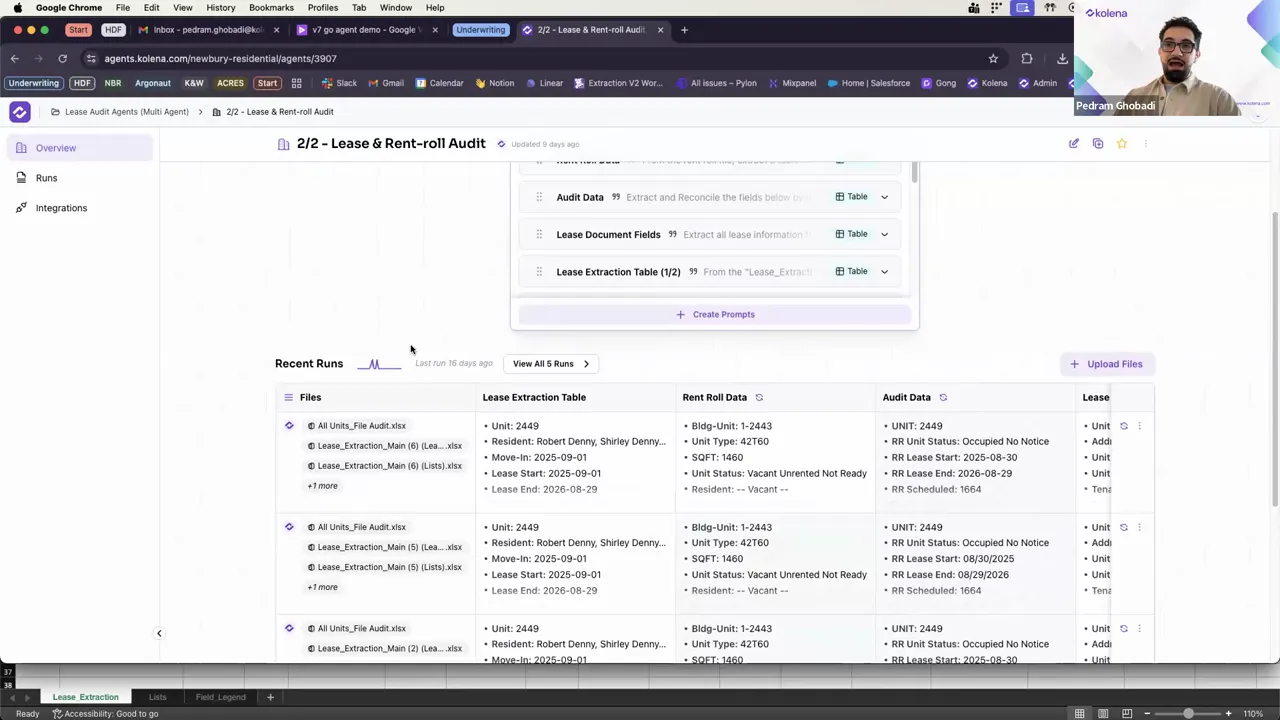
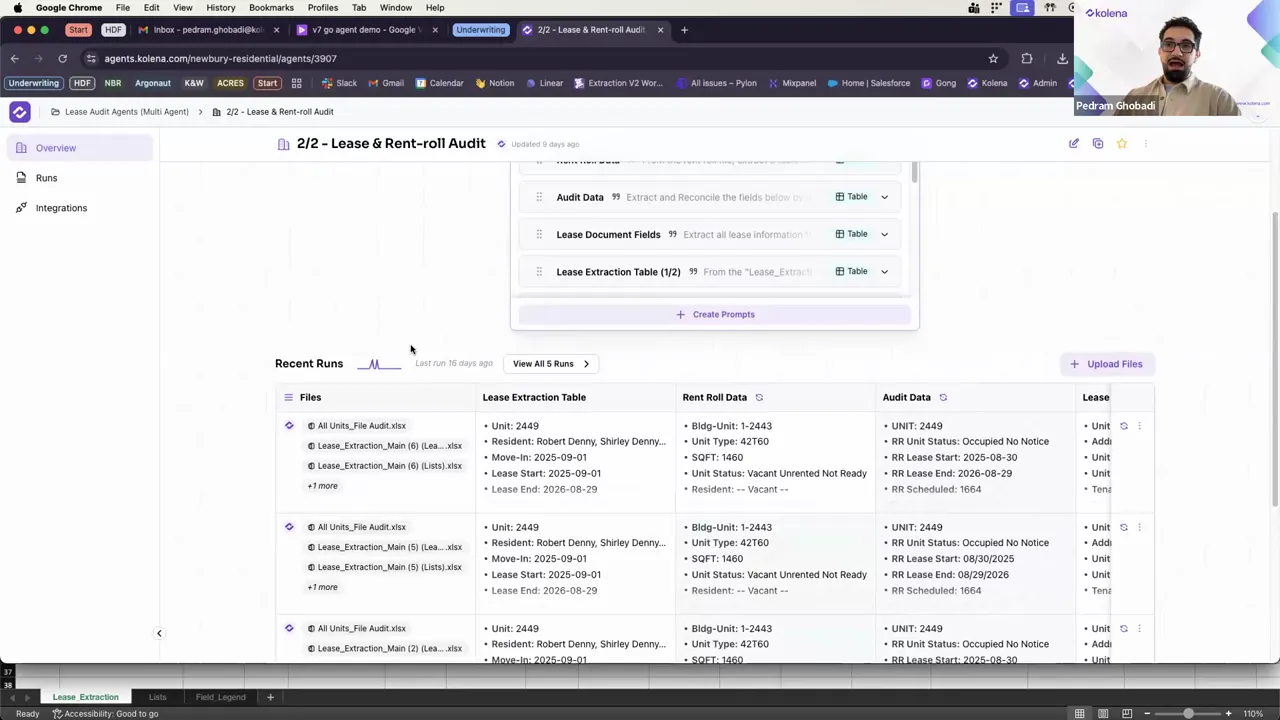
Kolena is an AI document automation platform for banking and lending teams. It picks up loan packages, UCC filings, and borrower documents from where they already land, applies the lender's own credit and compliance logic, and delivers the finished output to a loan origination system, core banking system, or compliance file.
The processing sequence reads and classifies every page, applies the credit and policy checklist, cross-references documents against each other, flags exceptions, and generates the institution's output template. Documents run hundreds at a time in parallel, every extracted value carries a page citation and a reasoning log, and items requiring judgment route to an exception queue for staff.
Key features include:
- Document understanding across formats: Parses PDFs, spreadsheets, emails, scans, and audio, automatically detecting document types and extracting the required fields without manual pre-sorting.
- Loan package and closing file validation: Checks the full closing package against the funding checklist, covering notes, guaranties, entity documents, insurance certificates, invoices, and proof of payment, and reconciles names, amounts, dates, and signatures across every document in the package.
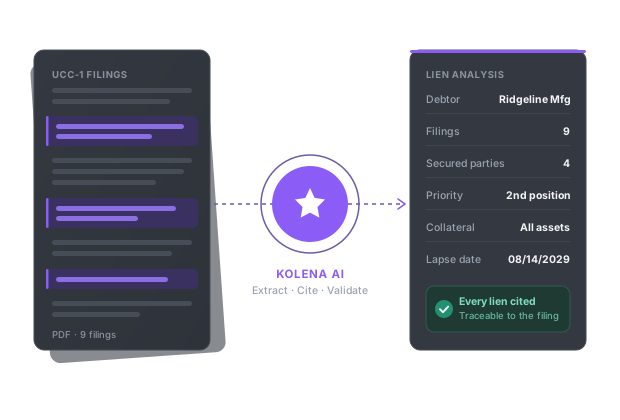
- UCC filing and lien position review: Reads UCC-1 and UCC-3 filings, search certificates, and equipment schedules, extracts debtor name, secured party, filing date, and collateral description, and determines lien position, flagging prior blanket liens, stale filings past lapse, and collateral overlaps.
- Bank statement analysis and financial spreading: Normalizes twelve months of statements across different bank formats, spreads them into the credit template, calculates DSCR, leverage, and global cash flow, and surfaces NSFs, unexplained deposits, and undisclosed debt service.
- KYC and beneficial ownership review: Resolves ownership chains across operating agreements, cap tables, and org charts, and flags expired IDs and unsigned certifications against CIP requirements.
- Field-level citations and reasoning logs: Every extraction and insight includes an explanation, a confidence score, and a citation linking the value to the exact page it came from.
- Output delivery and integrations: Generates structured output in the team's existing template and pushes it to an LOS, core banking system, Excel, CRMs, or SharePoint.
- Pre-built agents and prompt optimization: Ships a catalog of ready-made agents for loan onboarding, compliance testing, and appraisal abstraction, and rewrites user input into optimized prompts so results stay consistent without manual tuning.
Limitations (based on publicly available sources):
- Works alongside a core LOS: Handles document review, extraction, and validation rather than replacing an origination system, so lenders still need an LOS as the system of record.
- Pricing not published: Pricing details are not disclosed publicly and require contacting the vendor directly.
- Configuration to institution policy: Agents need to be pointed at the lender's own credit policy, checklists, and output templates before a workflow goes live.
Source: Kolena
2. Ocrolus

Best for: Bank statement, pay stub, and tax form data capture
Strengths: Document capture with human-in-the-loop validation and API
Things to consider: Turnaround can lag on complex statement sets
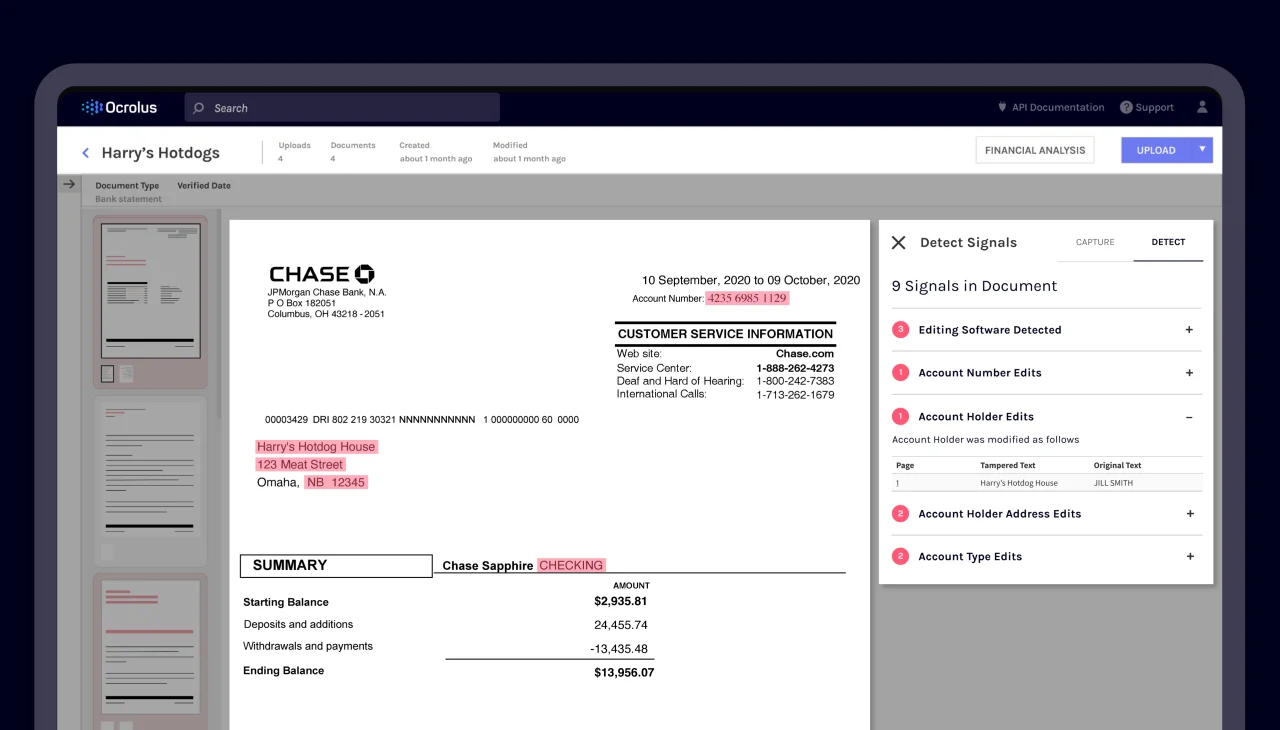
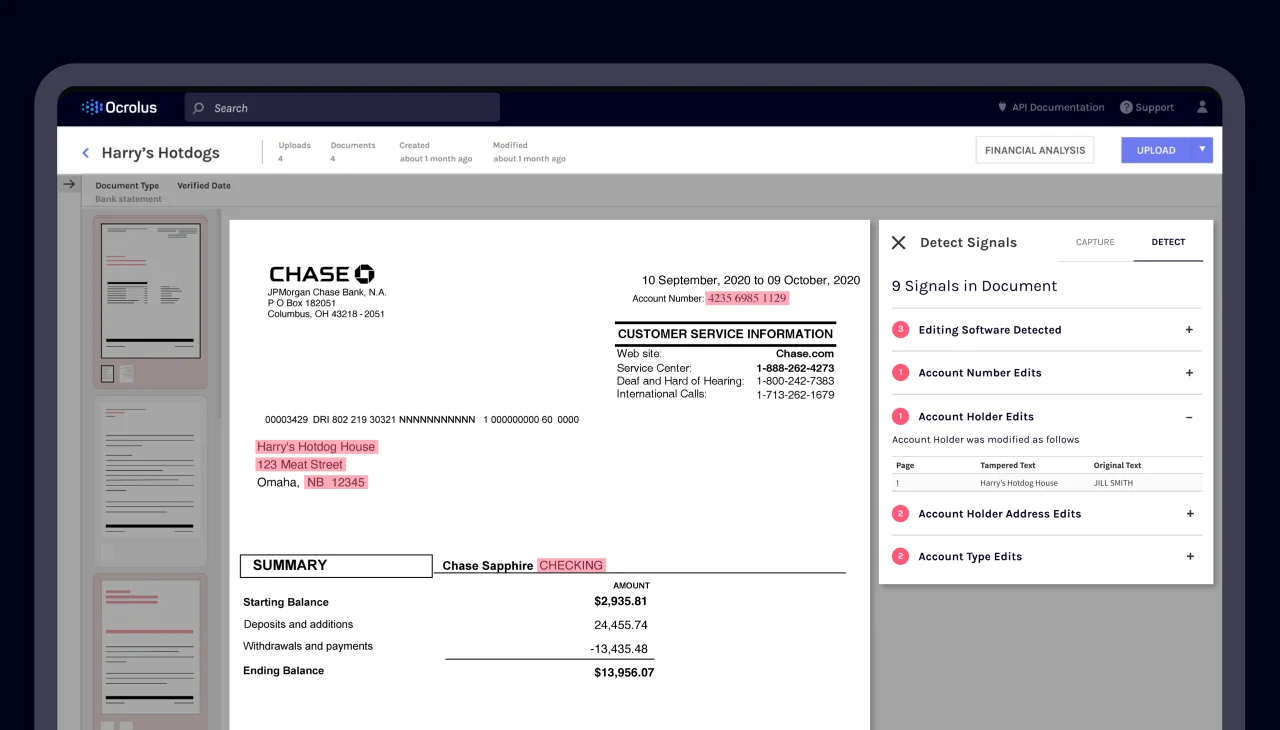
Ocrolus is an AI workflow and analytics platform for lenders that converts documents and digital data into credit analytics for underwriting. It specializes in bank statements, pay stubs, and tax forms, combining machine learning with human validation to produce structured, indexed output for each document type.
The platform is accessible through an API and a dashboard and delivers results into existing loan origination systems. Vertical products cover small business funding, with cash flow analysis and Encore for deal sharing, and mortgage, with income calculations and Inspect for creating and clearing underwriting conditions. Additional use cases include auto finance, consumer lending, and tenant screening.
Key features include:
- Document understanding: Classifies and indexes borrower-provided documents, specializing in bank statements, pay stubs, and tax forms, which removes the need to pre-sort files before submission.
- Human-in-the-loop validation: Combines machine learning with human review so extracted data is verified before it feeds an underwriting decision.
- Cash flow analysis: Measures revenue and debt capacity from transaction data for small business funding decisions.
- Income calculations: Evaluates income across borrower types for mortgage underwriting, including borrowers with non-traditional income sources.
- Inspect condition management: Automatically creates and clears underwriting conditions to move mortgage files through processing.
- Fraud detection: Identifies fake documents, data inconsistencies, and risk signals across submitted files.
- API and LOS delivery: Returns structured, indexed output for all document types through an API or dashboard and integrates into loan origination systems, so lenders can notify borrowers quickly about incorrectly submitted or missing information.
Limitations (as reported by users on Software Advice):
- Processing speed on complex files: Reviewers report longer waits on complicated or less common bank statements, which can slow the work that depends on the output.
- Occasional missed data: Some users describe having to double-check results for information the system did not capture on certain documents.
- Reporting depth: Reviewers ask for stronger reporting and a more transparent way to review flagged suspicious activity.
- Dashboard usability: The dashboard is described as less user-friendly than the underlying data output.
- Cost relative to turnaround: Some reviewers question the price given the processing times they experience.
- Release communication: Users report not being notified when new analytics are released and having to request updated documentation.
Source: Ocrolus
3. Zest AI

Best for: AI credit decisioning and automated application approvals
Strengths: Custom ML risk models with fair lending testing built in
Things to consider: Enterprise-scale commitment with a multi-month rollout
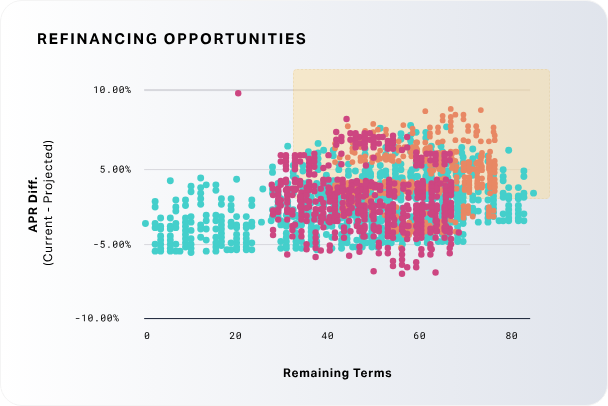
Zest AI builds client-tailored machine learning models for credit underwriting. Rather than applying a generic scorecard, it creates models trained on each lender's own data and lending requirements, using what the company describes as ethically sourced data. It reports risk ranking two to four times more accurate than generic models and coverage of 98% of American adults.
The models are applied across auto, credit card, home equity, personal, and SMB loan portfolios, and serve institutions processing anywhere from 100 to more than 600,000 applications a year. Underwriting insights are integrated into existing lending systems with little to no IT burden, with 80% of application decisions being automated.
Key features include:
- Client-tailored machine learning models: Models are built on each lender's borrower data and lending needs rather than applied as a generic scorecard.
- Automated decisioning: Auto-decisions up to 80% of applications and returns instant decisions to 80% of borrowers, with policies and cut-offs optimized to eliminate most manual review.
- Fair lending and bias reduction: Models are optimized for both accuracy and fairness using less discriminatory alternative searches and adversarial debiasing techniques, with reported approval lifts of 30% on average across protected classes.
- Policy and cut-off optimization: Simplifies decisioning by tuning policies and thresholds, with reported savings of up to 60% of time and resources in the lending process.
- Multi-portfolio coverage: Supports auto, credit card, home equity, personal loan, and SMB loan portfolios from the same platform.
- Lending system integration: Connects underwriting insights into existing lending systems with little to no IT lift required from the institution.
- Onboarding and model monitoring: A staged rollout runs a custom proof of concept in two weeks, model refinement in one week, integration in as little as four weeks, and test and deploy in under a week, followed by 24/7 model monitoring and business reviews up to four times a year.
Limitations (based on publicly available sources):
- Implementation timeline: Published assessments describe roughly three to six months from contract to production, covering data preparation, model development, validation, and integration.
- Volume economics: The enterprise pricing model is described as difficult to justify per loan for lenders with smaller portfolios or low annual decision volumes.
- Data preparation responsibility: Sourcing, licensing, and integrating alternative data beyond credit bureau records falls to the lender, which can be demanding for institutions with limited data infrastructure.
- Not a drop-in replacement: Lenders expecting a plug-and-play score substitute face meaningful implementation effort, and phased rollouts by product or channel are commonly advised.
Source: Zest AI
End-to-End Loan Origination and Processing Platforms
4. nCino
Best for: Commercial loan origination on a single bank platform
Strengths: Configurable workflows, credit analysis, and audit trails
Things to consider: Borrower-facing tools reported as less polished
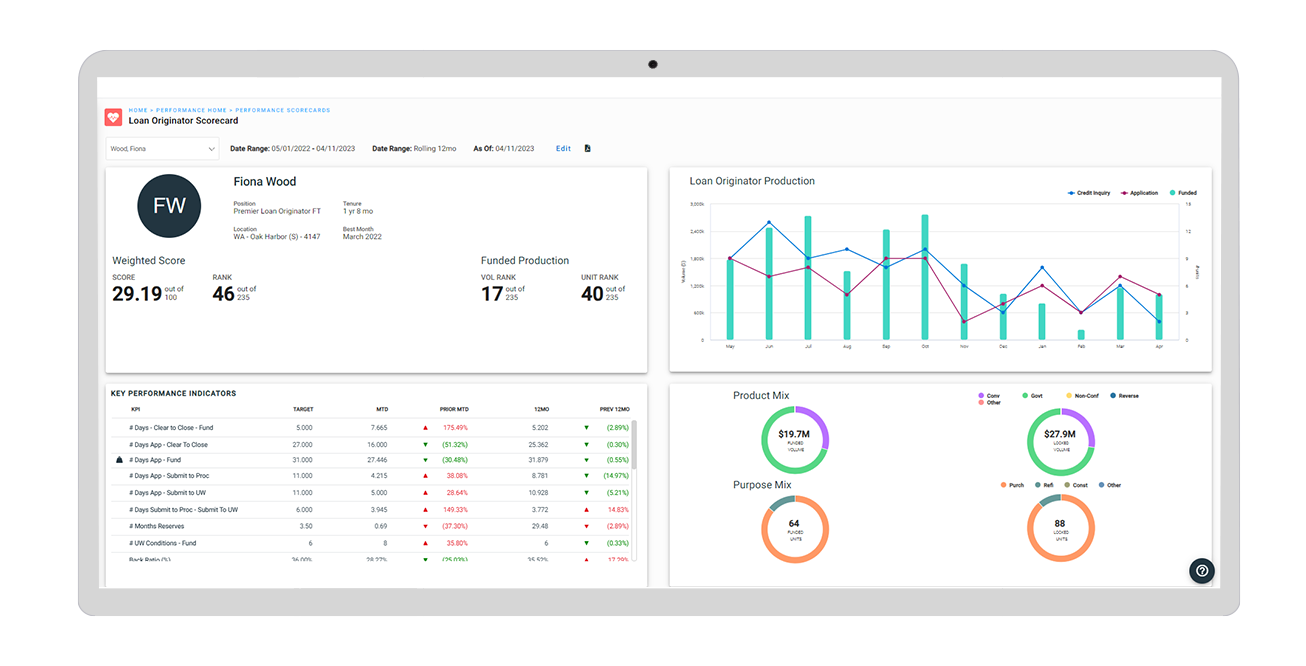
nCino Commercial Lending is a commercial loan origination system that replaces separate, siloed systems with one platform covering application, origination, underwriting, and portfolio management. It connects front, middle, and back office teams on a shared record and supplies real-time reporting for portfolio management.
The platform is used by more than 2,700 financial institutions. Commercial loans originated 54% faster, a 51% increase in new loan volume, a 280% increase in conversion rates, and a 92% reduction in loan servicing costs.
Key features include:
- Preconfigured onboarding workflows: Onboards new customers and assesses their needs using workflows configured ahead of time rather than assembled per deal.
- Policy-based automated decisioning: Automates pre-qualifications and credit approvals against the institution's own policy rules and identifies the parameters under which a loan should be automatically approved, declined, or referred for manual review.
- Integrated document repository: Holds loan documentation alongside the institution's policies and leaves a visual audit trail for auditors and teammates.
- Covenant tracking and notifications: Generates automatic notifications when a covenant approaches its due date and retains the record as evidence of compliance for auditing.
- Deal management: Provides a complete view of a client relationship in one place, supports structuring of credit and non-credit deals, and allows sub-loan creation, information cloning, and bulk editing of shared record details.
- Credit analysis and automated spreading: The Spreads toolset sits inside the origination workflow, and Automated Spreading reduces the time required to spread financials.
- Continuous credit monitoring: Delivers real-time, data-driven insights for risk monitoring across the credit lifecycle.
- Regulator and auditor reporting: Produces loan reports for regulators and auditors to support the compliance review process.
Limitations (as reported by users on Capterra):
- Borrower-facing experience: Reviewers describe the client portal as built for bank staff, with navigation and ease of use falling short from the borrower's perspective.
- Reliability complaints: A long-term commercial lending user reports recurring problems creating loans that persisted after years of adjustments and dedicated internal staff.
- Training requirement: Reviewers describe a system that takes considerable training and practice before users become efficient.
- Customization limits: Some users note limited adjustability on certain features.
- Custom build maintenance: Custom-built items have had to be removed and replaced with newer standard versions in order to keep receiving product updates.
Source: nCino
5. MeridianLink
Best for: Consumer, mortgage, and indirect lending on one platform
Strengths: Configurable workflows with hundreds of partner integrations
Things to consider: Many configuration changes require vendor support
MeridianLink loan origination software supports the full lending lifecycle across consumer, mortgage, business, and indirect products, connecting applications, decisions, and workflows into a single environment. Nearly 2,000 financial institutions use the suite to automate workflows, maintain compliance, and scale lending operations.
The product line separates into MeridianLink Consumer, a cloud-based consumer LOS, and MeridianLink Mortgage, alongside Opening for deposit account opening, Access for digital applications, DecisionLender for indirect lending, Collect for collections, and Data Connect for structured origination data.
Key features include:
- Advanced decisioning engine: Simplifies loan underwriting and funding with configurable workflow automation and a decisioning engine built for speed and accuracy.
- Connected lending ecosystem: Brings consumer and mortgage lending, account opening, digital application, data intelligence, collections, and marketing automation into one environment so data and decisions move across teams.
- Combined loan and deposit applications: Applicants can apply for a loan and open a deposit account in a single session without exiting or starting a new one.
- Embedded compliance controls: Automates regulatory compliance with built-in controls, audit trails, and integrations for fraud and identity verification.
- Mobile-first digital application: Smart forms and mobile-first design guide borrowers from application to funding with workflows intended to reduce abandonment.
- Open APIs and marketplace integrations: Connects to core banking systems, digital banking systems, and hundreds of partner integrations covering AI-enabled underwriting, identity verification, e-signing, and insurance.
- Multi-product support: Handles personal loans, credit cards, auto loans, business loans, real estate loans, and indirect lending from the same system.
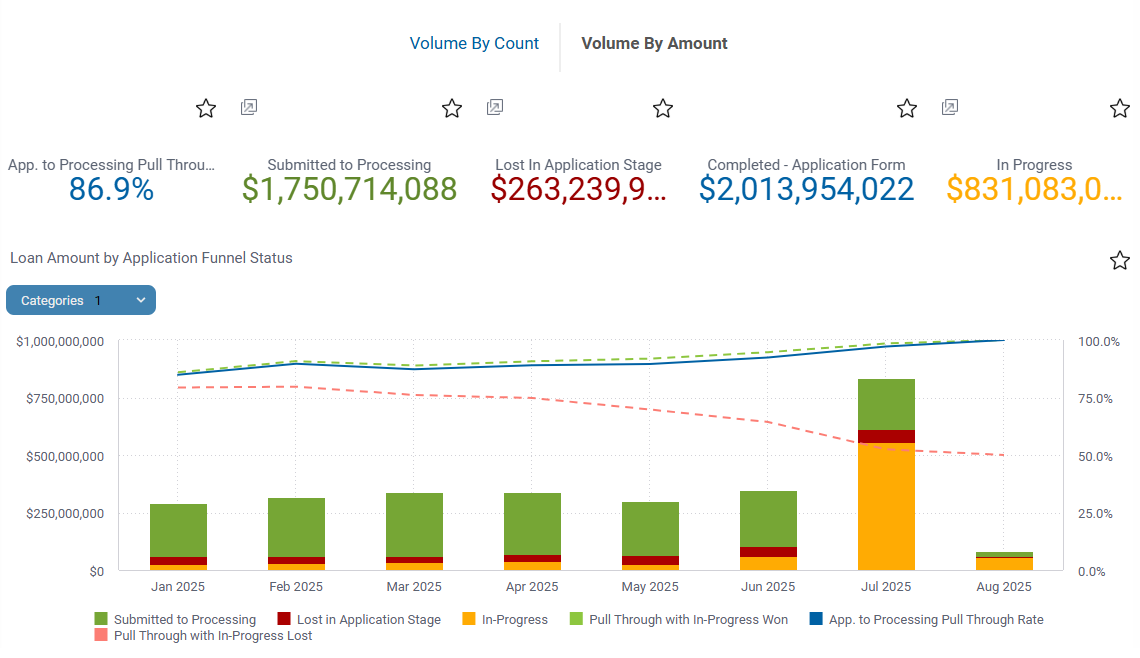
- Reporting and rate adjustment: Customizable dashboards and real-time analytics allow tailored reports and on-the-fly rate changes.
Limitations (as reported by users on Capterra):
- Decision engine capability: Multiple reviewers describe the instant approval decision engine as the weakest part of the system.
- Configuration dependency: Renaming fields or changing whether fields are required generally requires vendor support rather than in-house administration.
- Reporting flexibility: Users report being unable to pull certain fields into reports or add custom logic to forms and documents.
- Implementation effort: Reviewers describe configuration as difficult without dedicated in-house technical staff, though vendor consultants are noted as helpful.
- Interface density: Some users find the volume of information on individual pages overwhelming and describe back-office navigation as dated.
- Support ticket visibility: Reviewers report having to follow up repeatedly to learn the status of submitted tickets.
Source: MeridianLink
6. Encompass by ICE Mortgage Technology

Best for: End-to-end mortgage origination through investor delivery
Strengths: Deep mortgage workflows and a large partner network
Things to consider: Administration expertise and cost weigh on smaller teams
Encompass is a mortgage loan origination platform that connects each step of the lending process from a single system of record. It covers customer acquisition, loan origination and manufacturing, settlement and closing, secondary marketing, correspondent lending, and data and analytics, and is used by banks, credit unions, and independent mortgage bankers.
In 2024, there was an average increase of $1,056 in gross profit per loan, a 23% increase in loan production volume without adding staff, a three-day reduction in cycle times from application to close, and a fivefold return for every dollar invested in the platform.
Key features include:
- Configurable loan manufacturing workflows: Automation reduces errors and time spent on document collection, loan data verification, and quality checks across intuitive, configurable workflows.
- Point-of-sale and pricing tools: Consumer Connect and TPO Connect handle borrower and third-party originator applications, and ICE PPE supplies loan pricing inside the same system.
- Settlement and closing ecosystem: Handles pre-close, closing, and post-closing from the system of record, covering document ordering, partner collaboration, borrower signatures, investor delivery, MERS registration, and recording.
- Secondary marketing and investor delivery: Manages pricing and lock policies, trades, and loan delivery to a network of investors and GSEs.
- Correspondent lending workflows: Supports loan acquisition and pipeline management with automated, configurable workflows tailored to the lender's business.
- Integrated data solutions: Connects property, flood, tax, title, and fraud data directly into the origination process.
- Business intelligence: Real-time data delivery tools and a mortgage-focused BI platform support peer performance comparison and trend analysis.
- Compliance and API configurability: Supports industry and regulatory compliance changes, with an expansive API suite for configuring workflows by business need or lending channel.
Limitations (as reported by users on Capterra):
- Administration expertise: Setup and administration typically require a dedicated in-house Encompass administrator or an outside consultant who specializes in the platform.
- Cost: Reviewers describe the platform as expensive with pricing that is not published, and several note the burden on smaller businesses.
- Performance: Users report slowness, including noticeable delays when opening and closing individual loan files.
- Learning curve: The volume of fields and options is described as overwhelming for new users, with limited in-product guidance explaining them.
- Interface age: Several reviewers describe the interface as visually dated and busy.
- Mobile functionality: Mobile capability is reported as limited.
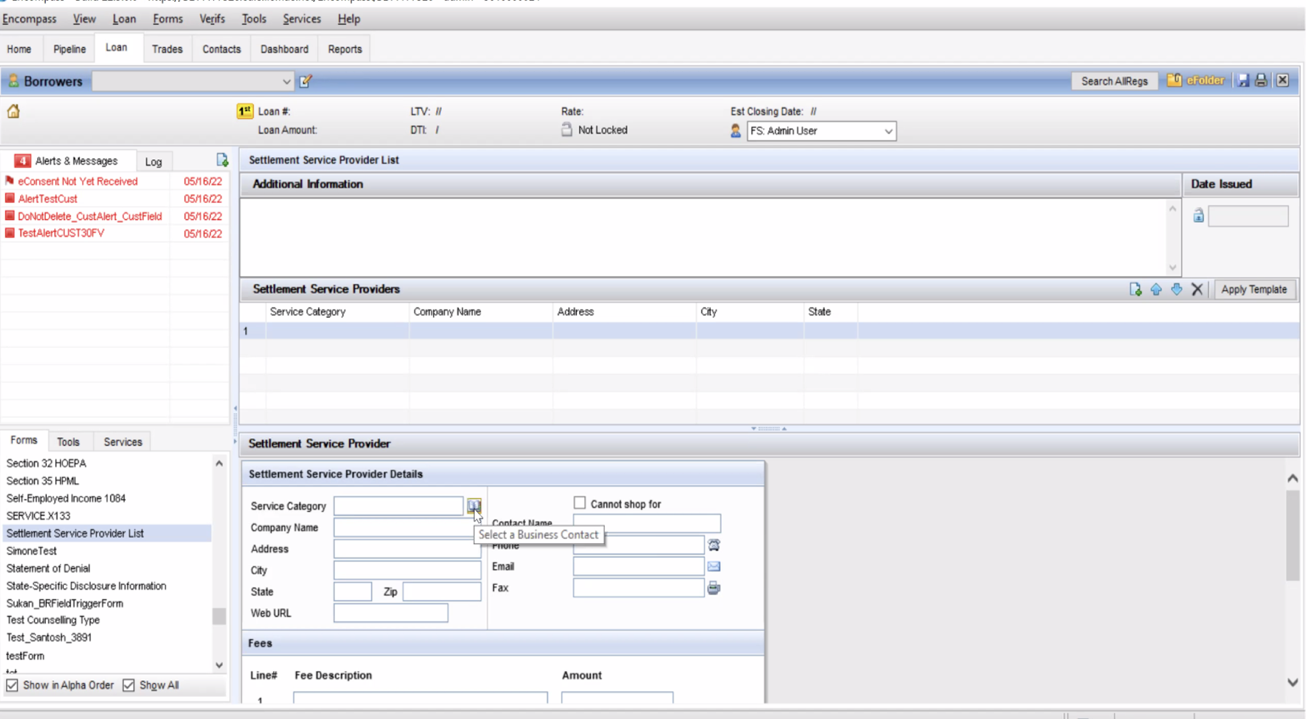
Source: ICE Mortgage Technology
7. Finastra Originate

Best for: Community bank origination across loans and deposits
Strengths: One configurable platform for mortgage, consumer, business
Things to consider: Users report update churn and multi-vendor coordination
Finastra Originate is a unified, cloud-based origination platform covering mortgages, loans, and deposit accounts for both consumer and business products. It is highly configurable and white-labeled to match the institution's branding, and guides applicants through a self-service application with real-time decisioning and immediate access to accounts and loans.
The suite includes MortgagebotLOS for retail, wholesale, and correspondent mortgage lending, LaserPro for loan document generation, Originate Consumer for loans and deposits, Originate Business for commercial deposit and loan applications, Originate Mortgagebot as the mortgage point of sale, and Data Insights for back-office analysis.
Key features include:
- Unified application across product types: A single configurable self-service application covers mortgages, consumer loans, business loans, and deposit accounts, and applicants can apply for multiple accounts in one pass.
- Real-time decisioning and disclosures: Delivers instant approvals and immediate online disclosures, including automated three-day disclosures on the mortgage side.
- LaserPro document engine: Produces loan documents with automated checks that reduce manual work across commercial, consumer, and mortgage lending.
- Compliance-first design: A compliance-first design strategy is used to identify and mitigate risk in lending operations, with support for Section 1071 of the Dodd-Frank Act.
- Workflow automation and reduced rekeying: Automated institution workflows and staff collaboration tools cut down on rekeying data between systems.
- Omnichannel capture: Supports origination across every point-of-sale channel where business is captured.
- Third-party LOS integration: Originate integrates with Finastra platforms and select third-party LOS solutions, each of which connects to LaserPro for document generation.
- MortgagebotLOS coverage: An all-in-one secure loan origination system supporting retail, wholesale, and correspondent mortgage lending.
Limitations (as reported by users on G2):
- Update frequency and downtime: Reviewers report frequent updates that get rolled back, along with associated downtime.
- Performance: Users describe the system as slow in day-to-day processing.
- Fit as a full LOS: Some reviewers say heavy reliance on custom fields is needed to make it work as an origination system, which introduces bugs.
- Support depth: Users report the help desk referring them to online documentation rather than resolving issues directly.
- Vendor coordination: Reviewers describe maintaining separate logins for other vendors and difficulty identifying which vendor to contact for a given problem.
- False error alerts: Some users report applications flagged for errors that do not exist during document preparation.
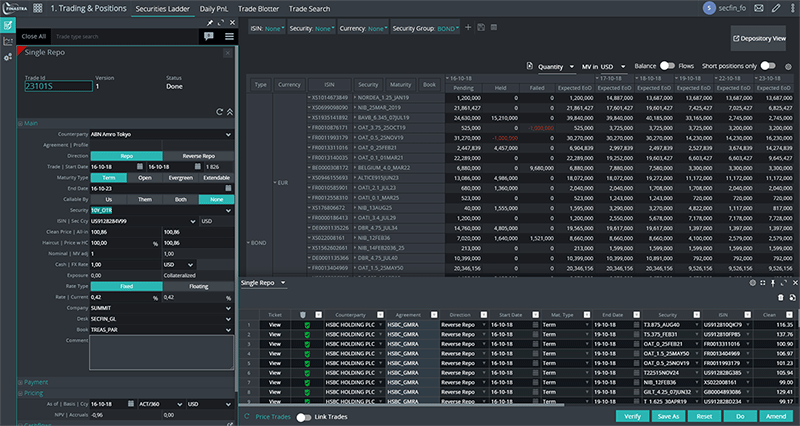
Source: Finastra
8. TurnKey Lender
Best for: End-to-end lending automation for non-bank lenders
Strengths: AI decision engine covering origination through collections
Things to consider: Customization beyond the standard package adds cost
TurnKey Lender is a lending automation platform covering origination, credit scoring and underwriting, servicing, and collections in one system rather than three to five separate tools. Its loan origination software includes a proprietary AI-driven Decision Engine that applies machine learning and deep neural networks to credit scoring using traditional and alternative risk data.
The origination module supports a fully configurable online application flow with custom flows, dictionaries, and loan offers, plus a back-office interface for staff. Available features include digital onboarding, AML and KYC compliance checks, application processing, credit scoring, and automatic decisioning.
Key features include:
- AI decision engine: Machine learning and deep neural networks score borrowers on traditional and alternative risk assessment data, returning credit decisions in about 30 seconds.
- Configurable application flow: Lenders can build custom application flows, dictionaries, and loan offers to match their products.
- Digital onboarding with AML and KYC checks: Anti-money laundering and know your customer compliance checks are built into the origination flow.
- Back-office workplaces: Origination, underwriting, servicing, and collection teams each get a dedicated workspace configured to their tasks.
- Loan management and servicing: Automates payments and servicing activity across the loan lifecycle from the same platform.
- Credit risk management: Risk assessment tools, analytics, and automated workflows monitor credit risk throughout the lending lifecycle.
- Debt collection: AI-based collections scoring, collection workflow automation, delinquency bucket management, and segmentation strategies handle post-delinquency activity.
- Third-party integrations: APIs connect the platform to third-party systems and data providers, with more than 75 preconfigured partners.
Limitations (as reported by users on Capterra):
- Customization cost: Reviewers note the standard package is reasonably priced, but building customizations on top of it becomes expensive.
- Updates on customized deployments: Users report that new product updates apply mainly to standard configurations, and heavily customized installations may not receive them.
- Document automation and reporting limits: Reviewers describe constraints in document automation and say that getting custom application fields out through standard reporting requires additional development.
- Performance: Some users report the platform running slowly at times, which affects productivity.
- Implementation experience: Several reviewers describe rocky integrations, early bugs after launch, and difficulty getting timely responses from the service desk.
- Regional configuration: The standard version is built around US requirements, so lenders operating elsewhere need customization to meet local needs.
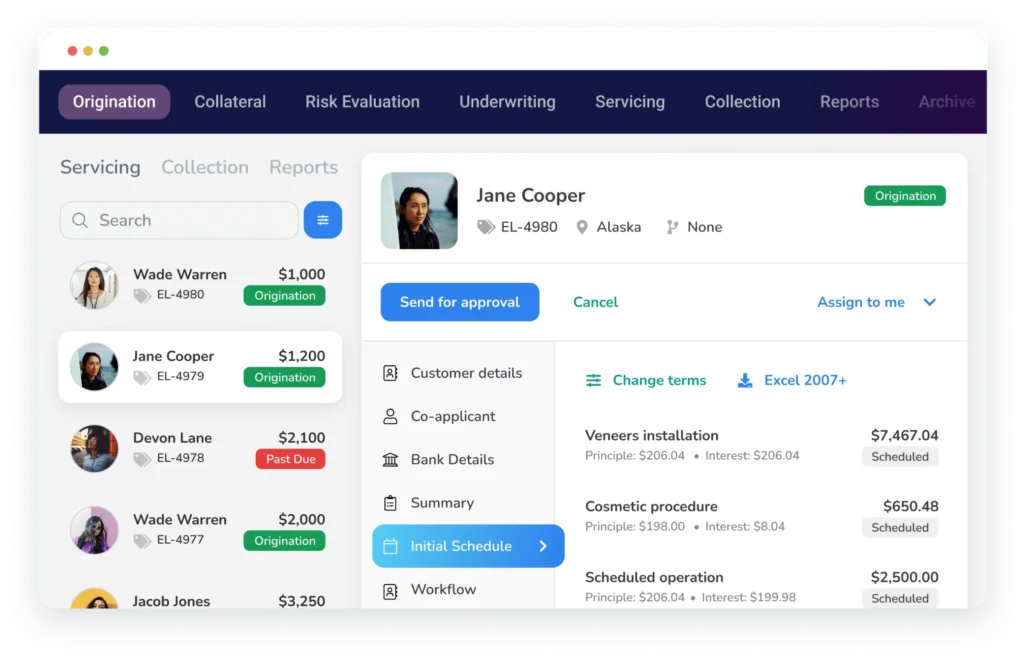
Source: TurnKey Lender
Conclusion
Loan processing software can reduce manual work across application intake, document review, underwriting, approvals, closing, and funding while giving lenders a consistent record of each decision. The right approach depends on whether the main bottleneck is document-heavy review, credit decisioning, workflow coordination, or full origination. Strong implementations combine automation with validation, exception handling, human review, and audit trails so faster processing does not come at the expense of accuracy, compliance, or underwriting control.