What Is a Non-Qualified Mortgage (Non-QM)?
A Non-Qualified Mortgage (Non-QM) is a flexible home loan designed for creditworthy borrowers who don't fit traditional lending criteria. Rather than using standard tax returns to verify income, lenders use alternative methods like bank statements, asset qualifiers, or a property's cash flow to evaluate the borrower's ability to repay.
Who benefits from non-QM loans:
These loans are suitable for homebuyers whose financial profiles fall outside standard Consumer Financial Protection Bureau (CFPB) guidelines:
Self-employed and freelancers: Borrowers who write off large business expenses and cannot qualify via standard W-2s can often use 12–24 months of personal or business bank statements to show income.
Real estate investors: Investors use DSCR (Debt Service Coverage Ratio) loans, which qualify a buyer based on the projected rental income of the property rather than their personal income.
Recent credit events: Borrowers who have experienced a bankruptcy, foreclosure, or short sale in the recent past may find lenders willing to approve a loan without waiting the standard multi-year periods required by conventional loans.
High-net-worth individuals: Those with substantial assets (e.g., retirement, checking, or investment accounts) but low verifiable income can utilize Asset Depletion programs.
This is part of a series of articles about loan processing
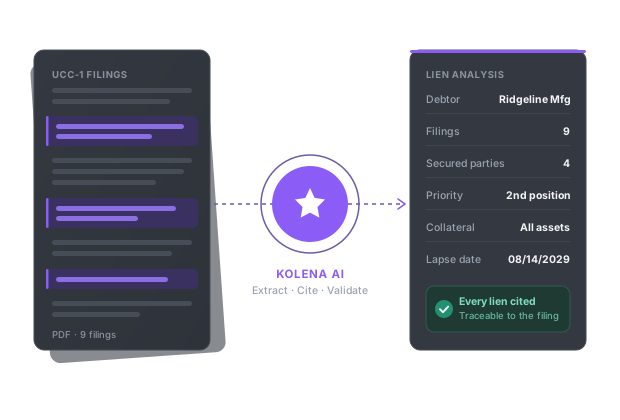
Analyze your first UCC filing in minutes with AI
Who Benefits from Non-QM Loans?
Self-Employed and Freelancers
Self-employed individuals and freelancers often face challenges when applying for traditional mortgages due to irregular income or the inability to provide standard W-2 forms and pay stubs. Non-QM loans allow alternative forms of income verification, such as bank statements, profit-and-loss statements, or asset-based calculations. This flexibility enables self-employed borrowers to demonstrate their ability to repay without fitting rigid documentation requirements.
Lenders offering Non-QM loans evaluate cash flow over longer periods, often using 12 to 24 months of bank statements. This approach provides a clearer picture of a borrower's financial health and offers a path to homeownership for those whose income fluctuates. By accommodating non-traditional income sources, Non-QM loans support gig workers, consultants, and business owners who are often underserved by conventional lending.
Real Estate Investors
Real estate investors often rely on Non-QM loans because traditional mortgages may restrict the number of financed properties or require extensive documentation of rental income. Non-QM loans, such as debt service coverage ratio (DSCR) loans, evaluate the income generated by the investment property rather than the investor’s personal income. This makes it easier for investors to qualify, especially when they own multiple properties or have complex financial profiles.
Non-QM loans also offer flexibility in property types, loan amounts, and down payment requirements. Investors can use these loans to expand their portfolios or finance properties that do not meet conventional lending criteria. By focusing on the income potential of the property, Non-QM lenders serve experienced and new real estate investors.
Recent Credit Events
Borrowers who have experienced recent credit events, such as bankruptcy, foreclosure, or short sale, often struggle to qualify for traditional mortgages due to mandatory waiting periods and stricter credit score requirements. Non-QM loans provide an alternative, as lenders may offer shorter waiting periods. This allows borrowers to re-enter the housing market sooner if they can demonstrate their ability to repay.
Non-QM lenders assess the overall financial profile, including income stability and the circumstances surrounding the credit event, rather than relying solely on credit scores. This approach enables individuals who have recovered financially from setbacks to access mortgage financing without waiting several years.
High-Net-Worth Individuals
High-net-worth individuals often have significant assets but may not have a regular paycheck or easily documented income. Traditional mortgages, with their focus on W-2 income and tax returns, can pose challenges for these borrowers. Non-QM loans, especially asset-based or asset depletion loans, allow lenders to use a borrower's liquid assets as the basis for qualifying.
For high-net-worth borrowers, Non-QM loans can accommodate large loan amounts, complex asset holdings, and customized repayment terms. This is relevant for individuals whose wealth is tied to investments, businesses, or trusts.
Non-QM vs. Traditional Loans: The Key Differences
Feature | Qualified Mortgage (QM) | Non-Qualified Mortgage (Non-QM) |
Income Verification | W-2s, pay stubs, tax returns | Bank statements, 1099s, cash flow, asset depletion |
Debt-to-Income (DTI) | Generally capped at 43% | Can often go over 50% |
Down Payment | As low as 3% to 5% | Typically requires 15% to 20% or more |
Credit Waiting Periods | Long waiting periods required after bankruptcy | Can sometimes qualify as little as 1 day after a credit event |
Backing | Eligible for Fannie Mae, Freddie Mac, or FHA | Held privately by the lender; no government backing |
1. Income Verification
Traditional loans require documentation such as W-2s, pay stubs, and tax returns to verify income. This approach can be restrictive for those with variable income or self-employment. Non-QM loans accept a broader range of income documentation, including bank statements, profit-and-loss statements, or asset statements, depending on the lender's guidelines.
For example, self-employed individuals can use 12 to 24 months of bank statements to show consistent cash flow. Real estate investors may use rental income statements. By expanding acceptable documentation, Non-QM loans make homeownership accessible to borrowers excluded by traditional requirements.
2. Debt-to-Income (DTI)
Traditional loans have strict debt-to-income (DTI) ratio limits, often capped at 43% for Qualified Mortgages. These limits can make it difficult for borrowers with higher income but substantial debt obligations to qualify. Non-QM lenders may accept higher DTI ratios, sometimes exceeding 50%, if the borrower demonstrates strong compensating factors such as significant assets or a high credit score.
This flexibility benefits self-employed borrowers, investors, or those with fluctuating income. It allows lenders to consider cash reserves and overall financial position rather than relying solely on fixed DTI thresholds.
3. Down Payment
Conventional loans typically require a down payment of at least 3% to 5%, but many Non-QM loans require higher down payments, often starting at 10% or more. The increased requirement helps offset the higher risk associated with Non-QM lending, as these loans are not backed by government entities.
While a larger down payment can be a barrier for some borrowers, it also provides greater equity and reduces the lender's risk. For borrowers with significant assets but non-traditional income, the higher down payment may be manageable.
4. Credit Waiting Periods
Traditional mortgage guidelines impose waiting periods after major credit events, such as bankruptcy or foreclosure, which can range from two to seven years depending on the event and loan type. Non-QM loans often have shorter waiting periods or may waive them if the borrower demonstrates financial recovery and stability.
Non-QM lenders evaluate the circumstances of the credit event and the borrower’s current financial situation, enabling a faster path to homeownership for those who have recovered from setbacks.
5. Backing
Traditional mortgages are backed by government-sponsored enterprises like Fannie Mae and Freddie Mac or insured by agencies such as FHA and VA. This backing provides security for lenders and standardized loan terms. Non-QM loans are not eligible for such backing and are held by private lenders or sold to private investors.
Non-QM loans carry higher risk for lenders because they lack government or agency backing. This is reflected in higher interest rates and stricter terms. This private market structure allows flexibility in underwriting and product offerings.
Common Types of Non-QM Loans
1. Bank Statement Loans
Bank statement loans are for self-employed borrowers who cannot provide traditional income documentation. Instead of W-2s and tax returns, lenders use 12 to 24 months of personal or business bank statements to assess income consistency and cash flow. Lenders analyze deposits and spending patterns to determine average monthly income. These loans typically require higher down payments and interest rates.
Example:
A self-employed marketing consultant applies for a mortgage but has significant tax deductions that reduce reported income on tax returns. Instead of using W-2s, the lender reviews 24 months of business bank statements and determines that the borrower has sufficient cash flow to qualify for the loan.
2. DSCR Loans
Debt service coverage ratio (DSCR) loans are for real estate investors. Instead of evaluating the borrower’s personal income, lenders focus on the property’s ability to generate enough rental income to cover the mortgage payment. The DSCR is calculated by dividing the property’s gross rental income by the proposed debt obligations, with most lenders seeking a ratio of at least 1.0 to 1.25. DSCR loans often come with higher interest rates and larger down payment requirements.
Example:
A real estate investor purchases a duplex that generates $3,500 in monthly rental income. Rather than reviewing the investor’s personal income, the lender evaluates whether the rental income covers the proposed mortgage payment and approves the loan based on the property's cash flow.
3. Asset Depletion or Asset-Based Loans
Asset depletion loans, also known as asset-based loans, are for borrowers with substantial liquid assets but limited traditional income. Lenders calculate a qualifying income amount based on assets such as savings accounts, investment portfolios, retirement funds, or other eligible holdings. The lender divides the value of these assets over a set period to estimate repayment ability. Lenders often require significant asset reserves and may apply discounts to certain asset types when calculating eligibility.
Example:
A recently retired executive has $4 million in investment and retirement accounts but limited monthly income. The lender uses the value of the borrower's assets to calculate a qualifying income amount, allowing them to purchase a new home without relying on employment income.
4. Interest-Only Loans
Interest-only loans allow borrowers to pay only the interest portion of the mortgage for an initial period, typically five to ten years. During this period, monthly payments are lower because no principal is paid. After the interest-only term ends, the loan converts to a fully amortizing schedule, resulting in higher monthly payments. Because the principal balance remains unchanged during the interest-only period, borrowers face higher payments when the loan transitions to regular amortization.
Example:
A physician expects a significant increase in income over the next several years and chooses an interest-only mortgage to reduce monthly payments during the early years of homeownership. Once earnings increase, the borrower plans to make larger payments after the loan converts to a standard amortizing schedule.
5. Jumbo Non-QM Loans
Jumbo Non-QM loans are for borrowers seeking loan amounts that exceed conforming loan limits set by Fannie Mae and Freddie Mac. These loans are used to finance high-value properties or homes in expensive housing markets. Lenders may accept alternative income documentation, asset-based qualification methods, or higher debt-to-income ratios. Jumbo Non-QM loans typically require strong credit profiles, significant down payments, and substantial cash reserves.
Example:
An entrepreneur purchases a $2.5 million home in a high-cost market but cannot qualify through conventional underwriting due to variable business income. The lender reviews bank statements, asset holdings, and cash reserves instead of relying solely on tax returns and approves a jumbo Non-QM mortgage.
Learn more about Hard Money.
Pros and Cons of Non-Qualified Mortgages
Non-QM loans provide an alternative for borrowers who do not fit traditional lending guidelines. However, that flexibility often comes with higher costs and stricter loan terms.
Pros:
Flexible income verification: Non-QM loans allow borrowers to qualify using alternative documentation such as bank statements, asset statements, or profit-and-loss reports.
More lenient credit requirements: Borrowers with recent bankruptcies, foreclosures, short sales, or lower credit scores may still qualify.
Higher DTI allowances: Many Non-QM lenders accept higher debt-to-income ratios than conventional lenders.
Financing for real estate investors: Products such as DSCR loans allow investors to qualify based on property income rather than personal earnings.
Cons:
Higher interest rates: Non-QM loans generally carry higher interest rates than conventional mortgages.
Larger down payment requirements: Many Non-QM loans require down payments of 10% to 20% or more.
Fewer consumer protections: Non-QM loans do not follow all Qualified Mortgage regulatory requirements.
Limited lender availability: Not all mortgage lenders offer Non-QM products.
More complex loan terms: Some Non-QM loans include features such as interest-only payments or unique qualification methods.
How to Apply for a Non-QM Loan
Here’s a step-by-step guide to applying for a non-qualified mortgage.
Step 1: Identify Why You Do Not Fit Traditional Mortgage Guidelines
Before applying for a Non-QM loan, determine why a conventional mortgage may not be the right fit. Common reasons include self-employment, irregular income, multiple investment properties, exceeding traditional DTI limits, or recent credit events. Understanding your situation helps you identify the appropriate Non-QM product.
Different loan programs address different borrower needs. For example, a self-employed borrower may benefit from a bank statement loan, while an investor may be better suited for a DSCR loan.
Action items:
Determine which aspect of your financial profile makes conventional qualification difficult.
Identify whether a bank statement, DSCR, asset-based, interest-only, or jumbo Non-QM loan best fits your needs.
Review your credit history and recent credit events.
Estimate your debt-to-income ratio and available cash reserves.
Define your property and financing goals before approaching lenders.
Step 2: Gather Alternative Documentation
Non-QM lenders rely on alternative documentation to evaluate repayment ability. Depending on the loan type, you may need bank statements, profit-and-loss statements, asset account statements, rental income records, or business financial documents. Lenders use these records to assess income stability, cash flow, and overall financial strength.
Action items:
Ensure that all documentation is accurate and up to date.
Collect the required number of bank statements if applying for a bank statement loan.
Gather asset statements, investment account records, and retirement account documentation if applicable.
Prepare rental agreements, rent rolls, or income records for investment properties.
Organize business financial statements and profit-and-loss reports if self-employed.
Verify that documents are complete and consistent across all records.
Step 3: Compare Non-QM Lenders
Because Non-QM loans are offered through private lenders, loan terms can vary significantly. Compare interest rates, down payment requirements, fees, credit score standards, reserve requirements, and available products.
Action items:
Request quotes from multiple lenders and review qualification criteria and costs.
Compare interest rates, points, and lender fees.
Review minimum credit score and down payment requirements.
Evaluate reserve requirements and documentation standards.
Confirm whether the lender offers the specific Non-QM program you need.
Research lender experience, reputation, and customer reviews.
Step 4: Review the Loan Estimate Carefully
After applying, the lender will provide a Loan Estimate outlining key details of the proposed mortgage. This document includes the interest rate, monthly payment, closing costs, loan term, and any features such as interest-only payments or prepayment penalties.
Action items:
Review these details carefully.
If anything is unclear, ask the lender for clarification before proceeding.
Compare the Loan Estimate against quotes from other lenders.
Review closing costs, origination fees, and prepaid expenses.
Check for features such as prepayment penalties, adjustable rates, or interest-only periods.
Confirm that the loan terms align with your financial goals and repayment strategy.
How Document Automation Can Support Non-QM Mortgage Reviews
Why Non-QM Loans Often Require More Documentation
Non-QM loans use alternative methods to evaluate risk. Instead of relying only on W-2s and tax returns, lenders review a broader set of financial records to verify income, assets, cash flow, and repayment ability. This supports ability-to-repay (ATR) requirements while operating outside conventional underwriting frameworks.
Because Non-QM borrowers often have complex financial situations, documentation tends to be more detailed. Self-employed individuals may have fluctuating income, investors may own multiple properties, and high-net-worth borrowers may qualify using assets rather than wages.
How automation helps:
Document automation can extract information from multiple sources, organize records, and identify key financial data points automatically. This reduces manual review time and improves consistency.
Related content: Learn how bank compliance software automates regulatory checks.
Common Documents Used in Non-QM Underwriting
Required documents vary by program, but lenders typically collect records that provide a clear view of the borrower's financial position. Bank statement loans often require 12 to 24 months of personal or business bank statements. Asset depletion loans may require investment account statements, retirement account records, and proof of liquid assets. For real estate investors, lenders request lease agreements, rental income statements, and property operating information.
Additional documentation may include profit-and-loss statements, business tax returns, business licenses, CPA letters, mortgage statements for existing properties, and evidence of cash reserves. Borrowers with recent credit events may need to provide letters of explanation and supporting documentation.
How automation helps:
Document automation platforms can classify documents, extract relevant data, validate information across sources, and flag inconsistencies for review.
Related content: Explore how loan underwriting software streamlines document review.
How AI Can Help Review Mortgage Documentation
Mortgage files often contain large volumes of documents, including bank statements, appraisals, income records, asset statements, and underwriting forms. Reviewing these files manually can be time-consuming and may require significant data entry. AI supports document automation in several ways:
Automating document review and data extraction: AI-powered document review tools can read uploaded documents, extract relevant information, and convert it into structured data used in underwriting. For example, AI can identify property details from appraisal reports, extract financial information from bank statements, and capture borrower or property data needed for loan review.
Supporting underwriting reviews: AI can evaluate mortgage files against predefined underwriting requirements. Automated systems can review documents, identify missing items, and flag potential exceptions. This allows underwriters to focus on decision-making rather than searching through documents.
Validating information across documents: Non-QM mortgage files often contain information from multiple sources. AI can compare data across documents and identify discrepancies before they create downstream issues. Early detection of mismatched information helps reduce rework and improve file accuracy.
Improving portfolio reviews and due diligence: AI can assist with large-scale mortgage reviews by analyzing multiple loans at the same time. Lenders can perform document checks across entire portfolios and identify exceptions or incomplete files. This reduces the time required for due diligence activities.
Increasing transparency and auditability: AI document review systems can provide records showing how information was extracted and which documents support findings. Audit trails, reasoning logs, and source references help reviewers verify results and maintain compliance with internal policies and regulatory requirements.
How AI Document Automation Streamlines Non-QM Loan Reviews with Kolena
Kolena is an AI-powered document automation platform for financial services, built for the complex, document-heavy processes that define Non-QM lending—from due diligence to compliance testing. Where Non-QM files combine bank statements, asset records, rental income, and disclosures, Kolena automates analysis, extraction, and reporting so lending teams move faster with greater accuracy and transparency, turning reviews that once took weeks into work completed in hours.
Key capabilities of Kolena:
Investment memo generation: Summarize PPMs, legal documents, appraisals, and reports into professional-grade memos automatically, and generate investor updates and quarterly reports from templates.
Compliance testing: Review disclosures, statements, and advertisements against regulations automatically, accelerating internal audit and compliance checks.
Deal due diligence: Extract key data across deal packages to support investment analysis and decision-making.
Portfolio reporting: Aggregate data from multiple sources into structured portfolio updates and risk dashboards.
Accuracy with source citations: Provide confidence scoring and source citations for every result, with audit-ready, regulator-compliant outputs.
Scalability without added headcount: Process hundreds of documents simultaneously with the same team, and deploy quickly with no IT overhaul.
To see how Kolena can accelerate your Non-QM document reviews and compliance testing, explore Kolena for Financial Services.