What Is a Loan Tape?
A loan tape is a comprehensive, data-rich spreadsheet or electronic file used by financial institutions, lenders, and investors to track and analyze a portfolio of loans. It details loan-level information from origination to repayment, covering borrower FICO scores, geography, interest rates, outstanding balances, and risk profiles.
Why loan tapes matter:
Risk and valuation: Investors use the data to view and price risk, run cash flow models, and value pools of collateralized assets.
Capital raises and securitization: Fintechs and banks must present loan tapes to secure debt capital or bundle pools of loans (like auto or solar loans) into securities.
Typical data points included:
A standard loan tape includes hundreds of data fields per loan, but usually highlights:
Borrower information: Identifies the borrower and includes details such as credit score, income, employment status, geographic location, and other underwriting data.
Loan details: Covers the loan amount, interest rate, origination date, loan term, payment structure, and maturity date.
Payment and performance data: Tracks payment history, delinquency status, days past due, defaults, modifications, and recoveries.
Collateral information: Describes the asset securing the loan, including property details, valuations, lien position, or other collateral characteristics.
Risk and credit metrics: Includes measures such as FICO scores, loan-to-value ratios, debt-to-income ratios, internal risk grades, and probability of default.
Servicing and operational data: Records servicing information, escrow balances, collection activities, servicing fees, and loan administration history.
This is part of a series of articles about loan processing
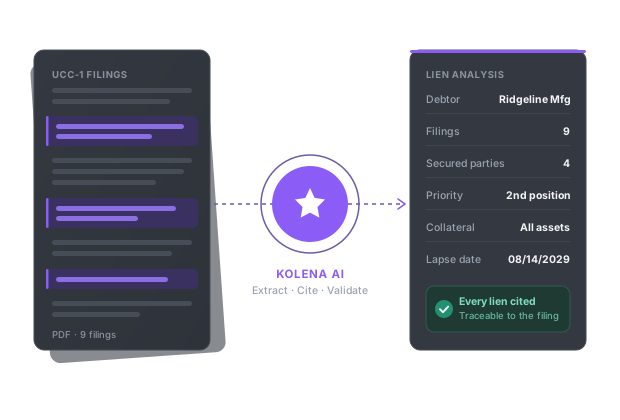
Analyze your first UCC filing in minutes with AI
Why Loan Tapes Matter
Risk and Valuation
Loan tapes are central to assessing the risk associated with a loan portfolio:
Each field in the tape, such as credit score, loan-to-value ratio, payment status, and collateral type, contributes to the overall risk profile.
Analysts aggregate and model this data to estimate default probabilities, potential losses, and cash flow projections.
By using loan tapes, investors can apply stress tests, simulate economic scenarios, and determine the sensitivity of the portfolio to various factors.
From a valuation perspective, loan tapes allow for granular pricing based on the characteristics of individual loans. Rather than treating a portfolio as a homogeneous block, the tape enables a bottom-up approach, where each loan is valued according to its own risk and return profile. This supports fair market pricing, negotiation between buyers and sellers, and accurate rating and structuring of securitized products. Inaccurate or incomplete loan tapes can lead to mispricing and increased risk.
Capital Raises and Securitization
In capital markets, loan tapes are especially important during capital raises and securitization:
When financial institutions seek to raise capital by selling loan portfolios or issuing asset-backed securities, they provide buyers and rating agencies with detailed data on every underlying loan.
The loan tape becomes the basis for due diligence, enabling third parties to verify the quality, performance, and risk of the assets involved.
Securitization relies on the transparency and granularity that loan tapes provide.
Rating agencies use the tape to model cash flows, estimate losses, and assign credit ratings to different tranches of a security. Investors depend on the tape to conduct their own analysis and validate deal assumptions. Without a complete and accurate loan tape, securitization transactions would face greater uncertainty, higher risk premiums, or regulatory rejection.
What Information Is Included in a Loan Tape?
1. Borrower Information
Borrower information fields capture the identity and credit profile of each individual or entity that has taken out a loan. This typically includes names, contact details, social security or tax ID numbers, and demographic data. Additional fields often cover employment status, income, and other background information relevant to assessing creditworthiness. For commercial loans, this section might also include business financials and ownership details.
Why this information is important:
The quality and completeness of borrower information are important for evaluating default risk and ensuring compliance with anti-money laundering (AML) and know-your-customer (KYC) regulations. Analysts use this data to segment portfolios, identify risk concentrations, and assess how macroeconomic factors could affect different borrower groups. Incomplete or inaccurate borrower data can undermine risk models and lead to compliance failures.
2. Loan Details
Loan details fields provide the contractual terms of each loan, defining the rights and obligations of both lender and borrower. Standard fields include the loan amount, origination date, interest rate, loan term, payment frequency, and maturity date. For adjustable-rate loans, additional fields may specify rate adjustment periods, caps, and indices. Other details might include prepayment penalties, balloon payments, or covenants for commercial loans.
Why this information is important:
Clear and detailed loan terms are necessary for modeling expected cash flows and understanding the legal framework governing each loan. These fields determine repayment schedules, interest accruals, and potential triggers for default or restructuring. Inaccurate or missing loan details can lead to errors in valuation, cash flow modeling, and compliance with contractual requirements.
3. Payment and Performance Data
Payment and performance data tracks the historical and current payment behavior for each loan. Key fields include payment status, such as current, delinquent, or in default, number of days past due, payment amounts, and dates of last payment. Additional data may capture modifications, forbearances, or payment holidays granted to the borrower. For securitized assets, cumulative loss and recovery amounts are often included.
Why this information is important:
This information is vital for monitoring portfolio performance and identifying emerging risks. Analysts use payment data to calculate delinquency rates, loss rates, and cure rates, which inform risk management and pricing decisions. In securitization, accurate performance data is required for modeling cash flow waterfalls and determining the allocation of payments to different tranches. Gaps or errors in this data can lead to misestimation of losses and servicing disruptions.
4. Collateral Information
Collateral information fields document the assets pledged to secure each loan. For mortgages, this includes property addresses, property types, appraised values, and lien positions. For auto loans, it includes vehicle details such as make, model, year, and VIN. Commercial loans may list business assets or inventory as collateral, along with valuations and ownership details.
Why this information is important:
Collateral data is critical for estimating recovery prospects in the event of borrower default. It enables analysts to calculate loan-to-value (LTV) ratios and assess the adequacy of collateral coverage. Accurate collateral information is also required for compliance with regulatory requirements and for supporting claims in legal or foreclosure proceedings. Missing or outdated collateral data can impair risk assessment and loss recovery efforts.
5. Risk and Credit Metrics
Risk and credit metrics fields quantify the creditworthiness of each loan and its likelihood of default or loss. Common metrics include borrower credit scores, such as FICO, debt-to-income ratios, LTV ratios, internal risk grades, and probability of default (PD) scores. For commercial loans, additional financial ratios may be included to capture business performance and sector risk.
Why this information is important:
These metrics are used by investors, rating agencies, and risk managers to segment portfolios and determine capital requirements. They also inform pricing, underwriting standards, and monitoring processes. Regular updates and validation of risk metrics help ensure that risk assessments remain accurate over time. Incomplete or outdated risk data can lead to underestimation of risk and inadequate provisioning for potential losses.
6. Servicing and Operational Data
Servicing and operational data tracks how each loan is managed after origination. This includes the identity of the servicer, servicing fee rates, contact information for servicing teams, and notes on servicing actions such as collections, modifications, or foreclosures. Additional fields may capture escrow balances, insurance status, and tax payment histories.
Why this information is important:
Operational data supports compliance and performance monitoring. It helps confirm that loans are serviced in accordance with contractual and regulatory requirements, and that exceptions or issues are tracked and resolved. For investors, this data provides insight into servicing quality and operational risk, which can affect portfolio performance and borrower outcomes. Missing or inaccurate servicing data can result in compliance failures and reduced recoveries.
Loan Tape Example: Common Fields
A loan tape can contain dozens or even hundreds of fields, depending on the asset class and reporting requirements. While the exact structure varies between lenders and transactions, most loan tapes include a core set of fields that describe the borrower, loan terms, performance, collateral, and risk characteristics.
Field | Description |
Loan ID | Unique identifier assigned to the loan |
Borrower ID | Identifier for the borrower or borrowing entity |
Origination Date | Date the loan was issued |
Original Balance | Initial principal amount of the loan |
Current Balance | Remaining unpaid principal balance |
Interest Rate | Current interest rate applied to the loan |
Loan Term | Length of the loan, typically in months |
Maturity Date | Date the loan is scheduled to be fully repaid |
Payment Amount | Required periodic payment amount |
Payment Frequency | Monthly, quarterly, biweekly, or other schedule |
Credit Score | Borrower credit score at origination or current date |
Debt-to-Income Ratio (DTI) | Borrower's debt obligations relative to income |
Loan-to-Value Ratio (LTV) | Loan balance relative to collateral value |
Payment Status | Current, delinquent, defaulted, or paid off |
Days Past Due | Number of days a payment is overdue |
Last Payment Date | Most recent payment received |
Property Type | Type of collateral, such as residential or commercial property |
Collateral Value | Appraised or estimated value of the collateral |
Servicer Name | Organization responsible for servicing the loan |
Risk Grade | Internal or external credit risk classification |
In practice, loan tapes often contain many additional fields beyond these examples. Mortgage loan tapes may include occupancy status, lien position, and escrow information. Auto loan tapes may include vehicle identification numbers (VINs), mileage, and vehicle age. Commercial loan tapes frequently include industry classifications, financial ratios, and guarantor information. The level of detail depends on the intended use of the tape, whether for portfolio management, due diligence, loan sales, or securitization.
Learn more about Hard Money.
Loan Tape Analysis: Key Metrics to Review
1. Delinquency and Default Rates
Delinquency and default rates are key indicators of portfolio health:
Delinquency measures the percentage of loans that are past due, often segmented into categories such as 30, 60, or 90+ days delinquent.
Default rates track loans that have failed according to contractual terms and are unlikely to return to performing status.
Reviewing these metrics helps analysts identify deteriorating credit quality and assess servicing and collection efforts.
Trend analysis is important: A portfolio with stable delinquency levels may present less risk than one where delinquency rates are rising rapidly. Analysts often compare current performance against historical data, underwriting cohorts, and industry benchmarks to determine whether issues require further investigation.
2. Credit Quality Metrics
Credit quality metrics evaluate the strength of the borrowers within the portfolio. Common measures include:
Credit scores
Debt-to-income (DTI) ratios
Internal risk grades
Probability of default estimates
These metrics help investors understand the overall risk profile and identify concentrations of higher-risk loans.
Distribution matters as much as averages: A portfolio with an average credit score of 700 may still contain a significant concentration of lower-credit borrowers. Analysts review score bands, risk segments, and trends over time to assess how borrower quality may affect future performance.
3. Loan-to-Value Ratios
Loan-to-value (LTV) ratios compare the loan balance to the value of the underlying collateral:
Higher LTV ratios generally indicate greater risk because there is less collateral protection if the borrower defaults.
Lower LTV ratios provide a larger collateral cushion, reducing potential losses and improving recovery prospects if the borrower defaults.
For secured lending products such as mortgages and auto loans, LTV is a key metric for estimating potential losses and recovery rates.
Analysts often review both current and original LTV ratios: Changes in collateral values can alter portfolio risk over time. In declining markets, rising effective LTVs may increase loss severity and reduce recovery prospects in default scenarios.
4. Portfolio Concentration Analysis
Concentration analysis examines whether a portfolio is overly exposed to elements such as:
Borrower groups
Industries
Geographic regions
Loan types
Risk categories
Excessive concentration can increase vulnerability to localized economic events or sector-specific downturns.
For example, a commercial loan portfolio heavily concentrated in a single industry may experience elevated losses if that sector faces economic stress. Diversification metrics help investors determine whether risk is distributed appropriately across the portfolio.
Related content: For managing exposure across large portfolios, see our guide to real estate portfolio management software.
5. Cash Flow and Prepayment Metrics
Cash flow analysis focuses on the timing and predictability of loan repayments. Key metrics include:
Scheduled principal payments
Interest collections
Prepayment rates
Expected cash flow timing
These measures are particularly important for investors in loan portfolios and asset-backed securities.
Prepayment behavior can affect returns: When borrowers repay loans earlier than expected, investors may receive principal sooner but lose anticipated interest income. Loan tape analysis helps model different prepayment scenarios and evaluate their impact on portfolio performance.
6. Loss Severity and Recovery Rates
Loss severity measures the percentage of loan value lost after default, while recovery rates measure the amount recovered through collateral liquidation, collections, or legal actions. Together, these metrics provide insight into the financial impact of borrower defaults.
Historical recovery performance is often used to estimate future losses and support valuation models. Portfolios with strong collateral and effective servicing operations generally exhibit lower loss severity and higher recovery rates than unsecured or poorly managed portfolios.
7. Data Quality and Completeness
Before drawing conclusions from a loan tape, analysts must assess the quality of the underlying data. These elements can distort risk assessments and valuation models:
Missing fields
Inconsistent values
Duplicate records
Outdated information
Data validation is a critical step in any loan tape review process.
Common checks include verifying balances against servicing records, confirming that required fields are populated, and identifying outliers that may indicate reporting errors. High-quality loan tapes improve confidence in analysis and reduce the risk of making decisions based on inaccurate information.
The Traditional Loan Tape Problem
Manual Data Entry Does Not Scale
Traditional loan tape creation often relies on employees manually reviewing documents and entering data into spreadsheets or loan management systems. This process may be manageable for small portfolios, but it becomes difficult as loan volumes grow. Reviewing thousands of loan files by hand requires significant time and resources, creating bottlenecks that slow underwriting, due diligence, and portfolio transactions.
Manual workflows also make it difficult to maintain consistency across large datasets. Different employees may interpret documents differently or enter data using inconsistent formats. As a result, organizations often face delays, higher operating costs, and challenges keeping loan tapes current as portfolios evolve.
Lending Data Is Trapped in Unstructured Documents
A large portion of lending data originates in unstructured or semi-structured documents such as loan applications, financial statements, bank statements, tax returns, appraisals, promissory notes, and servicing records. While these documents contain valuable information, the data is often embedded within text, tables, PDFs, or scanned images that cannot be easily analyzed at scale.
Extracting information from these documents typically requires manual review or specialized data processing tools. This creates friction whenever lenders, investors, or auditors need to build or update a loan tape. The challenge increases when data must be collected from multiple systems and document sources, making it difficult to create a complete and standardized portfolio view.
Errors Can Create Downstream Risk
Errors introduced during loan tape creation can have significant consequences throughout the loan lifecycle. Incorrect balances, missing borrower information, inaccurate collateral values, or misclassified payment statuses can distort risk models, valuation analyses, and investment decisions. Even small data quality issues can become amplified across large portfolios.
These errors can also create compliance, operational, and transaction risks. Investors may make decisions based on inaccurate information, rating agencies may apply incorrect assumptions, and servicers may encounter reporting discrepancies. During loan sales and securitizations, data inaccuracies often lead to additional due diligence, transaction delays, pricing adjustments, or requests for data remediation. Maintaining accurate loan tape data is necessary for effective risk management and portfolio operations.
How AI Can Help Build Loan Tapes
Creating and maintaining loan tapes has traditionally required significant manual effort. AI can automate many of the steps involved, helping organizations convert information from loan documents into structured datasets, validate data quality, and accelerate portfolio analysis:
Extract data from loan documents automatically: AI can review documents such as loan applications, financial statements, tax returns, appraisals, promissory notes, and servicing records. Key fields can be identified and extracted without manually entering information into spreadsheets.
Convert unstructured data into structured records: Lending information is often spread across PDFs, scanned documents, emails, forms, and other formats. AI can identify relevant data points and organize them into standardized loan tape fields.
Validate loan tape data against source documents: AI can compare loan tape entries with the underlying documents used to create them. Discrepancies such as incorrect balances, missing borrower details, or inconsistent collateral information can be flagged automatically.
Support large-scale due diligence: AI can analyze entire portfolios, perform document checks, and identify exceptions across large datasets.
Apply business rules and underwriting requirements: AI systems can evaluate loan data against predefined policies, investor guidelines, or internal credit criteria. Missing documentation, policy exceptions, and data inconsistencies can be identified automatically.
Generate structured outputs for downstream systems: Extracted and validated data can be delivered in formats compatible with servicing platforms, portfolio management systems, and reporting tools.
Handle incomplete and evolving loan files: AI can process new documents as they arrive and update loan tape records accordingly.
Improve speed while maintaining transparency: Automated workflows can reduce processes that traditionally take days or weeks to hours. AI-based systems can provide references to the source documents used for extracted data.
Related content: For a practical example of AI extracting data from lending documents, read our guide to loss run reports.
How to Build Loan Tapes Faster with Kolena
Building and maintaining accurate loan tapes means pulling data out of document-heavy, error-prone processes — exactly the work Kolena automates. Kolena uses AI to automatically review, extract, validate, and report on the financial documents that feed a loan tape, helping financial institutions analyze deals faster, reduce risk, and stay audit-ready while moving with greater accuracy and transparency.
Key capabilities of Kolena:
Automated data extraction: Extract key data across deal packages and source documents to support investment analysis and decision-making, eliminating manual data entry.
Portfolio reporting: Aggregate data from multiple sources into structured portfolio updates and risk dashboards, turning scattered loan-level information into a consolidated view.
Source-cited accuracy: Apply confidence scoring and source citations to every result, so each data point can be traced back to its underlying document.
Large-scale processing: Process hundreds of documents simultaneously with the same team, making it practical to build and update tapes across large portfolios.
Compliance testing: Review disclosures, statements, and filings against regulations automatically to accelerate internal audit and compliance checks.
Audit readiness: Produce outputs that are traceable and regulator-compliant, supporting due diligence and securitization requirements.
To see how Kolena can automate your loan tape and document workflows, explore Kolena for Financial Services.