The ROI of replacing a BPO contract with an AI document platform is typically larger than the BPO invoice alone suggests — and faster than most organizations expect. The reason most ROI calculations underestimate it is that they compare AI platform cost against the per-transaction BPO rate, without accounting for the full cost of the offshore model: the management layer, the quality control function, the rework cycles, the cost of turnaround delay on time-sensitive decisions, and the ongoing expense of institutional knowledge turnover as teams rotate.
This article builds the ROI case component by component, with illustrative examples by vertical. The goal is a framework you can apply to your own numbers, not a generic claim that AI saves money.
This is part of a series of articles about BPO Replacement.
Step 1: Calculate Your True BPO Baseline
The number on your BPO invoice understates what the model actually costs. Before modeling the AI ROI, build an honest BPO total cost of ownership that includes:
- Direct contract costs: the per-transaction or per-FTE fees. For commercial lease abstraction, offshore providers typically charge $5–$100 per lease depending on complexity and vendor. For insurance claims intake, per-transaction rates run roughly $8–$15 per FNOL and $12–$20 per policy issuance. Loan file processing varies widely by document complexity.
- Management overhead: the internal staff time spent coordinating with the BPO vendor — SLA reviews, error corrections, escalations, onboarding new team members as the offshore operation turns over. Non-voice BPO attrition runs at 15–30%, meaning this overhead recurs quarterly.
- Quality control and rework: the cost of reviewing BPO outputs for accuracy and correcting errors before they reach underwriters, investors, or compliance systems. This is often absorbed invisibly by senior internal staff.
- Delay cost: the business cost of 24–48 hour (or longer) turnaround. For time-sensitive decisions — a credit committee waiting on a loan file review, a deal team waiting on due diligence, an MGA waiting on FNOL triage — the value of same-day output is real and frequently underweighted.
Once these costs are included, the true BPO cost is typically 1.5–2x the invoice value. That is the baseline the AI ROI should be measured against.
Nine free AI document tools — pick your workflow
The ROI Formula
ROI from replacing BPO with AI has five components. Not every component applies to every workflow, but the combination determines the total case.
1. Direct cost saved
The difference between your BPO per-transaction rate and your AI platform subscription cost per equivalent unit. At volume, the platform subscription typically delivers a lower per-unit cost — and unlike the BPO model, the subscription cost does not scale linearly with volume. Processing twice the documents costs the same subscription rate.
2. Management and QC overhead eliminated
The internal staff hours currently spent coordinating with the BPO vendor, reviewing outputs, and correcting errors. At mid-market scale, this is often one to two hours per week of senior staff time per active workflow — time that immediately redirects to higher-value work once the workflow runs on an AI platform.
3. Speed value recovered
The business value of moving from 24–48 hour turnaround to minutes. In lending, faster document review means faster credit committee decisions and shorter loan processing cycles. In commercial real estate, faster lease abstraction means acquisition due diligence runs in days rather than weeks. In insurance, faster FNOL triage means faster claims response and better customer experience. This component is real but harder to quantify — most organizations assign it a conservative value and treat it as upside.
4. Revenue protection from accuracy
In workflows where errors have direct financial consequences — lease auditing that misses escalation clauses, loan underwriting that miscaptures borrower financials, claims processing that misclassifies coverage — the value of AI's consistent, cited output goes beyond cost savings. One commercial real estate firm captured approximately $100,000 in efficiency gains across 58 leases after switching to an AI document platform; the financial recovery was partly from abstraction cost savings and partly from surfacing terms that the prior process had missed.
5. Risk cost reduced
The cost of data residency exposure, audit trail gaps, and institutional knowledge loss — harder to quantify but increasingly material as regulatory environments require documented decision trails and organizations face scrutiny of their offshore data handling.
ROI by Vertical: Illustrative Examples
These examples use verified market cost ranges. Substitute your actual volume and contract rates to calculate your specific case.
| Vertical | Typical BPO cost (per unit) | AI impact | Illustrative annual savings at volume |
|---|---|---|---|
| Commercial lease abstraction (RE) | $5–$100/lease (offshore range) | Volume-independent subscription; minutes per lease | 500 leases/year × $50 avg = $25K direct + management overhead + delay cost eliminated |
| Insurance FNOL intake | $8–$15 per FNOL (per-transaction) | No queue, no delay; citations on every claim record | 5,000 FNOLs/year × $10 avg = $50K direct + rework and QC overhead |
| Loan file / UCC review | Varies by complexity; FTE billing typical | 96% labor reduction documented in one private lending deployment | Depends on file volume and current FTE cost; breakeven at modest volume |
| PE due diligence / IC memos | Analyst hours + offshore research support | First draft from data room in fraction of current time; every figure cited | Value is in deal velocity and analyst redirection to higher-value work |
What MIT's Research Found
The strongest published data point on BPO replacement ROI comes from MIT's Project NANDA, published in August 2025. The research documented firms that eliminated $2–10 million in annual BPO expenditure after deploying AI. The most striking case: an organization that saved approximately $8 million per year after spending roughly $8,000 on an AI tool. That is not a claim about AI in general — it is a documented outcome from a specific deployment in the type of document-heavy operational context this article describes.
The $8M-for-$8K case represents the upper end of the range; most organizations will see a more modest but still material ROI. The pattern — AI investment dramatically outperforming its cost against a BPO baseline — holds across the firms studied.
Related articles: offshore vs onshore document processing and genpact alternative.
The Non-Financial ROI
Three components of the ROI case are real but difficult to express in a spreadsheet:
Audit trail quality. An AI document platform returns field-level citations — every extracted value linked to its source location. That audit trail has value in regulatory examinations, investor due diligence, carrier audits, and internal compliance reviews that a BPO SLA report cannot provide.
Institutional knowledge retention. When an offshore team turns over, client-specific context leaves with them. An AI platform's extraction logic is documented in the configuration — it doesn't turn over, take sick leave, or need re-training after a vacation.
Surge capacity. A CAT event, an acquisition surge, or a deal-driven spike in document volume does not require advance planning, backup staff deployment, or contract renegotiation. The platform processes surge volume at the same speed and cost as baseline. That operational flexibility has a value that shows up in risk management, not in the BPO invoice comparison.
Payback Period
For most organizations, the payback period on replacing a single document workflow is measured in weeks to months, not years. The MIT research supports this — when the comparison is an $8,000 tool against an $8 million annual BPO contract, payback is near-immediate. At more typical mid-market scale, an organization with a $50,000–$200,000 annual BPO contract for a specific document workflow will typically recover platform costs within the first quarter of deployment.
The calculation is straightforward: monthly BPO cost for the workflow minus monthly platform cost equals monthly savings. Divide platform setup cost (if any) by monthly savings to get payback period in months. For most mid-market deployments at typical BPO contract sizes, that number is under 90 days.
How Kolena Works
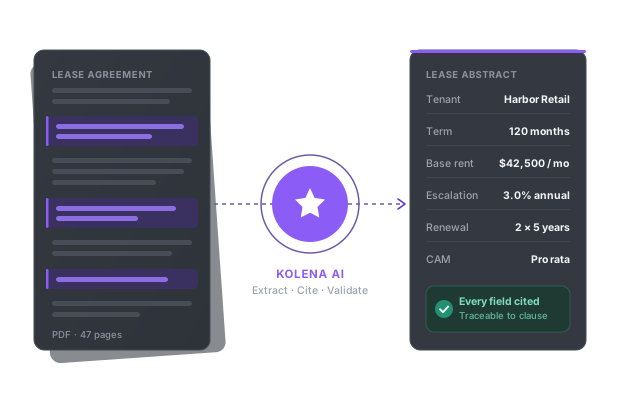
Kolena is an AI document automation platform built for the document workflows that mid-market organizations in commercial real estate, lending, insurance, and financial services currently run through BPO contracts. Rather than paying a per-transaction or per-FTE rate to an offshore team, Kolena customers deploy AI agents that read their documents, apply their specific extraction rubric, and return structured outputs — with every field cited to its exact location in the source document.
The platform handles any document format — PDFs, scans, emails, spreadsheets, images — and integrates with the systems already in use. Every run produces a full audit trail. SOC 2 Type II certified, onshore processing, no training on customer data. The typical deployment path starts with the highest-volume, most-standardized workflow in a current BPO scope, runs as a parallel POC for 30 days, and produces the cost-per-document comparison data that makes the commercial decision at the next BPO contract renewal straightforward rather than uncertain.