For underwriters and brokers in 2026, AI is the better answer for loss run analysis: an AI platform reads any carrier's loss run format and extracts claim history, loss ratios, and frequency/severity patterns in minutes, where an offshore team struggles with format variance and bottlenecks at renewal. Offshore loss-run processing still works for low, steady volume, but the format chaos and renewal-deadline bursts that define this workflow are exactly where AI pulls ahead.
This compares the two models for commercial insurance underwriters, brokers, and MGAs.
This is part of a series of articles about BPO Replacement.
What Offshore Loss Run Analysis Typically Looks Like
Offshore loss-run processing is a recognized BPO service — established insurance BPOs and offshore teams take loss run PDFs submitted by brokers or carriers, read out the claim histories and coverage details, and return structured data for underwriting and renewals, typically on a per-FTE or per-document basis with offshore cost savings that can reach 70%. For carriers and agencies drowning in loss-run intake, it offloads a tedious, high-volume task and frees underwriters from manual keying.
Nine free AI document tools — pick your workflow
Where the Offshore Model Falls Short for Loss Run Analysis
Three things specific to loss runs strain the offshore model. Non-standard format variation: every carrier produces loss runs differently — different layouts, field names, and conventions — and offshore teams calibrated to common formats slow down or err on the long tail of unfamiliar ones. Speed at renewal: loss runs arrive in bursts against renewal deadlines, and an offshore queue turns that burst into a bottleneck precisely when underwriters need turnaround most. Broker relationship pressure: underwriters who return loss-run analysis faster win more broker submissions, so queue lag isn't just an ops cost — it loses business. Offshore attrition of 15–30% and wage inflation near 9.5% a year make the format-calibration and cost problems worse over time.
How AI Compares
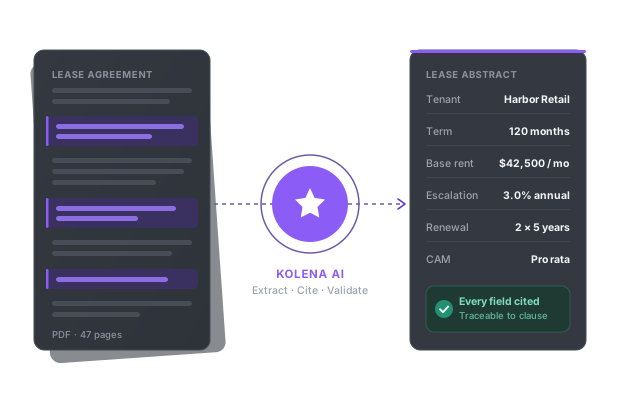
AI reads loss runs regardless of carrier format, normalizes them into structured claim histories and loss-ratio data in minutes, and cites each figure to its source row — so renewal bursts don't create a queue and the long tail of odd formats isn't a problem. The market trend supports the move: HFS Research found three in four enterprise leaders expect to pivot from staff-augmentation to AI-led delivery within two years.
| Factor | Offshore BPO | AI (Kolena) |
|---|---|---|
| Format variance | Calibrated to common formats; struggles on the tail | Reads any carrier's loss run layout |
| Turnaround | Per-document queue, bottlenecks at renewal | Minutes, even in renewal bursts |
| Surge capacity | Limited by staffed bench | No fixed ceiling for renewal spikes |
| Citations | Re-keyed values, limited sourcing | Field-level citation to the source row |
| Cost model | Per-FTE/per-document; rises with wages | Software cost; flat as volume scales |
| Data residency | Offshore | Onshore, SOC 2 Type II |
Format independence is the differentiator: AI doesn't need to be re-trained on each new carrier's layout the way an offshore bench effectively does.
Who Should Make the Switch — and Who Shouldn't
Switch when loss-run volume spikes at renewal, when you handle submissions from many carriers with varied formats, or when faster turnaround would win you more broker business. Offshore can still fit a small shop with low, steady loss-run volume from a narrow set of carriers. AI handles the reading and structuring; the underwriting judgment on what the loss history means stays with your underwriters.
Related articles: ai vs offshore kyc bank statement analysis and genpact alternative.
How Kolena Works
Kolena is an AI document automation platform built for commercial insurance underwriters, brokers, and MGAs. Multi-year loss run PDFs from any carrier go in; normalized claim histories, loss ratios, and frequency/severity data come out in minutes.
It reads any loss-run format — scans, PDFs, carrier exports — and pushes structured output into your underwriting workbench, with every figure cited to the source row so the analysis is verifiable. Every run produces a full audit trail: not just what was extracted, but the specific clause, line, or figure that justified each data point. SOC 2 Type II certified, onshore processing, no training on customer data.