AI is now replacing offshore document review teams — not as a future possibility, but as a present-day operational decision at companies in commercial real estate, lending, insurance, and financial services. The workflows that offshore teams have handled for decades — lease abstraction, loan underwriting, claims review, due diligence — are being automated at a pace that is making the traditional cost-and-scale argument for offshoring obsolete.
In August 2025, MIT's Project NANDA published The GenAI Divide: State of AI in Business 2025, and its most striking finding wasn't about technology — it was about who's actually being displaced. "AI is predominantly replacing outsourced, offshore workers," Aditya Challapally, the report's lead author, told Axios. Rather than cutting internal staff, organizations are "finding real gains from replacing BPOs and external agencies." The firms studied eliminated $2–10 million in annual BPO expenditure; one saved $8 million a year by spending $8,000 on an AI tool. A May 2025 survey of 600+ IT and business leaders by HFS Research and Publicis Sapient found three in four enterprise leaders expect a pivot from staff augmentation models to AI-led services within two years.
This isn't a forecast. It's already happening in commercial real estate, lending, insurance, and financial services — the four industries where document volume is highest and offshore teams have been embedded the longest.
Why Document Teams Are Being Replaced First
Not all job categories are equally exposed to AI automation. The workflows being automated first share a specific profile: high-volume, document-intensive, rule-based at their core, and until recently requiring human judgment primarily because the documents were unstructured.
Read about ai vs offshore mortgage document processing.
Offshore document review fits this profile exactly. A lease abstraction team reads the same fields — base rent, escalation clauses, lease term, options, co-tenancy — across hundreds of leases. A loan underwriting support team extracts the same data points from tax returns, rent rolls, and entity documents deal after deal. A claims intake team triages the same document types across every FNOL. None of this work requires judgment in the way that structuring a complex deal or setting claims reserves does.
What it requires is accuracy, speed, and consistency at scale. Those are exactly the properties that modern AI document agents — built on large language models with structured extraction and citation frameworks — can now deliver.
Read about offshore vs onshore document processing.
Nine free AI document tools — pick your workflow
The Document Workflows Being Automated
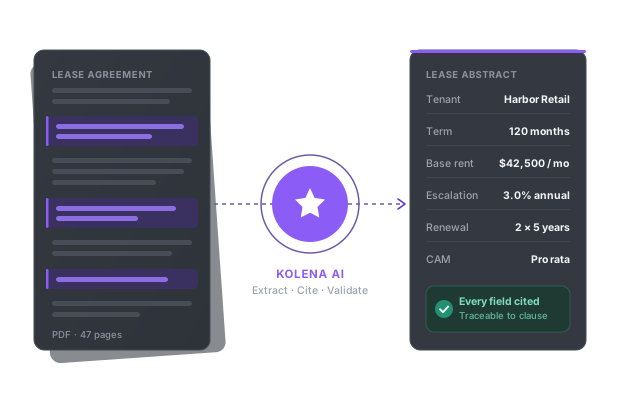
Lease abstraction. Commercial lease review has historically been outsourced to offshore providers at $5–$100 per lease, with 2–5 day turnaround times and known gaps on US-specific nuance: percentage rent breakpoints, co-tenancy trigger mechanics, go-dark provisions, and expense stop calculations. AI agents now abstract commercial leases in minutes, with every extracted field cited to its exact source clause. One real estate firm replaced their abstraction team and captured nearly $100,000 in efficiency gains across 58 leases.
Loan underwriting document review. Lenders processing UCC filings, tax returns, bank statements, rent rolls, and borrower entity documents were heavily reliant on offshore QA teams to validate data before credit committee. AI agents ingest a complete loan file, apply a custom underwriting rubric, and produce a decision memo with citations — reducing turnaround from five days to a matter of hours. One private lending customer cut UCC filing review labor by 96%.
Insurance claims triage. Offshore teams handling FNOL intake, medical bill review, and claims document assembly face structural limits: time-zone delay means first contact can lag 12+ hours, CAT events overwhelm fixed-capacity teams, and turnover regularly resets institutional knowledge. AI agents process loss notices, policy documents, and medical records simultaneously — flagging discrepancies and routing claims without the time-zone or capacity constraints.
Investment due diligence and IC memos. PE and real estate investment firms run analysts and offshore research teams through the same playbook on every deal: read the CIM, extract financials, pull comparable data, draft the IC memo. AI agents trained on a firm's standard IC format generate a first draft from a data room in a fraction of the time, with every figure cited to its source document.
Three Signals That the Shift Is Now
MIT's 2025 finding. The clearest data point on who's actually being displaced: not full-time employees, but the outsourced layer. The MIT NANDA research is explicit — enterprises are canceling BPO contracts, not cutting internal headcount. The ROI is not marginal: $2–10M in BPO expenditure eliminated per firm studied, with one company saving $8M a year from an $8K AI spend.
Capgemini's $3.3B acquisition of WNS. Announced July 7, 2025 and completed October 17, 2025, Capgemini acquired WNS — a 64,000-person BPO firm — explicitly to create what it called "a global leader in Agentic AI-powered Intelligent Operations." When the largest players in the BPO industry are buying their way into AI execution rather than defending their labor model, the labor model is structurally broken.
Rising offshore costs. The wage arbitrage that made offshore BPO compelling is narrowing. India's median salary increase held at 9.5% in both 2024 and 2025, per WTW's Salary Budget Planning Report. Offshore attrition in non-voice roles runs at 15–30%, meaning institutional knowledge turns over quarterly. At the same time, AI infrastructure costs continue to fall. The crossover point is no longer theoretical.
What AI Has to Do to Actually Replace an Offshore Team
The failure mode of early enterprise AI deployments was treating document AI like a chatbot — fast in demos, unreliable in production. For AI to genuinely replace an offshore document team in a regulated industry, it needs to clear a higher bar.
Read about ai vs offshore kyc bank statement analysis.
Citations on every output. Every extracted field, every risk flag, every decision point needs to link back to the exact location in the source document. Without citations there's no audit trail and no way to validate accuracy at scale. In real estate compliance, lending, and insurance claims, this isn't optional — it's table stakes.
Structured outputs that push downstream. Extraction alone isn't enough. The AI needs to deliver structured data into the systems your team already uses: your underwriting model, your claims platform, your lease management system. If the output is a PDF someone re-keys manually, you haven't replaced the workflow — you've added a step.
No training on your data. Moving document workflows from an offshore team to a cloud AI platform raises a legitimate data security question. Any AI document platform used in regulated industries must be explicit: your documents are not used to train models, and the platform is SOC 2 certified with full audit trails.
Onshore delivery. For US-based firms with compliance requirements or data residency concerns, processing needs to happen onshore — not routed through offshore infrastructure. This is increasingly non-negotiable for bank regulators and insurance commissioners.
Related articles: genpact alternative, ai vs offshore loan underwriting, resourcepro alternative, exl service alternative, and wns alternative.
How the Transition Actually Works
The companies replacing their offshore document teams aren't doing it in one move. The pattern that works:
Start with one workflow. Pick the highest-volume, most-standardized document workflow — lease abstraction, loan file review, or claims intake — and run a proof of concept against real documents. Compare accuracy and speed against your current offshore output.
Measure the right thing. The metric isn't "did the AI get it right?" — it's "what's the error rate compared to the offshore team, and what does that cost?" Offshore teams have error rates too. A well-configured AI agent with citation verification often has lower variance.
Replace contractually, not headcount. The cleanest transition is letting a BPO contract expire rather than cutting internal staff — which matches MIT's 2025 finding that AI is replacing outsourced positions first.
Expand by workflow. Once the first workflow is stable, add the next highest-volume document type. The infrastructure — integrations, rubrics, audit trails — largely carries over.
How Kolena Helps Companies Replace Offshore Document Teams
Replacing an offshore document team requires more than a powerful AI model. To automate real business workflows, organizations need accurate extraction, auditability, structured outputs, and integration with existing systems.
Kolena provides AI agents that automate document-intensive processes across commercial real estate, lending, insurance, and financial services. Common use cases include lease abstraction, loan file review, claims analysis, due diligence, and investment memo creation—workflows that have traditionally relied on offshore document review teams.
A critical requirement for replacing manual review is traceability. Kolena generates citation-backed outputs that allow teams to verify where every extracted field, calculation, or risk finding originated in the source documents. This creates an audit trail suitable for regulated industries.
Kolena also converts unstructured documents into structured outputs such as lease abstracts, underwriting summaries, reports, and spreadsheets that can be integrated into downstream systems. Combined with workflow automation and enterprise integrations, this enables firms to automate entire document processes rather than simply speeding up review.
Many organizations begin with a single workflow, validate results against their existing process, and then expand to additional document operations. The result is faster turnaround, lower operating costs, and a shift from manual document processing to AI-driven execution.