For P&C carriers, MGAs, and TPAs in 2026, AI is the better answer for claims intake and triage: an AI platform reads FNOL submissions and produces a structured, audit-traceable claim record in minutes with no surge ceiling, where an offshore team's capacity is fixed and its consistency drifts as adjusters rotate. Offshore claims support still works for steady baseline volume, but catastrophe surges and regulatory SLAs are where the offshore model strains and AI doesn't.
This is a direct comparison of the two models for claims intake and triage in regulated P&C environments.
This is part of a series of articles about BPO Replacement.
What Offshore Claims Processing Typically Looks Like
Offshore claims processing is a large, established market. Providers in India, the Philippines, and Eastern Europe — alongside TPAs — staff teams that take FNOL submissions, read policy and coverage documents and incident reports, and build a claim record, billing per claim (commonly cited in the $50–$150 range depending on volume) or per hour, with wages 30–60% below US levels. For routine, steady claim flow, it reduces cost meaningfully and gives carriers a flexible front-end team for first-notice handling.
Nine free AI document tools — pick your workflow
Where the Offshore Model Falls Short for Claims Processing
The strains show up exactly where claims are hardest. CAT surge: when a catastrophe hits, claim volume spikes overnight, and an offshore bench can't scale instantly — you wait on hiring and training while SLAs run. AI has no fixed ceiling and absorbs the spike. Consistency across adjusters: offshore team rotation and 25–40% attrition mean the same claim type gets handled differently depending on who's at the desk this quarter. Audit trail depth: regulated claims environments require a documented basis for each decision, and manual offshore processing produces a record without traceable sourcing back to the policy language. Speed to first response: many states impose regulatory SLAs on acknowledgment and first contact, and offshore queue lag eats into them. Wage inflation near 9.5% a year compounds the cost side over time.
How AI Compares
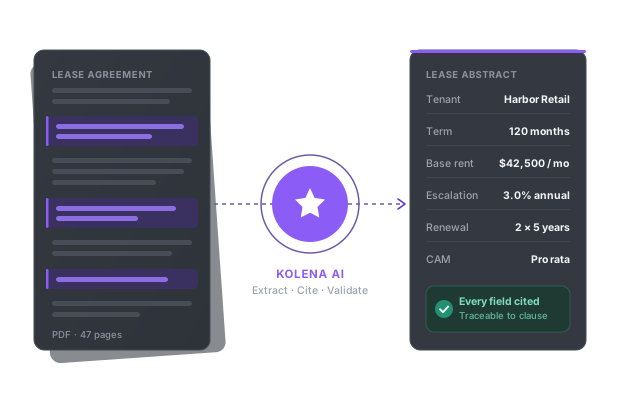
AI reads the FNOL packet, the policy, and the incident documents together, produces a structured claim record, and cites each extracted value to the source — instantly and at any volume. That matters most under surge and SLA pressure, where offshore capacity is the binding constraint. The broader shift is documented: MIT's Project NANDA study (Aug 2025) found early enterprise AI is predominantly replacing offshore work, with firms eliminating $2–10M in annual BPO spend.
| Factor | Offshore BPO | AI (Kolena) |
|---|---|---|
| Surge capacity | Fixed bench; scaling needs hiring | No fixed ceiling; absorbs CAT spikes |
| Speed to first response | Queue lag against state SLAs | Minutes, helping meet SLAs |
| Consistency | Varies with adjuster rotation (25–40% attrition) | Same triage rubric every time |
| Audit trail | Outputs without traceable sourcing | Field-level citation to policy and FNOL |
| Cost model | $50–$150 per claim or per hour; rises with wages | Software cost; flat as volume scales |
| Data residency | Offshore | Onshore, SOC 2 Type II |
The audit trail is decisive in regulated claims: AI ties every field to the policy clause or FNOL line that supports it, which manual offshore output rarely preserves.
Who Should Make the Switch — and Who Shouldn't
Switch when you face CAT surge exposure, hard regulatory SLAs, audit-trail requirements, or consistency problems across a rotating team. Offshore can still fit very low, stable claim volume, or genuinely judgment-intensive complex-claim handling that doesn't reduce to document extraction. AI handles intake, triage, and structuring; complex adjudication and customer empathy stay with your adjusters — AI just gets them a clean, sourced claim record faster.
Related articles: ai vs offshore kyc bank statement analysis and genpact alternative.
How Kolena Works
Kolena is an AI document automation platform built for P&C carriers, MGAs, and TPAs. FNOL submissions, policy and coverage documents, and incident reports go in; a structured, triage-ready claim record comes out in minutes, at any volume.
It reads any format — PDFs, scans, emails, images — and pushes structured output into your claims system, with every field cited to the policy clause or FNOL line that supports it for a regulator-ready audit trail. Every run produces a full audit trail: not just what was extracted, but the specific clause, line, or figure that justified each data point. SOC 2 Type II certified, onshore processing, no training on customer data.