In 2026, the default answer for most CRE teams is AI: an AI document platform abstracts commercial leases in minutes with field-level citations, where an offshore team takes days and delivers values you can't trace back to the source clause. Offshore lease abstraction still has a place for very low, sporadic volume, but for any recurring book of leases — especially amendment-heavy ones — AI now wins on speed, consistency, and auditability.
This is a direct comparison for acquisitions teams, asset managers, multifamily operators, and property managers deciding whether to keep abstracting leases offshore or move the work to AI.
This is part of a series of articles about BPO Replacement.
What Offshore Lease Abstraction Typically Looks Like
Offshore lease abstraction is a mature, well-run market. Providers based mostly in India and the Philippines staff trained analysts who read lease PDFs and key terms into your system, typically billing $5–$100 per lease (budget tiers around $30–$50, enterprise QC tiers $60–$100) with a 2–5 business-day turnaround per batch. For a firm that wants to hand off a backlog and pay a predictable per-lease rate, it works: the analysts know lease structures, and labor arbitrage makes it cheaper than abstracting in-house.
Nine free AI document tools — pick your workflow
Where the Offshore Model Falls Short for Lease Abstraction
The failure modes are specific to this document type. Amendment chaining is the big one: a lease is rarely one document — it's an original plus a stack of amendments that modify rent, term, and options. Offshore teams working out of sequence, or treating each PDF in isolation, miss the controlling version of a clause. US-specific clauses — co-tenancy, go-dark, SNDA, percentage-rent breakpoints — require an understanding of US market norms that varies across a rotating offshore bench. Custom template fit suffers because offshore delivery defaults to a standard abstraction form, not your firm's template with your fields and conventions. And citation depth is usually absent: you get a populated field, not a reference to the clause it came from, so every QC pass means re-opening the lease. These problems compound with non-voice BPO attrition of 15–30% — the analyst who learned your template turns over roughly quarterly — and with India wage inflation near 9.5% a year pushing per-lease cost up at each renewal.
How AI Compares
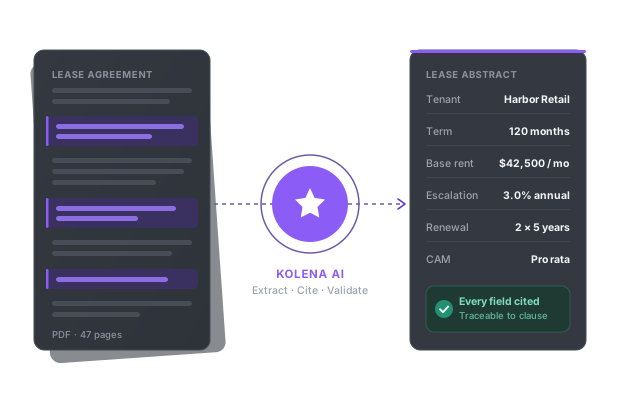
AI abstracts the lease against your own template, follows the amendment chain to the controlling clause, and cites every extracted value to its exact location. One commercial real estate firm using Kolena captured about $100,000 in efficiency gains across just 58 leases by extracting key provisions and verifying terms this way. The broader pattern is well documented: MIT's Project NANDA study (Aug 2025) found early enterprise AI is predominantly replacing offshore work, with firms eliminating $2–10M in annual BPO spend.
| Factor | Offshore BPO | AI (Kolena) |
|---|---|---|
| Turnaround | 2–5 business days per batch | Minutes per lease |
| Cost model | $5–$100 per lease; rises ~9.5%/yr with wages | Software cost; flat as volume scales |
| Amendment chaining | Often processed out of sequence or in isolation | Chained to the controlling clause automatically |
| US clause handling | Varies by analyst and tenure | Applied consistently on every lease |
| Custom template fit | Standard abstraction form by default | Your exact template and fields |
| Citations | Values without source references | Field-level citation to the exact clause |
| Data residency | Offshore | Onshore, SOC 2 Type II |
The consistency point matters most at portfolio scale: AI applies the same rubric to lease 1 and lease 5,000, where an offshore bench introduces variance every time it rotates.
Who Should Make the Switch — and Who Shouldn't
Switch when lease volume is recurring, when amendments are common, when you need your own template populated, or when deal and audit timelines make multi-day turnaround costly. Offshore can still be reasonable if your volume is genuinely tiny and one-off, or if you value fully handing the process to a vendor and never touching the tooling. Many firms run both: AI for the high-volume, structured abstraction and expert humans for a handful of genuinely unusual, judgment-heavy leases.
Related articles: ai vs offshore kyc bank statement analysis and genpact alternative.
How Kolena Works
Kolena is an AI document automation platform built for commercial real estate teams. Leases, amendments, estoppels, and rent rolls go in; structured, abstraction-ready data against your template comes out, in minutes, with the amendment chain resolved to the controlling clause.
It reads any format — PDFs, scans, emails — and pushes structured output into Yardi, MRI, and your data warehouse, with every field cited to its exact location in the lease. Every run produces a full audit trail: not just what was extracted, but the specific clause, line, or figure that justified each data point. SOC 2 Type II certified, onshore processing, no training on customer data.