For banks and lenders in 2026, AI is the better answer for KYC review and bank statement analysis: an AI platform extracts identity, ownership, and cash-flow data with documented, traceable reasoning and keeps sensitive PII onshore, where offshore processing produces outputs without an audit-ready decision trail and adds data-residency exposure. Offshore KYC support still works for low-risk, low-volume review, but BSA/AML audit requirements, PII sensitivity, and statement format variance favor AI.
This compares the two models for commercial banks, community banks, credit unions, and fintech lenders.
This is part of a series of articles about BPO Replacement.
What Offshore KYC and Bank Statement Analysis Typically Looks Like
Offshore KYC and statement analysis is a recognized KPO market. Providers staff trained analysts who review identity documents, beneficial ownership and entity structures, and OFAC/PEP screening, and read 12–24 months of bank statements to extract income, cash-flow patterns, NSFs, and financial-health indicators, typically per-FTE with cost reductions commonly cited up to 30%. For an institution facing rising compliance load, it adds review capacity without onshore hiring. One caveat the market itself stresses: you can outsource the work, but not the responsibility — accountability for the compliance decision stays with the institution.
Nine free AI document tools — pick your workflow
Where the Offshore Model Falls Short for KYC and Statement Analysis
The gaps are specific and compliance-critical. Regulatory audit trail: BSA/AML supervision requires documented decision logic — why a customer was cleared or escalated — and manual offshore review tends to produce an output without traceable reasoning back to the source document. Data residency: KYC files and bank statements are dense with sensitive PII, and offshore-jurisdiction handling creates compliance exposure that examiners increasingly probe. Bank statement format variance: every bank formats statements differently, and an offshore team calibrated to common layouts misses or misreads the others, weakening cash-flow analysis. Attrition of 15–30% turns over knowledge of your risk rubric roughly quarterly, and wage inflation near 9.5% a year erodes the cost case.
How AI Compares
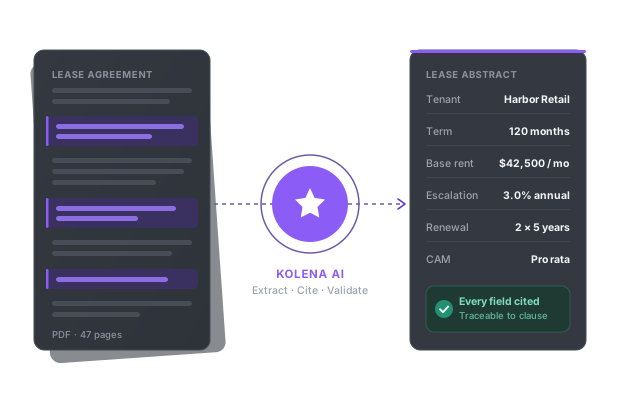
AI extracts KYC and statement data with a field-level citation behind every value — an audit-ready basis for each decision — reads any bank's statement format, and keeps PII onshore. That directly addresses the BSA/AML documentation and data-residency pressures the offshore model strains against. The broader shift is documented: HFS Research found three in four enterprise leaders expect to pivot from staff-augmentation to AI-led delivery within two years.
| Factor | Offshore BPO | AI (Kolena) |
|---|---|---|
| Audit trail (BSA/AML) | Outputs without documented reasoning | Field-level citation behind every value |
| Data residency / PII | Offshore-jurisdiction exposure | Onshore, SOC 2 Type II |
| Statement format variance | Calibrated to common layouts | Reads any bank's statement format |
| Consistency | Varies by analyst (15–30% attrition) | Same risk rubric every review |
| Turnaround | Per-FTE queue, time-zone lag | Minutes |
| Cost model | Per-FTE; rises with wages | Software cost; flat as volume scales |
The audit trail is the decisive factor: because you can't outsource the compliance responsibility, a documented, traceable basis for each decision — which AI produces and manual offshore review often doesn't — is what stands up to examination.
Who Should Make the Switch — and Who Shouldn't
Switch when BSA/AML audit-trail requirements are strict, when PII data residency is a compliance concern, or when statement format variance slows your team. Offshore can still fit very low-volume, low-risk review at a small institution. AI handles extraction and the documented evidence trail; the compliance decision — clear, escalate, or file — stays with your BSA/AML officers, who remain accountable.
Related articles: genpact alternative and ai vs offshore loan underwriting.
How Kolena Works
Kolena is an AI document automation platform built for commercial banks, community banks, credit unions, and fintech lenders. Identity documents, beneficial-ownership and entity records, OFAC/PEP materials, and 12–24 months of bank statements go in; extracted identity, ownership, and cash-flow data — income, NSFs, financial-health indicators — comes out in minutes.
It reads any bank's statement format and pushes structured output into your core and compliance systems, keeping PII onshore, with every value cited to its source for a BSA/AML-ready audit trail. Every run produces a full audit trail: not just what was extracted, but the specific clause, line, or figure that justified each data point. SOC 2 Type II certified, onshore processing, no training on customer data.