For commercial lenders working to credit-committee deadlines, AI is now the better answer in 2026: an AI platform assembles an underwriter-ready loan file in hours with cited extraction, where an offshore team runs a 24–48-hour queue and processes each document in isolation. Offshore underwriting support still makes sense for steady, low-urgency volume, but when deals are on a clock and documents must be cross-referenced as one package, AI wins.
This compares the two models for private lenders, CRE lenders, and balance-sheet banks deciding how to staff loan-file document review.
This is part of a series of articles about BPO Replacement.
What Offshore Loan Underwriting Support Typically Looks Like
Offshore underwriting support is an established, capable model. Providers staff analysts who read borrower financials, rent rolls, T12s, entity documents, appraisals, and environmental reports and assemble them into an underwriting package, billed either per-FTE or per-loan (flat fees commonly in the $400–$600 range per closed loan are typical in the broader processing market), with turnaround usually a day or two per file. Offshore labor runs roughly a third of US cost, so for a lender that wants to flex capacity without hiring, it delivers real savings and removes the need to invest in tooling.
Nine free AI document tools — pick your workflow
Where the Offshore Model Falls Short for Loan Underwriting
Two failure modes are specific to loan files. First, time sensitivity: credit committees meet on fixed dates, and a 24–48-hour offshore queue — longer at month-end — can mean a file misses the meeting and the deal slips. Second, multi-document cross-referencing: a sound underwriting package requires reconciling the rent roll against the T12, the entity docs against the borrower financials, the appraisal against the actuals. Offshore teams typically process each document in isolation, so the cross-checks that catch problems happen late, back onshore, with your underwriters. Add 15–30% offshore attrition turning over knowledge of your credit template roughly quarterly, and wage inflation near 9.5% a year, and the model gets slower and pricier exactly where speed matters.
How AI Compares
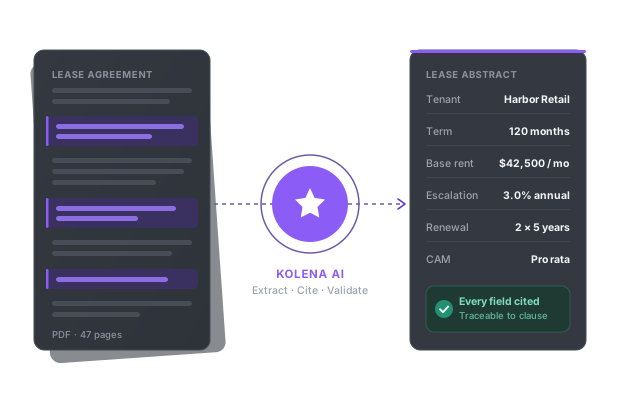
AI reads the entire loan file as one connected package, cross-references the documents, and returns an underwriter-ready output with every figure cited to its source. The impact is concrete: one private-lending customer using Kolena cut UCC filing review labor by 96% and took loan-file turnaround from about five days to hours. The market is moving the same direction — HFS Research found three in four enterprise leaders expect to pivot from staff-augmentation to AI-led delivery within two years.
| Factor | Offshore BPO | AI (Kolena) |
|---|---|---|
| Turnaround | 24–48 hours per file, longer at peak | Hours, against committee deadlines |
| Cost model | Per-FTE or per-loan; rises with wages | Software cost; flat as volume scales |
| Cross-referencing | Documents processed in isolation | Whole file read as one connected package |
| Surge capacity | Limited by staffed bench | No fixed ceiling |
| Citations | Summary values, limited sourcing | Field-level citation to each source document |
| Data residency | Offshore | Onshore, SOC 2 Type II |
For a lender, the cross-referencing and the citation together are what turn AI output into something an underwriter can sign off on without re-deriving it.
Who Should Make the Switch — and Who Shouldn't
Switch when deals are time-sensitive, when volume surges with the rate cycle, or when you need cross-referenced, cited files your underwriters can trust. Offshore can still fit a lender with steady, predictable, low-urgency volume and a strong tolerance for managing a remote team. Note too that AI handles the extraction and packaging; the credit decision itself stays with your underwriters — AI just gets them a clean, sourced file faster.
Related articles: offshore vs onshore document processing and genpact alternative.
How Kolena Works
Kolena is an AI document automation platform built for commercial lenders and credit teams. Borrower financials, rent rolls, T12s, entity documents, appraisals, and environmental reports go in; an underwriter-ready package with cross-referenced data comes out in hours.
It reads any format and pushes structured output into your loan-origination and spreading systems, with every figure cited to its source document so credit committee sees sourced numbers. Every run produces a full audit trail: not just what was extracted, but the specific clause, line, or figure that justified each data point. SOC 2 Type II certified, onshore processing, no training on customer data.