Genpact is one of the most capable managed services and BPO firms in financial services and insurance. That's exactly why it's not the right fit for most of the organizations currently looking for a Genpact alternative.
The firms researching alternatives are typically mid-market — commercial real estate operators, private lenders, regional carriers, MGAs, and investment managers with 50 to 2,000 employees. They need enterprise-grade document automation for lease abstraction, loan underwriting, claims processing, or due diligence. What they can't absorb is a multi-year managed services engagement, a six-month implementation, and a contract built for a Fortune 500 procurement process.
This is part of a series of articles about BPO Replacement.
What Genpact Does
Genpact is a global professional services company that has evolved from its origins as a GE back-office unit into one of the largest BPO and technology services providers in the world. They are a 2025 Gartner Magic Quadrant Leader in Finance and Accounting BPO, and a recognized leader in insurance business process services across Everest Group's PEAK Matrix assessments.
Their services span finance and accounting outsourcing, banking operations, insurance claims and underwriting support, procurement, and supply chain — delivered through a combination of offshore teams (primarily in India) and, increasingly, AI-powered automation layered on top of managed services delivery.
In 2025 Genpact launched the Genpact Insurance Policy Suite, built on Microsoft Azure AI Foundry, targeting commercial and specialty insurance underwriting. They claim up to 90% touchless submission clearance, a 75% reduction in manual cycle times, and 50% lower costs. For the insurers it's designed for — large carriers and reinsurers with the procurement infrastructure to evaluate and onboard a Genpact engagement — it is a serious product.
Nine free AI document tools — pick your workflow
The Mid-Market Problem
The issue for most organizations researching a Genpact alternative isn't Genpact's capability. It's the delivery model and what it costs to access that capability.
Genpact's engagement model is managed services: they staff, manage, and deliver a business process on your behalf, typically under a multi-year contract. Even with AI automation embedded in that delivery, you are buying a service, not a platform. The sales cycle runs months. Implementation runs months more. The contract requires a procurement process that most mid-market organizations don't have.
Three structural consequences follow from this model regardless of how much AI Genpact layers on top:
You're still paying for the delivery infrastructure. A managed services contract prices in the team, the management layer, the account infrastructure, and the overhead of running an offshore operation — not just the processing. A mid-market firm paying for lease abstraction or loan file review is funding capacity it may not use consistently.
Implementation time is fixed by the model, not the technology. Deploying a Genpact engagement involves scoping, SLA negotiation, team onboarding, workflow documentation, and governance setup. That timeline doesn't compress to days regardless of how fast the underlying AI is.
Switching cost is high. A managed services contract with embedded process ownership creates dependency. The institutional knowledge of how your workflows run lives inside the Genpact delivery team. Exiting requires rebuilding that context somewhere else.
How a Pure AI Platform Compares
A purpose-built AI document platform doesn't replace the managed services model — it operates differently by design.
Genpact (managed services) | Pure AI platform | |
|---|---|---|
Market served | Enterprise (Fortune 500, large carriers, global banks) | Mid-market (50–2,000 employees) |
Implementation | Months; scoping, SLA negotiation, team onboarding | Days to weeks; configure rubric, connect integrations |
Contract model | Multi-year managed services; staffing embedded in delivery | Platform subscription; no staffing dependency |
AI layer | AI embedded in managed services delivery | AI is the delivery mechanism; no staffing underneath |
Audit trail | Workflow-level SLA and process reporting | Field-level citations to exact source document location |
Volume flexibility | Contracted capacity; surge requires renegotiation | Scales with volume automatically |
Data residency | Offshore delivery (India primary) | Onshore processing |
Switching cost | High; institutional knowledge lives in delivery team | Low; rubrics and integrations are yours |
What the Workflow Difference Looks Like in Practice
Take loan underwriting document review — one of Genpact's core financial services offerings. In a Genpact managed services model, your loan files move to an offshore team that reviews them against a documented process, produces outputs, and reports against SLAs. The process is managed; the output is delivered.
In a pure AI platform, you configure an agent with your underwriting rubric — the specific fields you need extracted from tax returns, rent rolls, UCC filings, and entity documents. The agent processes each file and returns a structured output with every field cited to its source: the specific line on the specific page where it was found. No offshore team, no SLA negotiation, no capacity ceiling. Volume doubles on a specific week because a deal closes — the agent processes the same day.
The same principle applies to lease abstraction for commercial real estate operators, claims triage for insurance carriers and MGAs, and IC memo generation for investment managers. The workflows Genpact handles at enterprise scale, a mid-market organization can now run on a platform subscription with a two-week setup.
Related articles: resourcepro alternative and exl service alternative.
When Genpact Is the Right Answer
The point of this comparison isn't that Genpact is the wrong choice — it's that it's the wrong choice for a specific segment. If you are a large carrier with a multi-line insurance operation, a global bank with complex F&A outsourcing needs, or an organization with the procurement infrastructure to manage a multi-year vendor engagement, Genpact's depth of process expertise and scale of delivery is a genuine advantage.
If you are a mid-market commercial real estate operator, a private lender, a regional carrier, an MGA, or an investment manager who needs document automation that deploys in weeks, scales with your deal flow, and doesn't require a dedicated vendor management function — a purpose-built AI platform is the right category.
How Kolena Works
Kolena is an AI document automation platform built for mid-market organizations in commercial real estate, lending, insurance, and financial services that need enterprise-grade document processing without the enterprise-grade managed services contract.
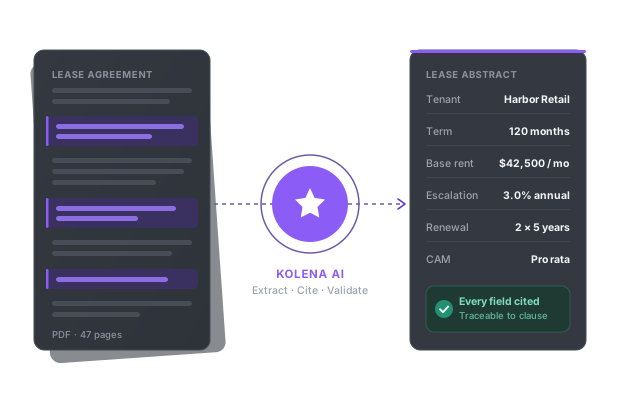
Rather than staffing a team to handle your lease abstractions, loan file reviews, claims documents, or IC memos, Kolena deploys AI agents that read your documents, apply your specific rubric or extraction template, and return structured outputs — with every field cited to its exact location in the source document.
Setup takes days. Kolena connects to the systems your team already uses — CRM, ERP, data platforms — so output flows directly downstream without re-entry. Every run produces a full audit trail: not just what was extracted, but the specific clause, line, or figure in the source document that justified each data point. SOC 2 Type II certified, onshore processing, no training on customer data.
For organizations that got a Genpact quote and found the engagement model out of reach, Kolena delivers the same document automation capability as a platform subscription that scales with your actual volume.