For mortgage lenders, community banks, and credit unions in 2026, AI is the better answer for mortgage document processing: an AI platform extracts data from 1003s, income documents, tax returns, bank statements, appraisals, and title commitments in minutes under hard TRID timelines, onshore, where offshore batching risks SLA misses and PII exposure. Offshore mortgage processing still works for steady baseline volume, but compliance deadlines, PII sensitivity, and rate-cycle volume swings favor AI.
This is a direct comparison of the two models for residential and commercial mortgage origination.
This is part of a series of articles about BPO Replacement.
What Offshore Mortgage Document Processing Typically Looks Like
Offshore mortgage processing is a large, mature market. Providers staff teams that review 1003 and 1008 forms, collect and verify income documentation, tax returns, bank statements, appraisals, and title commitments, and assemble the loan file — with offshore labor running roughly a third of US cost and commonly cited savings of 30–70%. For a lender managing high, routine document volume, it removes a heavy clerical burden and flexes capacity without onshore hiring.
Nine free AI document tools — pick your workflow
Where the Offshore Model Falls Short for Mortgage Processing
Three failure modes are specific to mortgage files. Regulatory compliance timelines: RESPA and TRID impose hard SLA deadlines on disclosures, and an offshore batch queue — especially across time zones — can push a file past a deadline, creating compliance and cure-cost exposure. PII sensitivity: mortgage files are dense with SSNs, income, and financial data, and offshore processing puts that PII in another jurisdiction, a growing data-residency concern. Volume variability: mortgage volume surges and collapses with the rate cycle, and an offshore bench sized for one regime can't absorb a refi wave or carries idle cost in a slow one. Attrition of 15–30% and wage inflation near 9.5% a year erode consistency and savings over time.
How AI Compares
AI extracts and verifies mortgage-file data in minutes, scales instantly with rate-cycle volume, and keeps PII onshore with a documented audit trail — so TRID deadlines are easier to hold and data-residency exposure drops. The broader shift is documented: MIT's Project NANDA study (Aug 2025) found early enterprise AI is predominantly replacing offshore work, with firms eliminating $2–10M in annual BPO spend.
| Factor | Offshore BPO | AI (Kolena) |
|---|---|---|
| Turnaround vs. TRID/RESPA SLAs | Batch queue risks deadline misses | Minutes, easing SLA compliance |
| PII / data residency | Offshore jurisdiction exposure | Onshore, SOC 2 Type II |
| Surge capacity | Bench can't absorb refi waves | Scales instantly with rate cycle |
| Consistency | Varies by analyst (15–30% attrition) | Same extraction rubric every file |
| Citations / audit trail | Outputs without traceable sourcing | Field-level citation to each document |
| Cost model | Per-FTE/per-loan; rises with wages | Software cost; flat as volume scales |
For mortgage, the PII-onshore point and the SLA speed are what reduce regulatory exposure while keeping pipelines moving.
Who Should Make the Switch — and Who Shouldn't
Switch when TRID/RESPA deadlines are tight, when PII data residency is a compliance concern, or when rate-cycle volume swings strain a fixed offshore bench. Offshore can still fit a lender with low, stable volume and a high tolerance for managing remote teams. AI handles extraction, verification, and file assembly; the underwriting and approval decisions stay with your loan officers and underwriters.
Related articles: ai vs offshore kyc bank statement analysis and genpact alternative.
How Kolena Works
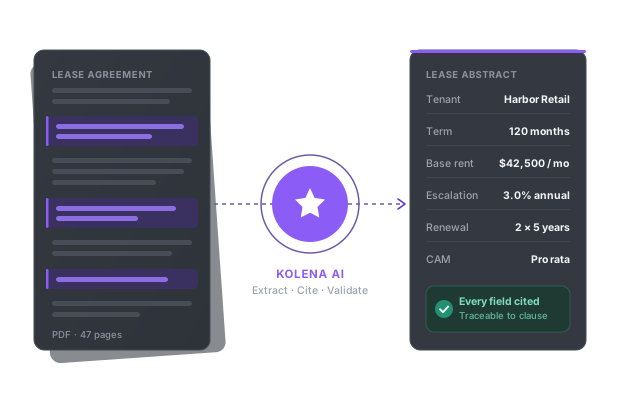
Kolena is an AI document automation platform built for mortgage lenders, community banks, and credit unions. 1003 applications, income documentation, tax returns, bank statements, appraisals, and title commitments go in; a verified, structured loan file comes out in minutes.
It reads any format and pushes structured output into your LOS, keeping PII onshore, with every field cited to its source document for a compliance-ready audit trail. Every run produces a full audit trail: not just what was extracted, but the specific clause, line, or figure that justified each data point. SOC 2 Type II certified, onshore processing, no training on customer data.