Offshore document processing was the cost-efficient answer for decades. A lower per-hour labor rate, a large trained workforce in India and the Philippines, and the ability to scale without hiring internally made the case straightforward. In 2026, that case is harder to make — not because offshore teams have gotten worse, but because the comparison itself has changed.
AI document platforms now handle the workflows that offshore teams were hired for: lease abstraction, loan file review, claims triage, policy checking, underwriting submission processing. The question for any organization still running these workflows through BPO contracts is whether the cost, quality, speed, and compliance profile of the offshore model still compares favorably when set against what an AI-native platform delivers. This article makes that comparison directly.
This is part of a series of articles about BPO Replacement.
Cost: The Narrowing Advantage
The offshore cost advantage was built on a wage arbitrage that is materially smaller than it was five years ago. India's median salary increase held at 9.5% in both 2024 and 2025, per WTW's Salary Budget Planning Report. That rate of increase, compounded over several years, has substantially closed the gap between offshore labor costs and the fully-loaded cost of onshore alternatives — including AI platforms.
The offshore cost model also carries structural costs that don't appear in the per-FTE rate: a management and coordination layer to oversee offshore teams, a quality control function to catch errors before they reach internal stakeholders, rework cycles when outputs need correction, and the ongoing cost of onboarding as teams turn over. Offshore attrition in non-voice document processing roles runs at 15–30%, meaning institutional knowledge about a client's specific document formats, rubrics, and edge cases turns over roughly quarterly.
An AI platform's cost structure is different. A subscription rate applies regardless of volume. Processing twice the COIs or three times the loan files during a surge period costs the same as a slow week. There is no management layer, no QC team, no rework cycle — the platform either returns a correct, cited output or it flags the document for human review. The MIT Project NANDA research published in August 2025 documented this economics directly: firms studied eliminated $2–10 million in annual BPO expenditure after deploying AI; one organization saved approximately $8 million per year after spending $8,000 on an AI tool.
Nine free AI document tools — pick your workflow
Quality: Consistency vs. Variability
Quality in document processing has two distinct components: accuracy on any given document, and consistency across thousands of documents processed by a rotating team over time.
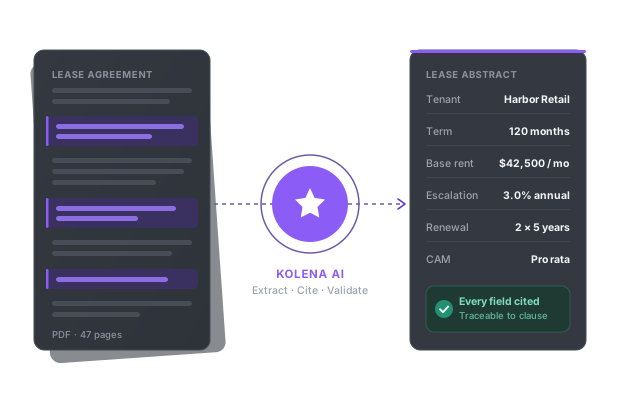
On accuracy, a well-configured AI document agent and a well-trained offshore specialist can produce comparable results on standard document types. The meaningful quality difference is in what comes back with the output. An AI platform returns field-level citations — every extracted value is linked to the exact location in the source document where it was read. A human-processed output returns the data; it does not tell you where in the document it was found or why that value was selected over another.
On consistency, the offshore model has a structural challenge that has nothing to do with the quality of individual analysts. Offshore document teams rotate. Senior analysts move on; new team members onboard. A client's specific edge cases, exceptions, and rubric nuances are re-learned by each incoming cohort. An AI platform applies the same extraction logic on the ten-thousandth document as it did on the first. When a systematic error exists, it is predictable and correctable. When variance exists in an offshore team, it is random and harder to detect at scale.
Speed: The Gap Has Widened
Standard offshore document processing turnaround is 24–48 hours for routine documents; 2–4 days for complex files with multiple amendments or attachments. Those turnarounds reflect shift coverage, queue depth, and coordination overhead that are inherent to staffing-based delivery.
An AI document platform returns outputs in minutes. For commercial lease abstraction — which offshore providers typically turn around in 2–5 days at $5–$100 per lease — the AI equivalent runs in under 5 minutes per document with the same structured output. For loan file review where a credit committee needs results before end of business, the difference between a 24-hour offshore queue and a same-hour AI output is a material business decision, not a convenience.
The speed gap widens further during surge events. A CAT event that doubles or triples claims intake volume requires offshore providers to deploy backup staff — a process with its own lead time and quality variance. An AI platform processes surge volume at the same speed and accuracy as baseline volume, with no advance planning.
Risk and Compliance: The Case for Onshore
Data residency has moved from a compliance checkbox to an active underwriting and regulatory concern. US insurers with state regulatory frameworks, banks subject to OCC and FDIC data governance requirements, and commercial real estate firms handling sensitive tenant and borrower data all face increasing scrutiny over where document data is processed and stored. Offshore processing — by definition routing documents through India, the Philippines, or other offshore jurisdictions — creates a data residency exposure that onshore AI processing eliminates.
Globally, the EU AI Act's high-risk classification for credit scoring and insurance pricing AI systems (Annex III) requires full audit trails, explainability, and documented decision logic for organizations with EU operations — obligations that come into full effect through 2026–2027. While primarily a European regulation, it is shaping audit trail expectations globally: organizations that cannot produce a field-level record of why a document was processed a certain way are increasingly finding that expectation in their client contracts, regardless of jurisdiction.
The attrition risk compounds the compliance exposure. When the offshore analyst who knew your document rubric leaves the firm, the institutional knowledge goes with them. An AI platform's logic is documented in the configuration itself — it doesn't walk out the door.
Related articles: genpact alternative and resourcepro alternative.
Side-by-Side Comparison
| Dimension | Offshore BPO | Onshore AI platform |
|---|---|---|
| Cost structure | Per-FTE; rises with volume and wage inflation | Subscription; volume-independent |
| Wage trajectory | India +9.5%/yr (WTW 2024–2025) | Fixed platform cost; no wage exposure |
| Turnaround | 24–48 hours typical; 2–4 days complex | Minutes |
| Surge handling | Staff deployment; advance planning required | No capacity ceiling; automatic |
| Audit trail | Process-level SLA reporting | Field-level citations to source document |
| Consistency | Varies with team rotation and attrition (15–30%) | Same rubric applied on every document |
| Data residency | Offshore jurisdiction (India, Philippines) | Onshore; no offshore data transfer |
| Training on your data | Varies by contract | No training on customer data |
| Institutional knowledge risk | High; turns over with team attrition | Documented in platform configuration |
When Offshore Still Makes Sense
Offshore BPO retains advantages in specific scenarios. For highly judgment-intensive work that doesn't reduce to structured extraction — complex coverage disputes, nuanced legal analysis, relationship-intensive underwriting conversations — human expertise at offshore labor rates remains cost-effective. For organizations that need a broad range of back-office functions (not just document extraction) under a single vendor relationship, a multi-tower BPS contract with a firm like Genpact, EXL, or the new Capgemini-WNS entity still makes sense at enterprise scale.
The offshore model is weakest where volume is high, document types are standardized, audit trail depth matters, and cost-per-document is a visible line item. That profile covers the majority of document processing in insurance, lending, commercial real estate, and financial services — which is why the shift toward AI platforms in these verticals is happening as fast as it is.
How Kolena Works
Kolena is an onshore AI document automation platform built for the document-heavy workflows that organizations in insurance, lending, commercial real estate, and financial services currently run through offshore BPO teams. Rather than routing documents to an offshore workforce, Kolena deploys AI agents that read documents, apply a customer-specific rubric or extraction template, and return structured outputs — with every field cited to its exact location in the source document.
The platform handles any format: PDFs, scans, emails, spreadsheets, images. It integrates directly with the systems already in use — AMS, ERP, CRM, data platforms — so output flows downstream without re-entry. Every run produces a full audit trail stored indefinitely: not just what was extracted, but the specific clause, line, or figure that justified each data point. SOC 2 Type II certified, onshore processing, no training on customer data. For organizations evaluating their next offshore contract renewal, Kolena is the comparison case that changes the economics of that decision.