For managing general agents in 2026, AI is the better answer for submission intake: an AI platform reads ACORD forms, supplemental applications, and prior-carrier loss runs and builds a structured underwriting file in minutes, where offshore batching creates queue delays that lose business to faster-responding competitors. Offshore intake still works for low submission volume, but the spikes, ACORD form variance, and need for fast declinations that define MGA intake favor AI.
This is a direct comparison of the two models for MGAs, program underwriters, and specialty insurers.
This is part of a series of articles about BPO Replacement.
What Offshore MGA Submission Intake Typically Looks Like
Offshore submission-intake outsourcing is a well-developed service. Providers staff teams that receive new submissions, read ACORD forms and supporting documents, validate and clear them, and prepare a structured pre-underwriting file, usually on a per-FTE or per-submission basis. For an MGA that wants to keep underwriting authority while offloading the clerical front end, it cuts cycle time versus doing intake manually in-house and gives a flexible team for submission preparation.
Nine free AI document tools — pick your workflow
Where the Offshore Model Falls Short for Submission Intake
The pain points are specific to MGA intake. Submission volume spikes: MGAs receive hundreds of submissions in bursts, and offshore batching turns a spike into a queue — while a submission sits in that queue, a faster-responding competitor quotes first and wins the business. ACORD form variance: ACORD 125, 126, 130, 140 and others carry field variations, and an offshore team trained primarily on one form misses or mishandles fields on the others. Declination speed: fast declinations matter as much as fast quotes — a submission you can't write should be cleared quickly so the broker moves on with goodwill intact, and offshore lag holds up both approvals and declinations. Attrition of 15–30% and wage inflation near 9.5% a year erode the form-handling consistency and cost advantage over time.
How AI Compares
AI reads every ACORD form variant and the supporting documents, builds the structured underwriting file in minutes, and flags clearance issues instantly — so volume spikes don't create a queue and declinations move as fast as quotes. The broader shift toward AI-led intake is well documented: MIT's Project NANDA study (Aug 2025) found early enterprise AI is predominantly replacing offshore work, with firms eliminating $2–10M in annual BPO spend.
| Factor | Offshore BPO | AI (Kolena) |
|---|---|---|
| Volume spikes | Batching creates queues; lost business | Absorbs hundreds of submissions at once |
| ACORD form variance | Calibrated to common forms; misses others | Reads ACORD 125/126/130/140 and supplements |
| Quote/declination speed | Queue lag delays both | Minutes for both |
| Consistency | Varies with team rotation | Same intake rubric every submission |
| Citations | Re-keyed fields, limited sourcing | Field-level citation to the form |
| Data residency | Offshore | Onshore, SOC 2 Type II |
For an MGA, response speed is competitive position: AI turning intake in minutes means you quote — or decline — before the broker's other markets do.
Who Should Make the Switch — and Who Shouldn't
Switch when submission volume is high or spiky, when you handle many ACORD variants, or when response speed is costing you broker business. Offshore can still fit an MGA with low, steady submission flow and a narrow product set. AI handles intake, clearance, and file preparation; the underwriting authority and risk decision stay entirely with your underwriters.
Related articles: ai vs offshore kyc bank statement analysis and genpact alternative.
How Kolena Works
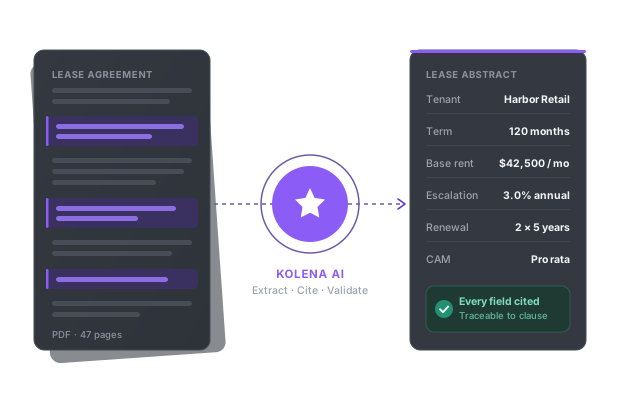
Kolena is an AI document automation platform built for managing general agents and program underwriters. ACORD forms, supplemental applications, prior-carrier loss runs, and supporting documents go in; a structured, clearance-checked underwriting file comes out in minutes.
It reads any submission format and pushes structured output into your underwriting and policy-admin systems, with every field cited to the ACORD form or document it came from. Every run produces a full audit trail: not just what was extracted, but the specific clause, line, or figure that justified each data point. SOC 2 Type II certified, onshore processing, no training on customer data.