Insurance operations teams that have built workflows around ResourcePro — COI processing, endorsements, renewals, direct bill, assistant underwriting — are increasingly asking whether a staffing-at-scale model is the right foundation for the next decade of their business. The answer isn't that ResourcePro doesn't work. It's that the model it runs on is being structurally displaced by AI platforms that separate cost from headcount.
This is part of a series of articles about BPO Replacement.
What ResourcePro Does
ResourcePro is one of the largest insurance-focused BPO firms in the world. With more than 10,000 employees serving over 1,800 carriers, brokers, and MGAs, it has earned recognition as a Leader in the ISG Provider Lens™ 2024 Quadrant Report for P&C Insurance BPO Services — and a 96%+ client retention rate held for over a decade. Insurance is their only industry. Their services cover the full back-office stack: certificates of insurance, endorsements, renewals, policy checking, direct bill processing, assistant underwriting, and accounting support.
ResourcePro has invested in AI tooling — products like Policy Insights ExpressCheck™ and Direct Bill Complete apply AI to specific workflows — but the delivery model remains humans at the center: a global staffing operation where technology accelerates what people do rather than replacing the staffing layer itself.
For insurance organizations that need reliability, scale, and insurance-specific expertise, ResourcePro has been a defensible choice for a long time. The question being asked now is whether that choice still makes sense when the cost model is tied to headcount rather than outcomes.
Nine free AI document tools — pick your workflow
The Structural Limit of Per-FTE Billing
ResourcePro's 96% retention record reflects genuine operational quality. The issue isn't execution — it's what the execution model costs as a function of volume, and what it structurally can't deliver regardless of team size.
Cost scales with volume, not with value. In a per-FTE staffing model, processing twice the COI volume costs roughly twice as much. An AI platform processes twice the volume at the same subscription cost. For insurance operations with seasonal surge (CAT events, renewal cycles, acquisition growth), that difference compounds. During slow periods, the staffing cost doesn't fall proportionally — billing continues against contracted capacity. During surge, additional capacity requires advance planning, hiring, and ramp time.
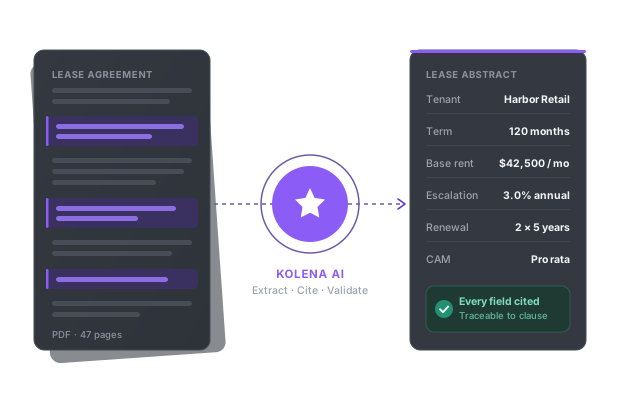
No field-level audit trail at any scale. ResourcePro's delivery produces workflow outputs — tasks completed, SLAs met, throughput reported. An AI document agent produces outputs with citations: every extracted field — policy number, coverage limit, effective date, exclusion clause — is linked to the exact location in the source document where it was read. For organizations with carrier audit requirements, state regulatory frameworks, or compliance infrastructure being built, the difference between "we processed it" and "here's the exact clause we read to generate this field" is a structural requirement, not a preference.
Data processed offshore at scale. ResourcePro's global workforce processes documents primarily offshore. For carriers and MGAs with data residency requirements or carrier agreements that restrict offshore handling of policyholder data, that remains a constraint regardless of how large or well-run the offshore operation is.
How They Compare
| ResourcePro (staffing at scale) | Pure AI platform | |
|---|---|---|
| Cost model | Per-FTE; cost scales with volume; billing continues during slow periods | Platform subscription; volume-independent cost |
| Processing speed | 24–48 hours typical; 2–4 days for complex work | Minutes |
| Audit trail | Workflow-level SLA and throughput reporting | Field-level citations to exact source document location |
| CAT / surge handling | Advance staffing and capacity planning required | No capacity ceiling; no advance planning needed |
| Data processing | Offshore (global workforce) | Onshore |
| AI capability | AI tools embedded in staffing delivery (humans at center) | AI is the delivery mechanism; no staffing layer underneath |
| Training on your data | Check contract terms | No training on customer data |
| Insurance focus | Insurance-only | Insurance, commercial RE, banking, financial services |
What Changes With a Pure AI Platform
The most significant shift isn't speed — it's the relationship between cost and volume. When processing 500 COIs and processing 5,000 COIs cost the same subscription rate, the economics of insurance operations change structurally. Decisions about which workflows to automate are no longer constrained by headcount planning. CAT event surge doesn't require a staffing conversation. Growth through acquisition doesn't require proportional BPO contract expansion.
The second shift is in what comes back. ResourcePro's delivery model is optimized for throughput and SLA compliance. An AI document platform is optimized for cited, traceable output — every data point sourced to the document it came from. For MGAs building compliance infrastructure, carriers responding to regulatory audits, or brokers who need to reconstruct what was read from which document, that's not a nice-to-have.
Related articles: genpact alternative and exl service alternative.
How the Transition Works
ResourcePro's 96% retention rate reflects real switching costs: embedded SOPs, account teams, escalation paths, system integrations. The transition isn't a single event — it's a series of workflow-by-workflow decisions made at contract renewal.
- Start with one standardized, high-volume workflow. COI processing and endorsements are the natural starting points — well-defined inputs and outputs, easy to run a parallel POC without disrupting the ResourcePro relationship or existing SLAs.
- Compare on the right metrics. Turnaround time and accuracy matter, but the metrics that change the commercial decision are cost per document, audit trail depth, and CAT-period performance — not just whether the AI demo looks good.
- Build the case for the next renewal. ResourcePro contracts have renewal cycles. A parallel POC on one workflow gives you the data to make a grounded commercial decision before the next renewal rather than defaulting to continuation because the alternative feels risky.
Most organizations replace one workflow at a time over one to two contract cycles. The goal is a data-driven decision at renewal, not an overnight disruption of an operation that's been running reliably for years.
How Kolena Works
Kolena is an AI document automation platform built for the insurance back-office workflows that carriers, brokers, and MGAs currently run through BPO teams. Rather than staffing a team to process your certificates, endorsements, renewals, and policy documents, Kolena deploys AI agents that read your documents, apply your specific rubric or extraction template, and return structured outputs — with every field cited to its exact location in the source document.
The platform handles any document format: PDFs, scans, emails, spreadsheets, images. It integrates directly with the AMS, CRM, and data systems your team already uses — Applied Epic, AMS360, Vertafore, and others — so output flows into existing workflows without re-entry. Every run produces a full audit trail: not just what was extracted, but the specific clause, line, or table in the source document that justified each data point.
For insurance operations currently running through ResourcePro, the practical transition point is whichever workflow has the highest volume and the most standardized document types — typically COI processing or endorsements. Setup for a focused workflow takes days. Kolena is SOC 2 Type II certified, processes data onshore, and never trains on customer data, satisfying the data residency and audit requirements that make offshore BPO models problematic for regulated insurers.
Frequently asked questions
How does ResourcePro's AI compare to a pure AI document platform?
ResourcePro's AI tools — like Policy Insights ExpressCheck and Direct Bill Complete — apply AI within a staffing delivery model where humans remain at the center. A pure AI platform replaces the staffing layer entirely: there's no offshore team underneath the automation, no per-FTE billing, and no capacity ceiling. The AI agent processes documents directly and returns structured outputs with field-level citations. The difference is in the delivery model, not just the technology layer.
How does per-FTE billing compare to a platform subscription at high volume?
In a per-FTE model, cost scales roughly linearly with processing volume — more work requires more staff, and contracted capacity is billed even during slow periods. A platform subscription decouples cost from volume: processing 500 COIs and 5,000 COIs cost the same rate. For organizations with seasonal variation, CAT exposure, or growth through acquisition, that difference compounds significantly over time.
How do you transition from ResourcePro without disrupting insurance operations?
Most organizations don't replace ResourcePro in a single move. The practical path is identifying one high-volume, standardized workflow — COI processing or endorsements — and running a parallel proof of concept while the ResourcePro relationship continues. The POC generates the cost-per-document, accuracy, and audit-trail data needed to make a grounded commercial decision at the next contract renewal, rather than defaulting to renewal because switching feels risky.
What is the audit trail difference between ResourcePro and an AI document platform?
ResourcePro's delivery produces workflow-level reporting: tasks completed, SLAs met, throughput tracked. An AI document platform produces field-level citations: every extracted value — policy number, coverage limit, exclusion clause — links to the exact location in the source document where it was read. For organizations subject to carrier audits, state regulatory requirements, or building compliance infrastructure, that difference is structural, not cosmetic.