The ROI difference between rolling out a general AI assistant like Claude and deploying purpose-built process automation is not accuracy. It is ownership. Claude reads a lease, a loan file, or a loss run very well. What a general-purpose assistant does not include is the layer around the model that a repeated, regulated workflow depends on — versioned logic, independent validation, exception routing, and an audit trail — and in a build-it-yourself deployment, your team owns all of it, permanently.
That distinction rarely shows up in a pilot. It shows up between month two and month six, when the work moves from a handful of documents reviewed by the person who set it up to hundreds of documents a month feeding decisions other people rely on.
This article covers what a general AI assistant genuinely does well for document-heavy work, where the economics diverge, and how to model the difference before committing to either path.
What Claude does well for document work
Any honest comparison starts here, because the common objection to purpose-built platforms is reasonable: capable general assistants have absorbed a lot of what used to require specialized tooling.
Read about claude mcp sharepoint documents.
Read about chatgpt mcp document workflows.
- Long-context document reading. Large context windows let a model take in a full lease with its amendments, or a complete credit file, without splitting it into fragments. For understanding one complex document deeply, this is genuinely excellent.
- Encoded expertise through Agent Skills. Skills package instructions, templates, and optional scripts into a reusable folder that the model invokes when relevant. A capable analyst can encode a real lease abstraction methodology this way.
- System connectivity through MCP. The Model Context Protocol connects assistants to document repositories and business systems. Getting files in and results out is no longer the hard part.
- Agentic execution. Products like Claude Cowork, launched in January 2026 and extended to web and mobile in July 2026, let a user hand over a multi-step task across a folder of files rather than prompting step by step. For developers, the Claude Agent SDK supports building custom agents directly.
Taken together, these are real capabilities, and a competent team can assemble something useful from them. The argument against doing so is not that it will not work. It is what happens next.
Nine free AI document tools — pick your workflow
Why the pilot succeeds and the rollout stalls
Nearly every internal AI document project succeeds at the pilot stage. Someone runs a lease through, checks the output, finds it broadly correct, and reports that it works. That report is accurate.
The pattern that follows is remarkably consistent across teams:
Around document 30, the outputs stop matching each other. One abstract records an escalation as a percentage, the next as a dollar amount, because the leases expressed it differently and no one specified which form to store. Each abstract is defensible on its own. Collectively they cannot be rolled into a portfolio view.
Around document 80, someone catches a wrong expiration date pulled from a renewal option rather than the term. The obvious next question — how many of the previous seventy-nine have the same error — cannot be answered without re-reading them.
Around document 150, the analyst who wrote the instructions takes two weeks off. Their colleague has the prompt but not the eleven refinements that live in that analyst's head, and the output shifts.
At document 400, an auditor asks why a specific file was processed the way it was. The output exists. Which version of the instructions produced it, which model version ran it, and whether anyone verified it do not.
None of these are model failures. A better model does not fix any of them.
The four costs a general assistant leaves with your team
1. The instructions become your most valuable asset, and they live nowhere
By the fourth week, a working prompt or Skill has become a serious document. It encodes your abstract template, which clauses your asset managers care about, how you treat percentage rent, your co-tenancy threshold, and which amendments override which originals. That is institutional knowledge, and it is often worth more than any individual output it produces.
In most self-built deployments it sits in one person's saved configuration with no version history, no record of who changed what, and no connection to the written policy it is meant to implement.
2. Consistency is not a prompt-engineering problem
Generating text is not the same as reading a value off a form. The same document processed twice can produce slightly different values. Across four hundred files that means measurable drift in your data — and most teams have never tested for it, so they do not know the magnitude or whether it matters.
3. Verification can cost more than extraction
Every field on an abstract or a credit summary has to be trustworthy enough to decide on. Verifying a field means locating it in a ninety-page document. Across twenty fields and four hundred files, that rebuilds the workload the project was meant to remove — unless each value carries a citation to its exact source location.
4. Maintenance is permanent and usually unassigned
Model versions change on the provider's schedule. Document formats change. A new investor guideline arrives. Each is a re-validation event: someone must prove the workflow still produces correct output before it carries real work again. In a self-built setup that responsibility belongs to your team, and in practice it is frequently assigned to no one at all.
Read about chatgpt document workflow questions.
The governance questions that decide the outcome
These are not deficiencies in a general assistant. They are design characteristics of a personal productivity tool, and they matter specifically when the work is regulated and repeated.
Who controls the logic. Custom Skills on Claude.ai are individual to each user, are not shared organization-wide, and cannot be centrally managed by administrators, per Anthropic's documentation. Skills uploaded on one surface are not automatically available on another. To get centralized, version-controlled logic, teams move to the filesystem-based developer path — which is engineering work, and returns you to the build question.
What is retained. Anthropic's documentation states that Agent Skills are not covered by zero-data-retention arrangements, and that Skill definitions and execution data are retained under standard retention policy. If your extraction logic encodes proprietary loan criteria or underwriting rules, that is a question worth raising with your security team before it becomes a production dependency rather than after.
What you can produce later. When a regulator, lender, or investor asks about one file from eighteen months ago, the answer is whatever your system recorded at the time. General assistants are not built to assemble that record, because that is not what they are for.
Related articles: chatgpt projects document analysis, chatgpt work document workflows, custom gpt document workflow, claude skills for document workflows, and claude agent sdk document automation.
Related articles: claude long context document analysis and claude cowork document workflows.
General assistant versus purpose-built platform
The useful comparison is not capability. It is what each approach leaves you responsible for.
| Dimension | Self-built on a general assistant | Purpose-built platform |
|---|---|---|
| Reads complex documents accurately | Yes | Yes |
| Who writes the extraction logic | Your analyst or developer | Built with you, from your template |
| Where that logic lives | A prompt, a Skill, or a person | Versioned configuration that doubles as policy documentation |
| Consistency across hundreds of files | Usually unmeasured | Validated independently, output structure enforced |
| Verifying a single field | Re-read the source document | Citation to the exact page and location |
| Degraded scan or contradictory amendment | Often returns a plausible answer | Flagged and routed before use |
| Error found in month three | Corrected going forward | Reprocess the period, receive a report of every changed value |
| Model version changes | Your team re-validates | Benchmarked and validated before promotion |
| Audit request on a specific file | The output | Documents, logic version, model version, citations, overrides, timestamps |
| Who owns the outcome | Your team | Shared with the vendor |
How to calculate the real ROI difference
Most build-versus-buy comparisons stop at the license cost, which is the smallest number in the model. A defensible comparison includes the full stack of costs the self-built path carries:
- Seat and usage cost — the visible line item, and usually the least significant.
- Build time — analyst or developer hours to write, refine, and stabilize the logic before it handles real work.
- Verification labor — minutes per document spent confirming values, multiplied by monthly volume. This is frequently the largest ongoing cost and the one most often omitted.
- Maintenance — hours per model change, format change, or policy update, times the frequency of each.
- Key-person risk — the cost of rebuilding if the person who owns the logic changes roles.
- Undetected error exposure — the financial consequence of a wrong value reaching a decision, times the probability that nothing catches it.
The first two favor building. The last four scale with volume and time, and they are the reason internal projects that look inexpensive in month one frequently look expensive in month twelve.
Read about ai document workflow questions.
A practical test: estimate the verification minutes per document, multiply by your monthly volume, and compare that number to the platform cost. For most teams processing more than a few hundred documents a month, verification labor alone exceeds the license.
When a general AI assistant is the right choice
Several situations do not need any of this, and it is worth being direct about them:
- Occasional review. A handful of documents a month, read by someone who knows what they are looking for.
- One-off deep analysis. A single complex document you need to understand thoroughly before a negotiation. Long-context reasoning is exactly right for this.
- Exploratory questions. Open-ended reading — what is unusual in this document — rather than structured extraction.
- Low volume. Below a few hundred documents a year, the economics of a platform generally do not clear the bar.
The dividing line is not document complexity. It is whether the work is repeatable, high-volume, and consequential enough that someone will eventually ask you to prove it.
How Kolena Works
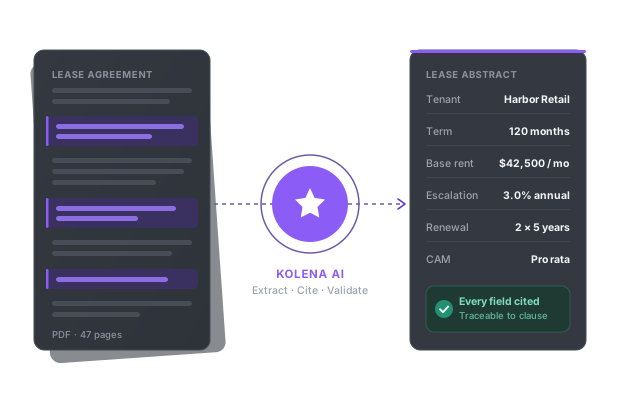
Kolena is an AI document automation platform built for document-heavy workflows in commercial real estate, lending, insurance, and financial services. Rather than asking your team to build and maintain the system around a model, Kolena deploys AI agents that read your documents, apply your specific rubric or extraction template, and return structured outputs — with every field cited to its exact location in the source document.
Kolena reads PDFs, scans, emails, spreadsheets, images, and audio, and pushes structured results into the systems you already run, including Yardi, MRI, Salesforce, and Snowflake. Every run produces a full audit trail: not only what was extracted, but the specific clause, line, or figure that justified each value. Kolena is SOC 2 Type II certified, processes onshore, and does not train on customer data.
Kolena also benchmarks leading models against real document tasks and routes each step to the one that performs best for that task, so upgrading to a newer model is a validated decision rather than a project your team owns. One lease abstraction customer realized roughly $100,000 in efficiency gains across 58 leases. One private lending customer cut UCC filing review labor by 96% and reduced loan-file turnaround from about five days to hours.
Frequently asked questions
Can I use Claude for lease abstraction or loan document review?
Yes, and it works well for individual documents. Claude reads complex leases and credit files accurately, and Agent Skills let you encode a reusable extraction methodology. The limitation appears at volume: a general assistant does not include versioned logic, independent validation of extracted values, automatic exception routing, or the audit trail a regulated workflow needs. In a self-built deployment your team owns and maintains all of that.
What is the ROI difference between a general AI assistant and purpose-built process automation?
The difference is rarely accuracy. It is the ongoing cost the self-built path leaves with your team: verification labor per document, maintenance whenever a model version or document format changes, key-person risk, and exposure from errors nothing catches. License cost favors building. Those four costs scale with volume and time, and for teams processing more than a few hundred documents a month, verification labor alone typically exceeds the cost of a platform.
Are Claude Skills enough to run a production document workflow?
Skills are an effective way to encode domain expertise and are a genuine improvement over ad hoc prompting. What they do not supply is governance. Per Anthropic's documentation, custom Skills on Claude.ai are individual to each user, are not shared organization-wide, and cannot be centrally managed by administrators; Agent Skills are also not covered by zero-data-retention arrangements. Centralized, version-controlled logic requires the filesystem-based developer path, which is engineering work your team maintains.
What happens when the AI model version changes?
A model update can improve general performance while changing behavior on one specific extraction task, and no release note will reference your documents. Someone has to re-prove accuracy across every task before the new version carries production work. In a self-built setup that responsibility belongs to your team and is frequently unassigned. A purpose-built platform should benchmark and validate before promoting a new model, and be able to show you the results.
When should we not buy a purpose-built document automation platform?
Low volume, occasional review, and one-off deep analysis of a single document are all better served by a general assistant. Below a few hundred documents a year the economics generally do not clear the bar. The dividing line is not how complex the documents are — it is whether the work is repeatable, high-volume, and consequential enough that someone will eventually ask you to prove how a specific result was produced.