A Custom GPT can package a document review methodology — instructions, uploaded reference files, and specific capabilities — into a reusable configuration a team invokes without re-explaining itself every time, and that's a real improvement over ad hoc prompting. It is not, on its own, a production document workflow, and the gap isn't about how well the GPT reads a document.
Per OpenAI's own documentation, a Custom GPT is "a version of ChatGPT configured for a specific purpose," built from instructions, uploaded knowledge files, and either connected apps or custom actions. For document work, this is exactly the shape a lease abstraction template or a loan review checklist needs to take: written once, applied consistently within the conversation, rather than re-typed every time.
Where that stops being sufficient is the same place it stops for any general assistant capability in this cluster — not at reading comprehension, but at what a Custom GPT is and isn't built to guarantee once volume climbs.
This is part of a series of articles about AI Build vs Buy.
What a Custom GPT Actually Is
A Custom GPT combines several configuration elements: instructions that shape tone, goals, and boundaries; uploaded knowledge files the GPT references when answering; capabilities like web search or image generation; and either connected apps or custom actions for external integrations, though not both at once.
For document work, this accommodates a lease abstraction methodology, an underwriting checklist, or a loss run mapping held as knowledge files and instructions, invoked automatically whenever the GPT is used. Building one requires a paid subscription, and changes have to be tested in preview before saving — a real, if lightweight, review step built into the authoring flow itself.
Nine free AI document tools — pick your workflow
What Custom GPTs Genuinely Solve
Three concrete problems get solved by moving a document review methodology into a Custom GPT rather than leaving it in a saved prompt or a person's head.
- Repetition. Methodology is written once, as instructions and knowledge files, rather than re-pasted into every conversation.
- Reviewability. The logic exists as an inspectable configuration — instructions and files a colleague can open and read — rather than living only in chat history.
- Distribution. A Custom GPT can be shared privately, with specific people, workspace-wide, or published to the GPT Store, giving a methodology reach beyond the person who built it.
Where Custom GPTs Stop for a Production Document Workflow
A Custom GPT defines instructions and reference material; it does not add the verification, citation, or governance layer a production document workflow needs on top of that.
- Instructions, not verification. A Custom GPT tells the model how to approach a document. It does not add an independent check on the result — if a figure is misread, nothing built into the GPT contradicts it, because the same model producing the answer would also confirm it.
- No exception state. A degraded scan or a contradictory amendment can return a confident, plausible wrong value that passes through unnoticed. Production workflows need a defined "route this to a person" outcome and a threshold that triggers it, and a Custom GPT's configuration doesn't include one.
- Citations aren't structural. A Custom GPT can be instructed to cite its source in a response, but that's an instructed behavior, not a field enforced on every extracted value the way a purpose-built pipeline enforces it.
- No change history. Per OpenAI's documentation, GPT builders "cannot view user conversations," and nothing in the platform ties a specific past output back to the exact GPT configuration version that produced it — when a value is questioned months later, there's no built-in record of what the instructions said at the time.
- Third-party actions aren't audited by OpenAI. When a Custom GPT uses connected apps or actions, per OpenAI's documentation, "third-party services may receive relevant input data" and OpenAI "doesn't audit their practices" — a real consideration before routing sensitive document content through a custom action.
Anthropic's Governance Playbook Applies Here Too — and So Does OpenAI's Own Retention Policy
Whether a Custom GPT is safe to build proprietary extraction logic into depends heavily on which plan and workspace it lives in, and OpenAI's own documentation is specific about the difference.
Training exclusion is the default for Business, Enterprise, and Edu customers across Custom GPTs; consumer plans may have conversation data used for model improvement unless a user opts out. Enterprise and Edu workspace admins can restrict GPT access, limit editor options, and control which sharing methods are available — real governance levers, but ones an admin has to actively configure rather than get by default. None of this changes the fact that the methodology itself — the instructions and knowledge files — still carries no built-in version history connecting a specific output to the exact configuration that produced it.
Related articles: chatgpt mcp document workflows and chatgpt projects document analysis.
Custom GPTs Compared With a Purpose-Built Document Agent
Both a Custom GPT and a purpose-built agent can encode a document review methodology; the table below shows who owns each requirement once that methodology has to run in production.
| Requirement | Custom GPT | Purpose-Built Agent |
|---|---|---|
| Encodes your methodology | Yes | Yes |
| Reusable without re-prompting | Yes | Yes |
| Independent validation of output | You build it | Built in |
| Field-level citation to source | Instructed, not enforced | Enforced on every field |
| Exception routing on low confidence | You build it | Built in |
| Version history linking output to configuration | Not built in, per OpenAI's documentation | Built in |
| Centralized control of the logic | Workspace admin controls access, not versioning | Built in |
| Re-validation when the model changes | Your team | Vendor benchmarks and validates |
| Audit record for a specific past run | You build it | Built in |
When a Custom GPT Is the Right Tool
Custom GPTs serve well in several specific scenarios that don't justify platform investment.
- An individual specialist's recurring work. One analyst, a repeated task, self-reviewed output — exactly what a Custom GPT was built for.
- Drafting and summarization. Output read by a person rather than fed directly into a downstream system doesn't need structural citations or exception routing.
- Prototyping a methodology. Testing whether an extraction approach is even correct, before committing to build or buy a production version, is a fast, cheap use of a Custom GPT.
- Low volume. Below a few hundred documents a year, the infrastructure a purpose-built platform adds is often overhead rather than protection.
The line isn't document complexity. It's whether the output feeds a decision someone will later ask you to justify.
How Kolena Works
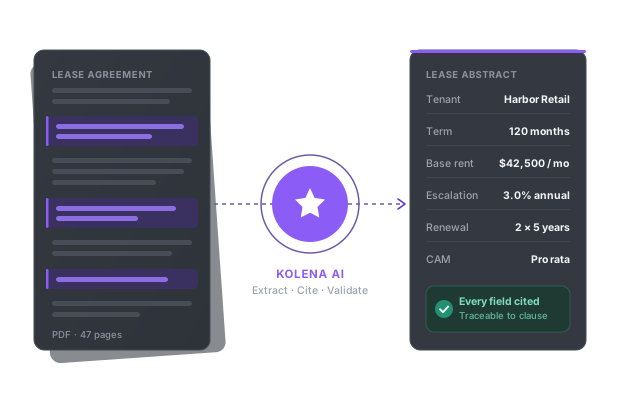
Kolena is an AI document automation platform built for commercial real estate, lending, insurance, and financial services teams. Where a Custom GPT encodes methodology and leaves validation, citations, and version history to the team building it, Kolena deploys AI agents that read your documents, apply your specific rubric or extraction template, and return structured outputs with every field cited to its exact location in the source — validation, exception routing, and audit trail built into the platform rather than assembled around it.
Kolena reads PDFs, scans, emails, spreadsheets, images, and audio or video, and delivers results into the systems teams already use, including Yardi, MRI, Salesforce, and Snowflake. Kolena also benchmarks leading models against real document tasks and routes each step to the best performer, so a model version change is validated before it reaches your workflow. Kolena is SOC 2 Type II certified, processes onshore, and does not train on customer data.
One lease abstraction customer realized approximately $100,000 in efficiency gains across 58 leases working this way — every lease abstracted to the same standard, cited the same way, with a record of what produced it.