Claude Cowork genuinely executes multi-step, autonomous tasks against your files and connected tools, and it keeps working in the background after you close your laptop — and per Anthropic's own safety guidance, "you remain responsible for all actions taken by Claude performed on your behalf," which is the sentence that separates a capable task assistant from a document workflow you can hand production volume and an audit request.
Cowork is a real product with real capability: it breaks a task into subtasks, coordinates parallel workstreams, reads and writes local files through the desktop app, and — per Anthropic's documentation — has already been used to build spreadsheets with working formulas, turn voice memos into polished documents, and process receipts into expense reports. It's easy to see that list and conclude a document review workflow — lease abstraction, loan file review, loss run intake — is just another multi-step task Cowork can be pointed at.
It can be pointed at one. Whether it should carry the volume, consistency, and accountability a document workflow needs is a separate question, and Cowork's own documentation on governance and safety answers it directly.
This is part of a series of articles about AI Build vs Buy.
What Claude Cowork Does Well
Cowork is a genuine agentic system, not a chat window with extra steps, and several of its capabilities are directly relevant to document-heavy work.
- Tasks run asynchronously and continue in the background across sessions — per Anthropic's documentation, "work continues in the background. Close your laptop and Claude keeps going" — and remain accessible from web, desktop, or mobile.
- Connectors, Skills, and plugins are supported on every surface, and local files are read and written directly through the desktop app, with folder-specific and global instructions giving a session persistent project context.
- Three approval modes — manually approve, automatically approve, or skip all approvals — give a real, documented control layer over what Claude is allowed to do without a person present, and per Anthropic, "Claude always asks before permanently deleting files, in any mode."
- Enterprise plans support groups and custom roles for selective Cowork enablement, curated plugin marketplaces with four distribution levels, and OpenTelemetry streaming of tool calls, file access, and approval decisions into a SIEM, plus a Compliance API for web and mobile sessions.
Nine free AI document tools — pick your workflow
What a Production Document Workflow Needs That Cowork Doesn't Include
A production document workflow needs every file processed against a fixed, versioned template with a defined accuracy check, and Cowork's task model is built for something more general than that.
- A Cowork task is described in natural language per session, with folder-level and global instructions — there is no extraction schema, no defined field list, and no enforced output structure that guarantees two runs against two similar documents come back in the same shape.
- Nothing in Cowork's documentation describes field-level citations bound to output. Task deliverables are files — a spreadsheet, a deck, a document — not structured records where every value carries a pointer to the clause or line it came from.
- Approval modes govern whether Claude may take an action, not whether a specific extracted value is accurate enough to use. There is no confidence threshold or exception queue that routes a low-confidence field to a person before it reaches your output.
- Per Anthropic's documentation, local Cowork sessions store conversation history on the user's device — "not subject to standard data retention policies and cannot be centrally managed." That's the opposite of the audit record a regulated document workflow needs to produce on request.
- On Team plans, the Cowork toggle is organization-wide: "either all members have access or none do." Selective, role-based control — turning Cowork on for one team's document work without turning it on for everyone — requires an Enterprise plan with custom roles.
Why "It Already Does Multi-Step Work" Isn't the Same Claim as "It Runs a Document Workflow"
Cowork's approval modes control permission, not correctness — they decide whether Claude may act, not whether the value it just extracted from a lease or a loan file is the right one.
That distinction is the whole gap. A document workflow needs a check that can disagree with the model's own output — a second pass, a cross-document reconciliation, a threshold that pulls a low-confidence field into a human queue — and nothing in Cowork's task model supplies that automatically. It supplies the opposite: a documented reminder, in every approval mode including full autonomy, that responsibility for the result sits with the person who ran the task. For an ad hoc task with one output a person reviews, that's a reasonable division of labor. For a workflow producing hundreds of extracted values a month that feed a credit decision or a claims file, someone still has to build the verification step Cowork doesn't include.
Who Owns the Instructions, the Audit Record, and the Re-Validation
The folder-level and global instructions that tell Cowork how to handle your documents are your extraction logic, and they live in your Cowork configuration rather than in a versioned, centrally managed template.
Two ownership questions follow from that. First, when a value is questioned later, the useful record is which instructions were active, on which files, producing which output — and for local sessions, per Anthropic's own documentation, that history isn't centrally retained or exportable by an admin. Second, when Anthropic ships a new model version, re-confirming that your task instructions still produce the same correct behavior is work your team schedules and performs; nothing in Cowork's task model does that validation for you before the new model reaches your workflow.
Related articles: chatgpt mcp document workflows and chatgpt projects document analysis.
Claude Cowork Compared With a Purpose-Built Document Platform
Cowork and a purpose-built document platform both execute multi-step work against your files, and the table below shows who owns each of the components that turn that work into a production process.
| Requirement | Claude Cowork | Purpose-Built Platform |
|---|---|---|
| Executes multi-step tasks against files | Yes | Yes |
| Runs in the background, across sessions | Yes | Yes |
| Extraction schema enforced per field | You describe it in task instructions | Built with you, enforced on output |
| Field-level citation to source location | Not structural to task output | Enforced on every field |
| Independent check on extracted values | You build it | Built in |
| Low-confidence exception routing | Not part of the task model | Built in |
| Centrally retained, exportable run history | Not for local sessions, per Anthropic | Built in |
| Role-based, selective enablement | Enterprise plan and custom roles required | Built in |
| Re-validation when the model changes | Your team | Vendor benchmarks and validates |
| Delivery into existing systems (Yardi, MRI, CRM) | Manual export from task output | Structured push into existing systems |
| Who is accountable for the result | You, per Anthropic's own guidance, in every mode | Shared with the vendor |
When Claude Cowork Is the Right Choice
Cowork is the right tool for genuinely multi-step work that stays ad hoc, exploratory, or personal to the person running it — several real situations fit that description well.
- One-off, multi-step deliverables. Turning a folder of notes into a formatted deck, or a stack of receipts into an expense report, is exactly the kind of task Cowork was built for, with one output a person checks before it's used.
- Exploratory research and synthesis. Pulling together a first-pass summary across a handful of documents, read by the person who asked for it, doesn't need a schema or a citation record.
- Individual or small-team automation of personal workflows. A single analyst or a small team running Cowork against their own desktop files, where the same person configuring the task also reviews its output, keeps the accountability Anthropic describes close to where the work happens.
- Low volume. Below a few hundred documents a year, the cost of building schema enforcement, citation capture, exception routing, and a retained audit record around Cowork usually exceeds what that infrastructure would save.
The dividing line isn't whether the task has multiple steps — Cowork handles that well. It's whether the output has to be structurally consistent, cited, and defensible across every document in a set, month after month, to someone other than the person who ran the task.
How Kolena Works
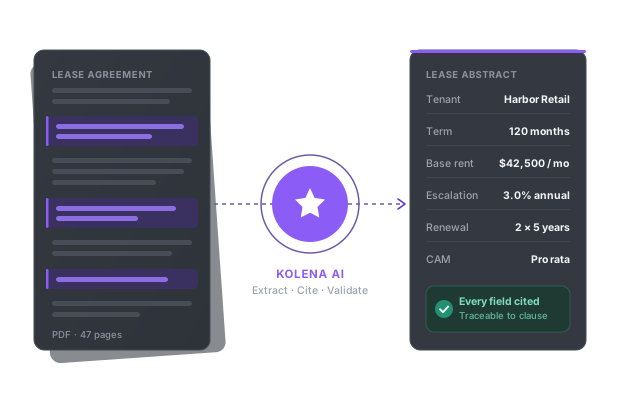
Kolena is an AI document automation platform built for commercial real estate, lending, insurance, and financial services teams who need every document in a set processed the same way, not a task run once against a folder. Kolena deploys AI agents that read your documents, apply your specific rubric or extraction template, and return structured outputs with every field cited to its exact location in the source — leases, loan files, loss runs, and rent rolls handled consistently across hundreds or thousands of documents, not one task at a time.
Kolena reads PDFs, scans, emails, spreadsheets, images, and audio or video, and pushes structured results into the systems teams already use, including Yardi, MRI, Salesforce, and Snowflake. Every run produces a full audit trail — not just what was extracted, but the specific clause, line, or figure that justified each value, retained centrally rather than on a single device. Kolena also benchmarks leading models against real document tasks and routes each step to the best performer, so a model version change is validated before it reaches your workflow instead of becoming re-validation work your team has to schedule. Kolena is SOC 2 Type II certified, processes onshore, and does not train on customer data.
One private lending customer uses Kolena this way for UCC filing review, cutting review labor by 96% and taking loan-file turnaround from roughly five days to hours — the kind of volume and consistency a task-by-task tool isn't built to guarantee.