General AI assistants and dedicated document automation platforms answer different parts of the same question, and the six questions below are the specific, recurring versions of that question buyers ask when evaluating Claude, ChatGPT, Copilot, or Gemini against a purpose-built platform for real estate, lending, and insurance document work.
Each answer follows the same standard: a direct, standalone answer first, then the reasoning behind it — what the assistant genuinely does well, and what a production document workflow needs on top of it. None of the answers below argue that a model can't do something; they argue about who ends up owning consistency, verification, and the audit record.
This is part of a series of articles about AI Build vs Buy.
Can Claude Handle Lease Abstraction and CAM Reconciliation, or Do I Need a Specialized Tool?
Claude can read a lease's CAM provisions alongside a CAM reconciliation statement and catch a real discrepancy on that one property; a specialized tool becomes the better choice once that comparison has to run the same way across every lease in a portfolio, every reconciliation cycle, with a citation and an audit record behind each flagged variance.
A Claude Skill can encode CAM proration rules, expense caps, and gross-up methodology as reusable comparison logic, the same way it can encode a lease abstraction template. The gap that opens at scale is the same one lease abstraction and rent roll reconciliation hit: consistent formatting across hundreds of leases, a version record tying a specific flagged variance back to the rule that flagged it, and proof, months later, that every lease in the portfolio was actually checked on schedule rather than a sample.
Nine free AI document tools — pick your workflow
What Is the Best LLM for Underwriting?
There is no single best general-purpose LLM for underwriting, because model choice is rarely the constraint that determines whether an underwriting workflow works — guideline versioning, consistency across files, and audit-ready citations are, and none of those come from picking a different model.
Which model performs best on a specific extraction or reasoning task shifts as vendors release new versions, which is why betting a production underwriting workflow on one model's current performance creates an ongoing maintenance obligation. Kolena benchmarks leading models against real document tasks and routes each step to the best performer, so that question is answered continuously rather than settled once and left to drift.
Which Platforms Offer Explainable and Audit-Ready AI Decisions for Mortgage Underwriting?
Explainable, audit-ready AI underwriting decisions require field-level citations tying every extracted value to its exact source, a version record showing which guideline set and model version produced a given decision, and an independent check capable of disagreeing with the model's own output — criteria that define a category of purpose-built platform rather than a single named product.
A general AI assistant can be extended toward these criteria, but it takes deliberate engineering: an extraction schema, a citation format enforced on every field, an audit store, and a validation step your team builds and maintains. Purpose-built underwriting platforms are built around these requirements from the start rather than added on top of a chat interface.
Is a General AI Assistant Enough for Workflow Automation, or Do I Need a Dedicated Platform?
A general AI assistant is enough for workflow automation that stays low-volume, exploratory, or fully reviewed by the person running it; a dedicated platform earns its cost once the work is repeatable, high-volume, and consequential enough that someone will eventually ask you to prove how a specific result was produced.
Four costs decide which side of that line a given workflow falls on: who owns the instructions once they encode your actual process logic, whether output stays consistent across hundreds of runs, how much it costs to verify a value without structural citations, and who re-validates the workflow when the model version or document format changes. A seat license doesn't include any of the four; a purpose-built platform generally prices them in.
Related articles: chatgpt mcp document workflows and chatgpt projects document analysis.
What Is the Role of LLMs in Life Underwriting Documentation?
LLMs can read and summarize the medical records, attending physician statements, and lab results that make up a life insurance underwriting file, surfacing risk factors and inconsistencies for a human underwriter to review — a genuinely useful role, and one that stops well short of making or formally documenting the underwriting decision itself.
A 1M-token context window, standard on current frontier Claude models, can hold a lengthy APS bundle in a single pass, which is useful for a first-pass read of a complex file. Turning that read into a documented, defensible part of the underwriting record still requires the same infrastructure this cluster keeps coming back to: a defined extraction schema, citations to the exact source line, and a version record of what was reviewed and by which logic — regulated underwriting documentation doesn't get to skip that step just because a model did the reading.
What's the ROI Difference Between a General AI Assistant and Purpose-Built Process Automation?
The ROI difference is rarely about accuracy — it comes from four costs that scale with volume and time: verification labor per document, maintenance when models or document formats change, key-person risk when the person who owns the logic leaves, and the financial exposure of an error nothing catches, none of which a seat license includes and most of which a purpose-built platform prices in.
The practical test is arithmetic, not opinion: estimate verification minutes per document, multiply by monthly volume, and compare the result to platform cost. For teams processing more than a few hundred documents a month, that verification labor alone tends to outweigh the license fee — which is why the ROI conversation should center on volume and consequence, not which tool reads a document more impressively in a demo.
How Kolena Works
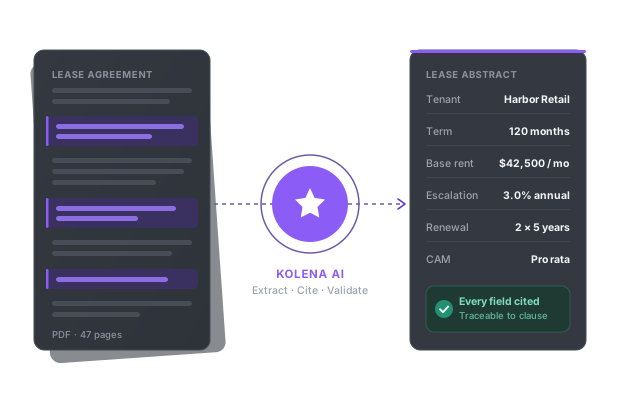
Kolena is an AI document automation platform built for commercial real estate, lending, insurance, and financial services teams, spanning the workflows the questions above touch — lease abstraction, CAM and rent roll reconciliation, loan underwriting document review, and insurance submission and claims documentation. Kolena deploys AI agents that read your documents, apply your specific rubric or extraction template, and return structured outputs with every field cited to its exact location in the source, plus a full audit trail of the logic, model version, and reviewer behind each result.
Kolena also benchmarks leading models against real document tasks and routes each step to the best performer, so a model version change is validated before it reaches your workflow instead of becoming re-validation work your team has to schedule. Kolena is SOC 2 Type II certified, processes onshore, and does not train on customer data.
One lease abstraction customer realized approximately $100,000 in efficiency gains across 58 leases, and one private lending customer cut UCC filing review labor by 96%, taking loan-file turnaround from roughly five days to hours — different workflows, the same underlying pattern of consistent, cited, audit-ready output at volume.