You can build a production document workflow on the Claude Agent SDK. Capable engineering teams do it, and the SDK gives them a genuinely strong starting point: the same agent loop, tool set, and context management that power Claude Code, programmable in Python and TypeScript. What the SDK does not include is the application — your extraction schema, the validation that catches a wrong value, field-level citation capture, exception routing, the audit store, and the person who maintains all of it as models and documents change.
That distinction is the entire build-versus-buy decision. The SDK is a harness. A lease abstraction or loan diligence workflow is a product built on top of one, and the cost of that product is not the first version. It is the eighteen months after it ships.
This is part of a series of articles about AI Build vs Buy.
What the Claude Agent SDK actually gives you
Any fair assessment starts with how much is already handled. Per Anthropic's documentation, the SDK provides:
- The agent loop and context management. Automatic compaction so long-running agents do not exhaust context, plus prompt caching and performance optimizations.
- Built-in tools. Read, Write, Edit, Bash, Glob, Grep, WebSearch, WebFetch, and others execute without you implementing a tool runner.
- Lifecycle hooks. PreToolUse, PostToolUse, SessionStart and others let you run custom code at defined points in the agent's execution.
- Subagents. Delegate focused subtasks to separate agents with their own context.
- Fine-grained tool permissions. Control precisely what the agent is allowed to do.
- MCP client support. First-class Model Context Protocol integration for connecting external systems.
- Resumable and forkable sessions, plus built-in error handling and session management.
It also loads Claude Code's filesystem configuration, including Skills, memory files, and plugins. Authentication runs through an Anthropic API key or through Amazon Bedrock, Google Vertex AI, or Microsoft Foundry.
These are real primitives, and the hooks and permissions system in particular means you can build validation and controls. The question is not whether it is possible. It is what building and keeping it costs.
Nine free AI document tools — pick your workflow
What a document workflow needs that the SDK does not include
The SDK is deliberately general. A regulated document workflow is specific, and the gap between them is the application layer your team writes:
- The extraction schema. Every field, its type, its units, its permitted values, and what happens when a document does not contain it.
- The domain logic. How your organization treats percentage rent, which amendment supersedes which original, what your co-tenancy threshold is, how your investor guidelines define an exception.
- Independent validation. A mechanism capable of disagreeing with the extraction, rather than the same model confirming its own output.
- Field-level citation capture. Recording the page and location for every value at extraction time, so an auditor can resolve a field without reopening the document.
- Exception routing. A defined low-confidence state, a threshold that triggers it, and a queue a human actually works.
- The audit store. Inputs, logic version, model version, outputs, human overrides, and timestamps, retained for the period your obligations require.
- Reprocessing. The ability to re-run a historical population under corrected logic and produce a field-level diff.
- Delivery. Structured output pushed into Yardi, MRI, a data warehouse, or a lender template, with failure handling.
None of this is exotic. All of it is code your team writes, tests, documents, and owns.
The verify step is the one you build
Anthropic describes the agent loop as gather context, take action, verify work, repeat. For code generation, the verify step often comes close to free: run the tests, run the linter, compile it. The output is precise and machine-checkable, which is why the SDK excels at coding agents.
Document extraction has no equivalent. There is no compiler for "is this the correct commencement date." Verification has to be constructed: a second extraction path, a cross-document reconciliation, an arithmetic check against the rent roll, a confidence threshold with a human queue behind it. That construction is the hardest part of the build, it is the part most first versions skip, and it is the part that determines whether the workflow can run unsupervised.
A pilot without a verify step looks finished. It is a demo.
What you still own after version one ships
The build estimate that kills these projects is not the initial one. It is the standing obligation:
- Model change re-validation. Model versions change on the provider's schedule. Each one requires proving accuracy still holds across every field before it carries real work. Anthropic's own enterprise guidance for Skills notes that effectiveness varies by model and recommends testing across each model an organization uses; the same applies to an SDK-based agent.
- Document format drift. New carrier formats, new lease templates, a new investor guide. Each is a change to logic and a re-test.
- Prompt and tool regressions. Changes made to improve one field can quietly degrade another. Catching that requires a regression suite, which is another thing to build and maintain.
- Key-person concentration. The engineer who built it understands why every decision was made. Documentation rarely captures that, and reassignment is common.
- Operational support. Somebody responds when a batch fails at 6pm on a Friday before a closing.
These costs do not appear in month one, which is why internal builds look inexpensive at approval and expensive at renewal.
Related articles: chatgpt mcp document workflows and chatgpt projects document analysis.
The cost model is different from a seat license
The SDK itself is a library. What you pay for is model tokens, and per Anthropic's documentation, agents built on the Agent SDK authenticate with an API key rather than drawing on Claude.ai subscription limits, unless previously approved.
That matters for forecasting. A per-seat assistant subscription has a predictable ceiling. A token-metered agent processing hundreds of documents a month has a cost that scales with volume, retries, validation passes, and reprocessing — and reprocessing a historical population to fix a bug is exactly the operation that consumes the most tokens.
Agent SDK build compared with a purpose-built platform
| Component | Build on the Agent SDK | Purpose-built platform |
|---|---|---|
| Agent loop, tools, context management | Provided by the SDK | Provided |
| System connectivity | Provided via MCP | Provided |
| Extraction schema and domain logic | You write it | Built with you, from your template |
| Independent validation | You build it with hooks | Built in |
| Field-level citation capture | You build it | Enforced on every field |
| Exception routing and review queue | You build it | Built in |
| Audit store and retention | You build it | Built in |
| Reprocessing with field-level diff | You build it | Built in |
| Model change re-validation | Your engineers, every time | Vendor benchmarks and validates |
| Time to first production workflow | Depends on your engineering capacity | Days |
| Who is accountable for accuracy | Your team | Shared with the vendor |
When building on the Agent SDK is the right call
Several situations genuinely favor building, and it is worth naming them:
- The workflow is your product. If document processing is what you sell, own it. Do not outsource your differentiator.
- You have dedicated engineering capacity, permanently. Not a motivated analyst and not a quarter of someone's time — an assigned owner with a maintenance budget.
- The requirement is unusual. A workflow no platform serves, where the domain logic is genuinely novel rather than merely specific to you.
- Code-shaped output. The SDK is exceptionally strong where the deliverable is code or machine-verifiable artifacts, because the verify step comes closer to free.
The situation that does not favor building is the common one: an operations team with real document volume, no dedicated engineers, and a workflow that looks standard because it largely is.
How Kolena Works
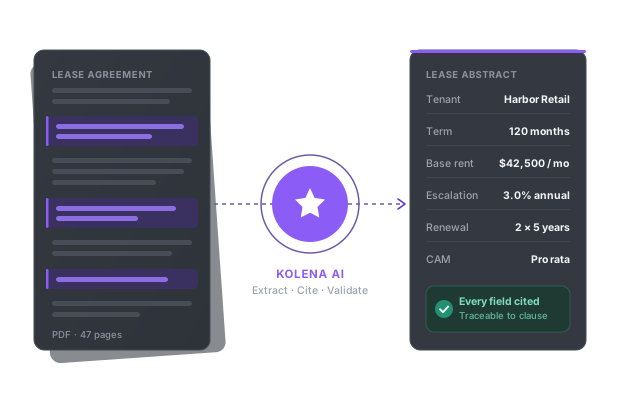
Kolena is an AI document automation platform for document-heavy workflows in commercial real estate, lending, insurance, and financial services. Where the Agent SDK gives your engineers the harness and leaves the application to them, Kolena delivers the application: AI agents that read your documents, apply your specific rubric or extraction template, and return structured outputs with every field cited to its exact location in the source.
Validation, exception routing, version history, reprocessing, and the audit trail are part of the platform rather than components your team builds and maintains. Kolena reads PDFs, scans, emails, spreadsheets, images, and audio, and delivers structured results into the systems you already run, including Yardi, MRI, Salesforce, and Snowflake. Every run records not only what was extracted but the specific clause, line, or figure that justified each value. Kolena is SOC 2 Type II certified, processes onshore, and does not train on customer data.
Kolena also benchmarks leading models against real document tasks and routes each step to the one that performs best, so model-change re-validation happens before it reaches your workflow rather than becoming an engineering ticket. One private lending customer cut UCC filing review labor by 96% and reduced loan-file turnaround from about five days to hours.
Frequently asked questions
Can I build a document extraction agent with the Claude Agent SDK?
Yes. The SDK provides the agent loop, built-in file and search tools, lifecycle hooks, subagents, fine-grained permissions, and MCP support in Python and TypeScript. What it does not provide is the application layer a document workflow needs: your extraction schema, domain logic, independent validation, field-level citation capture, exception routing, and an audit store. Those are code your team writes and maintains.
How long does it take to build a production document workflow on the Agent SDK?
A working prototype is fast, often days. Production is a different question, because the components that separate a demo from a production workflow — validation that can disagree with the extraction, citation capture, an exception queue, an audit store, and a regression suite — are the bulk of the work. The more consequential number is ongoing: re-validation on every model change, logic updates as document formats drift, and an owner assigned permanently.
Does the Claude Agent SDK include validation or accuracy checking?
Not for document extraction specifically. The SDK provides lifecycle hooks such as PreToolUse and PostToolUse, which let you run custom code at defined points, so you can build validation. Anthropic describes the agent loop as gather context, take action, verify work, repeat — and for document extraction the verify step is the part you construct. Unlike code generation, there is no compiler or test suite that can confirm a commencement date is correct.
What does it cost to run an agent built on the Claude Agent SDK?
The library is free; you pay for model tokens. Per Anthropic's documentation, agents built on the Agent SDK authenticate with an API key rather than drawing on Claude.ai subscription rate limits unless previously approved. Cost therefore scales with document volume, retries, validation passes, and reprocessing — and reprocessing a historical population to correct an error is typically the most token-intensive operation you will run.
When should we build on the Agent SDK instead of buying a platform?
Build when document processing is your product rather than your overhead, when you have permanently assigned engineering capacity with a maintenance budget, when the domain logic is genuinely novel, or when the output is code or otherwise machine-verifiable. Buy when you have an operations team with real document volume, no dedicated engineers, and a workflow that resembles what other firms in your sector also run.