An insurance loss run report is an official document from your insurance carrier that summarizes your business's claims history. It is often compared to a personal credit report but for commercial insurance. The report typically covers three to five years of history. It shows specific details for each claim filed.
In essence, loss runs break down the claims paid out versus the premiums paid, offering a detailed snapshot of a policyholder’s risk profile and claims history. They are important in insurance underwriting because they provide a comprehensive history of losses for underwriters to assess risk. A loss run helps insurers and brokers understand patterns in claims (frequency, severity, types of losses) which inform pricing, coverage decisions, and risk management strategies.
What is included in a loss run report:
Policy and coverage details: Named insured, policy number, policy period, carrier, coverage type, and sometimes limits, deductibles, or locations.
Claim details: Claim number, date of loss, cause or description of the incident, and current claim status.
Loss amounts: Amounts already paid, outstanding reserves for expected payments, and total incurred losses for each claim.
Valuation date: The date when claim amounts and statuses were last updated, showing how current the loss data is.
Why is it difficult to manually review loss run reports:
Inconsistent formats: Carriers use different layouts, terminology, date conventions, and field names, requiring manual standardization.
Time-consuming data entry: Reviewers may spend hours reading reports and re-keying claim information into spreadsheets or underwriting systems.
Risk of errors: Manual entry can introduce missed claims, incorrect amounts, duplicate records, and other mistakes that affect risk analysis.
Delayed insights: Time spent extracting and reconciling data slows the identification of claim trends, unusual losses, and other underwriting signals.
How AI can help automate loss run reports:
Extract claim data: AI can read PDFs, scans, and spreadsheets and capture fields such as claim dates, paid amounts, reserves, causes, and statuses.
Normalize carrier data: AI maps different carrier terminology, formats, and conventions into a consistent schema for analysis.
Validate and flag issues: Automated checks can identify missing information, inconsistent totals, unusual claims, and records that need human review.
Generate usable outputs: Structured data can be summarized, exported to spreadsheets, or sent directly to underwriting and analytics systems.
Why Are Loss Run Reports Important?
Loss run reports give insurers, brokers, and risk managers evidence of how an account has performed over time. Instead of relying only on current exposure information, they show the frequency, severity, and development of actual claims. This history supports several parts of the underwriting and risk management process:
Risk assessment: Underwriters use past claims to identify recurring losses, unusually severe claims, and other patterns that may indicate future exposure.
Pricing and underwriting: Claim frequency, severity, and total incurred losses help insurers determine appropriate premiums, deductibles, limits, and other coverage terms.
Open claim evaluation: Outstanding reserves and open claim statuses show where additional payments may still occur. This helps underwriters distinguish settled losses from claims with ongoing financial exposure.
Renewals and carrier changes: Current loss runs allow insurers to evaluate recent claims experience when renewing coverage or quoting an account that is moving from another carrier.
Risk management: Loss patterns can reveal operational problems, such as repeated workplace injuries, vehicle accidents, or property losses. Businesses can use this information to target prevention efforts.
Data validation: Comparing loss runs across policy years and carriers helps brokers and underwriters identify missing periods, duplicate claims, inconsistent values, or outdated claim information before making decisions.
Turn loss runs into a clean spreadsheet in minutes with AI
What a Loss Run Report Includes
Policy, insured, and coverage details
A loss run report typically identifies the named insured, policy number, policy period, insurance carrier, and the types of coverage included. Depending on the policy, it may also show limits, deductibles, locations, business units, or other information that helps connect each claim to the correct coverage.
These details are important because underwriters need to verify that the reported claims belong to the policies and exposure periods being evaluated. When several carriers or policy years are involved, consistent policy information also makes it easier to consolidate loss history without double-counting or omitting claims.
Claim number, date of loss, and claim status
Each claim is generally assigned a unique claim number and includes the date the loss occurred. The report also indicates whether the claim is open, closed, reopened, pending, or subject to another carrier-specific status.
Claim status can materially affect how the loss history is interpreted. A closed claim may have little or no remaining financial exposure, while an open claim can continue to generate payments or reserve changes. Reviewing dates of loss also helps identify claim frequency, recurring incidents, and trends across policy periods.
Paid losses, reserves, and total incurred
Loss runs usually separate the amount already paid on a claim from the amount the insurer has reserved for expected future payments. Paid losses may include indemnity payments, medical costs, legal expenses, or other claim-related expenses, depending on how the carrier structures the report.
Total incurred generally represents the combined financial impact of amounts already paid plus outstanding reserves. Underwriters often review both components because two claims with the same incurred value can have very different risk implications if one is fully settled and the other still carries a substantial open reserve.
Cause of loss and valuation date, including "currently valued"
The cause or description of loss explains what generated the claim, such as a slip and fall, vehicle collision, property damage, theft, fire, or workplace injury. Reviewing these descriptions helps identify recurring loss patterns and determine whether multiple claims stem from a common operational or safety issue.
Loss runs also include a valuation date showing when the claim figures were last updated. A notation such as "currently valued" generally means the paid amounts, reserves, and claim statuses reflect the carrier's records as of the stated valuation date. This matters because claim values can change significantly over time, particularly for open claims, so underwriters should confirm they are working from recent loss-run data.
How to Read a Loss Run Report
Reading a loss run report involves confirming the data is complete and accurate, then evaluating claim activity for severity, frequency, development, and underwriting impact.
Verify entity names, policy numbers, and periods: Confirm the named insured, legal entities, policy numbers, and policy periods match the account. Check for missing years or inconsistent names that could distort the claims history.
Separate open from closed claims: Review open and closed claims separately because open claims may still develop. Pay close attention to large open claims with significant outstanding reserves.
Compare incurred losses against premium: Compare total incurred losses with earned premium to assess loss performance. Use the loss ratio as a guide, but consider claim maturity, exposure changes, and large individual losses.
Spot frequency patterns and repeat causes: Review claims by date, type, location, and cause to identify recurring issues. Repeated small claims may signal operational or risk-control problems.
Flag stale reserves and data errors: Look for old open reserves, duplicate claims, missing values, inconsistent dates, negative amounts, and mismatched totals. Clarify issues before using the data for pricing or underwriting.
How to Request Loss Runs and How Many Years to Provide
Loss runs are typically requested from the insurance carrier, broker, or agent that handled the policy. The request should specify the insured entity, policy number, coverage type, and policy period, and ask for loss runs that are valued as recently as possible.
For underwriting, businesses are commonly asked to provide three to five years of loss runs, although the exact period depends on the line of coverage, insurer, and nature of the risk. Higher-risk accounts or policies with long-tail claims may require a longer history.
Before submitting the reports, confirm that:
All requested years and carriers are included.
The named insured and policy periods are correct.
Reports have a recent valuation date.
Both open and closed claims are shown.
Paid amounts, reserves, and total incurred losses are included.
Any major or unusual claims are accompanied by additional context when relevant.
The Pain of Manual Loss Run Analysis
Traditionally, analyzing loss runs has been a labor-intensive, manual process. Insurance professionals often spend hours (even days) combing through documents, re-keying data into spreadsheets, and reconciling information across multiple files. This manual workflow is rife with pain points:
Slow and Inefficient: Human reviewers must read through pages of claims data. One brokerage firm reported spending over 20,000 hours per year on re-keying loss run data. This leads to long turnaround times – it’s not uncommon for compiling and analyzing loss runs to add days or weeks to underwriting and quoting processes.
Inconsistent Formats: Every insurance carrier has its own loss run format and terminology. An underwriter might see “Total Incurred Losses” on one report and “Total Claims Paid” on another for the same concept. Manually standardizing these differences is painstaking and error-prone. Older template-based software often breaks when faced with a new format, leaving humans to fill the gap.
Error-Prone Data Entry: Hand-keying figures from PDFs increases the risk of mistakes – a slip in reading a number or a missed line can skew an analysis. Important details can be overlooked, especially when fatigued staff handle lengthy loss runs. These inaccuracies directly affect risk evaluation and pricing decisions, potentially leading to mis-priced policies or compliance issues.
High Costs and Burnout: Manual processing isn’t just slow; it’s expensive. Whether done in-house or outsourced, thousands of staff hours translate to high operational costs. Burnout is a real risk – teams stuck in paperwork drudgery face low morale and productivity. As Kolena noted, claims and underwriting teams “stuck in a paperwork nightmare” suffer from slow operations, higher costs, increased compliance risk, and burned-out teams.
Delayed Insights: While analysts toil on data extraction, opportunities can be missed. For example, spotting a pattern of frequent small claims that hint at a larger risk exposure, or identifying a spike in claims that could suggest fraud, is difficult when you’re buried in paperwork. The delay in analysis also slows down responding to clients with quotes or renewal terms, putting firms at a competitive disadvantage.
In short, manual loss run analysis is a bottleneck. It drags down efficiency, drives up costs, and leaves less time for the strategic work that truly adds value (like negotiating better terms or implementing risk improvement plans). This pain is why the industry is ripe for an AI-driven solution.
What Is Loss Run Automation?
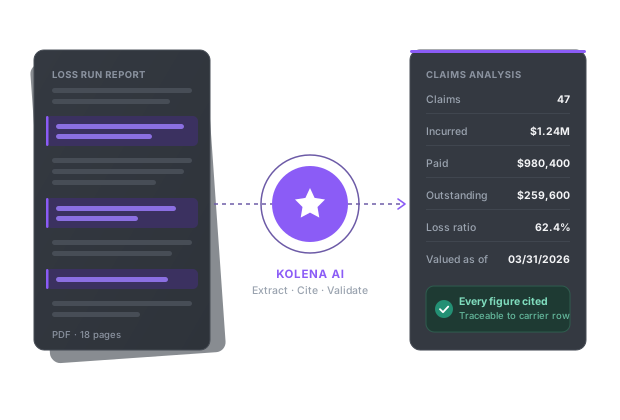
Loss run automation is the use of AI to ingest, read, and standardize loss run reports so that claims history flows into underwriting and analytics systems without manual re-keying. Instead of an analyst opening a 40-page PDF and typing claim numbers into a spreadsheet, an AI agent extracts every field, maps carrier-specific terminology to a common schema, and returns a structured dataset in minutes.
The distinction matters. Simple document scanning only converts a page into text. True loss run automation covers the full path from raw carrier document to decision-ready output, which in practice means four things:
Ingestion: accepting loss runs in any form – native PDFs, scanned images, emailed attachments, or spreadsheets from dozens of different carriers.
Normalization: reconciling inconsistent field names, date conventions, and currency formats so records from different carriers can sit side by side.
Validation: checking totals against stated sums, flagging missing policy years, and surfacing records that need a human second look.
Delivery: pushing clean data into an underwriting workbench, a rating model, or a broker submission package.
Because a single AI workflow handles all four steps, loss run automation removes the handoffs between people and systems where errors and delays typically accumulate.
How Loss Run Automation Works
AI is reshaping how insurers handle loss run reports by automating data extraction, analysis, and reporting. Modern loss run automation platforms typically combine several advanced technologies behind the scenes:
Optical Character Recognition (OCR): The first step is converting unstructured documents (PDFs, scans of loss runs) into machine-readable text. Advanced OCR can handle the varied layouts of carrier loss runs – tables, forms, even faxed or slightly blurry documents. This turns a static report into digital text data that algorithms can process.
Natural Language Processing (NLP) & Data Parsing: NLP algorithms interpret the extracted text to pull out key fields and normalize terminology. For instance, the AI will identify all the critical data points (claim dates, paid amounts, reserves, causes of loss, etc.) and standardize labels that differ between carriers. Inconsistent headings are mapped to a common vocabulary – e.g., “Total Incurred” = “Total Paid + Reserved” – so that data from different sources becomes comparable. This automatic standardization is crucial for multi-carrier loss run analysis.
Machine Learning & Pattern Recognition: AI models, trained on large volumes of historical loss run data, learn to recognize patterns and anomalies that a human might miss. They can adapt to new report formats on the fly by generalizing from examples. ML algorithms can also intelligently group related claims (for example, multiple line items that actually pertain to one incident) and flag outliers. This means the AI isn’t thrown off by unusual layouts or phrasing – it continuously improves as it sees more data.
Automated Summarization & Reporting: Once data is extracted and normalized, AI can instantly perform analysis and generate reports or dashboards. This could include summary tables of total losses by year, interactive visualizations of loss trends, or even written narrative summaries. Generative AI can draft an executive summary of loss runs highlighting key insights (e.g. “Claims spiked in 2022 due to several large property losses; liability claims have a rising trend of small slip-and-fall incidents”) – all at the click of a button.
Integration & Alerts: Leading AI solutions integrate with existing insurance systems. For example, an AI agent might automatically feed cleaned loss run data into an underwriting workbench or alert a risk manager when certain thresholds (like loss ratio or frequency of claims) exceed a limit. This ensures the insights from loss runs are not siloed but immediately actionable within the business workflow.
Human-in-the-Loop Validation: Even with high automation, leading solutions keep underwriters and brokers in control by routing complex or flagged outlier claims for human review before final binding or quoting. This ensures accuracy on edge cases while the AI handles the bulk of the work.
In practice, what used to take days can now take minutes. One case study showed that using AI, an analysis that previously required a full day’s work was completed in just a couple of hours – and that gap only widens as the volume of data grows. Crucially, this speed doesn’t come at the expense of quality; on the contrary, automation can dramatically improve accuracy.
Kolena’s AI Technology for Loss Run Automation
One standout example of this technology in action is Kolena’s AI agent platform, which is specifically designed for loss run automation and similar document-heavy workflows. Kolena’s platform allows insurance teams to create custom AI agents in minutes that handle the heavy lifting of document analysis – without needing to write code.
Using Kolena’s AI platform, an insurer or broker can configure an AI agent to ingest loss run documents, extract all the pertinent data, and output a standardized report or dataset. The process is remarkably straightforward: you can even give the AI instructions in plain English. For instance, you might tell it: “Extract each claim’s date, paid amount, reserve amount, cause of loss, and status from this loss run, and summarize total losses by policy year.” The platform’s natural language interface interprets that and generates the necessary data-extraction logic automatically. This means domain experts (like an underwriting manager) can teach the AI what to do without needing an IT intermediary.
Kolena’s AI agents also incorporate a feedback loop for continuous improvement. If the initial results miss something or need refinement, users can provide corrections or additional instructions in natural language, and the AI will update its logic accordingly. This is a game-changer for handling the variability of real-world loss runs – whether it’s a new carrier format or a quirky data field, the AI learns and adapts.
By leveraging such an AI-driven solution, insurance teams can automate the entire loss run analysis process. Kolena’s platform, for example, quickly analyzes loss run documents, extracts key information, and presents it in a structured format, freeing up teams to focus on higher-value tasks. In fact, insurance organizations using Kolena have been able to reduce review cycles from days to minutes in their underwriting workflows. The end result is that underwriters and brokers get the insights they need almost instantly, with far less effort.
Actionable Insights for Industry Leaders
AI-powered loss run reporting has unique implications for different roles across the insurance value chain. Here are some actionable insights and takeaways for key stakeholders looking to harness AI for loss run analysis:
Insurance Executives (CXOs): Champion a culture of innovation. As a senior leader, recognize that automating loss run analysis is part of the broader digital transformation in insurance. Encourage your teams to pilot AI solutions and set clear KPIs (e.g. reduction in processing time, accuracy gains, cost savings) to measure impact. Invest in training and change management – ensure underwriting and claims teams understand the AI tools and trust the outputs. By driving this initiative from the top, you signal its strategic importance. Also, consider the long-term payoff: faster underwriting cycles can translate to writing more business and improving combined ratios. Action: Identify a business unit or process (like commercial auto underwriting or large account renewals) where manual loss run work is a known pain point, and initiate an AI automation project there as a proof of concept.
Brokers and Agents: Leverage AI as your competitive edge. In brokerage, time is money – being the first to deliver a comprehensive quote or renewal proposal can win the account. By using AI to automate loss run analysis, brokers can drastically cut the time required to get loss information from clients into a digestible format. This means you can respond to client inquiries faster and with more insightful advice (e.g. highlighting loss drivers or recommending coverage changes based on trends). Action: If you’re a broker leader, integrate a loss run automation tool into your submission intake process. When you receive client loss runs, have the AI immediately process them and produce a summary for your team. This will free your account managers from manual data prep, allowing them to focus on marketing the risk to carriers and negotiating the best terms. You’ll also impress clients with slick, speedy analysis in your renewal meetings.
Risk Managers (Insurance Buyers): Turn data into actionable risk improvements. If you manage insurance programs for a company, insist on getting your own loss run data analyzed by AI. Rather than relying solely on insurers’ analysis, use AI tools to comb through your history and identify loss patterns. This can uncover loss drivers that you can address through safety programs or retention level changes. For example, AI might reveal an increase in small property damage incidents at certain locations – something you can mitigate with a targeted risk control plan. Action: Work with your broker or an insurtech provider to run your loss runs through an AI analysis annually (or even quarterly). Use the findings to drive internal risk management decisions and to strengthen your hand during insurance renewals (knowledge of your loss history = power when underwriters are assessing your account). By proactively presenting data-driven insights to underwriters, you demonstrate professionalism and may earn better terms.
Insurtech Developers and Product Managers: Integrate AI into insurance workflows. For those building solutions in the insurtech space, automating loss run analysis is a high-value feature to offer carriers and brokers. Rather than reinventing the wheel, you can integrate with platforms like Kolena via APIs to add AI-driven document analysis to your product. Focus on seamless user experience – for example, a feature where a user uploads a PDF and within seconds sees a dashboard of loss run metrics. Ensure that your solution can handle the common edge cases (multiple carriers’ formats, very large schedules, etc.) possibly by partnering with specialized AI providers. Action: Explore partnerships or SDKs from AI companies that specialize in insurance document processing. Build prototypes that show how much time can be saved in an underwriting or claims workflow when loss run data populates automatically. Also, implement a feedback mechanism for users to correct any data points and feed that back to continuously improve the AI model’s performance in your specific niche. By embedding advanced AI capabilities into your insurtech product, you’ll increase its value proposition to clients (carriers, brokers, or risk managers) who are looking for efficiency gains.
No matter the role, the key is to start small but start now. Identify a workflow where automated loss run analysis can make an immediate impact, trial it, and measure results. The insights and efficiency you gain will build the business case to expand AI adoption across other processes.
Conclusion: Embracing AI for a Competitive Edge
The message is clear: AI-driven loss run analysis and reporting is no longer a futuristic concept – it’s here now, delivering real results. Insurance organizations that embrace these tools are reaping the rewards in efficiency, insight, and agility. From dramatically shorter processing times to more accurate risk assessments and better customer service, the advantages are driving a new standard in the industry. As one thought leader put it, this shift “isn’t a trend. It’s your new unfair advantage.”
Executives, brokers, risk managers, and developers should view AI not as a threat to the old ways, but as an opportunity to elevate their work. By automating the grunt work of loss run analysis, you liberate talent to focus on strategy and relationships – the human elements of insurance that truly move the needle. Moreover, early adopters of AI in insurance operations are positioning themselves as market leaders. They can respond faster, underwrite smarter, and innovate continuously, leaving competitors who cling to manual processes at a serious disadvantage.
In the end, adopting AI for tasks like loss run analysis is about delivering better outcomes – for your team, your clients, and your business. It’s about being proactive and future-ready in a landscape where data is growing and speed matters. Those who modernize now will set the benchmark in underwriting excellence and operational efficiency.
Kolena’s AI technology is one compelling way to achieve these goals, offering a proven platform for loss run automation with ease and sophistication. As you consider next steps, remember that doing nothing carries its own risk: the risk of falling behind. The tools are available, the case studies are promising, and the path to implementation is smoother than ever. It’s time to cut through the paperwork chaos and let AI help you focus on what truly counts – understanding risk, serving customers, and driving growth.