If your organization has a WNS contract for insurance operations, finance and accounting, or document processing, you are now a Capgemini client — whether or not that is what you signed up for. The October 2025 acquisition closed WNS as an independent company and folded 66,000 employees and 700+ client relationships into Capgemini's Global Business Services. That transition creates something most BPS contracts rarely produce: a natural moment to re-evaluate.
This is part of a series of articles about BPO Replacement.
What WNS Was — and What It Is Now
WNS (Holdings) Limited built its business over two decades as a specialized BPS firm with genuine vertical depth in insurance, healthcare, travel, and finance and accounting. At the time of acquisition, WNS had 66,085 professionals across 65 delivery centers worldwide, serving more than 700 clients. In insurance specifically, WNS covered claims administration, underwriting support, policy administration, customer experience, and analytics — a broad back-office capability that made it a credible choice for mid-to-large insurers and financial services firms.
Capgemini acquired WNS in October 2025 for $3.3 billion with an explicit rationale: to add BPS depth in insurance, healthcare, and travel — verticals where Capgemini was underpenetrated — and to build what it called a "global leader in Agentic AI-powered Intelligent Operations." The combined entity is now the 19th-largest BPS provider by revenue globally. WNS shares were delisted from the NYSE on October 17, 2025.
For WNS clients, the practical consequence is a change in what they bought. They contracted with a focused BPS specialist; they now have a relationship with a large IT services and consulting conglomerate whose primary business is not BPS. Account teams, pricing structures, escalation paths, and strategic priorities are all mid-integration. That's not a reason to leave automatically — but it's a reason to look.
Nine free AI document tools — pick your workflow
What the Acquisition Signals About the BPS Model
The Capgemini-WNS deal is itself a useful data point. Capgemini paid a 17% premium over WNS's closing share price and valued WNS at 16.3x EBITDA — a significant premium over the BPS sector median — specifically to acquire AI-powered BPS capability it couldn't build fast enough organically.
That transaction structure says something about where the BPS industry believes the pressure is coming from. The defensive move for a large BPS operator facing AI displacement is to acquire AI capability and bolt it onto an existing staffing delivery model. The resulting entity can credibly claim "Agentic AI-powered" delivery while maintaining the underlying economics: offshore teams, managed services contracts, volume-dependent cost structures.
A purpose-built AI document platform starts from the opposite direction: the AI agent is the delivery mechanism, and the staffing layer never existed. For document-heavy workflows — insurance claims triage, underwriting submission review, F&A document extraction — the question for any WNS client is whether the AI-retrofitted BPS model or an AI-native platform better fits their specific problem.
How They Compare
| WNS / Capgemini (BPS model) | Pure AI document platform | |
|---|---|---|
| Current status | WNS now integrated into Capgemini Global Business Services | Independent; no acquisition mid-cycle |
| AI model | AI retrofitted to BPS staffing delivery; "Agentic AI-powered" positioning | AI-native; no staffing layer underneath |
| Insurance depth | Strong; WNS built vertical expertise in insurance over 20+ years | Insurance document workflows purpose-built; COIs, claims, endorsements, policy checking |
| Delivery model | Offshore specialists + AI tools; managed services contract | AI agents process documents directly; no offshore team |
| Audit trail | SLA and throughput reporting | Field-level citations to exact source document location |
| Contract model | Multi-year managed services; enterprise pricing | Platform subscription; scales with usage |
| Data processing | Offshore delivery centers (India and global) | Onshore |
| Training on your data | Check contract terms — now Capgemini terms | No training on customer data |
What Changes With an AI-Native Document Platform
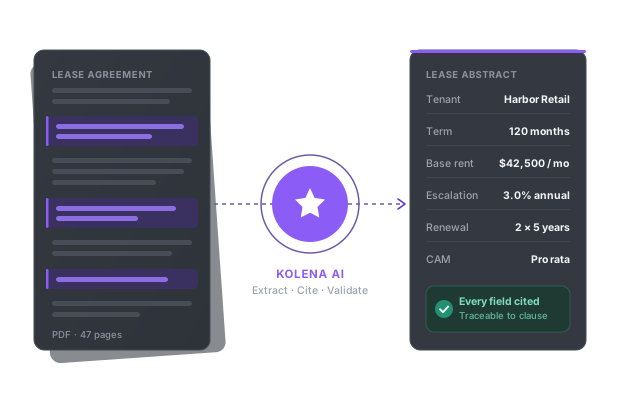
The core workflow difference is in what gets returned. WNS's BPS delivery produces outputs against SLAs — a processed claim, a checked policy, a completed F&A reconciliation. An AI document platform produces outputs with citations: every extracted field — policy number, coverage limit, exclusion clause, claimant data, financial line item — is linked to the exact location in the source document where it was read. The output is not just complete; it's auditable at the field level.
For insurance organizations with carrier audit requirements, state regulatory frameworks, or compliance programs, that distinction matters regardless of how well WNS or Capgemini meets its SLAs. For F&A teams processing large volumes of invoices, contracts, or financial documents, the same logic applies: structured, cited outputs that feed downstream into ERP or analytics systems without requiring manual validation.
The second change is in the relationship between cost and volume. WNS's managed services model prices on staffing and contracted capacity. An AI platform processes twice the volume at the same subscription rate. For operations with variable document flow — CAT seasons, acquisition activity, renewal cycles — that decoupling matters.
Related articles: genpact alternative and resourcepro alternative.
Why the Acquisition Is a Natural Evaluation Moment
Most BPS relationships renew through inertia: the cost of switching feels higher than the cost of staying, and the existing team has institutional knowledge. Acquisitions reset that calculus. Account teams turn over. Pricing conversations reopen. The organization you contracted with is substantively different from the one now delivering the service.
The practical path for any WNS client currently in this position:
- Identify the most document-intensive workflow in the current WNS scope — claims intake, underwriting submission review, or F&A document processing are typical candidates.
- Run a parallel POC on an AI platform during the integration period — while Capgemini and WNS teams are mid-integration, the disruption to your existing operation is low, and the comparison data is easier to generate.
- Make the contract decision with data — cost per document, turnaround time, audit-trail depth, and CAT-period performance, not assumptions inherited from a relationship signed with a company that no longer independently exists.
How Kolena Works
Kolena is an AI document automation platform built for insurance, financial services, lending, and commercial real estate teams that run document-heavy workflows through BPS contracts. Rather than managing offshore teams or navigating a managed services engagement, Kolena deploys AI agents that read your documents, apply your specific rubric or extraction template, and return structured outputs — with every field cited to its exact location in the source document.
For organizations currently in the WNS-to-Capgemini transition, Kolena handles the workflows WNS was typically contracted for: claims and FNOL document processing, underwriting submission review, policy checking, and F&A document extraction. The platform handles any format — PDFs, scans, emails, spreadsheets — and integrates with the AMS, ERP, and data systems already in use. Setup for a specific workflow takes days. There's no integration period, no account team handoff, and no offshore dependency to manage. Kolena is SOC 2 Type II certified, processes data onshore, and never trains on customer data.