Companies searching for an EXL Service alternative for insurance or financial services document workflows are usually asking a specific question: is there a way to automate the extraction of data from documents — claims files, policy packets, loan packages, underwriting submissions — without taking on an enterprise analytics transformation engagement? The answer is yes, but understanding why requires understanding what EXL actually is and what it isn't.
This is part of a series of articles about BPO Replacement.
What EXL Does
EXL Service (NASDAQ: EXLS) is a publicly traded data and AI company with more than 55,000 employees, serving clients in insurance, banking, financial services, and healthcare. They are a 2025 Gartner Magic Quadrant Leader for Finance and Accounting BPO — their fourth consecutive year in that position — and a recognized Leader across Everest Group's P&C Insurance BPS, NelsonHall's P&C Analytics & AI, and HFS Insurance Services assessments.
What distinguishes EXL from traditional BPO firms is the degree to which they've embedded analytics and AI throughout their delivery. More than half of EXL's revenue now comes from data and AI-led services. In insurance, their capabilities span claims management, underwriting support, policy administration, actuarial services, and risk analytics — combining generative AI, machine learning, and cloud platforms with deep industry expertise.
EXL has built real AI capability. That's not in dispute. The question is whether their AI solves the specific problem that drives most organizations to search for an alternative.
Nine free AI document tools — pick your workflow
Analytics AI Versus Document Extraction AI
EXL's AI is strongest where data already exists in structured or semi-structured form: modeling loss ratios, predicting churn, optimizing claims reserves, generating reporting insights. These are analytics problems, and EXL is genuinely well-positioned to solve them at enterprise scale.
The problem that drives organizations to search for an EXL alternative is different: documents arrive as unstructured PDFs, scanned images, or email attachments containing the data — and someone has to read them, extract the relevant fields, and produce a structured output before any analytics can begin. A claims packet. A loan file. An underwriting submission. An insurance policy for checking.
EXL's approach to these workflows is a managed services model: a team of offshore specialists, augmented by AI tools, processes documents and delivers outputs against SLAs. That's a legitimate approach for enterprise clients with multi-tower outsourcing relationships. It's a poor fit for mid-market organizations — regional carriers, MGAs, commercial real estate operators, private lenders — that need to automate one document workflow in weeks, not transform their analytics infrastructure over quarters.
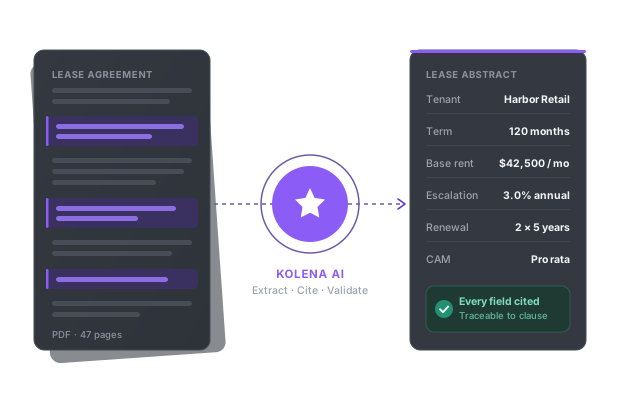
A purpose-built AI document platform operates differently: it reads the documents directly, applies a specific extraction rubric, and returns structured outputs with every field cited to its exact location in the source. No offshore team. No managed services overhead. The platform is the delivery mechanism.
How They Compare
| EXL Service | Purpose-built AI document platform | |
|---|---|---|
| Core AI strength | Analytics, modeling, data transformation across enterprise operations | Unstructured document extraction with field-level citations |
| Delivery model | Managed services; offshore specialists + AI tools | AI is the delivery mechanism; no staffing layer |
| Market fit | Enterprise; multi-tower outsourcing relationships | Mid-market; focused workflow automation |
| Implementation timeline | Multi-quarter transformation programs | Days to weeks for a specific workflow |
| Audit trail | SLA and throughput reporting | Field-level citations to exact source location |
| Cost model | Managed services contract; enterprise pricing | Platform subscription; scales with usage |
| Data processing | Offshore delivery centers (India, Philippines, Eastern Europe) | Onshore |
| Training on your data | Check contract terms | No training on customer data |
What Changes With a Purpose-Built Document Platform
The shift isn't from less AI to more AI — it's from analytics-layer AI to extraction-layer AI. Organizations that need their claims documents, loan packages, or underwriting submissions read, extracted, and structured before analysis can happen need a different tool than one optimized for the analysis itself.
A purpose-built document platform handles the extraction problem specifically. Every field — coverage limit, effective date, exclusion clause, borrower entity, lease term — is linked to the exact document location where it was found. That output feeds downstream into whatever analytics, underwriting, or compliance system the organization uses. EXL's analytics tools are well-suited to the next step; a document AI platform handles the step before it.
For mid-market organizations that don't have the procurement infrastructure to stand up an EXL engagement, or that need one workflow automated now rather than in a transformation roadmap, that distinction is the practical decision point.
Related articles: genpact alternative and resourcepro alternative.
When EXL Is the Right Answer
If you are a large insurer or financial services firm with complex, multi-line analytics needs — loss modeling, actuarial work, enterprise reporting transformation, multi-tower outsourcing — EXL's combination of data science depth and managed services delivery is a genuine fit. Their recognition across Gartner, Everest, and HFS reflects real capability at that tier.
If you are a mid-market carrier, MGA, commercial lender, or investment manager that needs to automate a specific document workflow — not transform your analytics infrastructure — a purpose-built platform deploys faster, costs less, and delivers the audit trail that managed services models don't.
How Kolena Works
Kolena is an AI document automation platform built for the extraction problem that precedes analytics: reading unstructured documents, applying a specific rubric, and returning structured outputs with every field cited to the exact location in the source document.
Rather than staffing a team or embedding into a multi-quarter managed services program, Kolena deploys AI agents that handle the document workflows where extraction accuracy and audit trail depth matter most: insurance claims and FNOL triage, underwriting submission review, commercial loan file processing, lease abstraction, and IC memo drafting for investment firms. The platform handles any document format — PDFs, scans, emails, spreadsheets, images — and integrates with the systems already in use. Setup for a specific workflow takes days, not quarters.
Kolena is SOC 2 Type II certified, processes data onshore, and never trains on customer data. For organizations that have evaluated EXL and found the engagement model out of reach, or that need a focused document workflow automated without a broader transformation commitment, Kolena is built for that specific problem.