What Is Hard Money in Real Estate Lending?
Hard money typically refers to a short-term, asset-based real estate loan provided by private investors or companies rather than traditional banks. It is approved based on the value of the property rather than your personal credit score, and is mostly used by house flippers or investors who need rapid access to capital.
The defining characteristic of hard money is its accessibility for projects or borrowers who might not qualify for conventional financing. This could include situations where the property is distressed, the borrower needs funds quickly, or the transaction doesn’t fit standard lending criteria.
The trade-off for this flexibility is higher interest rates, shorter loan terms, and increased fees, making hard money a tool best suited for specific investment strategies rather than long-term financing.
This is part of a series of articles about loan processing
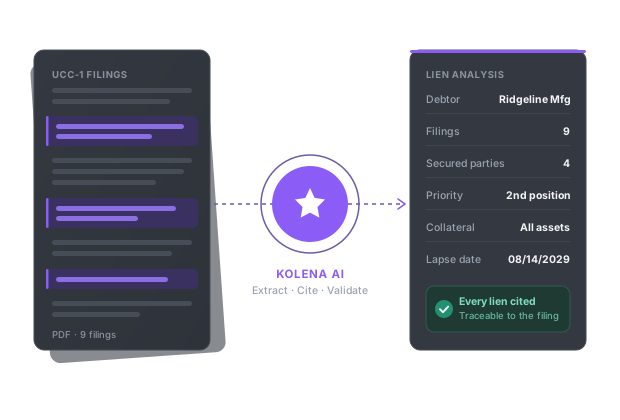
Analyze your first UCC filing in minutes with AI
How Hard Money Loans Work
There are several types of hard money loans.
1. Property-Backed Lending
Hard money loans are fundamentally different from traditional loans because they rely on the property’s value as the main basis for approval. Instead of scrutinizing the borrower’s income, employment, or credit history, hard money lenders focus on the property that will secure the loan. The evaluation process typically involves a property appraisal or broker price opinion to determine current market value and the property’s potential after planned improvements.
This asset-based approach allows borrowers to access capital even if they have poor credit or lack verifiable income, provided the property offers sufficient security for the lender. For investors, this means projects that would be rejected by banks, such as major rehabs or purchases of distressed assets, can still be financed. Lenders reduce risk by lending less than the property’s value, ensuring they can recover their investment if the borrower defaults.
2. Loan-to-Value and Loan-to-Cost
Loan-to-value (LTV) and loan-to-cost (LTC) are key metrics in hard money lending. LTV is the ratio of the loan amount to the current appraised value of the property, while LTC refers to the loan amount compared to the total project cost, including purchase and renovation expenses. Hard money lenders typically set maximum LTVs between 60% and 75%, meaning they will lend only a portion of the property’s value to protect their position.
LTC is particularly relevant for projects involving renovations, such as fix-and-flip investments. Here, the lender may fund a percentage of both the purchase price and the rehab budget, often requiring the borrower to contribute some capital upfront. These conservative lending ratios ensure that lenders have a cushion if the project does not go as planned, reducing the risk of loss if the property must be sold after default.
3. Short Loan Terms
Hard money loans are short-term solutions, with typical loan terms ranging from six months to three years. This short duration reflects the intended use of these loans: to bridge a financing gap, complete a rapid property improvement, or enable a quick resale. Borrowers are expected to repay the loan either by selling the property, refinancing with long-term debt, or using other exit strategies within the agreed timeframe.
Because of these compressed timelines, hard money loans come with strict repayment schedules and often include balloon payments at the end of the term. Borrowers need a clear plan for how they will exit the loan, making these products unsuitable for buy-and-hold investors who cannot secure refinancing or complete a sale within the loan period.
4. Higher Interest Rates and Points
One of the most notable features of hard money loans is their cost. Interest rates are significantly higher than those offered by banks, often ranging from 8% to 15% or more, depending on the lender and risk profile. In addition to interest, borrowers usually pay “points,” upfront fees calculated as a percentage of the loan amount, with one point equal to 1%. It is common for hard money lenders to charge two to four points at closing.
These higher costs reflect the increased risk and reduced documentation requirements associated with hard money lending. Lenders accept less borrower information and move faster, but they offset this by charging more. For borrowers, this makes hard money an expensive tool, best used when the speed and flexibility outweigh the higher interest and fees.
Common Uses of Hard Money in Real Estate
Fix-and-Flip Projects
Hard money is popular among real estate investors engaged in fix-and-flip projects. These investors acquire properties in need of repair, renovate them quickly, and resell for a profit. Traditional lenders are often reluctant to finance such deals because the properties may be in poor condition and the investment timeline is short. Hard money fills this gap, offering fast funding based on the property’s after-repair value.
The structure of hard money loans aligns with the needs of fix-and-flip investors:
Short loan terms match the rapid turnaround required for these projects, and the ability to finance both the purchase and renovation costs simplifies the process.
Investors can move quickly on undervalued properties and compete with cash buyers, then pay off the loan through the sale of the improved property.
Bridge Loans
Bridge loans are another common use for hard money in real estate. These loans serve as temporary financing solutions, bridging the gap between the purchase of a new property and the arrangement of long-term financing or sale of an existing property. Hard money lenders can provide bridge loans in situations where timing is critical and conventional lenders would take too long to approve funding.
The speed and flexibility of hard money bridge loans allow investors and homeowners to act on time-sensitive opportunities:
For example, a buyer may use a hard money bridge loan to purchase a property before their current home sells.
Alternatively, an investor may use it to close quickly on a new acquisition while waiting for permanent financing.
Rental Property Acquisition and Rehab
Hard money can be used to acquire and rehabilitate rental properties that do not qualify for conventional financing due to condition or occupancy issues. Investors often use hard money to purchase distressed properties, complete necessary repairs, and stabilize occupancy, making the property eligible for a traditional mortgage or agency loan later.
This approach allows investors to turn non-bankable properties into income-producing assets:
The short-term nature of hard money is not a drawback in this case, since the plan is to refinance into a long-term loan once the property is rent-ready and meets lender requirements.
This strategy requires careful planning and execution to ensure the project can be completed and refinanced within the loan term.
Distressed or Non-Bankable Properties
Hard money lenders are often the only financing option for properties that are distressed or otherwise unqualified for traditional loans. This includes properties with significant physical defects, legal issues, or those lacking stable tenants. Banks typically avoid these deals due to risk or regulatory constraints, but hard money lenders are more willing to assess the asset’s potential after improvements.
Hard money remains useful for properties that banks avoid:
For borrowers, this opens up opportunities to acquire undervalued or challenging properties, provided they have a plan to resolve issues and add value.
Once stabilized, these properties can be sold for a profit or refinanced with a lower-cost loan.
Competitive Cash-Like Offers
In highly competitive real estate markets, buyers who can present cash or cash-equivalent offers have an advantage:
Hard money loans enable investors to make offers with the speed and certainty of cash.
The underwriting process is simplified and not contingent on lengthy bank approvals.
Sellers often prefer these offers, as they reduce the risk of deal fallout and enable faster closings.
While hard money is more expensive than traditional financing, the ability to secure desirable properties quickly and reliably can outweigh the additional cost, particularly for experienced investors with a clear exit strategy.
Hard Money vs. Traditional Real Estate Loans
Hard money loans differ from traditional real estate loans in several key ways.
Traditional loans, such as mortgages from banks or credit unions, are typically based on the borrower’s credit score, income, employment history, and debt-to-income ratio. The approval process is thorough and often slow, involving extensive documentation and underwriting. Traditional real estate loans offer lower interest rates and longer terms, often 15 to 30 years, making them suitable for homeowners and long-term investors.
Hard money loans are asset-based, focusing primarily on the property’s value and the project’s potential, with less emphasis on the borrower’s financial profile. These loans have higher interest rates, more upfront fees, and shorter terms, usually one to three years. This makes hard money best suited for short-term projects or situations where conventional financing is not available or practical.
Related articles: ai ucc filing review and loan underwriting software.
Pros of Hard Money in Real Estate Lending
Hard money loans offer advantages that make them valuable in specific real estate situations. Their speed, flexibility, and focus on the property rather than the borrower allow investors to pursue opportunities that might not be possible with conventional financing. However, these benefits come at a cost, and borrowers must weigh the advantages against the higher expenses and shorter repayment timelines:
Pros
Fast approval and funding: Loans can often be approved and funded in days rather than weeks or months.
Flexible underwriting: Lenders focus primarily on the property and project, making financing available to borrowers with imperfect credit or nontraditional income.
Access to distressed properties: Hard money can finance properties that traditional lenders consider too risky due to condition, vacancy, or other issues.
Simplified documentation: The application process usually requires less paperwork than a conventional mortgage.
Supports value-add strategies: Investors can finance acquisitions and renovations.
Competitive purchasing power: Quick closings can make offers more attractive to sellers.
Cons
Higher interest rates: Borrowing costs are higher than those of traditional real estate loans.
Upfront fees and points: Lenders commonly charge origination points and other fees that increase the total cost of financing.
Short repayment periods: Loan terms are typically measured in months rather than decades.
Risk of default: If a project is delayed or does not perform as expected, borrowers may struggle to repay the loan on time.
Lower loan-to-value ratios: Borrowers often need to contribute more cash upfront because lenders generally finance only a portion of the property's value or project cost.
Not suitable for long-term financing: The high costs and short terms make hard money a poor choice for long-term property ownership without a clear exit strategy.
Best Practices for Using Hard Money in Real Estate
Here are some of the ways that borrowers and investors can better handle the risks associated with hard money loans.
1. Start with a Clear Exit Strategy
Hard money loans are short-term by design, so every borrower should know how the loan will be repaid before closing. Common exit strategies include selling the property after renovations, refinancing into a conventional mortgage, or using proceeds from another transaction. The lender will often evaluate the feasibility of the exit plan as part of the approval process. A weak or unrealistic exit strategy is a common cause of project failure. Investors should identify potential risks that could delay a sale or refinancing and develop contingency plans.
How to implement:
Define how the loan will be repaid before closing the transaction.
Evaluate both primary and backup exit options.
Confirm refinancing eligibility early if refinancing is the planned exit.
Monitor project milestones to ensure the exit timeline remains realistic.
Account for potential delays in sales, financing, or construction.
2. Run Conservative Deal Numbers
Successful hard money projects depend on accurate financial projections. Investors should estimate acquisition costs, renovation expenses, financing costs, holding costs, taxes, insurance, and selling expenses before committing to a deal. Profit projections should be based on realistic assumptions rather than best-case scenarios. It is also wise to build a margin of safety into the analysis. Renovations often cost more than expected, and market conditions can change during the project.
How to implement:
Base projections on realistic market values and sale prices.
Include all financing, renovation, holding, and transaction costs.
Build contingency reserves into the project budget.
Stress-test returns under less favorable market conditions.
Recalculate profitability before closing if assumptions change.
3. Keep Leverage Manageable
Although hard money lenders may finance a significant portion of a project's cost, maximizing leverage is not always the best strategy. Borrowers who contribute more equity typically have greater flexibility and a stronger financial cushion if the project encounters delays or cost overruns. Lower leverage also improves the likelihood of successful refinancing or resale. Projects financed too aggressively can become difficult to exit if property values decline or lending standards tighten.
How to implement:
Contribute sufficient equity rather than maximizing loan proceeds.
Maintain cash reserves for unexpected costs or delays.
Avoid relying on future appreciation to make the project profitable.
Review loan-to-value and loan-to-cost ratios carefully.
Ensure the project remains viable even if property values decline.
4. Build a Realistic Renovation Budget and Timeline
Many hard money loans are used for properties that require repairs or improvements. Underestimating renovation costs or the time required to complete the work can create challenges, particularly because interest and holding costs continue to accumulate throughout the project. Investors should obtain detailed contractor estimates, account for permits and inspections, and include contingency reserves for unexpected issues. A realistic timeline should consider material delays, labor availability, and local approval processes.
How to implement:
Obtain detailed bids from qualified contractors before closing.
Include contingency funds for unforeseen repairs and change orders.
Account for permits, inspections, and regulatory approvals.
Factor in material procurement and labor availability.
Review progress regularly and update timelines when conditions change.
5. Prepare Documents Before Applying
Hard money lending involves less documentation than conventional financing, but borrowers should still be prepared to provide key information quickly. Typical requirements may include purchase contracts, renovation plans, property details, contractor bids, insurance information, and evidence of available cash reserves. Having these materials organized in advance can speed up approval and funding. Since hard money is often used in competitive situations where timing matters, borrowers who can respond quickly to lender requests are better positioned to secure financing and close transactions without unnecessary delays.
How to implement:
Organize purchase agreements, property information, and project plans.
Gather contractor bids, renovation budgets, and supporting estimates.
Prepare proof of funds for down payments and reserves.
Maintain current insurance and entity formation documents if applicable.
Create a complete digital loan package to respond quickly to lender requests.
How AI Document Automation Supports Hard Money and Private Lending
Hard money and private lending often depend on speed, but processing loan files can still require manual work. Teams must review appraisals, verify property information, check loan requirements, compare documents, and identify exceptions before making lending decisions. AI document automation helps reduce this workload by extracting data from loan files and organizing it into structured formats that are easier to review and analyze.
Common use cases for AI in financial documentation include:
Appraisal review: AI systems can automatically pull key property information such as square footage, lot size, bedroom and bathroom counts, appraised values, comparable sales, and other property characteristics. Instead of manually entering information from appraisal reports, lending teams can access structured data immediately, reducing processing time and minimizing data entry errors.
Underwriting: AI can also support underwriting by reviewing loan files against predefined lending criteria. Documents can be analyzed automatically to identify missing information, flag exceptions, and determine whether a file meets established requirements. This creates a more consistent review process and reduces the need for manual checklist-based evaluations.
Loan tape and validation: For lenders managing multiple loans, automation can assist with loan tape creation and validation. Data can be extracted from various documents, compared against existing records, and checked for inconsistencies. Identifying discrepancies early helps improve data quality and reduces issues during servicing, reporting, or secondary market transactions.
Portfolio-level due diligence: Rather than reviewing large numbers of loan files manually, lenders can run document checks across entire portfolios and quickly identify loans that require additional attention. This allows teams to focus on exceptions and higher-risk files instead of routine document review.
Many AI document automation platforms also provide audit trails, reasoning logs, and source references that make it easier to trace how information was extracted and evaluated. Combined with security controls such as encryption, access management, and compliance-focused governance features, these capabilities help lenders improve operational efficiency while maintaining transparency and control over the review process.
How to Speed Up Hard Money and Private Lending Decisions with Kolena
Hard money and private lending move fast, but the document review behind every deal often doesn't. Kolena's AI for Financial Services automates analysis, extraction, and reporting across document-heavy lending workflows, so teams can review loan files, appraisals, and disclosures faster, reduce risk, and stay audit-ready. Financial institutions handle complex processes from investment due diligence to compliance testing, and Kolena turns weeks of manual review into hours while improving accuracy and transparency.
Key capabilities of Kolena for Financial Services:
Deal due diligence: Extracts key data across entire deal packages to support investment analysis and lending decisions, so underwriters can evaluate a property and borrower file without manual data entry.
Investment memo generation: Summarizes PPMs, legal docs, appraisals, and reports into professional-grade memos automatically, and generates investor updates and quarterly reports from templates.
Compliance testing: Reviews disclosures, statements, and advertisements against regulations automatically, accelerating internal audit and compliance checks before funds are released.
Portfolio reporting: Aggregates data from multiple sources into structured portfolio updates and risk dashboards for lenders managing multiple loans.
Source-cited accuracy: Provides confidence scoring and source citations for every result, so each extracted value can be traced back to its origin.
Audit readiness: Produces outputs that are traceable and regulator-compliant, giving lending teams consistent, defensible records.
Scalability: Processes hundreds of documents simultaneously with the same team, with quick deployment that requires no IT overhaul.
Real estate firms, insurers, banks, and financial institutions cut turnaround times by 95%+ with Kolena's AI-powered document automation. See how Kolena accelerates lending analysis and compliance testing