Private lenders are using AI to cut UCC filing review labor by 96% — AI reads across lien searches, collateral descriptions, entity documents, and tax-lien records in multiple formats and jurisdictions at once and flags the discrepancies, removing the manual cross-referencing that consumes analyst time on every deal. One private-lending customer achieved exactly that 96% reduction.
This is for private lenders, hard-money lenders, bridge lenders, and commercial mortgage originators, where UCC review is a fixed tax on every transaction.
This is part of a series of articles about Loan Processing.
The Pain: High-Volume Pattern-Matching on Every Deal
UCC filing review is exacting, repetitive work. It means verifying lien searches, checking that collateral descriptions match across documents, validating entity documents, and confirming tax liens — and doing it across multiple document types and jurisdictions that each format the same information differently. It's pattern-matching at volume: most of it is routine, but the one discrepancy that matters — a mismatched debtor name, a collateral description that doesn't line up, an unexpected prior lien — is exactly what the review exists to catch. Done manually, it's slow and consumes analyst hours on every single deal.
Analyze your first UCC filing in minutes with AI
How AI Handles It
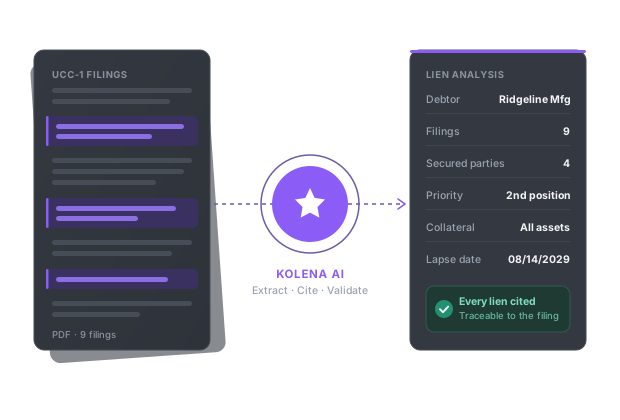
AI reads across all the document types and jurisdictions simultaneously, matches debtor and entity details, compares collateral descriptions, and flags discrepancies — no manual side-by-side cross-referencing. Because the same checks run identically every time, the review is consistent rather than dependent on which analyst pulled the file, and every flag is cited to the exact document and field behind it, so verification is fast and auditable.
| Factor | Manual UCC review | AI UCC filing review |
|---|---|---|
| Cross-referencing | Manual, document by document | Across all docs and jurisdictions at once |
| Labor (documented) | Significant analyst time per deal | 96% reduction |
| Consistency | Varies by analyst | Same checks every deal |
| Discrepancy flags | Found by careful reading | Surfaced automatically, each cited |
| Data residency | Varies | Onshore, SOC 2 Type II |
For a high-volume lender, that 96% labor reduction turns UCC review from a recurring bottleneck into a fast, repeatable step. Kolena also offers a free AI UCC filing review tool, so lenders can see the workflow on their own documents before committing to a full deployment.
What Changes in the Workflow
When UCC review stops consuming analyst hours per deal, the analysts are freed for judgment work, and deals move faster because the review is no longer a queue. The consistency matters too: a rotating manual or offshore team introduces variance precisely on the pattern-matching that UCC review depends on, while AI applies the same logic to every filing. And because each flag is sourced, a reviewer can resolve it in seconds rather than re-pulling the underlying documents.
Who Should Adopt This — and Who Shouldn't
Adopt it when UCC review volume is high and recurring — the labor savings compound with every deal. A lender doing very few transactions a month may find manual review manageable. As always, AI handles the reading, matching, and flagging; the final legal and credit judgment on a flagged discrepancy stays with your team.
Related articles: loan underwriting software and ai bank statement analysis.
How Kolena Works
Kolena is an AI document automation platform built for private lenders and commercial mortgage originators. Lien searches, UCC filings, collateral descriptions, entity documents, and tax-lien records go in; a structured review with discrepancies flagged and each finding cited to its source comes out in minutes.
It reads any format across jurisdictions and pushes structured output into your loan-origination workflow, with every flag linked to the exact document and field that triggered it. Every run produces a full audit trail: not just what was extracted, but the specific line, field, or clause that justified each data point. SOC 2 Type II certified, onshore processing, no training on customer data.