AI mortgage document processing reads the full loan file — 1003 application, income documentation, tax returns, bank statements, appraisal, title commitment — extracts structured data, flags missing items and inconsistencies, and accelerates time to clear-to-close, all while keeping sensitive borrower data onshore. Under RESPA and TRID timelines, that speed is a regulatory requirement, not just a convenience.
This is for mortgage lenders, community banks, and credit unions with residential and commercial mortgage origination.
This is part of a series of articles about Loan Processing.
The Pain: Large Files, Hard Deadlines, Sensitive Data
A mortgage file is a large, multi-document package, and manual review of it creates two problems. The first is delay: reading and verifying a 1003, income docs, tax returns, bank statements, an appraisal, and a title commitment by hand takes time the TRID clock doesn't give you, and a missed disclosure deadline is a compliance event with cure costs. The second is data exposure: mortgage files are dense with PII — SSNs, income, account data — so routing them to an offshore team puts that data in another jurisdiction, a growing concern for lenders and examiners alike.
Analyze your first UCC filing in minutes with AI
How AI Handles It
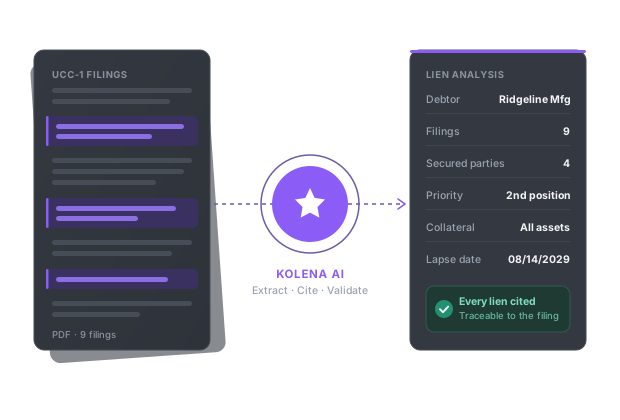
AI reads the full mortgage package, extracts the structured data each document carries, and flags missing items and inconsistencies — an income figure that doesn't match across documents, an absent disclosure, a title issue — so the file moves toward clear-to-close faster. Processing happens onshore, and every extracted value is cited to its source document, producing the audit trail a compliance review expects.
| Factor | Manual / offshore review | AI mortgage document processing |
|---|---|---|
| Turnaround vs. TRID/RESPA | Slow; risks deadline misses | Fast, easing SLA compliance |
| Missing-item detection | Depends on reviewer | Flagged systematically |
| PII / data residency | Offshore jurisdiction exposure | Onshore, SOC 2 Type II |
| Consistency | Varies by analyst (15–30% attrition) | Same extraction rubric every file |
| Audit trail | Manual, if any | Field-level citation to each document |
Keeping processing onshore isn't a nice-to-have for mortgage files — it directly removes the data-residency exposure that comes with offshoring documents full of borrower PII.
What Changes in the Workflow
Faster, onshore processing changes the risk profile of the pipeline. TRID and RESPA deadlines become easier to hold because review is hours, not days. Volume swings — the refi waves and seasonal surges that come with the rate cycle — are absorbed without temporary staffing, because AI has no fixed throughput ceiling. And the documented audit trail means a post-close or examiner review can trace every extracted figure to its source without reconstructing the file by hand.
Who Should Adopt This — and Who Shouldn't
Adopt it when TRID/RESPA deadlines are tight, when PII data residency is a compliance concern, or when rate-cycle volume strains a fixed team. A very low-volume originator with steady flow may manage manually. AI handles extraction, verification, and gap-flagging; the underwriting and approval decisions stay with your loan officers and underwriters.
Related articles: ai ucc filing review and loan underwriting software.
How Kolena Works
Kolena is an AI document automation platform built for mortgage lenders, community banks, and credit unions. 1003 applications, income documentation, tax returns, bank statements, appraisals, and title commitments go in; a structured loan file with missing items and inconsistencies flagged comes out, processed onshore.
It reads any format and pushes structured output into your LOS, keeping borrower PII onshore, with every field cited to its source document for a TRID- and RESPA-ready audit trail. Every run produces a full audit trail: not just what was extracted, but the specific line, field, or clause that justified each data point. SOC 2 Type II certified, onshore processing, no training on customer data.