AI for bank statement analysis reads any bank's statement format, normalizes the data, and returns a structured cash-flow summary — revenue, average daily balances, NSF frequency, and large deposits and withdrawals across 12–24 months — with every line item cited to the source statement. It turns a manual, format-inconsistent task into a fast, consistent step for loan underwriting.
This is for commercial lenders, private lenders, SBA lenders, and community banks underwriting business loans, especially where bank statements are primary income documentation.
This is part of a series of articles about Loan Processing.
The Pain: Manual, Slow, and Format-Inconsistent
Spreading bank statements by hand is one of the more tedious tasks in underwriting. An analyst works through 12–24 months of statements to pull revenue, cash-flow patterns, average daily balances, NSF occurrences, and notable deposits and withdrawals — and every bank formats its statements differently, so there's no single template that works. The inconsistency is the core problem: a process calibrated to one bank's layout slows down or makes errors on the next, and an offshore team calibrated to common formats struggles on the long tail.
Analyze your first UCC filing in minutes with AI
How AI Handles It
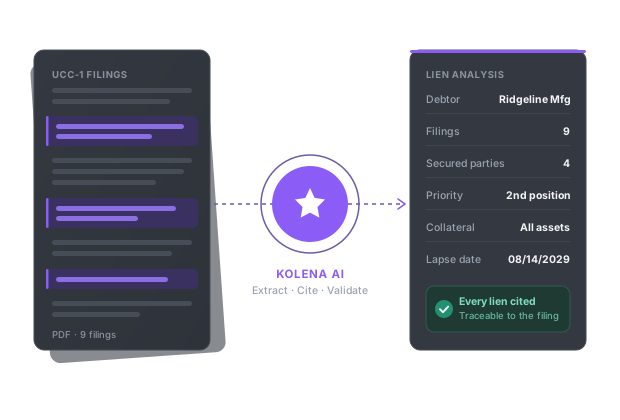
AI reads statements regardless of format, normalizes the figures into a consistent structure, and returns a cash-flow summary with each line item cited back to the source statement. Revenue, average daily balance, NSF frequency, and large transactions are extracted uniformly across every account and every bank, so the analyst gets a clean, comparable view rather than a stack of mismatched layouts to reconcile.
| Factor | Manual statement spreading | AI bank statement analysis |
|---|---|---|
| Format handling | Re-learned per bank | Reads any bank's statement format |
| Turnaround | Hours per file across 12–24 months | Minutes |
| Consistency | Varies by analyst and layout | Normalized uniformly across accounts |
| Extracted signals | Revenue, balances, NSFs — by hand | Same signals, automatically, each cited |
| Data residency | Varies | Onshore, SOC 2 Type II |
For SBA and commercial underwriting, that consistency is what makes statement analysis dependable: the same cash-flow signals, extracted the same way, every time.
What Changes in the Workflow
When statement spreading drops from hours to minutes and becomes format-independent, underwriting throughput rises without added headcount, and decisions rest on consistent data rather than whatever a particular analyst pulled from a particular layout. Because every figure is cited to the source statement, a reviewer or auditor can verify the cash-flow summary directly instead of re-spreading the statements.
Who Should Adopt This — and Who Shouldn't
Adopt it when bank statements are a primary income source in your underwriting, when you handle statements from many different banks, or when statement volume is high. A lender that rarely relies on statement-based income may not need it. As elsewhere, AI extracts and normalizes the data; the credit judgment on what the cash flow means stays with your underwriters.
Learn more about ai ucc filing review.
How Kolena Works
Kolena is an AI document automation platform built for commercial, private, SBA, and community-bank lenders. 12–24 months of bank statements in any format go in; a structured cash-flow summary — revenue, average daily balances, NSF frequency, large deposits and withdrawals — comes out in minutes, each line cited to its source statement.
It reads any bank's statement format and pushes structured output into your spreading and loan-origination systems, normalized uniformly across every account. Every run produces a full audit trail: not just what was extracted, but the specific line, field, or clause that justified each data point. SOC 2 Type II certified, onshore processing, no training on customer data.