ChatGPT can abstract a single lease well — read the full document with its amendments in one pass and produce a reasonable-looking summary — but a 300-lease acquisition portfolio doesn't fail on any one lease. It fails on the two-hundredth lease being abstracted a little differently than the tenth, in a way nobody notices until someone downstream relies on it.
That gap between "reads one lease accurately" and "abstracts a portfolio consistently" is where lease abstraction projects built on a general assistant tend to stall, and it's worth walking through concretely, because the failure pattern isn't about the model getting a lease wrong.
This is part of a series of articles about Lease Abstraction.
What ChatGPT Does Well for Lease Abstraction
ChatGPT has real, documented capabilities that make it a genuinely useful starting point for lease abstraction work.
- GPT-5.6's flagship models carry a 1.05-million-token context window as standard, per OpenAI's documentation — enough to hold a complete lease with every amendment and side letter in a single pass, without splitting the document into chunks that risk losing a cross-reference between the original term and a later amendment.
- A Custom GPT can encode an abstraction template — escalation treatment, co-tenancy thresholds, termination rights, assignment and sublease restrictions — as a reusable configuration, so an analyst doesn't re-explain the house methodology in every conversation.
- Apps and connectors can reach lease files stored in SharePoint, Google Drive, or a shared mailbox directly, under the analyst's existing permissions, without a manual export step.
- ChatGPT Work can run a multi-step task against a folder of lease files, producing a first-pass abstract for each one and continuing to work while an analyst does something else.
Try our AI-powered lease abstraction tool
Where the Portfolio, Not the Lease, Starts to Break
Lease abstraction at scale fails in a predictable sequence, and none of the four points below are a single lease being misread — they're what happens once dozens or hundreds of abstracts have to agree with each other.
- Around lease 30, a co-tenancy threshold gets recorded as a percentage of gross leasable area in one abstract and as an absolute square footage figure in another — each defensible read in isolation, but the two can't be aggregated into a single portfolio-level co-tenancy exposure report without someone going back through both.
- Around lease 85, an expiration date gets pulled from a renewal option rather than the base term, because the two sit close together in the amendment and both look like a plausible lease-end date. The abstract is wrong, it's confident, and nothing in the process contradicts it.
- Around lease 150, the analyst who wrote the Custom GPT's instructions is reassigned to a different deal. A colleague inherits the configuration, but not the string of small corrections — how to treat a co-tenancy remedy period, which amendment supersedes which — that only ever lived in the first analyst's head. Abstracts from this point forward shift slightly.
- At lease 380, a lender's diligence team asks which version of the abstraction methodology produced the summary for one specific property, and whether that value was independently checked. The abstract exists. The instruction version, the reviewer, and the verification status behind it do not.
None of this is a model failure a newer version of ChatGPT fixes. It's what happens when reading documents well and abstracting a portfolio consistently are treated as the same problem.
Why Consistency and Verification Cost More Than the Abstract Itself
Producing an abstract and confirming an abstract is correct are two different jobs, and only the first one is what ChatGPT, on its own, is doing when it reads a lease.
Every field on a lease abstract — base rent, escalation schedule, expiration, co-tenancy language, assignment restrictions — has to be trustworthy enough for someone to act on without re-reading the source lease. Without a citation binding each value to its exact location, verifying one field means opening the lease again. Across twenty fields and three hundred leases, that verification workload can equal or exceed the abstraction work the project was meant to eliminate — unless the output includes structural, not just requested, citations.
Who Owns the Abstraction Template, the Version History, and the Re-Validation
The abstraction instructions — whatever encodes your house treatment of percentage rent, amendment hierarchy, and co-tenancy remedies — are the most valuable and least protected part of a self-built deployment.
In a typical self-built setup, that logic sits in a Custom GPT with no version history connecting a given abstract back to the exact instruction wording that produced it, and per OpenAI's own documentation, GPT builders "cannot view user conversations" — no record of who last changed the configuration or how a specific past output was produced. And when ChatGPT's underlying model version changes, or a landlord switches lease templates, re-confirming that the abstraction instructions still produce correct output is work someone has to schedule — in practice, it's frequently work nobody is assigned to do at all.
Related articles: Scalable AI Lease Abstraction Providers and abstract commercial leases with ai.
ChatGPT-Based Lease Abstraction Compared With a Purpose-Built Platform
| Requirement | Self-Built on ChatGPT | Purpose-Built Platform |
|---|---|---|
| Reads a complex lease with amendments accurately | Yes | Yes |
| Consistent field formatting across hundreds of leases | Usually unmeasured | Enforced output structure |
| Abstraction template version history | Not built in, per OpenAI's documentation | Built in |
| Field-level citation to source clause | Instructed, not enforced | Enforced on every field |
| Cross-abstract portfolio aggregation | Requires uniform manual formatting | Native, from structured output |
| Exception routing for degraded scans or conflicting amendments | You build it | Built in |
| Re-validation when the model version changes | Your team | Vendor benchmarks and validates |
| Delivery into existing systems (Yardi, MRI) | Manual export | Structured push into existing systems |
| Audit record tying an abstract to logic and reviewer | You build it | Built in |
| Who owns the outcome | Your team | Shared with the vendor |
When Using ChatGPT Directly for Lease Abstraction Is the Right Choice
ChatGPT, used directly, is a good fit for lease abstraction work that stays occasional, single-document, or reviewed line-by-line by the person doing it.
- One-off review before a negotiation. Reading a single complex lease in full ahead of a renewal conversation is exactly what a large context window is built for.
- A specialist's recurring personal workload. One analyst abstracting their own small caseload, reviewing every output themselves, doesn't need portfolio-level consistency infrastructure.
- Prototyping an abstraction template. Testing a new methodology on a handful of leases before committing to a larger rollout is a legitimate, low-cost use of a Custom GPT.
- Low volume. Below roughly a hundred leases a year, the offshore and self-built alternatives — abstraction typically runs $5 to $100 per lease with a two-to-five-day turnaround in the outsourced market — often cost less than the infrastructure a purpose-built platform adds.
The dividing line isn't how complex any single lease is. It's whether the abstracts have to aggregate cleanly across a portfolio and hold up to a lender, an auditor, or a buyer's diligence team asking how a specific value was produced.
How Kolena Works
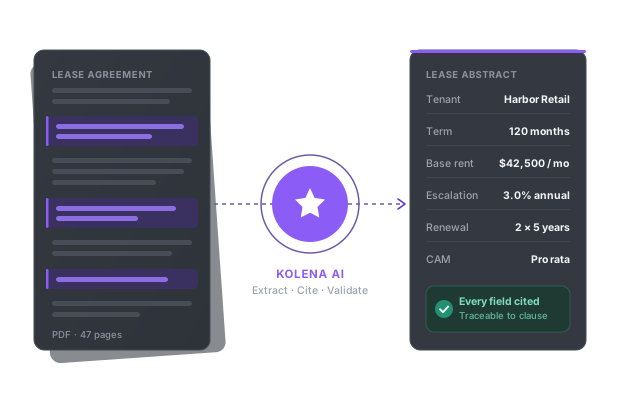
Kolena is an AI document automation platform built specifically for commercial real estate teams running lease abstraction at portfolio scale. Kolena deploys pre-built lease abstraction agents, fully customizable to your own abstract template, that read every lease and amendment in a set and return structured outputs — base rent, escalations, co-tenancy language, termination rights, assignment and sublease restrictions — with every field cited to its exact location in the source.
Kolena reads PDFs, scans, and emailed lease packages, and pushes structured abstracts into the systems teams already use, including Yardi, MRI, and Salesforce. Every run produces a full audit trail — the specific clause that justified each value, and which template version was in force when it ran. Kolena also benchmarks leading models against real document tasks and routes each step to the best performer, so a model version change is validated before it ever reaches your abstracts. Kolena is SOC 2 Type II certified, processes onshore, and does not train on customer data.
One lease abstraction customer realized approximately $100,000 in efficiency gains across 58 leases working this way — every lease abstracted to the same standard, cited the same way, ready for the diligence request before it arrives.