TL;DR: AI lease abstraction software uses AI, OCR, and NLP to extract and structure key lease terms in minutes. Best for scalable document automation: Kolena; best for small-volume abstraction: LeaseLens; best for CRE portfolio data: Prophia; best for accounting compliance: Trullion.
What Is AI Lease Abstraction Software?
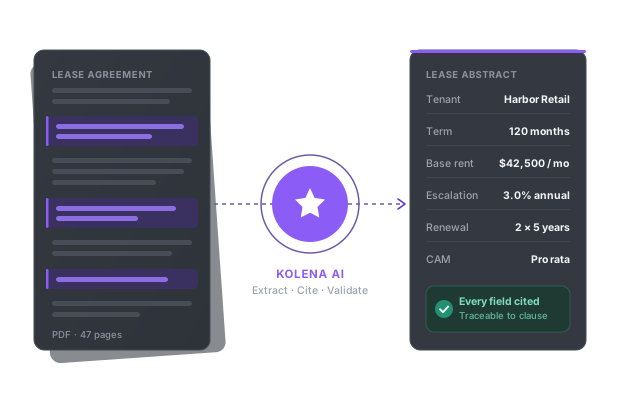
AI lease abstraction software turns long, complex property contracts into easy-to-read summaries and structured data. It uses Optical Character Recognition (OCR), a technology that converts scanned images of documents into editable text, then applies Artificial Intelligence (AI) to read the text, find key terms like rent amounts and renewal dates, and create a report.
AI lease abstraction technology addresses the challenges of document inconsistency and the volume of leases handled by property management and legal teams. By standardizing data extraction and reducing human error, it enables organizations to streamline operations and improve data accessibility. As a result, businesses can better manage lease compliance, reporting, and decision-making processes with minimal manual intervention.
Try our AI-powered lease abstraction tool
AI Lease Abstraction Software at a Glance
The table below summarizes the key differences between the software options covered in this article. We explore each of them in more detail below.
Category | Solution | Best For | Key Strengths | Things to Consider |
AI-First Lease Abstraction Software | Kolena | CRE teams automating lease abstraction and document workflows at scale | Customizable AI agents, batch processing, enterprise security | Built for recurring, higher-volume document workflows |
AI-First Lease Abstraction Software | LeaseLens | Quick, low-cost abstraction of a small number of leases | Free to view, 200+ standard fields, OCR, optional human review | Paid export; limited native system integrations |
AI-First Lease Abstraction Software | Prophia | CRE teams needing structured, portfolio-wide lease data | AI plus expert validation, source hyperlinks, interconnectivity | Focused on office, retail, and industrial CRE |
AI-First Lease Abstraction Software | MRI Contract Intelligence | Enterprises abstracting lease data for ASC 842/IFRS 16 | AI extraction, audit trail, ERP integration, multi-language | Enterprise-oriented; strongest within MRI's ecosystem |
Lease Administration & Accounting Platforms with AI Abstraction | Trullion | Finance and accounting teams abstracting leases for compliance | AI OCR, bespoke field extraction, source traceability | Slower on very large report runs; no lease duplication |
Lease Administration & Accounting Platforms with AI Abstraction | Yardi Smart Lease | Yardi Voyager users abstracting new commercial leases in-platform | Native Voyager integration, OCR extraction, AI assistant | Requires Voyager; new commercial leases at launch |
Lease Administration & Accounting Platforms with AI Abstraction | CoStar Real Estate Manager | Enterprise teams centralizing lease administration and accounting | Centralized data, automated critical dates, market data | Abstraction sits within a broader admin platform |
Lease Administration & Accounting Platforms with AI Abstraction | Accruent Lucernex | Multi-site occupiers managing real estate and equipment leases | Compliance automation, centralized data, ERP integrations | Interface learning curve; abstraction within a suite |
Benefits of AI Lease Abstraction Software
AI lease abstraction software helps organizations process lease documents faster and with greater consistency. By automating repetitive review tasks, it reduces manual effort while making lease data easier to search and analyze.
Faster lease processing: Extracts key lease terms in minutes instead of requiring hours of manual review.
Improved accuracy: Reduces human error by consistently identifying and capturing clauses, dates, and financial terms.
Lower operational costs: Decreases time spent on manual abstraction, allowing teams to focus on higher-value work.
Standardized lease data: Converts information from different lease formats into a consistent structure for reporting and analysis.
Better compliance management: Helps track critical dates, renewal options, and obligations to reduce missed deadlines.
Easier document search: Makes lease information searchable, allowing users to quickly find clauses or terms.
Scalable document processing: Handles large lease portfolios without proportional increases in staffing.
Better business decisions: Provides structured lease data for portfolio analysis, financial planning, and risk management.
How AI Lease Abstraction Software Works
Document Ingestion and OCR
The first step in AI lease abstraction is document ingestion, where the software accepts lease files in formats such as PDF, Word, or scanned images. Optical character recognition (OCR) converts these documents into machine-readable text. OCR extracts information from non-digital or poorly formatted leases, so scanned or photographed documents can be processed.
High-quality OCR is important because inaccuracies at this stage can affect subsequent steps of the abstraction process. Many AI lease abstraction solutions use OCR engines that handle handwritten notes, multi-language documents, and complex layouts. By digitizing the content accurately, the software supports reliable clause detection and data extraction.
Lease Clause and Data Extraction
Once the lease document has been converted into text, the AI system applies natural language processing algorithms to identify and extract relevant clauses and data points. These might include rent amounts, commencement dates, renewal options, termination clauses, and other key terms. The software scans the document, recognizing variations in phrasing and structure.
The extraction process is configurable, allowing organizations to target specific clauses or data fields. Machine learning models are trained on datasets of lease documents, enabling them to improve accuracy over time. This adaptability is important, as leases differ in language and format depending on jurisdiction, property type, and negotiation terms.
Data Validation and Confidence Scoring
After extraction, the software performs data validation to check the accuracy and completeness of the information. This may involve cross-referencing extracted data with expected formats or predefined business rules. For example, the software might check that dates are in the correct format, monetary values are within reasonable ranges, or required fields are not missing.
Confidence scoring is applied to each extracted data point. The AI assigns a confidence level based on probability models. Low-confidence results are flagged for review, allowing users to focus on potential problem areas. This approach balances automation with quality control.
Human Review and Exception Handling
Despite high automation, human review remains part of the lease abstraction process. The software routes low-confidence or ambiguous extractions to subject matter experts, who verify and correct the data. This exception handling ensures that complex or unusual clauses are interpreted correctly.
Human-in-the-loop workflows provide feedback to the AI models, helping them learn from corrections and improve over time. By combining automation with expert oversight, organizations can maintain both efficiency and accuracy in lease abstraction.
Export to Property Management and Accounting Systems
Once the lease data has been validated and approved, the software exports the structured information into property management and accounting platforms. Integration with these systems allows updates to lease records, rent schedules, and financial reports. This removes manual data entry and reduces errors.
Automated export capabilities support compliance and audit requirements by maintaining accessible records. By connecting lease abstraction outputs with operational systems, organizations can streamline workflows and respond to business or regulatory changes.
Related articles: abstract commercial leases with ai and AI Tools for Automating Lease Review.
Key Features of AI Lease Abstraction Software
Automated Lease Data Extraction
Automated lease data extraction is central to AI lease abstraction software. Using NLP and machine learning, the system reads lease documents and identifies key data points without manual intervention. This includes critical dates, rent amounts, tenant obligations, and renewal options. Automation speeds up the process and promotes consistency across document sets.
The system can handle diverse document types and formats. Whether dealing with standard leases, amendments, or non-standard agreements, the AI adapts to varying layouts and terminology. This allows organizations to process a range of leases with less manual customization.
Customizable Lease Abstract Templates
Customizable lease abstract templates allow organizations to define which data points and clauses should be captured. Users can tailor templates to match reporting needs, compliance obligations, or workflows. This ensures that the abstracted data aligns with business and regulatory requirements.
Templates can be updated as needs change, allowing adaptation to new lease types or market conditions. By standardizing the abstraction process with customizable templates, companies can maintain consistency across lease abstracts.
Base Lease and Amendment Reconciliation
Base lease and amendment reconciliation ensures all changes to a lease are reflected in the abstracted data. The software compares the base lease with subsequent amendments, identifying modifications to terms, dates, or financial obligations. This reduces the risk of missing updates.
By consolidating information from multiple documents into a single abstract, organizations gain a complete view of lease obligations. Automated reconciliation reduces manual effort and oversight risks.
Financial Term and Rent Schedule Generation
AI lease abstraction software generates financial term summaries and rent schedules based on extracted data. The system calculates metrics such as base rent, escalation clauses, operating expenses, and payment schedules. This reduces the need for manual calculations and captures financial terms in a structured format.
Structured rent schedules support budgeting, forecasting, and financial reporting. Organizations can assess portfolio impact and identify anomalies in rent obligations.
Bulk and Parallel Lease Processing
Bulk and parallel lease processing allow organizations to abstract data from multiple leases simultaneously. This benefits companies managing large portfolios or undergoing mergers and acquisitions. The software distributes workload across processing threads, reducing turnaround time.
Parallel processing supports scalability, enabling teams to handle peak periods without bottlenecks. Organizations can process large volumes while maintaining consistent data quality.
Automated Validation and Quality Control
Automated validation and quality control verify the accuracy of extracted lease data before finalization. The software applies business rules, cross-checks reference data, and flags inconsistencies for review. This reduces the risk of inaccurate information entering business systems.
Quality control improves over time as the system learns from corrections and user feedback. Embedding validation into the workflow supports reliable data for compliance and reporting.
Workflow and System Integrations
AI lease abstraction software integrates with workflow tools, property management systems, and accounting platforms. These integrations enable data transfer and reduce manual re-entry. Automated triggers and notifications can alert teams of completed abstractions or required actions.
Integrations also support analytics and reporting by feeding structured lease data into business intelligence platforms. Embedding abstraction into digital workflows improves visibility across the organization.
Related content: Read our guide to lease abstraction services
Notable AI Lease Abstraction Software
How we selected these tools: We shortlisted AI lease abstraction software based on their ability to extract and structure key lease terms, handle amendments and complex documents, validate extracted data, and integrate with property management and accounting systems.
AI-First Lease Abstraction Software
1. Kolena
Best for: CRE teams automating lease abstraction and document workflows at scale
Strengths: Customizable AI agents, batch processing, enterprise security
Things to consider: Built for recurring, higher-volume document workflows
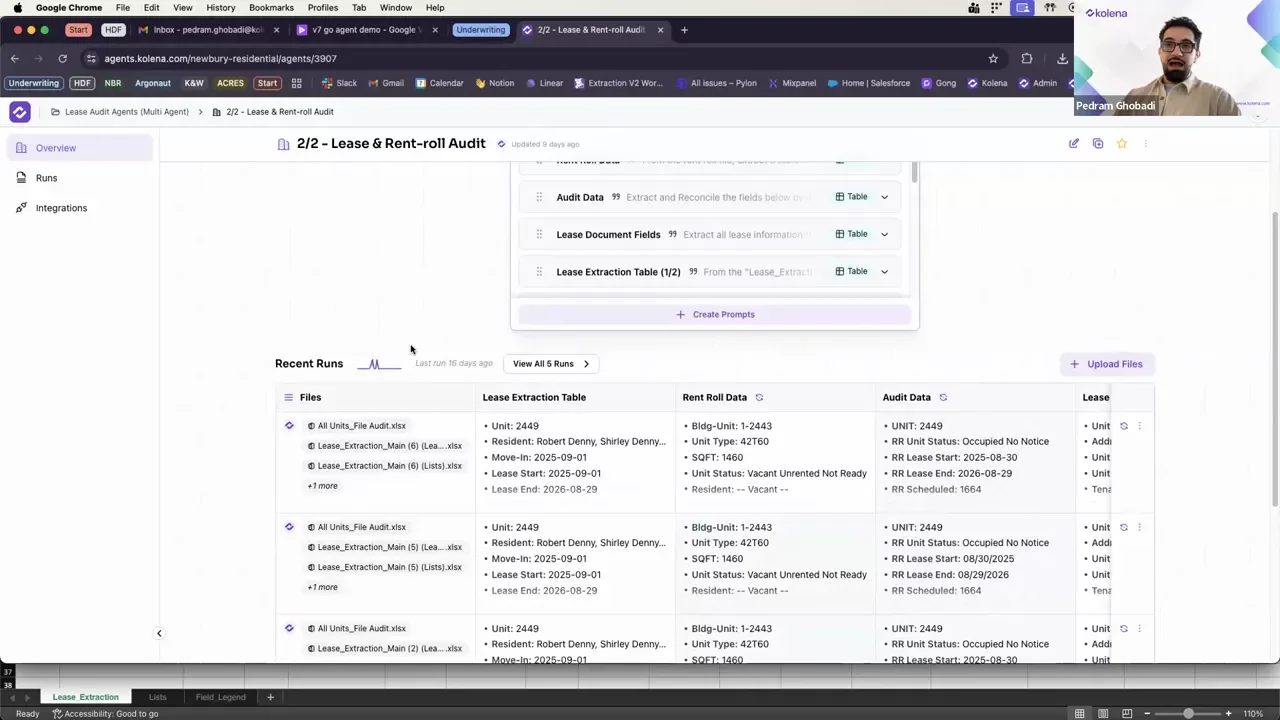
Kolena is an AI document automation platform for commercial real estate, insurance, financial services, and banking teams. It uses AI to review, validate, generate, and act on documents such as leases and financial packages. For real estate, it automates lease abstraction alongside deal underwriting, loan sizing, mortgage due diligence, and quarterly lease audits.
Users upload lease agreements, and Kolena extracts and summarizes key terms. Agents can be cloned and customized to a team's workflows, policies, templates, and documents. The platform runs lease abstractions at scale.
Key features include:
AI document workflow automation: Reviews, validates, generates, and acts on documents including leases and financial packages.
Lease term extraction and summarization: Extracts and summarizes key terms into structured output.
Customizable AI agents: Agents can be cloned and adapted to a team's workflows, policies, templates, and documents.
Scale and batch processing: Runs lease abstractions across large document volumes.
Real estate workflow coverage: Supports lease abstraction, deal underwriting, loan sizing, mortgage due diligence, and quarterly lease audits within one platform.
Enterprise security and compliance: PCI, SOC 2, and HIPAA compliant, with no training on customer data, a complete audit trail, encryption in transit and at rest, role-based access control, and zero data retention.
Limitations (based on publicly available sources):
Suited to recurring, higher-volume work: Public discussions note the platform delivers the most value for teams running document workflows at volume.
Custom onboarding: Agents are tailored to each organization's templates and policies, so teams invest setup time to configure workflows before going live.
Newer entrant: As a recent platform, it has a smaller third-party review footprint than long-established lease systems.
Source: Kolena
2. LeaseLens
Best for: Quick, low-cost abstraction of a small number of leases
Strengths: Free to view, 200+ standard fields, OCR, optional human review
Things to consider: Paid export; limited native system integrations
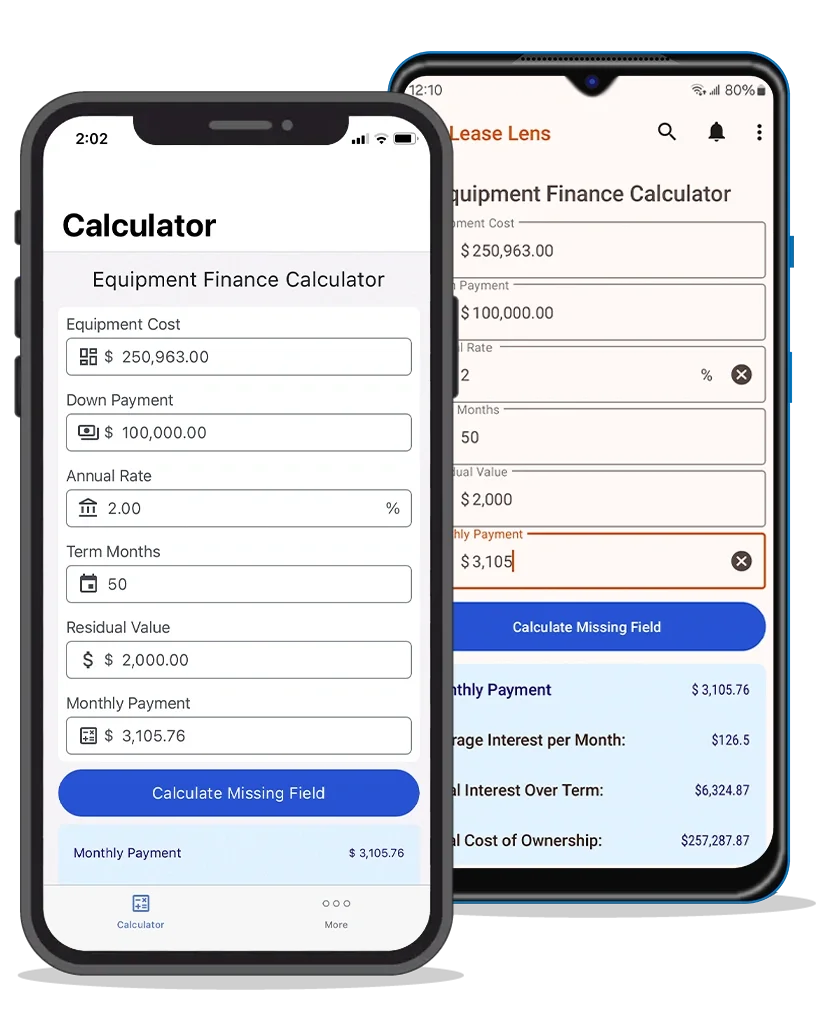
LeaseLens is an AI-based lease abstraction tool that extracts data points from real estate and commercial lease documents. Users upload a lease, and the software processes it through OCR and a machine learning model to produce an abstract in minutes.
It can identify over 200 industry-standard fields, including title, critical dates, renewal options, and premises square footage, and lets users customize which provisions to capture. Viewing an abstract is free; exporting to Excel or Word costs $25 per abstract. Leases are deleted after abstraction, and data is not shared with third parties.
Key features include:
OCR-based document reading: Processes uploaded leases through OCR so the model can interpret the document.
200+ standard field extraction: Identifies over 200 industry-standard fields such as title, critical dates, renewal options, and square footage.
Customizable abstracts: Lets users choose which provisions and fields to capture.
Excel and Word export: Exports completed abstracts to Microsoft Excel or Word for $25 per abstract.
ETL output for system upload: Provides results in an ETL spreadsheet format on request for upload into lease administration or property management systems such as Yardi.
Optional human review: For bulk projects, connects an experienced lease abstraction firm to review AI results.
Limitations (based on publicly available sources):
Export requires payment: Exporting to Excel or Word carries a per-abstract fee.
Limited native integrations: Does not offer direct property management integrations; system uploads rely on an ETL-format file.
Oriented to smaller volumes: Public descriptions position it for analyzing a small number of leases, with bulk processing handled separately.
Source: LeaseLens
3. Prophia

Best for: CRE teams needing structured, portfolio-wide lease data
Strengths: AI plus expert validation, source hyperlinks, interconnectivity
Things to consider: Focused on office, retail, and industrial CRE
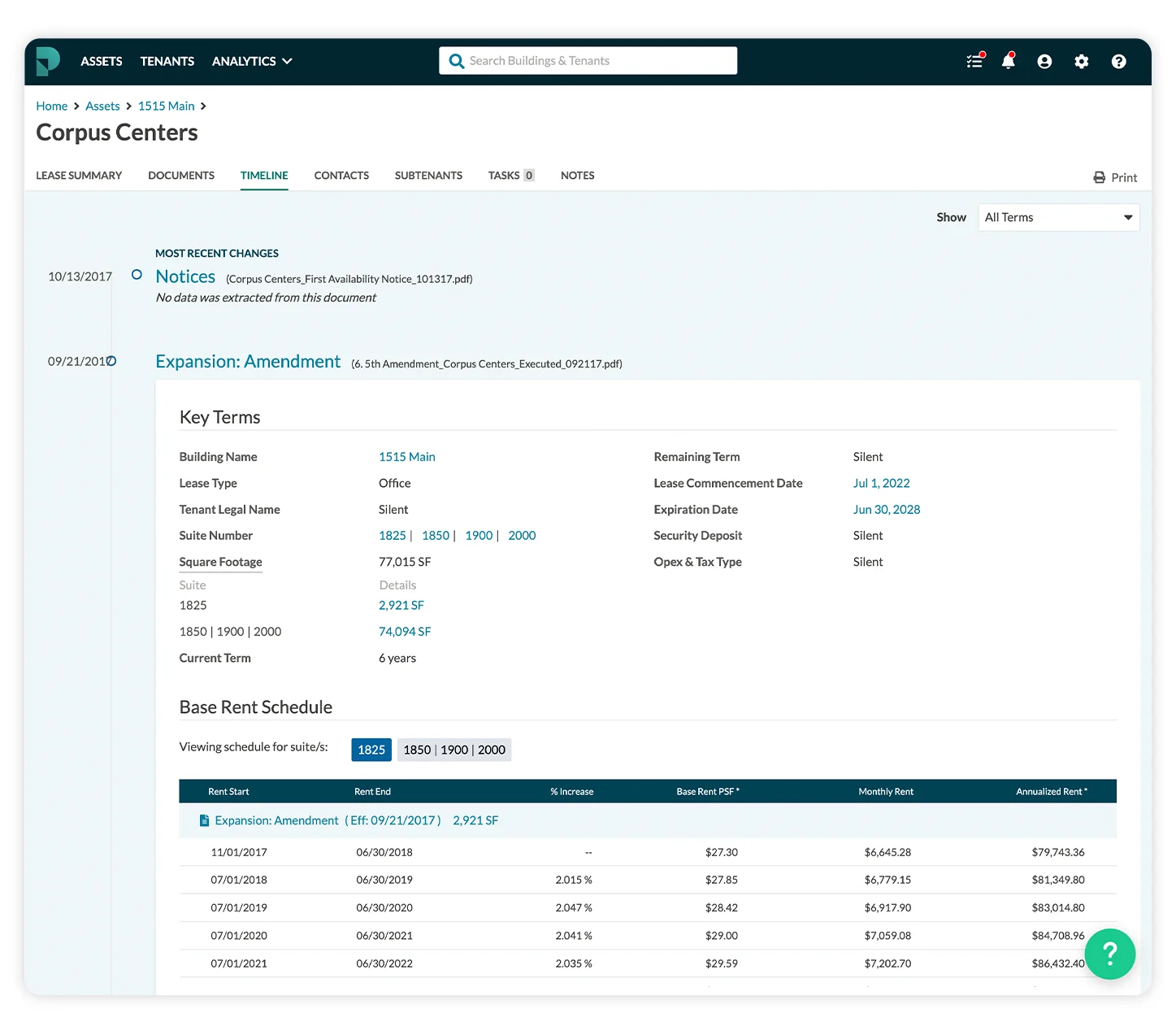
Prophia is AI-powered lease abstraction software for commercial real estate teams. It combines AI with expert validation to produce structured lease data across a portfolio. The AI captures, annotates, and organizes lease data into a digital abstract.
Prophia links summarized terms back to the source document with hyperlinks so users can verify data points, tracks tenant rights and encumbrances across a portfolio, and connects documents so amendments and renewals update data automatically.
Key features include:
AI plus expert validation: Combines AI extraction with expert review to deliver structured lease data across a portfolio.
AI-generated source hyperlinks: Links terms in the abstract to the original language in the lease or amendment.
In-document search: Adds an AI-annotated layer to PDFs so users can search for tenant terms and jump to the relevant clause or section.
Rights and encumbrances tracking: Discovers and flags tenant rights and encumbrances across the portfolio.
Document interconnectivity: Links uploaded documents so amendments and renewals update data and maintain a historical record of changes.
Limitations (as reported by users on Capterra):
Manual upkeep: Some users note the system requires manual upkeep, which can introduce human error.
Navigation learning curve: Reviewers mention navigation can be confusing, with extra clicks to open documents or return to search results.
Performance and support: Some report slower performance at times and request more responsive support.
Source: Prophia
4. MRI Contract Intelligence
Best for: Enterprises abstracting lease data for ASC 842/IFRS 16
Strengths: AI extraction, audit trail, ERP integration, multi-language
Things to consider: Enterprise-oriented; strongest within MRI's ecosystem
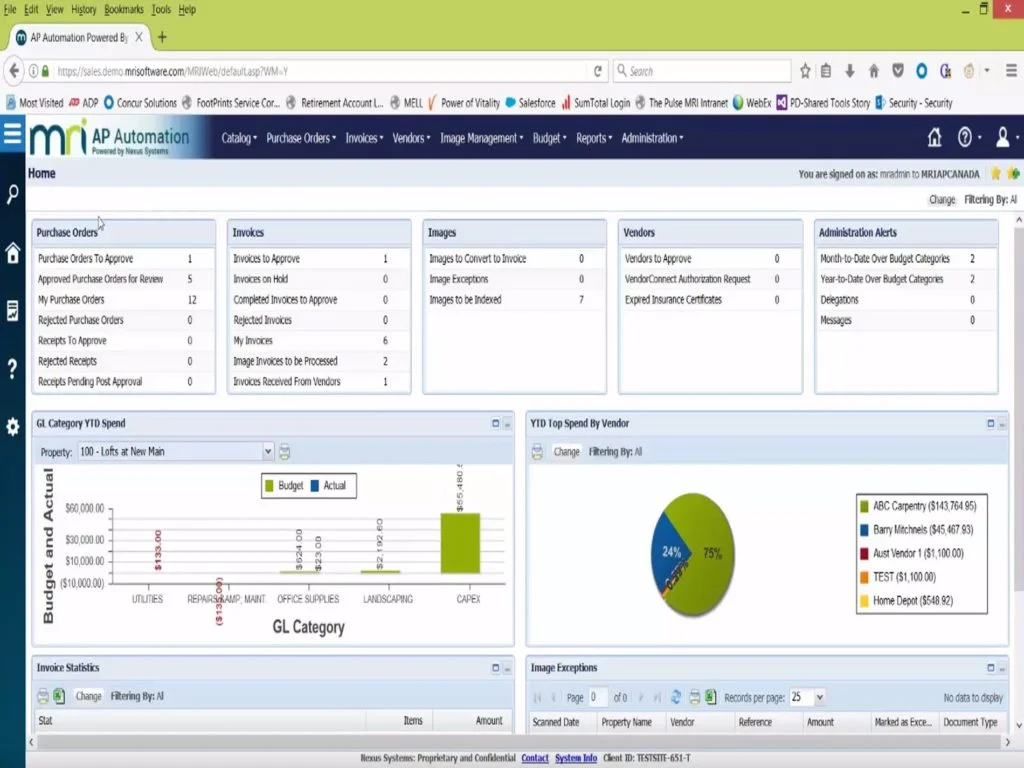
MRI Contract Intelligence, formerly Leverton, is an AI-powered data extraction and contract analytics platform for corporate and legal documents. It abstracts lease data to reduce manual effort and supports IFRS 16 and ASC 842 compliance.
The platform automates data capture, calculations, notifications, and reporting, and provides a clickable provenance link from abstracted terms back to specific lease language. It integrates with lease accounting systems and ERPs and can operate as a standalone data source or alongside MRI's lease accounting software.
Key features include:
AI lease data extraction: Extracts, cleanses, and aggregates data from lease documents, including scanned paper leases.
Contract analytics: Analyzes corporate and legal documents to structure data and surface discrepancies.
Provenance and audit trail: Provides a clickable provenance link from each abstracted term to the lease language and logs changes for audit transparency.
Compliance support: Feeds structured data into IFRS 16 and ASC 842 lease accounting workflows, with automated calculations and remeasurements.
System and ERP integration: Integrates with lease accounting systems and ERPs so extracted data flows into financial systems.
Automated alerts: Provides alerts for renewals, rent changes, and expirations.
Limitations (based on publicly available sources):
Learning curve: Extensive capabilities may require training for adoption.
Support consistency: Some feedback points to inconsistent customer support.
Enterprise orientation: Pricing is custom and geared toward large organizations.
Source: MRI Software
Lease Administration and Accounting Platforms with AI Abstraction
5. Trullion

Best for: Finance and accounting teams abstracting leases for compliance
Strengths: AI OCR, bespoke field extraction, source traceability
Things to consider: Slower on very large report runs; no lease duplication
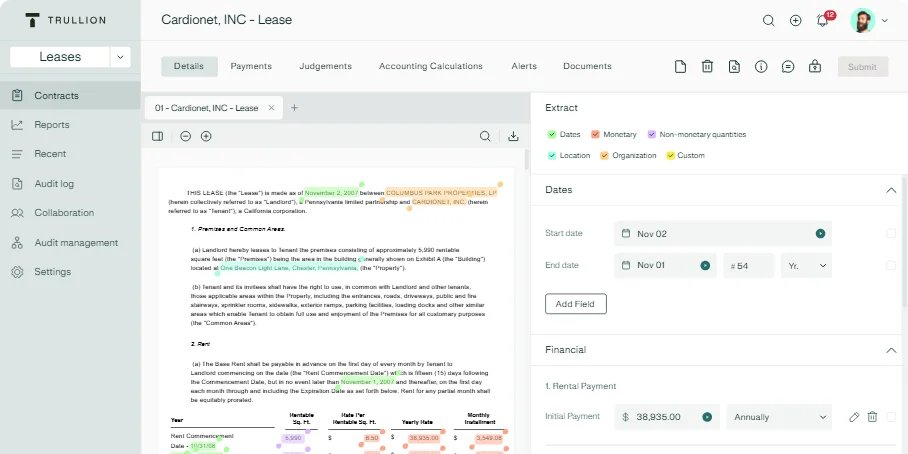
Trullion is an AI-powered platform that extracts data from lease documents for finance and accounting teams. Its AI scans, pulls, and organizes lease data down to individual clauses and amendments, with validation, source traceability, and version tracking.
AI-powered OCR and guidepoint technology turn PDFs and unstructured data into searchable, structured insights. The platform interprets contextual phrases such as "first day of the last week of January" and outputs exact lease dates. It can also generate summaries and translate documents.
Key features include:
AI-powered OCR and smart data: Converts PDFs and unstructured data into searchable, structured information using OCR and guidepoint technology.
Contextual date interpretation: Interprets phrases like "first day of the last week of January" and outputs exact lease dates.
Bespoke field extraction: Lets users create custom questions to extract specific contract data.
Summaries and translation: Generates document summaries and translates content across English and other languages.
Source traceability and version tracking: Links extracted data to source documents and tracks changes.
Clause and amendment handling: Organizes lease data down to individual clauses and amendments.
Limitations (as reported by users on G2):
Large report runs: Some users report slower performance when running reports that include more than 1,000 leases.
No lease duplication: Reviewers note there is no way to duplicate a lease.
Extraction accuracy: Some users point to limitations in AI accuracy when extracting certain contract details.
Occasional bugs: Some users encounter bugs and request clearer visibility into known issues.
Source: Trullion
6. Yardi Smart Lease

Best for: Yardi Voyager users abstracting new commercial leases in-platform
Strengths: Native Voyager integration, OCR extraction, AI assistant
Things to consider: Requires Voyager; new commercial leases at launch
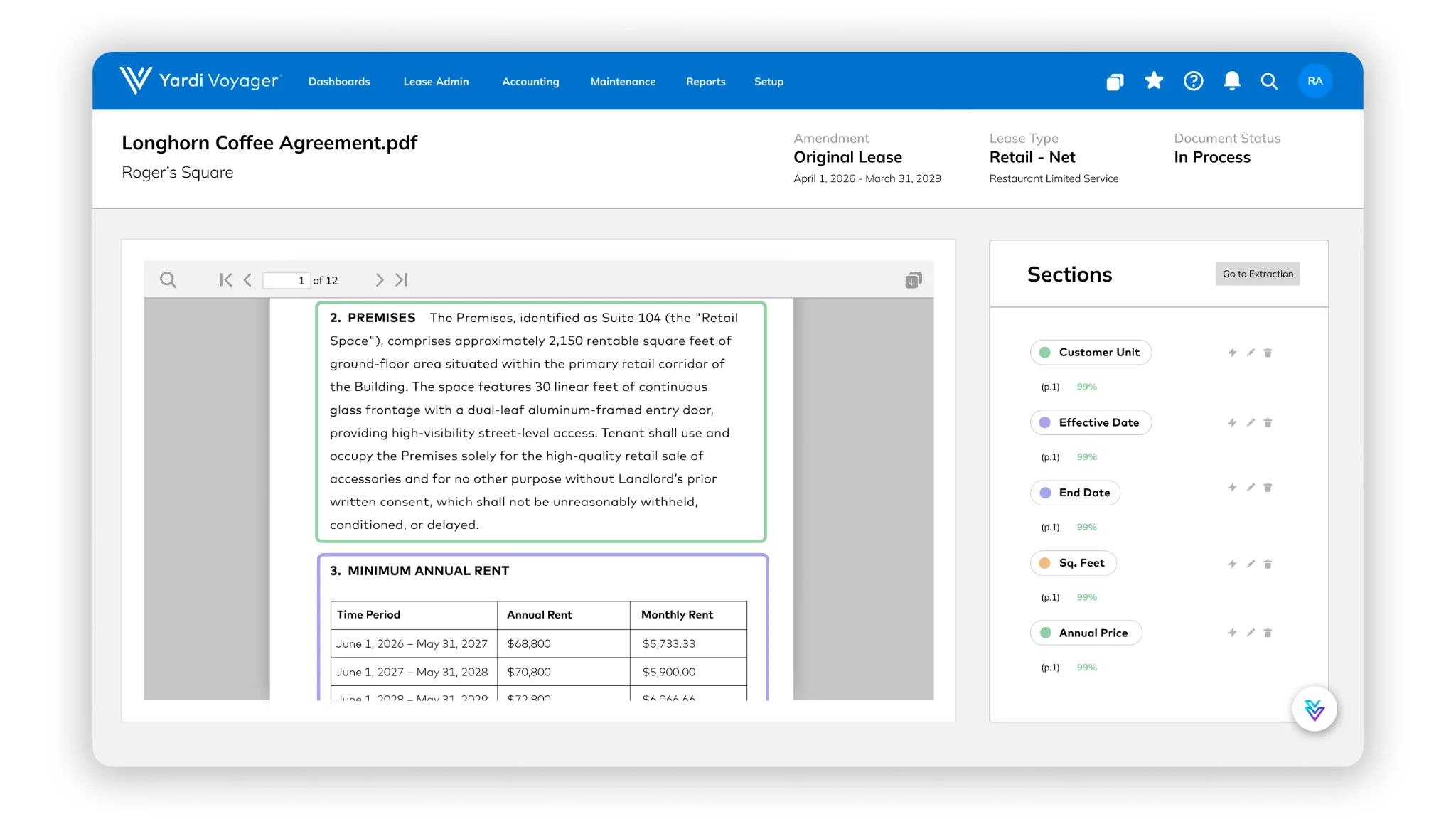
Smart Lease is an AI-powered lease abstraction solution built into Yardi Voyager Commercial. It uses AI and OCR to scan lease documents, detect key sections, and populate structured fields, then writes source-linked data into Voyager lease records.
Because it is native to Voyager, extracted data moves into operational lease fields without exports or re-keying. A team member reviews, corrects, and approves the AI output before finalization.
Key features include:
Native Voyager integration: Writes structured lease data directly into Voyager records.
AI and OCR extraction: Scans documents with OCR, detects key sections, and populates data fields.
Human review and approval: Routes AI output to a reviewer who corrects and approves data.
Machine learning over time: Learns from a portfolio's lease types to improve extraction, with training data kept private.
One-click source verification and bulk processing: Lets reviewers verify extracted data against the source and queue documents for bulk processing.
Smart Lease AI assistant: Answers plain-language questions about a lease inside Voyager.
Limitations (based on publicly available sources):
Requires Yardi Voyager: Intended for teams operating in Voyager Commercial.
New commercial leases at launch: Initially supports new commercial leases, with additional workflows planned.
Human review still needed: AI output requires review and approval before finalization.
Source: Yardi
7. CoStar Real Estate Manager

Best for: Enterprise teams centralizing lease administration and accounting
Strengths: Centralized data, automated critical dates, market data
Things to consider: Abstraction sits within a broader admin platform
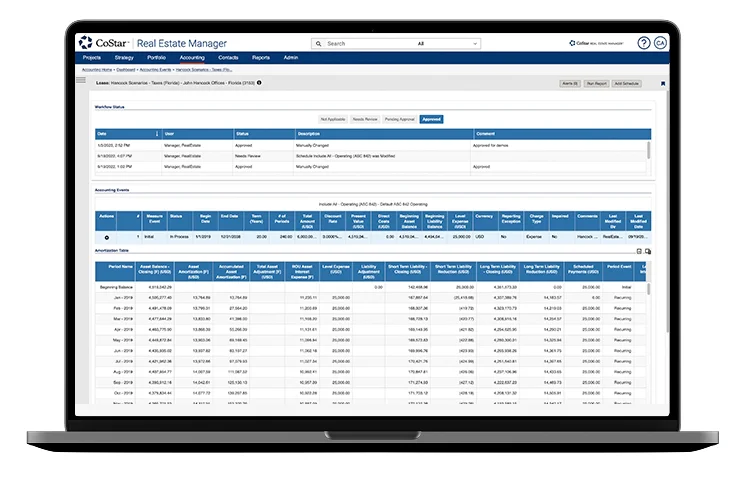
CoStar Real Estate Manager is an enterprise lease administration platform that centralizes real estate and equipment leases, payments, and renewals. It automates rent payments, tracks critical dates, and keeps data consistent across the organization.
The platform combines lease, occupancy, and market data for portfolio analysis and integrates with ERP, AP, and financial systems. Lease abstracts and critical terms are stored and standardized within the platform.
Key features include:
Centralized lease administration: Consolidates leases, payments, and location details into one system, with dashboards for finance and real estate leaders.
Automated renewals and payments: Sets alerts for key dates and streamlines rent approvals and payment workflows.
Critical date tracking: Tracks renewals, expirations, and obligations.
ERP and financial integration: Connects with ERP, AP, and financial systems to automate workflows and reporting.
Portfolio and market data: Combines lease, occupancy, and market data to analyze performance.
Security and access controls: Provides SOC 1 and SOC 2 certified security, role-based access, single sign-on, and change logging.
Limitations (as reported by users on G2):
Performance and stability: Some users report slow performance, lag with large data sets, and being logged out mid-task.
Interface learning curve: Reviewers note the interface can feel unintuitive and require multiple clicks.
Reporting and editing: Some find reporting less intuitive and editing or exporting sections cumbersome.
Non-US and multi-asset handling: Some users cite difficulty managing non-US leases and multiple assets, along with limited end-user support.
Source: CoStar
8. Accruent Lucernex
Best for: Multi-site occupiers managing real estate and equipment leases
Strengths: Compliance automation, centralized data, ERP integrations
Things to consider: Interface learning curve; abstraction within a suite
Accruent Lucernex (Lx Contracts) is a cloud-based lease administration and accounting platform for real estate and equipment leases. It centralizes lease data into a single source of truth, automates lease and expense calculations, and maintains compliance with ASC 842, IFRS 16, and GASB 87.
The platform includes clickable lease abstracts, configurable dashboards, and audit logs. It integrates with ERPs such as Oracle and SAP, accounting systems, CRMs, BI tools, and CMMS or FM solutions. Alerts and notifications track important dates such as renewals.
Key features include:
Clickable lease abstracts: Provides configurable lease abstracts within the lease management system.
Lease and expense automation: Automates lease and expense calculations and centralizes data.
Compliance management: Maintains compliance with ASC 842, IFRS 16, and GASB 87, verified by an independent third-party accounting firm.
Audit logs and monthly close: Provides audit logs supporting SOX compliance and automated reporting for the monthly close.
Configurable integrations: Integrates with ERPs such as Oracle and SAP, accounting systems, CRMs, BI tools, and CMMS or FM solutions.
Alerts and role-based access: Creates alerts for important dates and sets permissions based on employee role.
Limitations (as reported by users on G2):
Interface learning curve: Some users describe the system as clunky and not intuitive for new users.
Report customization: Reviewers note that customizing reports can be difficult without training.
Bugs with new releases: Some users report bugs following new releases.
Support responsiveness: Some cite delays in support response times.
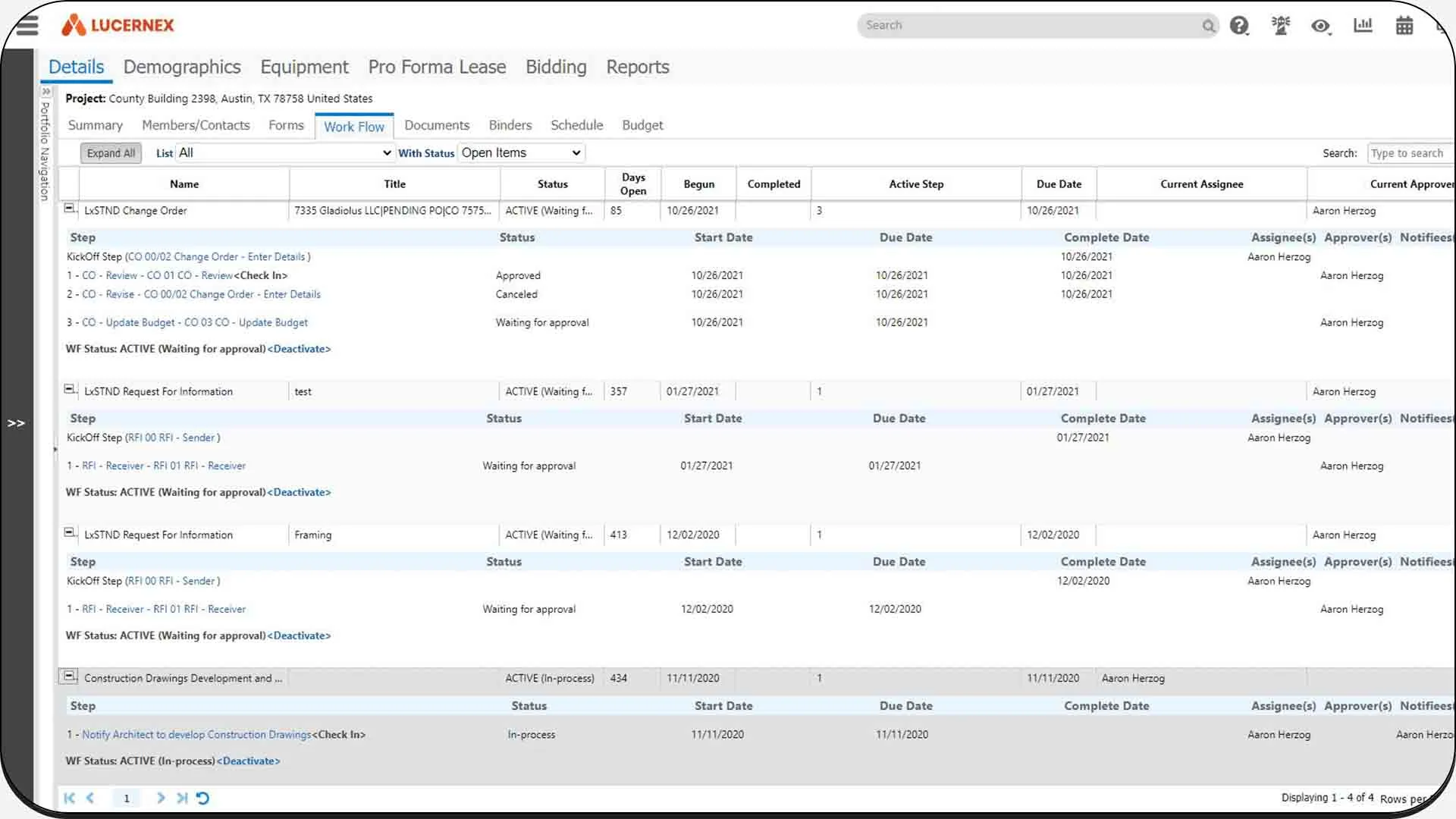
Source: Accruent
Conclusion
AI lease abstraction software offers a transformative approach to managing property contracts, significantly reducing manual effort while enhancing data accuracy. By automating document ingestion, clause extraction, and validation, these solutions empower organizations to streamline compliance and make more informed decisions. Adopting this technology ensures scalability and consistency, turning complex lease portfolios into structured, actionable assets.