TL;DR: Scalable AI lease abstraction providers extract structured data from commercial leases at volume. Best for AI-native abstraction: Kolena; best for portfolio insight: Prophia; best for per-lease extraction: Lextract; best for Voyager-native workflows: Yardi Smart Lease.
What Are AI Lease Abstraction Providers?
Scalable AI lease abstraction providers use artificial intelligence to read, interpret, and digitize complex legal lease documents. This technology extracts crucial clauses, dates, and costs, automatically structuring them into digital formats or software platforms. It reduces manual data entry time by up to 80%.
Core capabilities:
Automated lease data extraction: Extracts key lease terms, dates, financial obligations, and clauses automatically from complex documents.
Support for leases, amendments, and related CRE documents: Processes the full lease document set to maintain complete and accurate records.
Citation-backed outputs: Links every extracted data point to its original location in the source document.
Custom templates and structured data models: Adapts extracted fields and output formats to business-specific requirements.
Bulk processing and fast turnaround: Processes hundreds or thousands of documents simultaneously with rapid delivery.
Portfolio-level search and Q&A: Enables natural language search across an entire lease portfolio for instant answers.
Integration with CRE and business systems: Connects extracted lease data with lease management, ERP, and property management platforms.
This is part of a series of articles about AI lease abstraction
Category | Solution | Best For | Key Strengths | Things to Consider |
AI-First Abstraction Platforms | Kolena | Automating lease, rent roll, and diligence review at scale | No-code AI agents, source citations, confidence scores | Extraction tool that pairs with a system of record |
AI-First Abstraction Platforms | Prophia | CRE owners managing lease data across a portfolio | AI plus human validation with source hyperlinks | Commercial only; no residential or multifamily |
AI-First Abstraction Platforms | Lextract | Per-lease commercial abstraction, no subscription | 126 fields, confidence scores, red flag checks | Extraction only; no portfolio administration |
AI-First Abstraction Platforms | Kira (by Litera) | High-volume legal contract review and diligence | Hybrid AI, 1,400+ fields, audit-ready exports | Legal focus, not CRE-specific workflows |
Enterprise Lease Management Platforms | Visual Lease | Enterprise lease administration and accounting | CoStar Lease LLM validated on market data | Users want more reporting flexibility |
Enterprise Lease Management Platforms | LeaseAccelerator | Enterprise lease accounting and compliance | Asset-level sub-ledger and ERP integrations | Broad platform with a steep learning curve |
Enterprise Lease Management Platforms | MRI Software | Commercial owners, occupiers, and investors | Proprietary OCR, analytics, full audit trail | Multi-module setup carries a learning curve |
Enterprise Lease Management Platforms | Yardi Smart Lease | Abstracting leases inside Yardi Voyager Commercial | Native Voyager abstraction with AI assistant | New commercial leases and Voyager only |
Related content: Read our guide to lease abstraction services
Try our AI-powered lease abstraction tool
Why Scalability Matters in Lease Abstraction
Large Lease Portfolios Create Operational Bottlenecks
Managing a large lease portfolio manually often leads to significant operational delays. Every lease, amendment, and related document requires careful review to identify and extract relevant data points. As the number of documents increases, internal teams struggle to keep up with the workload. This can result in missed deadlines, incomplete data, and a lack of visibility into lease obligations; problems that become more pronounced as portfolios grow.
Operational bottlenecks not only slow down day-to-day processes but also impact strategic initiatives like portfolio optimization, compliance audits, and financial planning. When abstraction is handled manually, scaling up means hiring and training additional staff, which is costly and time-consuming. By contrast, scalable AI solutions automate repetitive tasks and handle large document volumes efficiently, allowing organizations to focus resources on higher-value activities.
Lease Data Must Stay Accurate Over Time
Lease data is not static; it evolves as new amendments, renewals, and other changes are made throughout a lease’s lifecycle. Maintaining data accuracy over time is critical for compliance, reporting, and strategic planning. Inaccurate or outdated information can lead to missed deadlines, financial penalties, and poor business decisions. Manual updates are slow and error-prone, especially as portfolios expand and document volumes increase.
AI lease abstraction providers address this challenge by automating data extraction and updates whenever new documents are added or existing ones are amended. These systems are designed to recognize changes and integrate new information without duplicating effort or introducing inconsistencies. As a result, organizations can trust that their lease data is always current, reducing risk and enabling more confident decision-making across the enterprise.
Manual Processes Increase Risk
Manual lease abstraction processes are inherently risky due to human error, inconsistent data entry, and a lack of standardization. Even experienced reviewers can overlook critical details, especially when faced with high document volumes and tight deadlines. Mistakes in abstraction can lead to significant financial and legal consequences, such as missed rent escalations, overlooked renewal options, or compliance violations.
Relying on manual processes also makes it difficult to implement robust audit trails or enforce data consistency across a portfolio. Without automation, organizations may struggle to meet regulatory requirements or respond quickly to internal and external audits. Scalable AI lease abstraction providers reduce these risks by automating data capture, applying standardized rules, and maintaining detailed records of every extraction, ensuring accuracy and accountability.
Key Benefits of Using Scalable AI Lease Abstraction Providers
Scalable AI lease abstraction providers help organizations process growing lease portfolios without proportionally increasing time, cost, or staffing requirements. Beyond automating document review, they improve data quality, support ongoing lease management, and make critical lease information easier to access across the business. Key benefits include:
Process large lease volumes efficiently: AI platforms can extract data from thousands of leases and amendments in a fraction of the time required for manual review. This allows organizations to complete portfolio-wide abstraction projects faster and keep pace with continued portfolio growth.
Improve data accuracy and consistency: Standardized extraction models reduce inconsistencies caused by manual data entry. Lease information is captured using the same rules across all documents, making reporting and analysis more reliable.
Reduce operational costs: Automating repetitive abstraction tasks lowers labor costs and reduces the need to expand internal teams as document volumes increase. Staff can focus on validation, analysis, and strategic work instead of manual data extraction.
Accelerate access to lease information: Structured lease data makes it easier to search for critical terms, obligations, dates, and financial information. Teams can retrieve the information they need without reviewing lengthy legal documents.
Support ongoing portfolio management: AI solutions can process new leases, amendments, and renewals as they are received, helping organizations maintain up-to-date lease records throughout the lease lifecycle instead of relying on periodic manual updates.
Strengthen compliance and audit readiness: Centralized, standardized lease data simplifies compliance reporting and internal audits. Many platforms also maintain detailed extraction records, making it easier to verify where data originated and how it was captured.
Integrate with existing real estate systems: Many AI lease abstraction providers connect with lease administration, property management, and enterprise resource planning (ERP) platforms. This reduces duplicate data entry and keeps lease information synchronized across business systems.
Provide better insights for decision-making: Accurate, structured lease data enables organizations to analyze portfolio trends, identify upcoming obligations, evaluate financial exposure, and make more informed real estate decisions based on complete and current information.
Core Capabilities of Scalable AI Lease Abstraction Providers
Scalable AI lease abstraction providers are distinguished by a set of core capabilities that enable them to handle large and complex CRE portfolios. These include automated data extraction, support for a range of document types, and the ability to process documents in bulk with rapid turnaround times. The platforms also offer customizable templates, structured data outputs, and integration with existing business systems, making it easy to align abstraction workflows with organizational needs.
Advanced providers go further by delivering features like citation-backed results, enabling users to trace every data point to its source in the original document. Portfolio-level search and Q&A tools allow users to quickly find answers across their entire lease database, improving accessibility and decision-making. These capabilities, combined with robust security and audit features, ensure that organizations can trust and scale their lease abstraction processes as business demands evolve.
Automated Lease Data Extraction
Automated lease data extraction uses AI models to read and interpret lease documents, identifying and extracting key data points such as rent amounts, expiration dates, and renewal terms. The process eliminates manual review, allowing organizations to process high volumes of leases quickly and with minimal oversight. Advanced systems can handle a variety of lease formats and languages, adapting to the unique structure and terminology of each document.
The automation not only accelerates the abstraction process but also improves accuracy by applying consistent logic to every document. Errors that are common in manual processes (such as missed clauses or misinterpreted terms) are significantly reduced. By leveraging machine learning, these platforms continuously improve their extraction capabilities over time, learning from new document types and user feedback to deliver even greater reliability.
Support for Leases, Amendments, and Related CRE Documents
Comprehensive AI lease abstraction providers are equipped to handle more than just base leases: they also process amendments, addenda, and related documents like guaranties or estoppels. These additional documents often introduce new terms, modify existing ones, or create exceptions that must be tracked to maintain data integrity. Effective abstraction requires identifying and linking all relevant documents to ensure a complete and accurate lease record.
By supporting the full spectrum of CRE documentation, scalable AI platforms help organizations maintain a holistic view of their lease obligations and rights. This capability is especially important during portfolio audits, acquisitions, or compliance reviews, when understanding the complete contractual landscape is critical. Automated systems ensure that no critical detail is overlooked, even as document volumes and complexity increase.
Citation-Backed Outputs
Citation-backed outputs provide a direct link between extracted data points and their source text in the original document. This feature is essential for auditability and verification, enabling users to quickly trace key terms back to their context. It reduces the risk of misinterpretation and helps resolve disputes or questions about how data was derived during abstraction.
Scalable AI lease abstraction providers typically highlight or reference the exact section, page, or clause from which each data point was taken. This transparency builds trust in the abstraction process and supports compliance requirements. It also streamlines review workflows, allowing legal and asset management teams to validate extracted information without manually searching through lengthy documents.
Custom Templates and Structured Data Models
Custom templates and structured data models allow organizations to define exactly which data points are extracted and how they are organized. This flexibility is crucial because CRE portfolios often have unique reporting needs or compliance requirements. Providers offer configurable templates that can be tailored for different property types, regions, or business units, ensuring that the abstraction process aligns with internal standards.
Structured data models ensure that extracted information is delivered in a consistent, machine-readable format such as Excel, JSON, or direct integration with lease management systems. This supports downstream workflows, from analytics and reporting to automated notifications and compliance checks. Customization options also enable organizations to adapt quickly as their data requirements evolve, maximizing the value of the abstraction process.
Bulk Processing and Fast Turnaround
Bulk processing capabilities allow AI lease abstraction providers to handle large batches of documents simultaneously, significantly reducing project timelines. This is especially valuable during portfolio acquisitions, mergers, or compliance audits, when hundreds or thousands of documents must be reviewed in a short period. Automated systems can process these volumes without the bottlenecks that slow down manual teams.
Fast turnaround times ensure that lease data is available when needed for critical business decisions. AI-driven abstraction providers often deliver results in hours or days instead of weeks, enabling organizations to move quickly on new opportunities or respond to regulatory demands. The combination of bulk processing and speed supports business agility and reduces the operational costs associated with large-scale lease management.
Portfolio-Level Search and Q&A
Portfolio-level search and Q&A allows users to find information across an entire lease portfolio instead of opening and reviewing individual documents. Users can ask natural language questions such as which leases expire next year, which tenants have expansion options, or which agreements include specific operating expense clauses. The platform searches structured lease data and, in many cases, the underlying documents to return relevant results quickly.
This capability improves productivity for asset managers, legal teams, finance departments, and executives who need answers without building complex reports or manually reviewing leases. When combined with citation-backed responses, users can verify every answer against the source document, making the information suitable for operational decisions, audits, and portfolio analysis.
Integration with CRE and Business Systems
Scalable AI lease abstraction providers integrate with lease administration software, property management platforms, ERP systems, document management repositories, and business intelligence tools. These integrations automatically transfer extracted lease data into downstream systems, eliminating duplicate data entry and reducing the risk of inconsistencies between applications.
Integration also supports ongoing lease management by keeping business systems synchronized as new leases, amendments, and other documents are processed. Organizations can automate workflows such as reporting, financial forecasting, compliance monitoring, and lease administration while ensuring that every department works from the same accurate and up-to-date lease data.
Learn more about abstract commercial leases with ai.
Notable AI Lease Abstraction Providers
How we selected these providers: We shortlisted AI lease abstraction providers based on their ability to extract structured data from commercial leases and amendments, cite results back to the source document, validate accuracy, process documents at volume, and integrate with real estate and accounting systems.
AI-First Abstraction Platforms
1. Kolena
Best for: Automating lease, rent roll, and diligence review at scale
Strengths: No-code AI agents, source citations, confidence scores
Things to consider: Extraction tool that pairs with a system of record
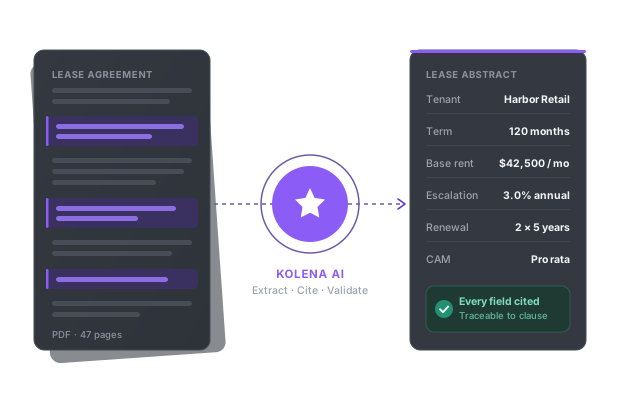
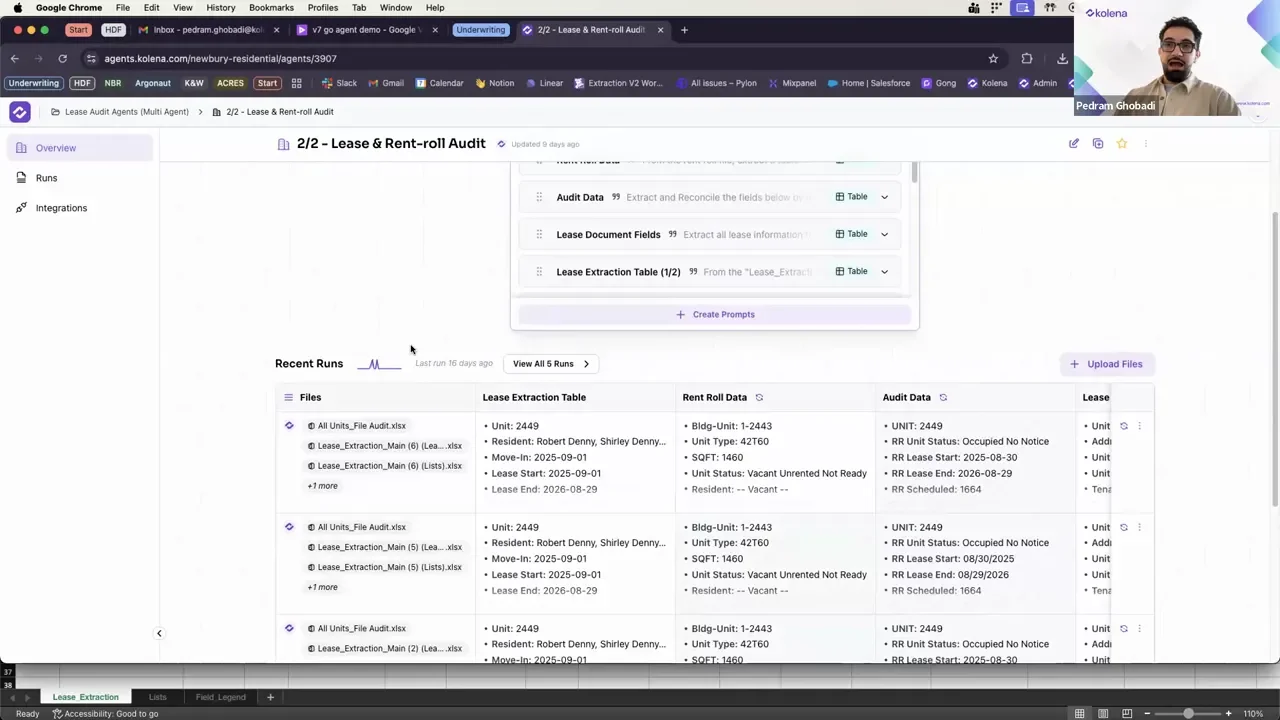
Kolena is an AI document automation platform that commercial real estate teams use to abstract leases, rent rolls, and due diligence files. Users build no-code AI agents that read documents in many formats, from digital PDFs to scanned files, and return structured data. The platform extracts, cross-checks, and validates each clause, number, and date, then produces structured reports, financial models, and compliance summaries.
Every extracted value carries a source citation and a confidence score, so a value can be traced to the exact page it came from. Kolena supports acquisition due diligence, ongoing operations, and compliance work across a portfolio, and connects to the tools teams already use rather than acting as a lease system of record.
Key features include:
No-code AI agents: Teams define extraction objectives in plain language and build lease abstraction agents without writing code or engineering prompts.
Multi-format document intake: Reads leases, amendments, and rent rolls as digital PDFs or scanned documents and converts them into structured fields.
Source citations and confidence scores: Each extracted value links back to the exact page in the source document and carries a confidence score that flags uncertain items for review.
Validation and cross-referencing: Cross-checks clauses, numbers, and dates across related documents so amendments reconcile against the base lease.
Batch processing at scale: Processes large volumes of leases at once, allowing a team to raise throughput without adding headcount.
Structured outputs and integrations: Delivers structured reports, financial models, and compliance summaries, and connects with Yardi, Box, SharePoint, OneDrive, and Excel.
Security and compliance: SOC 2 Type II certified, with reasoning logs and audit trails, and does not use customer data to train models.
Limitations (based on publicly available sources):
Newer CRE entrant: As a more recently established option in commercial real estate, it carries a smaller base of third-party user reviews than long-standing lease platforms.
Works alongside a system of record: It focuses on extraction and structured output and connects to platforms such as Yardi for downstream lease administration rather than replacing them.
Review of AI output: As with any AI abstraction, complex clauses call for human validation before data is finalized.
Source: Kolena
2. Prophia

Best for: CRE owners managing lease data across a portfolio
Strengths: AI plus human validation with source hyperlinks
Things to consider: Commercial only; no residential or multifamily
Prophia is an AI-powered lease abstraction and portfolio platform built for commercial real estate. It combines AI extraction with expert human validation to turn leases into structured, consistent data across office, retail, and industrial assets. Its OCR handles both recent and decades-old documents, including handwritten notes and faded text.
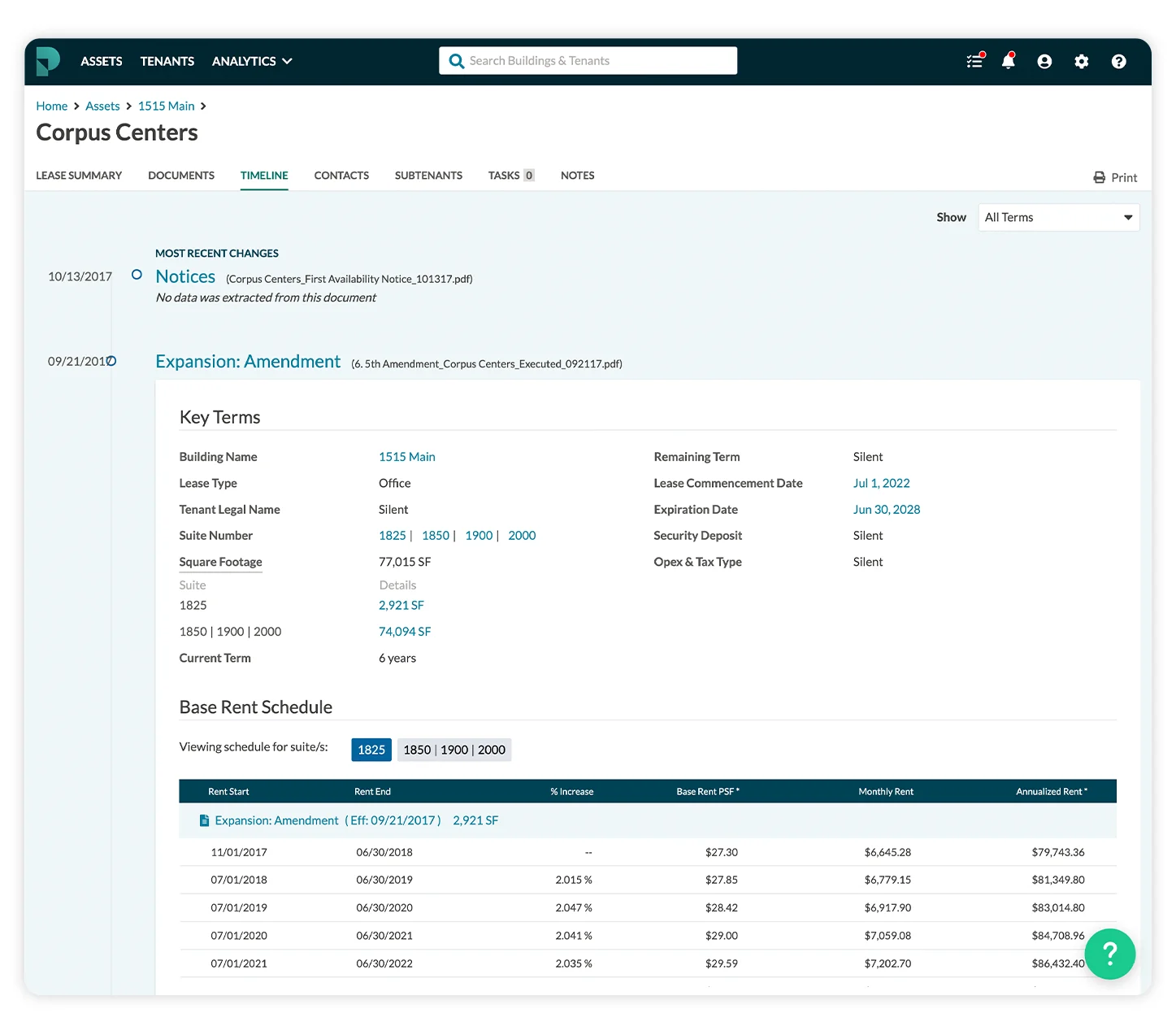
Prophia links each abstracted term back to the source language through hyperlinks, so users can check data points without opening the original file. It offers Prophia Abstract, a free AI-only tool that pulls around 20 terms in minutes, and Prophia Essentials, which extracts more than 215 terms into an interactive lease administration platform with dashboards, reporting, and portfolio insights.
Key features include:
AI abstraction with human validation: Prophia Essentials pairs AI extraction with expert review and reports 99% accuracy on verified terms.
Source hyperlinks: Each data point in the abstract links to the exact clause in the original lease for one-click checking.
In-document search: An AI-annotated layer lets users search lease language and jump directly to the clause, section, or figure.
Rights and encumbrances tracking: The AI surfaces and flags tenant rights across a portfolio so obligations can be managed from one place.
Document interconnectivity: Amendments, renewals, and related agreements update linked data automatically and keep a historical record of changes.
Dynamic stacking plans and reporting: A self-updating stacking plan and portfolio-level reports, including critical date reports, support ongoing management.
Integrations and export: Connects natively to Yardi Voyager and MRI, with CSV and PDF export and API access on Prophia Essentials.
Limitations (as reported by users on G2):
Search speed: Some users note the search function can run slowly at times.
Navigation learning curve: A few reviewers find the platform less intuitive at first and note it takes time to learn where to go.
Bulk data handling: Users mention difficulty exporting the stacking plan to Excel, downloading all lease files, or locating every lease for a property.
Setup timing on integrations: One user noted the Yardi data push was delayed by the time needed to set up and review all leases initially.
Source: Prophia
3. Lextract
Best for: Per-lease commercial abstraction, no subscription
Strengths: 126 fields, confidence scores, red flag checks
Things to consider: Extraction only; no portfolio administration
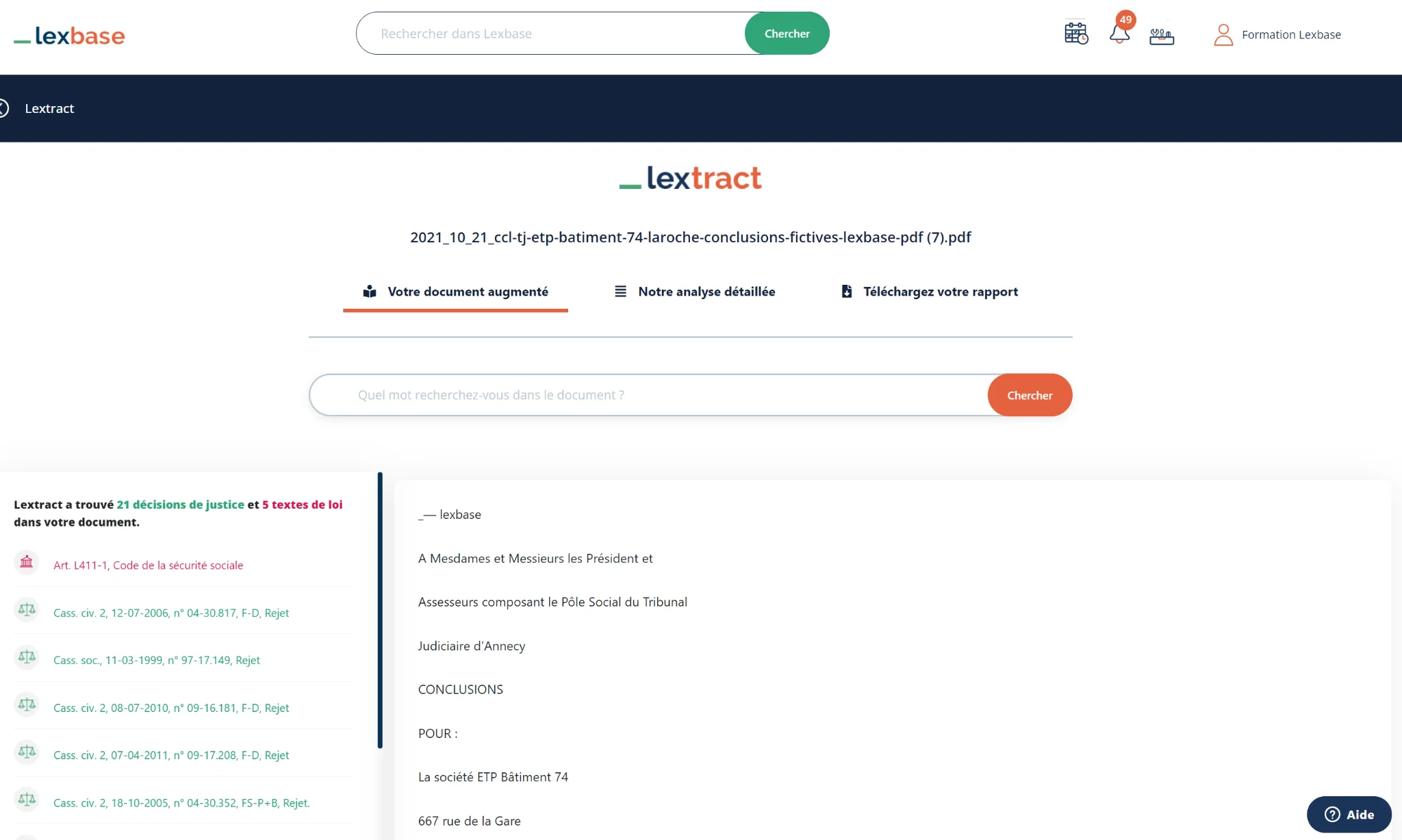
Lextract is a purpose-built AI lease abstraction tool for commercial real estate. Users upload a commercial lease PDF, digital or scanned, up to 200 pages, and receive 126 structured fields in minutes. It runs a two-stage pipeline that pairs AWS Textract OCR with Anthropic Claude AI, then passes each lease through primary extraction, adversarial validation, and an escalation pass on disputed critical fields.
Every field carries a High, Medium, or Low confidence score, and the tool runs 20 automated red flag checks. Pricing is per lease with no subscription, and results export to JSON, Excel, Word, and PDF. It supports NNN, gross, modified gross, ground, retail, office, industrial, and percentage leases.
Key features include:
126-field structured extraction: Pulls fields across 14 categories, including parties, base rent and schedules, CAM provisions, critical dates, options, and use clauses.
Two-stage OCR and AI pipeline: AWS Textract performs layout-aware OCR, then Claude AI extracts and structures the data, reading tables and defined terms.
Multi-pass validation: Each lease runs through primary extraction, adversarial validation, and an escalation pass on disputed critical fields.
Per-field confidence scores: Every field is scored High, Medium, or Low so reviewers can target uncertain values for verification.
Automated red flag detection: Twenty checks flag risky commercial lease patterns.
Structured exports: Output exports to JSON, Excel, Word, and PDF, with JSON suited to feeding systems such as Yardi or MRI.
Pay-per-lease access: Priced per lease with no subscription, setup fee, or minimum commitment.
Limitations (based on publicly available sources):
Extraction only: Lextract produces structured lease data and does not provide portfolio management or lease administration.
Complex leases need review: The vendor notes that long ground leases and heavily amended legacy leases call for human review on top of the AI output.
Export-based integration: Data moves into other systems through file export such as JSON rather than a live two-way integration.
Limited track record: As a newer, single-purpose tool, it has little third-party review coverage compared with established platforms.
Source: Lextract
4. Kira (by Litera)

Best for: High-volume legal contract review and diligence
Strengths: Hybrid AI, 1,400+ fields, audit-ready exports
Things to consider: Legal focus, not CRE-specific workflows
Kira, from Litera, is an AI contract intelligence platform used by legal teams for high-volume contract review and due diligence, including real estate lease abstraction. It combines proprietary machine learning models with generative AI, and reports 90%-plus accuracy on extractions.
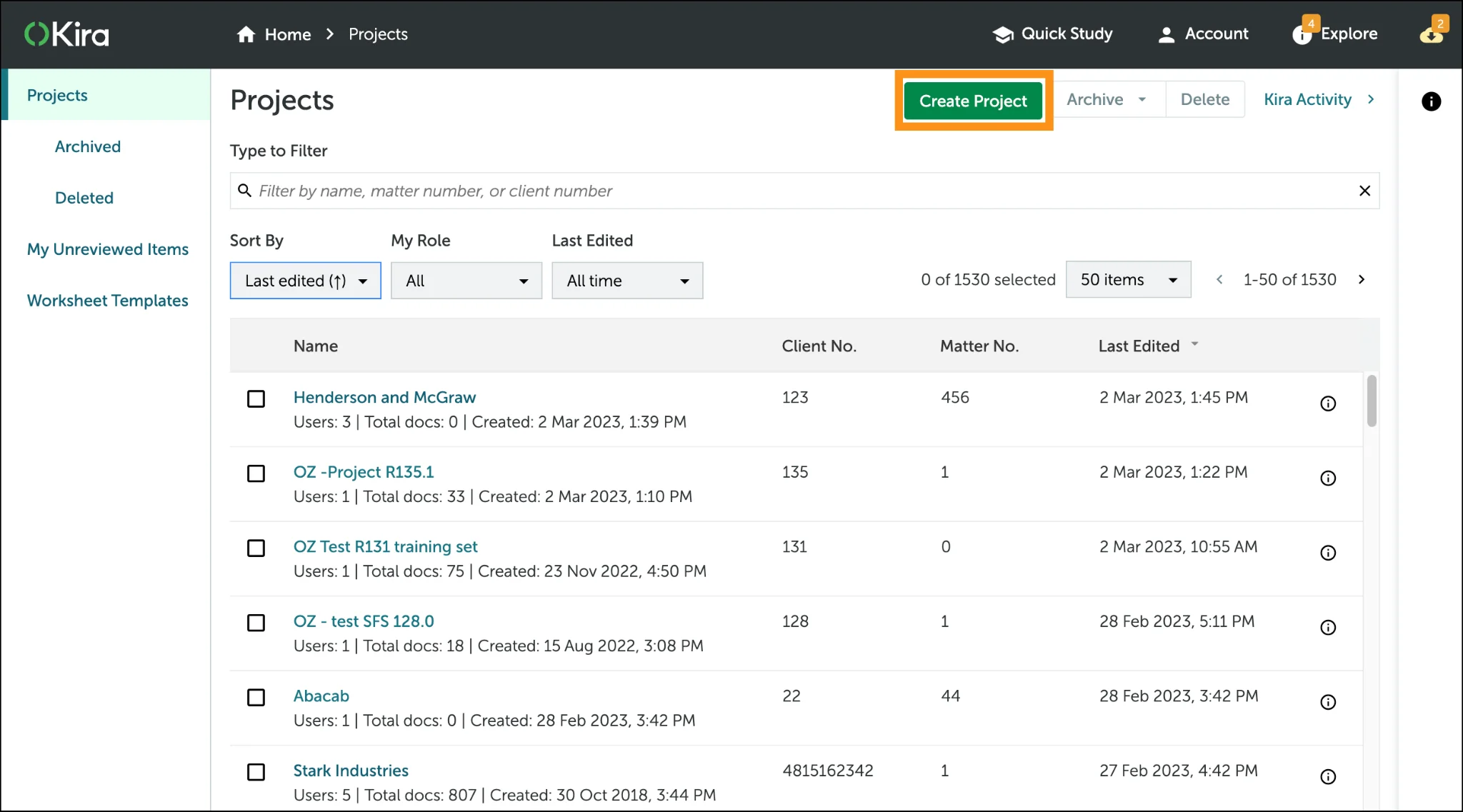
Kira ships with more than 1,400 pre-trained smart fields across 40-plus practice areas, and its real estate models cover lease provisions such as rent escalations, renewal options, and co-tenancy clauses. Users can create fields in natural language, search concepts across a document set, and generate summaries with linked citations. It handles bulk import, review, comparison, and export, and connects to the wider Litera transaction stack.
Key features include:
Hybrid AI extraction: Combines proprietary predictive models with generative AI to identify and extract clauses and data points.
Pre-trained smart fields: Offers more than 1,400 fields across 40-plus practice areas, with mature real estate models for lease terms.
Generative smart fields: Users describe what to extract in natural language and create custom fields without labeled training data.
Concept search and chat: Finds any concept across a document set and answers natural-language questions with linked citations.
Smart summaries: Generates clause and document summaries for diligence reporting.
Large-scale review workflow: Supports bulk import, deduplication, classification, tagging, comparison, and redlines across many documents.
Governance and export: Toggles generative AI on or off per project, meets SOC 2 Type II, and exports findings to Word, Excel, and PDF.
Limitations (based on publicly available sources):
Legal rather than CRE focus: Kira is built around legal contract review and due diligence, not commercial real estate lease administration workflows.
Implementation effort: Setup and data migration can be complex and typically call for dedicated expertise.
Cost for smaller teams: Pricing is quote-based, can be steep for smaller organizations, and is most attractive as part of a broader Litera bundle.
Sold as a Litera module: Since the 2021 acquisition, Kira is positioned within the Litera platform, so buyers evaluate its roadmap in that context.
Source: Litera
Enterprise Lease Management Platforms
5. Visual Lease

Best for: Enterprise lease administration and accounting
Strengths: CoStar Lease LLM validated on market data
Things to consider: Users want more reporting flexibility
Visual Lease is an enterprise lease management, accounting, and compliance platform, now part of CoStar Group. Its AI lease abstraction is powered by CoStar's Lease LLM and built with input from CoStar's in-house abstractors and attorneys. OCR classifies each file and processes tables, strikeouts, and margin notes, then the engine produces AI summaries of extracted fields with supporting commentary.
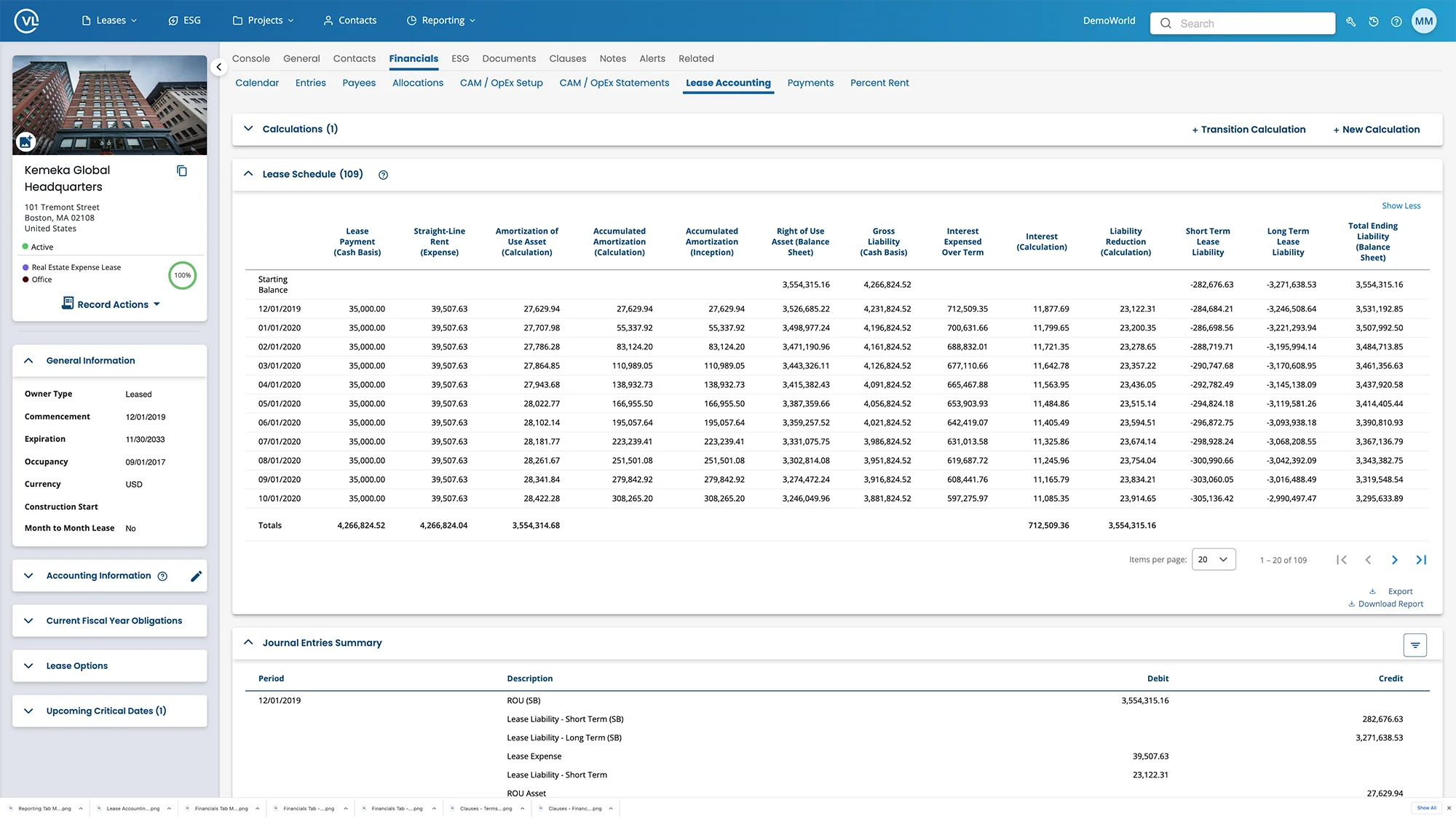
Draft records and rent schedules are auto-populated and tie back to the source language. Every document runs through more than 40 validations, and results are checked against CoStar's market data. Customer data is not used to train AI models, and the platform supports ASC 842, IFRS 16, and GASB 87 reporting.
Key features include:
CoStar Lease LLM abstraction: A lease-specific model built and validated with CoStar's abstractors, attorneys, and market data.
Full-document OCR: Classifies files and processes tables, strikeouts, and handwritten margin notes.
AI field summaries: Provides concise summaries of extracted fields with supporting commentary for context.
Auto-populated records and rent schedules: Draft lease records and rent schedules are generated and linked to source lease language.
Layered validation: More than 40 validations, plus benchmarks against CoStar property data, check accuracy.
Lease accounting and compliance: Supports ASC 842, IFRS 16, and GASB 87 with amortization schedules and disclosure reporting.
Searchable digital leases: Produces a searchable digital version of each lease for locating specific terms.
Limitations (as reported by users on G2):
Reporting flexibility: Reviewers cite reporting and filtering as an area they want to be more flexible.
Handling ended leases: One user noted that once a lease moves to a historical status, it must be recaptured to run a modification.
Setup and learning curve: Some admins and reporting users report a learning curve when configuring the system.
Source: Visual Lease
6. LeaseAccelerator

Best for: Enterprise lease accounting and compliance
Strengths: Asset-level sub-ledger and ERP integrations
Things to consider: Broad platform with a steep learning curve
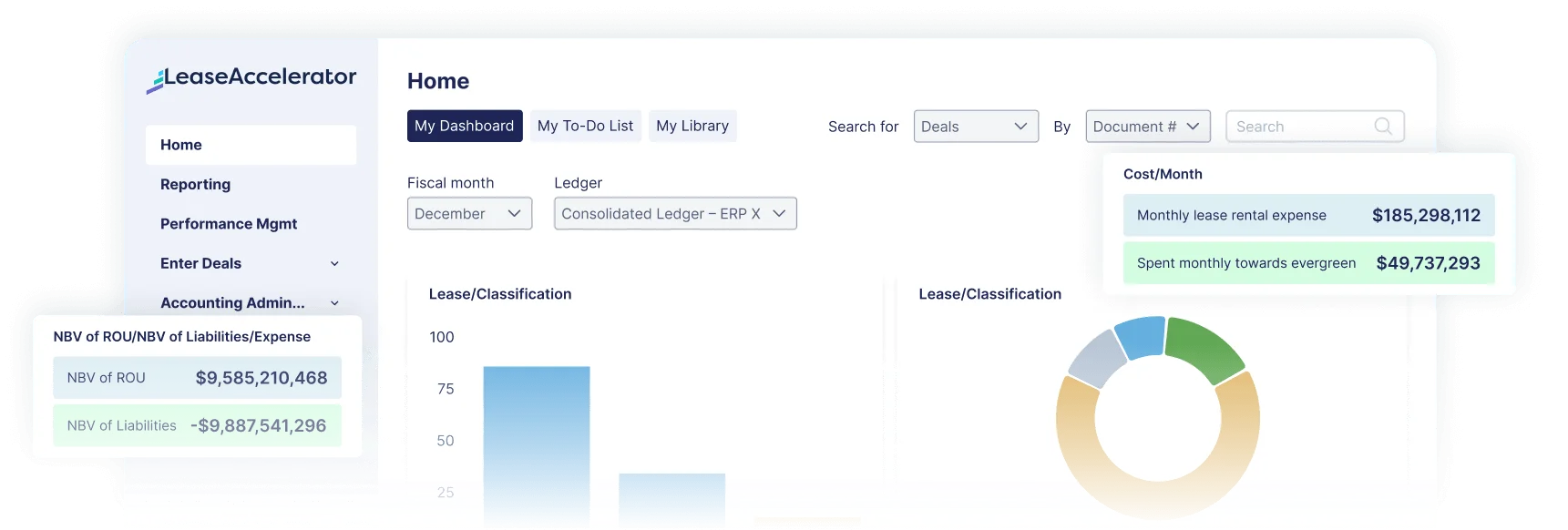
LeaseAccelerator, an insightsoftware company, is an enterprise lease lifecycle platform that centralizes real estate and equipment leases in a single system. Data capture and abstraction feed a full lease sub-ledger and an accounting engine that automates ASC 842 and IFRS 16 treatment.
The platform applies automated validation and classification, generates amortization schedules, interest, right-of-use assets, and journal entries, and posts them to ERP systems through integrations. It also adds lease-vs-buy analysis, end-of-term decisioning, scenario modeling, and asset-level visibility, with roll-forward analytics that drill down into period-over-period changes.
Key features include:
Full lease sub-ledger: Maintains an asset-level sub-ledger that protects the general ledger and centralizes lease data.
Automated accounting: Calculates ROU assets, liability schedules, interest, and journal entries under ASC 842 and IFRS 16.
Validation and classification: Applies automated validation rules and classification logic to lease data.
ERP integrations: Posts lease accounting entries to systems such as Oracle and SAP through built-in integrations.
Roll-forward analytics: Provides drill-down analytics that explain period-over-period changes for audits.
Scenario modeling: Simulates restructuring, early termination, extensions, and consolidations using real lease data.
Lifecycle management: Covers lease sourcing, administration, end-of-term decisioning, and event tracking across global portfolios.
Limitations (as reported by users on G2):
Learning curve: Reviewers note the platform does a great deal and requires strong training to use fully.
Processing speed: Some users report the system can be slow, with simple changes taking time to process.
Report customization: Standard reports can be very large, and users want more flexible report and dashboard customization.
Integration effort: Certain third-party ERP integrations can require additional manual work.
Source: LeaseAccelerator
7. MRI Software
Best for: Commercial owners, occupiers, and investors
Strengths: Proprietary OCR, analytics, full audit trail
Things to consider: Multi-module setup carries a learning curve
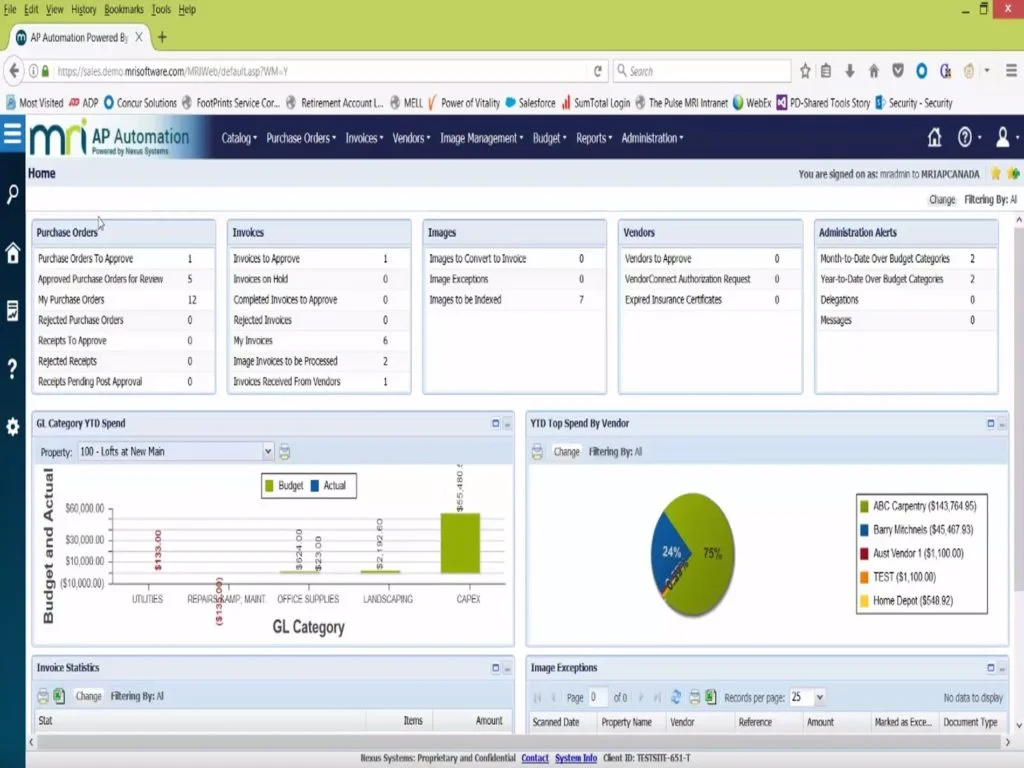
MRI Software offers AI-powered lease abstraction for commercial property owners, operators, occupiers, and investors. A proprietary OCR engine reviews documents and converts them to machine-readable text stored in a central repository. Beyond extraction, its contract analytics let teams view and analyze data in index, map, and table formats and build dashboards and reports.
Each extracted data point links to its source, providing a full audit trail accessible in one click. The abstraction tool integrates with MRI Commercial Management, ProLease, and Horizon to keep one source of truth, and supports IFRS 16 and ASC 842 compliance across real estate, retail, telecom, automotive, financial services, legal, and aviation leases.
Key features include:
Proprietary OCR extraction: Converts lease documents into machine-readable text and stores them in a central repository.
Contract analytics: Presents data in index, map, and table views and supports custom dashboards and reports.
Full audit trail: Links each extracted data point to its source document for one-click verification, even from a spreadsheet.
Compliance support: Helps maintain IFRS 16 and ASC 842 compliance and reduces manual aggregation.
Native integrations: Connects with MRI Commercial Management, ProLease, and Horizon for a single source of truth.
Cross-industry coverage: Handles real estate, retail, telecom, automotive, financial services, legal, and aviation leases.
Discrepancy detection: Helps identify data discrepancies across a portfolio.
Limitations (as reported by users on G2):
Learning curve: Users note the software can be hard to understand at first before it becomes straightforward.
Interface navigation: Some reviewers find the interface uses many screens and lacks conveniences such as a back button on reports.
Modules cost extra: Certain capabilities sit behind additional purchases rather than the base product.
Configuration complexity: Configuration can require navigating multiple modules and detailed rules, which takes training.
Source: MRI Software
8. Yardi Smart Lease

Best for: Abstracting leases inside Yardi Voyager Commercial
Strengths: Native Voyager abstraction with AI assistant
Things to consider: New commercial leases and Voyager only
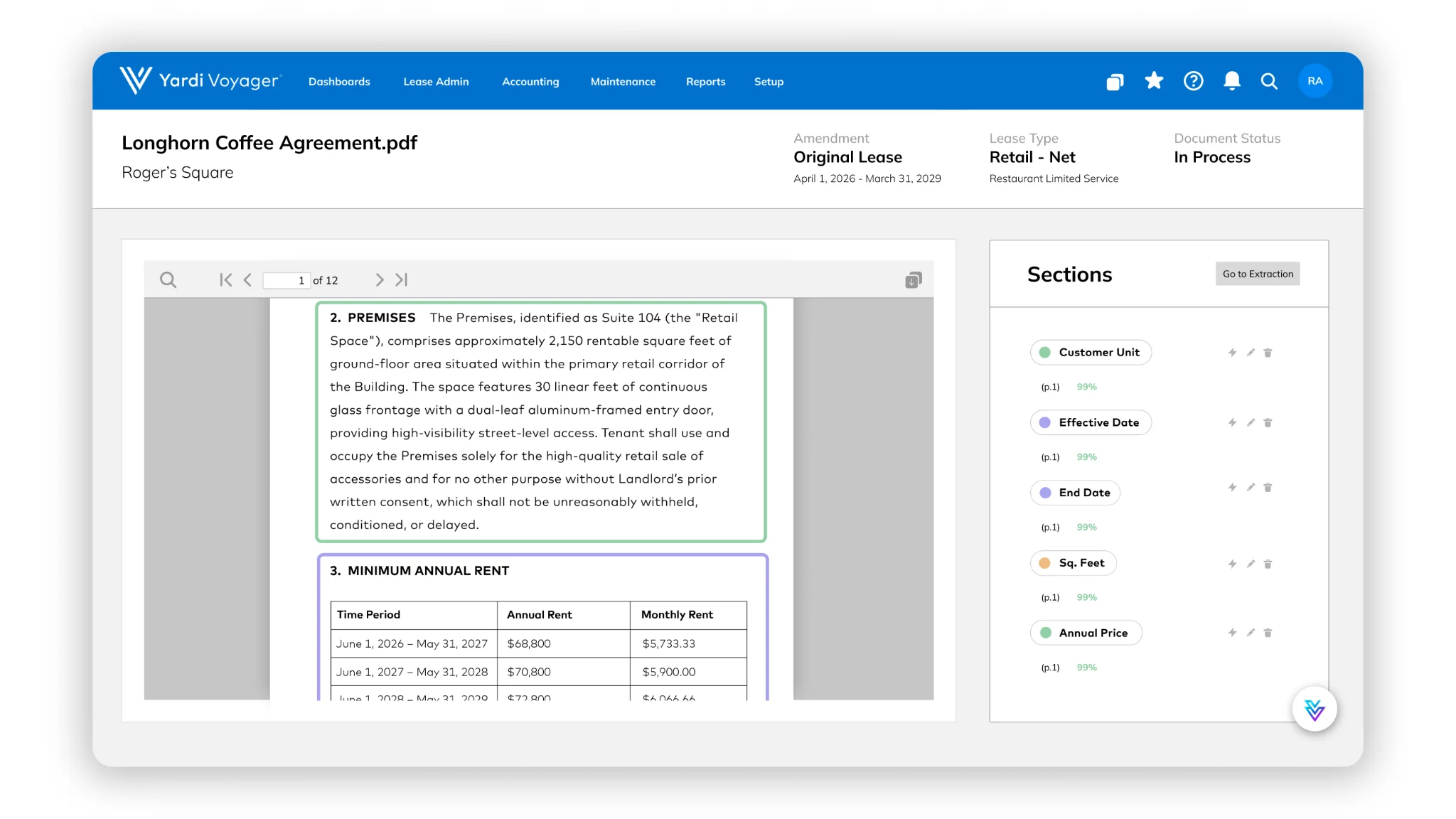
Yardi Smart Lease is an AI-powered lease abstraction solution built directly into Yardi Voyager Commercial. It uses AI and OCR to scan lease documents, detect key sections, and populate structured fields, which write straight into Voyager lease records with no exports or re-keying. Teams review, correct, and approve the extracted data, and can drag and drop a missed clause into the correct Voyager field.
Accuracy improves over time as the system learns a portfolio's lease types, with training data kept within the customer's environment. A built-in AI assistant answers plain-language questions about a lease inside Voyager, and bulk processing queues multiple documents at once.
Key features include:
Native Voyager abstraction: Writes structured lease data directly into Voyager lease records, removing exports, re-keying, and separate repositories.
OCR and clause detection: Scans documents with OCR, detects key sections, and populates data fields for review.
Human review workflow: Teams review, correct, and approve extracted data, and drag and drop missed clauses into Voyager fields.
Portfolio-trained machine learning: Accuracy improves as the system learns a customer's lease types, with training data kept private to that environment.
Source verification: Extracted values link back to the source for one-click checking.
Bulk processing: Queues multiple leases so structured data moves into Voyager across teams.
Smart Lease AI assistant: Answers plain-language questions about a lease, such as notice periods or rent terms, inside Voyager.
Limitations (as reported by users on G2):
Voyager learning curve: Reviewers describe Voyager as powerful but note a steep learning curve and an interface that can feel dated.
Setup and administration: Getting the most from the platform often requires dedicated admin resources or a consultant for configuration.
Early product scope: Smart Lease supports new commercial leases at launch, with renewals and additional workflows planned for later.
Ecosystem dependence: Because it is native to Voyager, its value is tied to using the Yardi system of record.
Source: Yardi
Conclusion
Adopting scalable AI for lease abstraction enables commercial real estate organizations to process high document volumes with greater speed and accuracy. By replacing manual data entry with automated extraction, firms can reduce operational costs, minimize risk, and ensure lease data remains current. Integrating these capabilities empowers teams to focus on strategic decision-making rather than repetitive administrative tasks.