TL;DR: AI solutions for lease processing use OCR, NLP, and machine learning to extract and structure lease data automatically instead of reading contracts by hand. Best dedicated AI automation solution: Kolena; best lease management platform with AI features: Visual Lease.
What Are AI Solutions for Lease Processing?
AI solutions for lease processing can automate tedious tasks like reading contracts, extracting data, and answering tenant questions. These tools significantly reduce review times, cut operational costs, and eliminate manual data entry errors. These tools rely on technologies such as optical character recognition (OCR), generative AI, and traditional machine learning to quickly analyze leases and identify key terms, clauses, and dates.
AI lease processing solutions often integrate with existing property management or enterprise resource planning (ERP) systems, enabling end-to-end automation of lease processing workflows. This not only saves time and labor costs but also helps organizations remain compliant with evolving accounting and regulatory standards by ensuring data consistency and transparency.
Core AI lease processing technologies:
Lease document ingestion: Imports leases from PDFs, Word files, scans, and other formats, automatically classifying documents, extracting metadata, and organizing them for downstream processing.
OCR and document understanding: Uses OCR, NLP, and machine learning to convert unstructured leases into machine-readable text while identifying clauses, key terms, and document structure.
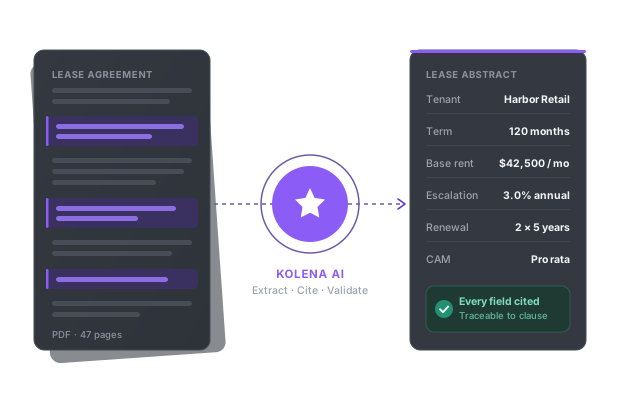
AI lease abstraction: Extracts lease data such as dates, rent, renewal options, and obligations into structured fields, with validation checks to improve consistency and accuracy.
Generative AI summaries and lease Q&A: Creates concise lease summaries and answers natural language questions about contracts using extracted lease data and contextual understanding.
Workflow automation: Automates reviews, approvals, notifications, integrations, and audit tracking to streamline lease processing and enforce business rules across systems.
Try our AI-powered lease abstraction tool
AI Lease Processing Solutions at a Glance
The table below summarizes the key differences between the solutions covered in this article. We explore each one in more detail in the sections that follow.
Category | Solution | Best For | Key Strengths | Things to Consider |
AI-First Lease Abstraction | 1. Kolena | CRE, finance, and insurance teams automating document workflows | Cited, explainable extractions with prebuilt industry workflows | Enterprise setup; outputs still need human verification |
AI-First Lease Abstraction | 2. Prophia | CRE owners and operators standardizing portfolio lease data | Source-linked abstracts using AI plus expert validation | Commercial only; some manual upkeep and limited exports |
AI-First Lease Abstraction | 3. Trullion | Finance and accounting teams under ASC 842 and IFRS 16 | AI extraction tied to audit-ready lease accounting | Accounting-first; reporting depth can feel limited |
Lease Management Platforms with AI Abstraction | 4. Visual Lease | Enterprises needing AI abstraction plus lease accounting | CoStar-backed engine with heavy validation and security | Steep learning curve; slower on very large portfolios |
Lease Management Platforms with AI Abstraction | 5. MRI Software | Enterprises standardizing large, multi-format portfolios | OCR extraction with contract analytics and audit trail | Enterprise pricing; dated navigation and reporting |
Lease Management Platforms with AI Abstraction | 6. Yardi Smart Lease | Commercial operators already running on Yardi Voyager | Native abstraction that writes straight into Voyager | New commercial leases only at launch; tied to Voyager |
Lease Management Platforms with AI Abstraction | 7. Occupier | Commercial tenants managing 30+ leases across locations | Tenant-built platform with AI clause summaries | Newer AI; occasional clause misclassification |
Lease Management Platforms with AI Abstraction | 8. Leasecake | Multi-unit retail, restaurant, and franchise operators | Simple setup with AI abstraction and date alerts | Lighter reporting; limited multi-suite and currency math |
Why Lease Processing Is Difficult Without AI
Lease Documents Are Long and Inconsistent
Lease documents often span dozens or even hundreds of pages and contain dense legal language, varied formatting, and unique structures depending on the parties involved or the property type. There is no universal lease template, which makes it challenging to standardize document review or data extraction processes. Each lease may use different terminology for similar concepts, and important information can be buried in lengthy clauses, making manual review time-consuming and error-prone.
Inconsistent layouts and varying document quality further complicate the process. Older leases may be scanned images with poor legibility, while newer digital files might use complex tables or embedded attachments. The lack of standardization forces staff to read through each document line by line, increasing the risk of missing critical details or misinterpreting obligations. This variability creates significant bottlenecks for organizations managing large lease portfolios.
Manual Lease Abstraction Is Slow and Error-Prone
Traditional lease abstraction requires skilled personnel to review every lease document, identify relevant clauses, and manually enter data into tracking systems. This manual process is slow, especially for organizations dealing with hundreds or thousands of leases, and it ties up valuable human resources that could be used elsewhere. The repetitive nature of the work also leads to fatigue, which increases the likelihood of errors and omissions.
Even minor mistakes in lease abstraction—such as entering the wrong date or missing a renewal clause—can have significant financial or legal consequences. Manual processes lack the checks and consistency provided by automated systems, and verifying the accuracy of extracted data often requires additional rounds of review. As lease portfolios grow, the limitations of manual abstraction become more pronounced, resulting in delays, increased costs, and compliance risks.
Related content: Read our guide to lease abstraction services
Lease Data Is Often Siloed
In many organizations, lease data is stored in disparate systems, spreadsheets, or even physical files across multiple departments. This fragmentation makes it difficult to get a unified view of lease obligations, payment schedules, or key dates. When information is siloed, collaboration between teams such as finance, legal, and operations becomes inefficient, leading to miscommunication and delays in decision-making.
Siloed lease data also hampers reporting and compliance efforts. For example, new accounting standards require organizations to track lease liabilities accurately, which is nearly impossible without consolidated and reliable data. Without integration, data updates in one system may not be reflected elsewhere, increasing the risk of outdated or conflicting information. Breaking down these silos is essential for efficient lease management and strategic planning.
Benefits of AI Solutions for Lease Processing
AI solutions help organizations process leases faster while improving the quality and consistency of extracted data. By automating document analysis and integrating lease information into existing systems, these tools reduce manual effort and make lease management more accurate, scalable, and compliant.
Faster lease abstraction: AI extracts key lease terms, dates, payment schedules, and clauses in minutes instead of hours, significantly reducing document review time.
Higher data accuracy: Automated extraction minimizes manual entry errors and applies consistent rules across all lease documents, improving data quality.
Lower operating costs: By reducing repetitive manual work, organizations can process larger lease volumes without proportionally increasing staffing costs.
Improved compliance: AI helps capture the information required for accounting standards such as ASC 842 and IFRS 16, supporting more accurate financial reporting and audit readiness.
Better visibility into lease portfolios: Centralized lease data makes it easier to search agreements, monitor obligations, track renewals, and generate reports across the organization.
Scalable document processing: AI can process hundreds or thousands of leases with consistent performance, making it well suited for growing organizations and large property portfolios.
Automatic identification of key clauses: AI can detect provisions such as renewal options, termination rights, rent escalation clauses, and maintenance responsibilities without requiring manual review of every page.
Improved collaboration across teams: Finance, legal, real estate, and operations teams can access the same structured lease data, reducing communication gaps and improving decision-making.
Faster response to business changes: With searchable and structured lease information, organizations can quickly assess the impact of acquisitions, portfolio changes, or regulatory updates.
Continuous workflow automation: AI integrates with lease management, ERP, and property management systems to automate downstream processes such as approvals, notifications, reporting, and payment tracking.
Learn more about abstract commercial leases with ai.
Core Capabilities and Technologies of AI Lease Processing Solutions
Lease Document Ingestion
AI lease processing platforms begin with robust document ingestion capabilities, allowing users to upload leases in various formats—PDFs, Word documents, scanned images, and more. These platforms can handle bulk uploads, automatically detect document types, and organize files by property, tenant, or contract status. This automation eliminates manual sorting and ensures that all relevant documents are captured at the start of the workflow.
Effective document ingestion also involves metadata extraction, such as document creation dates, author names, and version history. By cataloging these details, AI systems create a searchable repository that supports audit trails and easy retrieval. Automated ingestion lays the foundation for downstream processing, enabling the seamless application of OCR, data extraction, and workflow automation tools.
OCR and Document Understanding
Optical character recognition (OCR) is essential for converting scanned or image-based lease documents into machine-readable text. Advanced OCR engines can handle poor-quality scans, handwritten notes, and complex formatting, ensuring that valuable information is not lost during digitization. Accurate OCR is the first step in enabling AI systems to analyze and extract data from diverse lease documents.
Beyond OCR, document understanding leverages NLP and machine learning models to interpret the context and meaning of lease clauses. These technologies identify section headings, key terms, and relationships between data points, even when leases use non-standard language. Document understanding bridges the gap between raw text and actionable information, allowing downstream AI tools to extract, summarize, and analyze lease data effectively.
AI Lease Abstraction
AI lease abstraction automates the identification and extraction of key data points from lease documents, such as commencement dates, rent amounts, renewal options, and termination clauses. Machine learning models are trained on large datasets of leases to recognize relevant information regardless of document layout or language variation. This automation greatly reduces the manual effort required to summarize complex leases and ensures consistency across large portfolios.
Automated abstraction also supports customizable data fields, enabling organizations to extract information specific to their business needs. AI-driven validation routines can flag anomalies or missing data for human review, providing an extra layer of quality control. By standardizing lease data extraction, AI abstraction tools help organizations maintain accurate and up-to-date records, which are essential for compliance and strategic planning.
Generative AI Summaries and Lease Q&A
Generative AI can create concise summaries of lengthy lease agreements, highlighting the most important clauses, obligations, and risks. These AI-generated summaries allow users to quickly understand key aspects of a lease without reading the entire document. This capability is particularly valuable for legal, finance, or property management teams that must review large volumes of leases in short timeframes.
In addition, AI-powered lease Q&A systems enable users to ask natural language questions about specific documents or portfolios. For example, a user might ask, “When does the lease expire?” or “Are there any early termination penalties?” The AI system searches the extracted data and provides direct, context-aware answers, improving accessibility and supporting faster, more informed decision-making.
Workflow Automation
AI-driven workflow automation streamlines the end-to-end lease processing lifecycle. These solutions can automatically route documents for review, trigger notifications for critical dates (such as renewals or rent escalations), and integrate with contract management or accounting systems. Automation reduces manual handoffs, accelerates processing times, and ensures that nothing falls through the cracks.
Workflow automation also supports compliance by enforcing approval hierarchies, tracking changes, and maintaining detailed audit logs. Organizations can configure rules and triggers to match their internal processes, such as requiring legal review for certain clauses or flagging leases that deviate from standard terms. By embedding automation throughout lease management, AI solutions drive efficiency, accountability, and scalability.
Notable AI Solutions for Lease Processing
How we selected these solutions: We shortlisted AI lease processing solutions based on their ability to ingest lease documents in multiple formats, extract and structure key terms with AI, link extracted data back to the source, and integrate with lease management, accounting, and property systems.
AI-First Lease Abstraction Solutions
1. Kolena

Best for: CRE, finance, and insurance teams automating document workflows
Strengths: Cited, explainable extractions with prebuilt industry workflows
Things to consider: Enterprise setup; outputs still need human verification
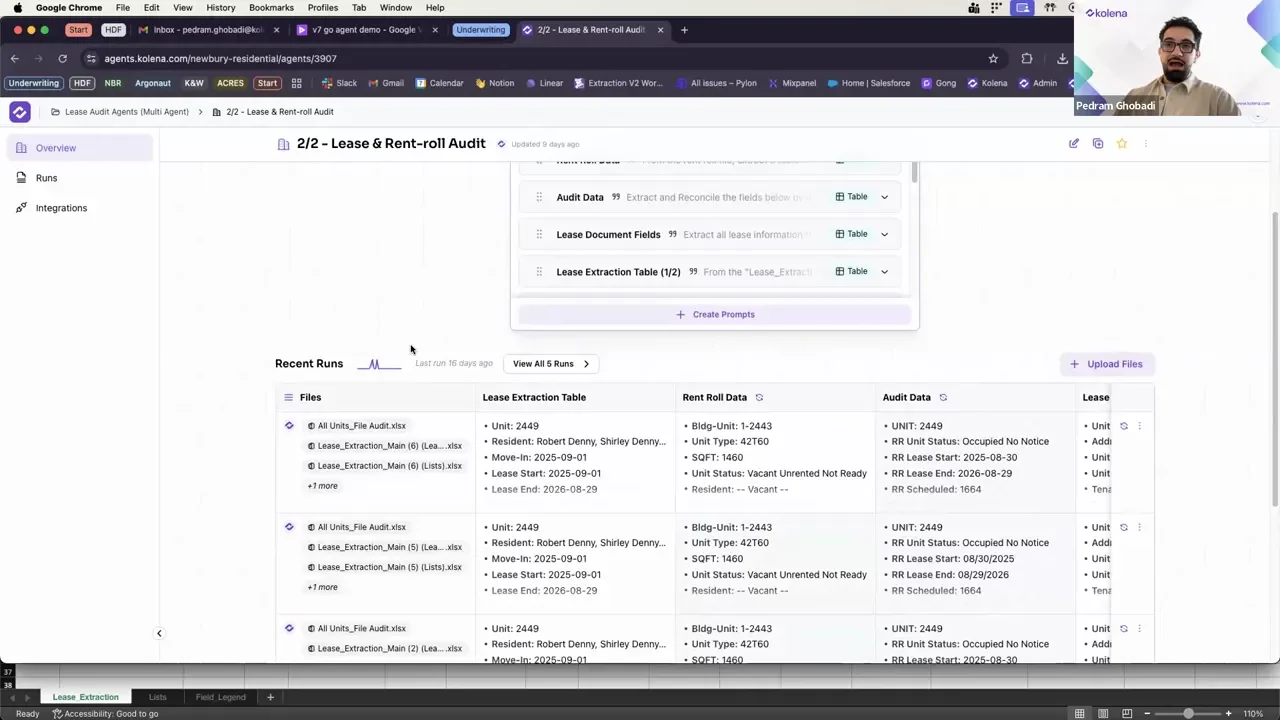
Kolena is an AI document automation platform that handles lease abstraction alongside underwriting, compliance audits, loan validation, and other document-heavy workflows. It reads leases, amendments, rent rolls, and related files, automatically detects document types, and extracts the fields a team defines.
Users upload documents or email them in, the AI agents run, and results come back as structured, template-ready outputs. Every extraction includes reasoning, confidence scores, and citations that link each value back to the exact document and page. Prebuilt workflows for real estate, insurance, banking, and finance can be tailored to a team's policies, templates, and reporting requirements.
Key features include:
Document understanding: Parses data from PDFs, spreadsheets, emails, scans, and audio, automatically detecting document types and extracting the required details.
Inline citations and reasoning: Links every extracted data point back to the exact document and page, and includes reasoning that shows how the agent reached each conclusion.
Multi-model quality control: Validates extractions across models and repeated requests to reduce errors and hallucinations, applying business rules and cross-checks to each field.
Template-first outputs: Exports results into the exact Excel, Word, or underwriting model a team uses, with batch ingestion that handles leases, amendments, and exhibits together.
Prompt optimization: Rewrites and optimizes user prompts automatically so non-technical users get consistent results without prompt engineering.
Integrations: Connects with Excel, Yardi, MRI, VTS, Salesforce, Box, Drive, and SharePoint to push structured output into existing systems.
Scale: Processes hundreds or thousands of documents in parallel for portfolio-level volume.
Limitations (based on publicly available sources):
Pricing visibility: Itemized public pricing is not published; access is through a free trial or a demo, with plans tailored to each organization.
Human verification step: Because outputs feed downstream financial and legal decisions, the workflow keeps a human review stage to confirm AI-extracted fields against the cited source.
Vertical focus: Prebuilt automations center on real estate, insurance, banking, and financial services, so workflows well outside these areas may need additional configuration.
Source: Kolena
2. Prophia

Best for: CRE owners and operators standardizing portfolio lease data
Strengths: Source-linked abstracts using AI plus expert validation
Things to consider: Commercial only; some manual upkeep and limited exports
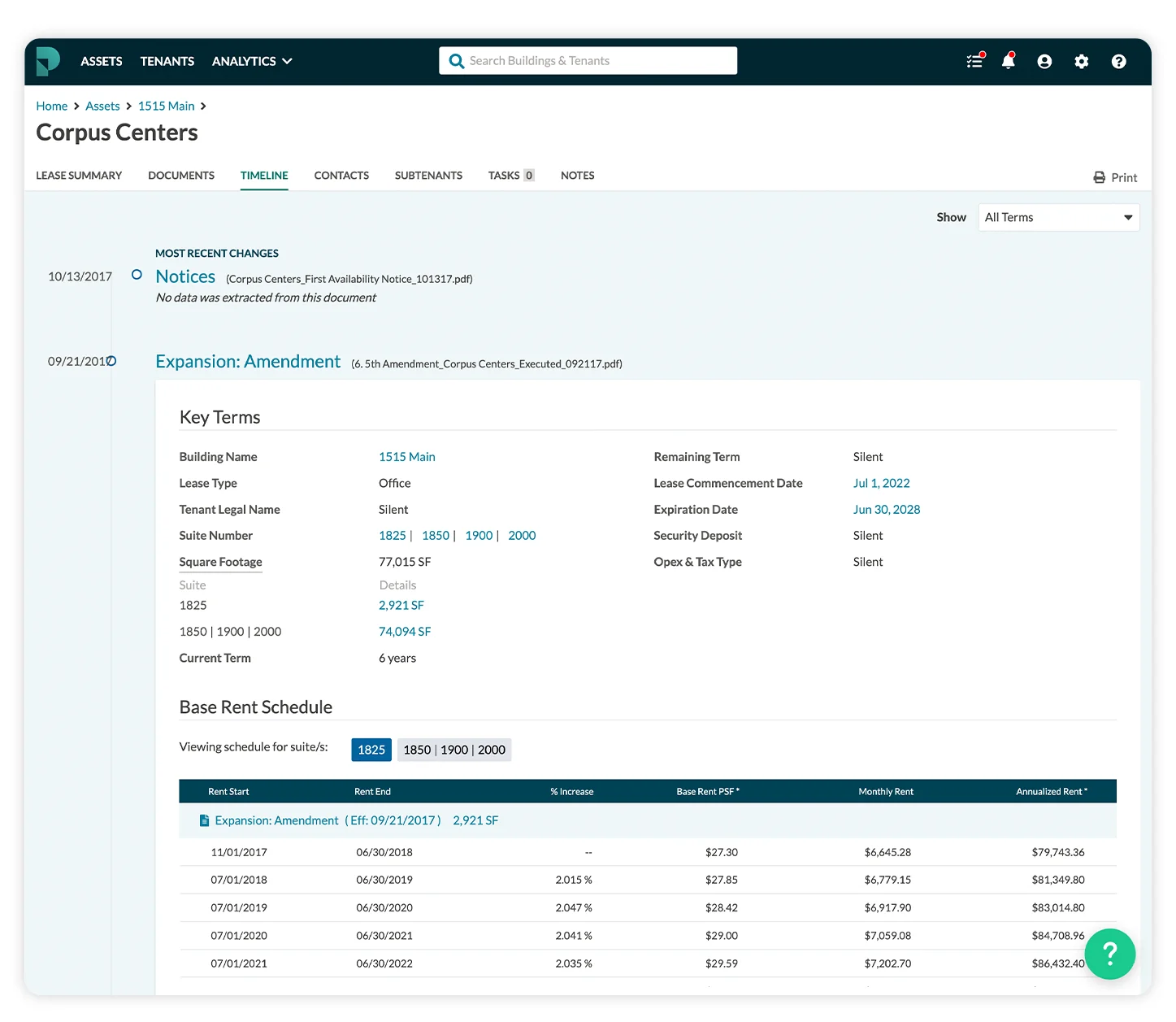
Prophia is an AI-powered lease abstraction and portfolio data platform for commercial real estate teams. Users drag and drop a lease, amendment, or rent roll, and Prophia captures, annotates, and organizes the data into a structured digital abstract.
The platform combines AI extraction with expert validation to produce consistent data across a portfolio. Summaries hyperlink back to the original lease language so team members can verify figures without opening separate documents. Prophia is built to make lease data usable for reporting, underwriting, and asset management, not just to summarize documents.
Key features include:
AI-generated hyperlinks: Links concepts in each abstract directly to the original lease or amendment language, so users move from summary to source without opening another screen.
In-document search: Adds an AI-annotated layer over lease PDFs that lets users search tenant terms and jump to the exact clause, section, sentence, or figure.
Rights and encumbrances tracking: AI discovers and flags tenant rights across the portfolio so teams can track obligations from one place.
Document interconnectivity: Uploaded amendments, renewals, and agreements interact through logic-based links and update data in real time, keeping a historical record of changes.
Portfolio standardization: Applies a consistent abstraction method to every lease so data patterns stay predictable for reporting and analysis.
Limitations (as reported by users on G2):
Manual upkeep: Some users note that tenant information requires manual updating, which leaves room for error.
Limited exports and integrations: Reviewers mention the stacking plan cannot be exported to Excel and would like more accounting integrations.
Navigation friction: Opening documents can spawn multiple browser tabs, and some users find navigation and performance less smooth at times.
Source: Prophia
3. Trullion

Best for: Finance and accounting teams under ASC 842 and IFRS 16
Strengths: AI extraction tied to audit-ready lease accounting
Things to consider: Accounting-first; reporting depth can feel limited
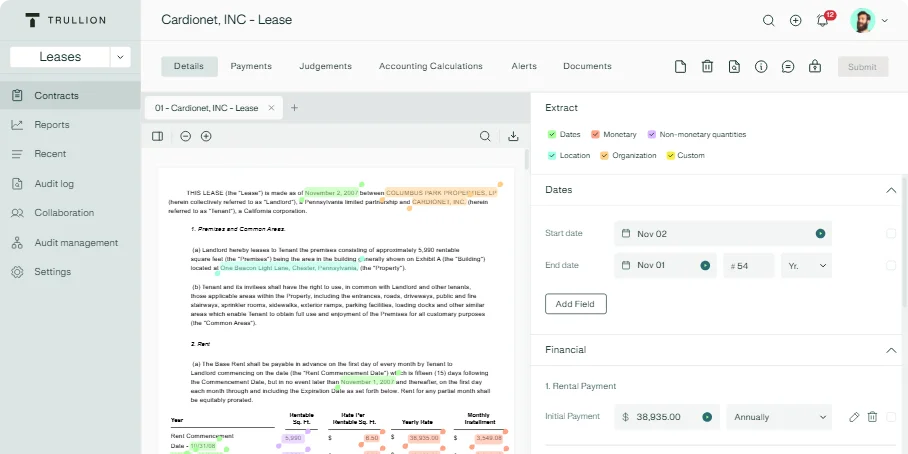
Trullion is an AI-powered lease abstraction and lease accounting platform aimed at finance and accounting teams. Users upload PDF or Excel lease contracts, and the AI scans, extracts, and organizes lease data down to individual clauses and amendments.
Extracted values link back to the source document for traceability, and built-in validation and version tracking keep outputs clean. The platform is built around compliance standards including ASC 842, IFRS 16, and GASB 87, and it connects extraction directly to journal entries, schedules, and disclosures.
Key features include:
AI-powered OCR and data extraction: Converts complex PDFs and unstructured data into structured, searchable fields, pulling text, tables, and custom fields.
Contextual date interpretation: Understands phrases such as "first day of the last week of January" and outputs exact lease dates.
Bespoke field extraction: Lets teams write custom questions unique to their leases to extract specific contract data and details.
Summarization and translation: Generates concise document summaries and translates content across English and other languages.
Source traceability: Links each data point back to the source contract with audit logs that track changes for internal and external stakeholders.
Limitations (as reported by users on G2):
Trullion is highly rated and strictly negative reviews are limited; the points below are drawn from critical feedback within otherwise positive reviews.
Reporting depth: Some users describe the reporting section as less robust and want more flexibility.
Data-entry navigation: Reviewers note that mapping codes are not placed prominently during contract entry.
Learning curve: New users report an initial learning curve before the platform becomes efficient.
Source: Trullion
Lease Management Platforms with AI Abstraction
4. Visual Lease

Best for: Enterprises needing AI abstraction plus lease accounting
Strengths: CoStar-backed engine with heavy validation and security
Things to consider: Steep learning curve; slower on very large portfolios
Visual Lease is a lease management and lease accounting platform whose AI Lease Abstraction engine is built on CoStar's lease dataset. Its OCR classifies each file and processes tables, strikeouts, and margin notes, then produces AI summaries of extracted fields with supporting commentary.
The engine auto-populates a draft lease record and auto-calculates rent schedules, with every field tied back to the lease language for verification. Results are validated against CoStar market data, and abstraction sits inside a broader platform for lease management, accounting, and ASC 842, IFRS 16, and GASB compliance.
Key features include:
Complete AI lease scanning: OCR classifies each document and processes every table, strikeout, and margin note to capture the full lease.
AI field summaries: Provides concise summaries of extracted fields plus supporting commentary that adds context.
Auto-populated records and rent schedules: Generates a draft lease record and calculated rent schedules that users verify against the source language.
Multi-layer validation: Runs each document through more than 40 validations and checks outputs against CoStar benchmarks to flag rent anomalies, square-footage mismatches, and out-of-range TI allowances.
Enterprise data protection: Uses an isolated setup through AWS Bedrock, and customer data is not used to train AI models or exposed to the public cloud.
Searchable lease versions: Produces a complete digital, searchable version of each lease.
Limitations (as reported by users on G2):
Historical status handling: When a lease ends, its status switches to historical and cannot be modified without recapturing it, which users find time-consuming.
Learning curve and setup: Users report a steep learning curve, complex setup, and reliance on support for advanced configuration.
Performance and reporting: Some note slower performance with large portfolios and report customization that can feel rigid.
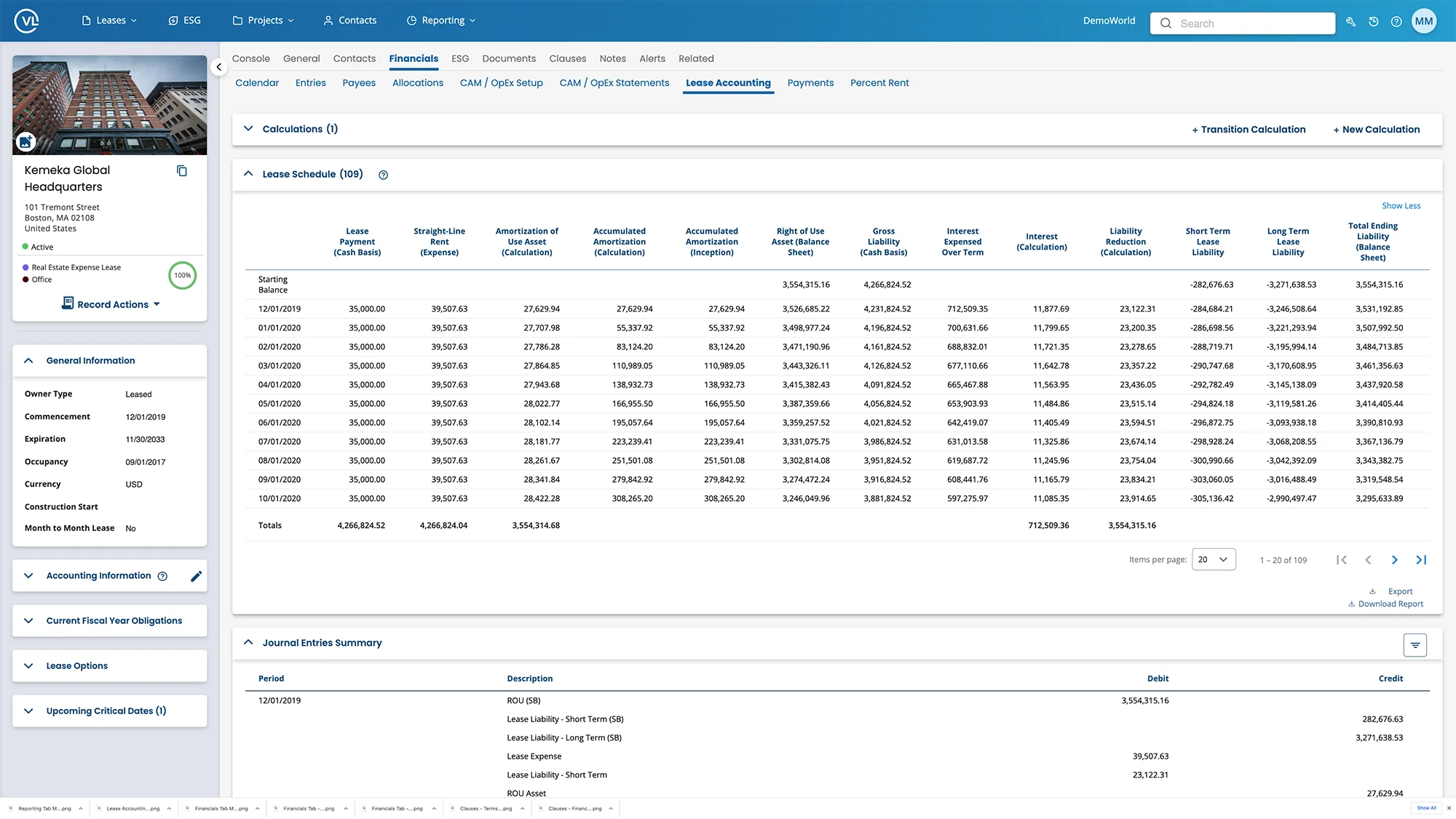
Source: Visual Lease
5. MRI Software

Best for: Enterprises standardizing large, multi-format portfolios
Strengths: OCR extraction with contract analytics and audit trail
Things to consider: Enterprise pricing; dated navigation and reporting
MRI Software offers AI-powered lease abstraction, delivered through MRI Contract Intelligence, for commercial property owners, operators, occupiers, and investors. A proprietary OCR engine converts lease documents into machine-readable text stored in a centralized repository, and the AI extracts and validates key data such as rent, term, and critical dates.
Each extracted data point links back to its source for a complete audit trail. The abstraction tool goes beyond extraction with contract analytics, and it integrates with MRI Commercial Management, ProLease, and Horizon to maintain one source of truth across a portfolio.
Key features include:
OCR-based extraction: A proprietary OCR engine reviews documents, converts them to machine-readable text, and stores them in a centralized repository.
Contract analytics: Lets teams analyze extracted data in index, map, or table views and build dashboards and reports.
Complete audit trail: Links each extracted data point to source information, accessible in one click even from a spreadsheet.
Data integration: Connects directly with MRI Commercial Management, ProLease, and Horizon for data integrity across the portfolio.
Multi-language and multi-sector support: Supports more than 25 languages and handles real estate, retail, telecom, automotive, financial services, legal, and aviation leases.
Compliance support: Helps keep data accurate for lease accounting standards such as IFRS 16 and ASC 842.
Limitations (as reported by users on G2):
Navigation: Users describe too many screens and the lack of an easy back button, requiring report filters to be re-entered.
Reporting: Some find reports need exporting to Excel and manual cleanup to be usable.
Module integration and support: Reviewers note the different modules do not always connect smoothly, and support quality can vary by contract tier.
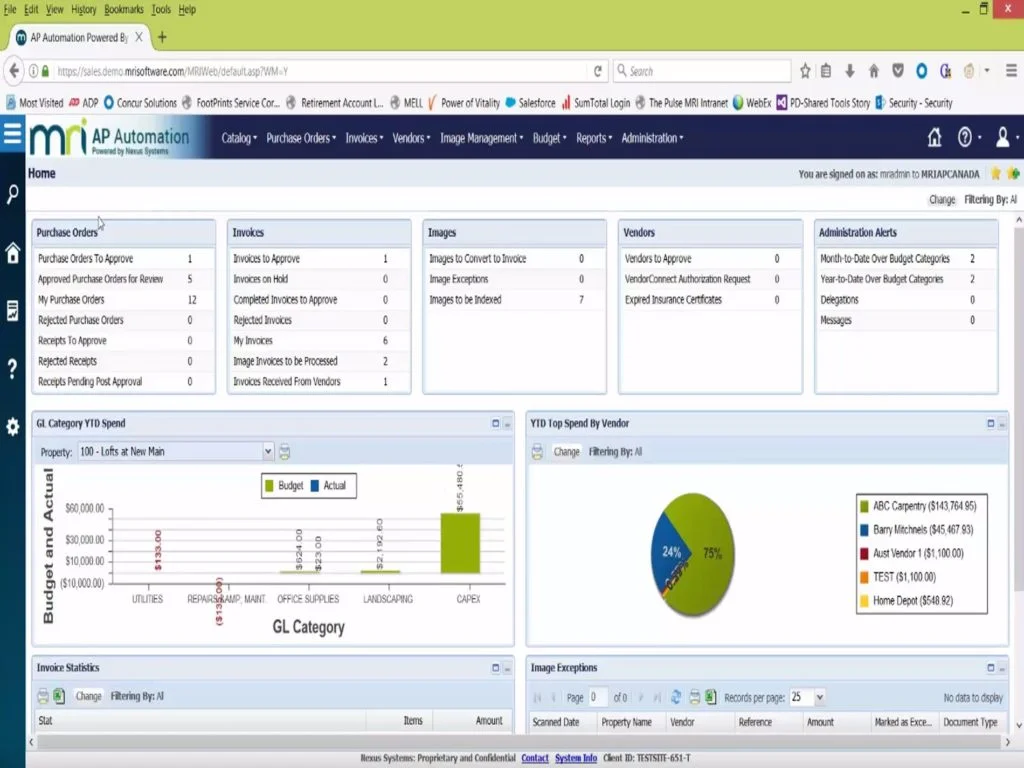
Source: MRI Software
6. Yardi Smart Lease

Best for: Commercial operators already running on Yardi Voyager
Strengths: Native abstraction that writes straight into Voyager
Things to consider: New commercial leases only at launch; tied to Voyager
Yardi Smart Lease is an AI-powered lease abstraction solution built directly into Yardi Voyager Commercial. It uses AI and OCR to scan lease documents, detect key sections, and populate structured fields, which a team reviews and approves before the data is finalized.
Because it is native to Voyager, extracted data writes straight into operational lease records, removing exports, re-keying, and reconciliation. Accuracy improves over time as the system learns from a portfolio's lease types, with training data kept within the customer's environment.
Key features include:
Native Voyager integration: Writes structured data directly into Voyager lease records, eliminating duplicate repositories and disconnected workflows.
AI abstraction with oversight: AI scans documents with OCR, detects key sections, and populates fields; users review, correct, and approve, and can drag and drop a missed clause into the right field.
Machine learning that adapts: Identifies relevant clauses based on patterns learned from the portfolio, improving accuracy over time with private, contained training data.
Bulk processing: Queues multiple documents for bulk processing so structured data flows into Voyager faster.
Smart Lease AI assistant: Answers plain-language questions about a lease inside Voyager, such as notice periods or rent terms, without leaving the system.
One-click source verification: Lets users verify extracted values against the source document.
Limitations (Smart Lease is a 2026 release; the points below reflect the Yardi Voyager platform it runs inside, as reported by users on G2):
Scope at launch: Smart Lease supports new commercial leases at launch, with renewals and additional workflows planned for later releases.
Performance and interface: Voyager users report the interface can feel dated and that pages may time out, requiring filters to be re-entered.
Learning curve and support: Reviewers note a significant ramp-up for new users and that support response times can be slow.
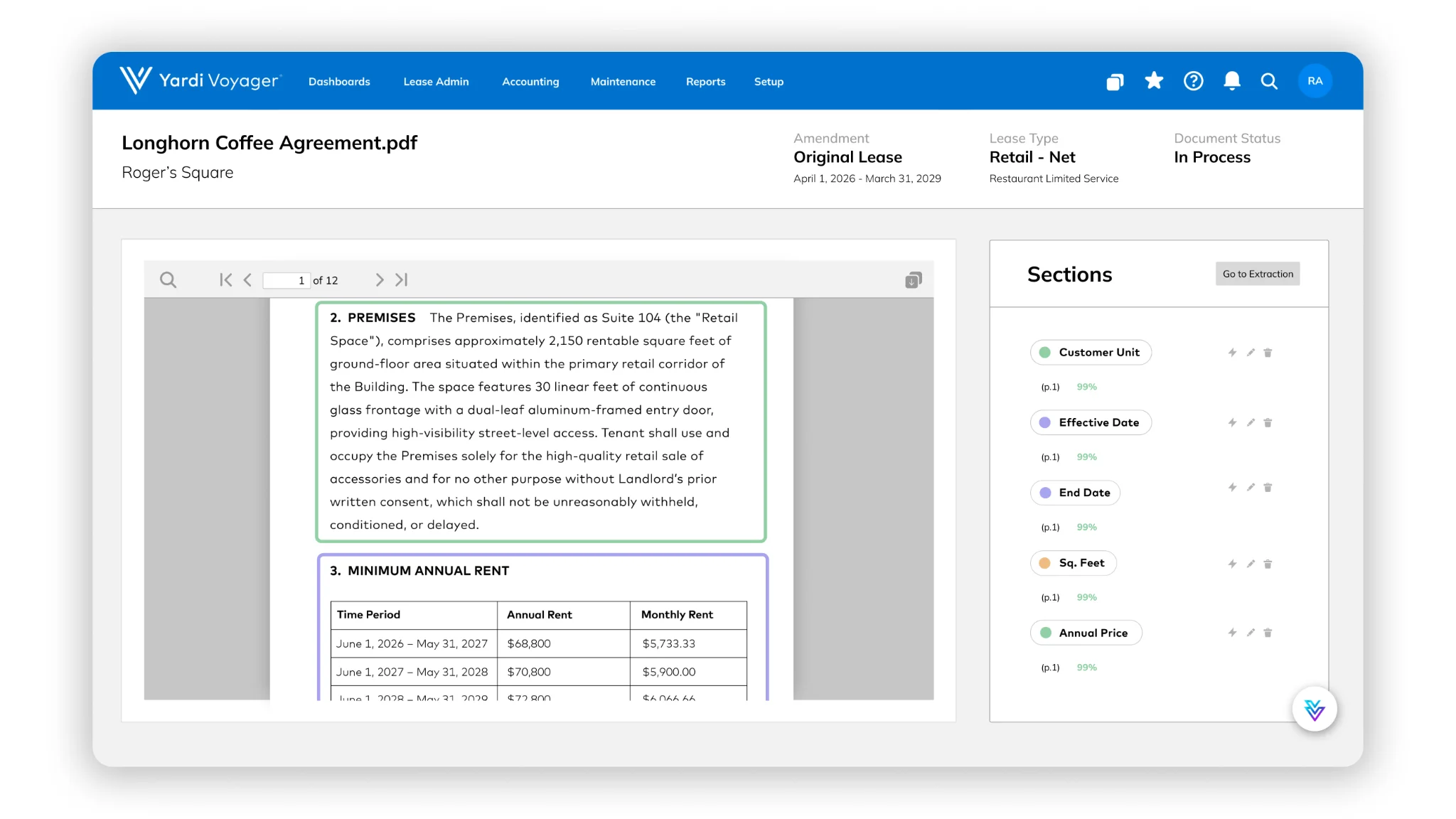
Source: Yardi
7. Occupier

Best for: Commercial tenants managing 30+ leases across locations
Strengths: Tenant-built platform with AI clause summaries
Things to consider: Newer AI; occasional clause misclassification
Occupier is a lease management and accounting platform built for commercial tenants, with AI features embedded across the workflow. Its AI Clause Intelligence turns dense legal language into clear summaries in seconds, and AI Responsibilities Mapping extracts landlord and tenant obligations and structures them for portfolio-wide filtering.
Both AI features work on clauses already in an account and are included in all plans. Alongside AI, Occupier centralizes lease data, tracks critical dates, and automates ASC 842 and IFRS 16 accounting so real estate and finance teams work from the same source.
Key features include:
AI clause summaries: Generates clear, actionable summaries of individual clauses and of 100-plus clauses at once so teams can act sooner.
AI responsibilities mapping: Extracts landlord and tenant obligations from clause text and lets users filter by theme, party, lease, or tag.
Auto-detected themes: Assigns themes such as maintenance, CAM, insurance, HVAC, parking, and signage based on clause content, with editable and custom themes.
Critical date tracking: Automated alerts for renewals, terminations, and rent escalations keep teams ahead of deadlines.
Lease accounting automation: Generates ASC 842/IFRS 16 calculations, journal entries, and disclosure reports, updating records when lease terms change.
Limitations (as reported by users on G2):
Clause classification: Some users report clauses being misclassified, with corrections taking longer than expected.
Reporting: Reviewers note limited report customization and extra steps to produce consolidated reports across separate entities.
Renewals and gaps: Adding a renewal to an existing location is not always easy, and some want a dedicated property insurance section.
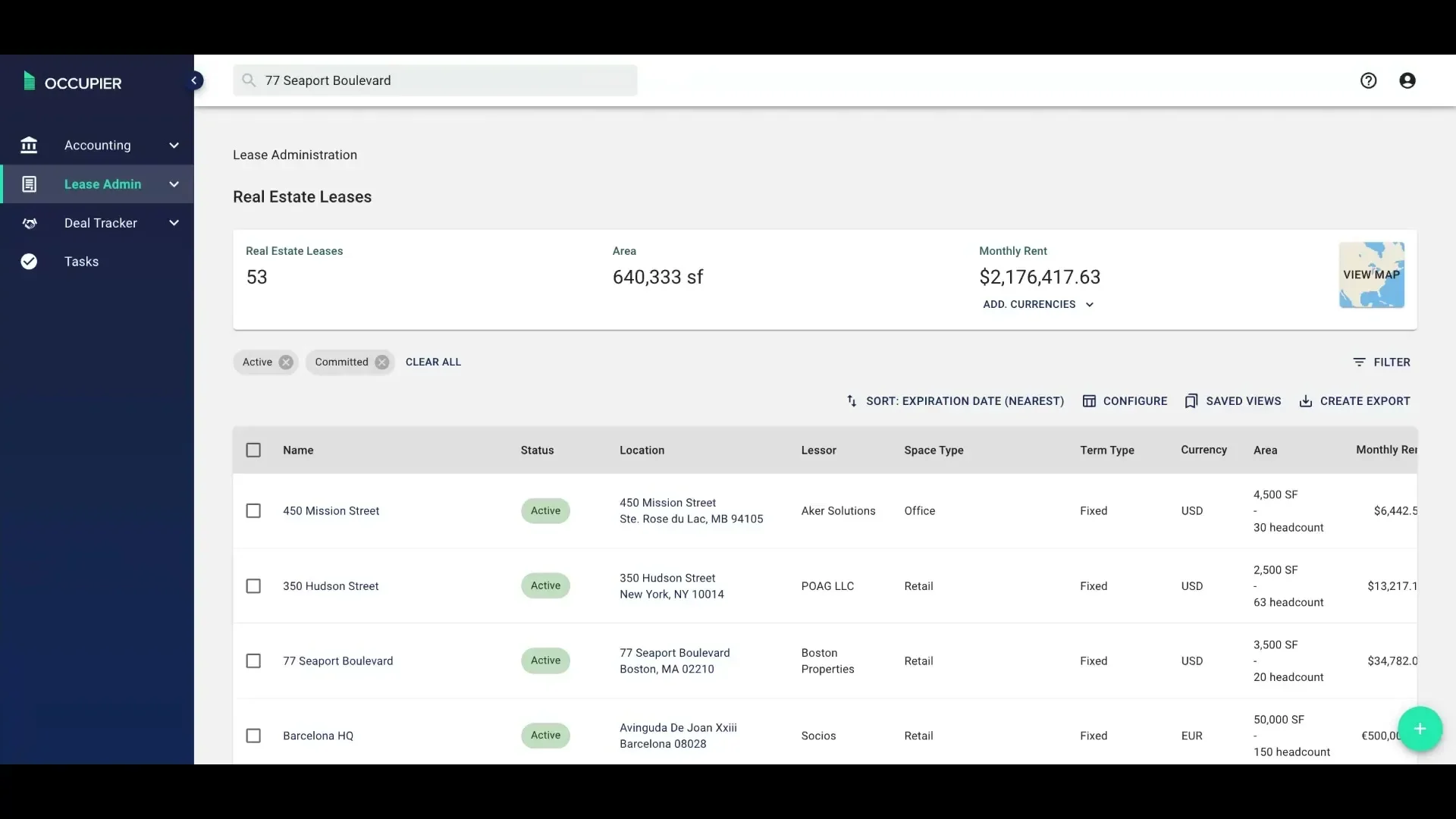
Source: Occupier
8. Leasecake

Best for: Multi-unit retail, restaurant, and franchise operators
Strengths: Simple setup with AI abstraction and date alerts
Things to consider: Lighter reporting; limited multi-suite and currency math
Leasecake is a lease and location management platform for multi-unit operators in retail, food and beverage, franchise, and similar sectors. Its AI assistant (CakeBot) handles lease abstraction, lease search, and risk analysis, extracting details from leases, amendments, franchise agreements, and permits and letting users query documents in plain language.
The platform centralizes lease terms, rent schedules, renewal options, and critical clauses by location, and automates ASC 842 lease accounting with audit-ready journal entries. Automated alerts flag upcoming renewals and other critical dates so operators stay ahead of deadlines.
Key features include:
AI lease abstraction (CakeBot): Uses AI to extract lease details, summarize documents, flag risk, and speed up entering a single lease.
Natural-language document queries: Lets users ask questions about specific terms or clauses and get real-time answers.
Critical date alerts: Automated reminders highlight upcoming renewals, expirations, and escalations to reduce missed dates.
Location and document management: Stores leases, licenses, permits, assets, and franchise agreements by location as a single source of truth.
Lease accounting: Automates ASC 842 accounting and generates audit-ready journal entries and monthly imports for accounting software.
CAM and cost visibility: Provides line-item visibility into CAM and operating costs to surface overcharges and savings.
Limitations (as reported by users on G2):
Reporting and export: Users note limited custom reporting and no one-click way to back up or download all files and data.
Calculation gaps: Reviewers report square-footage totals that do not sum correctly across multiple suites and multi-currency totals that do not display on the dashboard.
Data entry and setup: Downloaded abstracts show building-level rather than tenant-level use, and adding locations still under construction requires backfilling details later.
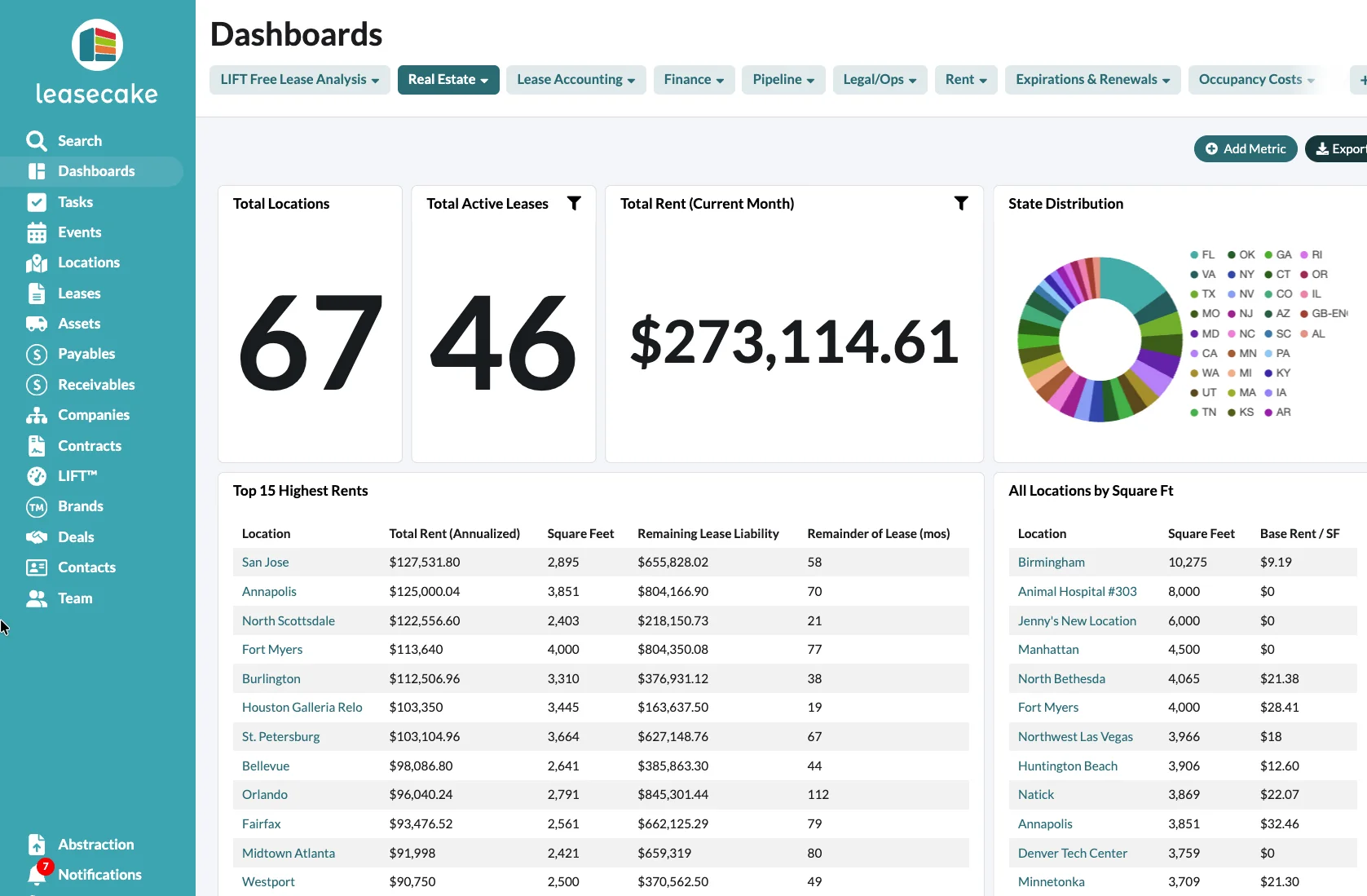
Source: Leasecake
Conclusion
AI lease processing transforms contract management by automating data extraction, reducing manual errors, and accelerating review workflows. By centralizing lease data and providing instant insights, these solutions enable finance and legal teams to maintain higher compliance and operational visibility. Organizations that adopt these technologies position themselves to handle larger portfolios with greater precision and efficiency.