TL;DR: AI tools for automating lease review use OCR, NLP, and machine learning to extract clauses, dates, and financial terms from leases and flag risk. Best for AI abstraction: Kolena; for CRE portfolios: Prophia; for legal review: Kira; for lease accounting: Visual Lease.
What Are AI Tools for Automating Lease Review?
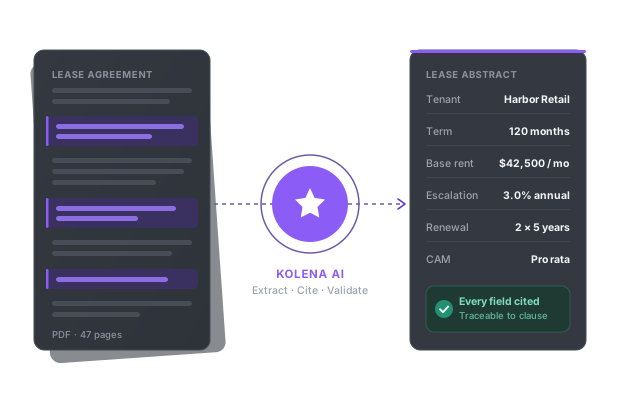
AI lease abstraction tools use optical character recognition to read documents and natural language processing to extract key terms. This reduces a 4-hour manual review to under 15 minutes while maintaining over 90% accuracy. Top tools highlight auto-renewals, rent increases, and liabilities.
How the AI works:
Document ingestion and classification: You upload a PDF of the lease agreement into the software.
Optical character recognition (OCR) and document parsing: The AI scans the images of the document to convert them into readable, searchable digital text.
Lease clause identification: Natural language processing identifies, classifies, and labels clauses such as renewal options, rent escalations, maintenance obligations, and termination rights.
Key data and obligation extraction: Algorithms identify context and patterns to instantly pull critical data (e.g., start dates, security deposits, late fees, rent escalation formulas) into a database.
Risk and exception detection: The AI flags unusual terms, missing provisions, non-standard language, and potential legal or financial risks for further review.
Human review and approval: Legal or real estate professionals validate extracted information, resolve ambiguities, and approve the final lease abstract before it is stored or shared.
Try our AI-powered lease abstraction tool
AI Lease Review Tools at a Glance
The table below summarizes the key differences between the tools covered in this list. We explore each of them in more detail in the sections that follow.
Category | Solution | Best For | Key Strengths | Things to Consider |
AI Lease Abstraction and Extraction | Kolena | Document-heavy lease, finance, and insurance review | Reasoning, confidence scores, and source-page citations | Broad multi-industry platform; pricing not listed publicly |
AI Lease Abstraction and Extraction | Prophia | CRE teams standardizing lease data across a portfolio | AI abstracts hyperlinked to source, with expert validation | Search can surface irrelevant hits; some export gaps |
AI Lease Abstraction and Extraction | MRI Contract Intelligence | Enterprises abstracting large or multilingual portfolios | Patented AI/OCR extraction, source links, 25+ languages | Enterprise, sales-led, best inside the MRI suite |
AI Lease Abstraction and Extraction | Kira | Legal and diligence teams reviewing high contract volumes | Multi-layer AI, 1,400+ trained fields, governance controls | Setup and cost geared to enterprise legal |
Lease Management and Accounting with AI Abstraction | Visual Lease | Teams tying abstraction to lease accounting | CoStar-backed abstraction, 40+ validations, rent schedules | Learning curve; reporting and archived-lease access |
Lease Management and Accounting with AI Abstraction | Trullion | Accounting teams on ASC 842 and IFRS 16 | AI extraction with source traceability and versioning | Extraction accuracy and reporting depth vary |
Lease Management and Accounting with AI Abstraction | Leasecake | Multi-location retail and franchise operators | AI abstraction and clause search across leases | Reporting and customization limited |
Lease Management and Accounting with AI Abstraction | LeaseAccelerator | Large enterprises automating lease lifecycle compliance | Full lease sub-ledger, automated validation, ERP links | Slow performance; steep learning curve |
How AI Tools Automates the Lease Review Process
Step 1: Document Ingestion and Classification
The first step in AI-powered lease review is document ingestion, where the system receives digital or scanned copies of lease agreements. AI platforms handle a wide range of formats, including PDFs, Word documents, and image files. Once ingested, the AI classifies documents based on type (such as commercial, residential, or ground leases) using machine learning models trained on thousands of lease samples.
Why it’s needed:
This classification ensures that each document is routed through an appropriate analysis workflow, tailored to the lease type and jurisdiction. Effective classification also helps in organizing large volumes of lease agreements within document management systems. By tagging and categorizing each lease automatically, AI reduces manual sorting and the risk of misfiling.
Related content: See how automation is reshaping the sector in our guide to AI in commercial real estate.
Step 2: Optical Character Recognition and Document Parsing
Optical Character Recognition (OCR) is essential when leases are provided as scanned images or non-editable PDFs. OCR technology converts these image-based documents into machine-readable text, enabling further analysis by AI algorithms. Modern OCR systems are highly accurate, even with complex layouts, handwritten notes, or degraded print quality, ensuring that as much text as possible is captured for subsequent parsing and review.
Why it’s needed:
After OCR, document parsing algorithms break down the lease into logical components such as headings, sections, paragraphs, and clauses. This structural understanding allows the AI to navigate the document efficiently, identify relevant sections, and prepare for targeted data extraction. Parsing also standardizes various formats and layouts, enabling consistent processing of leases from multiple sources, which is critical for organizations managing diverse lease portfolios.
Step 3: Lease Clause Identification
Lease agreements often contain dozens of clauses, each governing specified rights, obligations, and contingencies. AI systems use natural language processing to identify and label these clauses automatically, regardless of how they are worded or where they appear in the document. Pre-trained models recognize common legal phrases, synonyms, and context, allowing the AI to map clauses such as rent escalation, renewal options, or maintenance responsibilities to standardized categories.
Why it’s needed:
Accurate clause identification is vital for risk assessment and compliance tracking. By consistently labeling and organizing clauses, AI enables users to compare terms across leases, spot missing or unusual provisions, and ensure that critical obligations are not overlooked. This systematic approach minimizes manual review time and supports faster, more reliable decision-making, particularly when managing large volumes of leases.
Step 4: Key Data and Obligation Extraction
Once clauses are identified, AI extracts key data points such as party names, rent amounts, commencement and expiration dates, and escalation terms. This process relies on advanced NLP techniques that not only locate information but also interpret context, such as recognizing dates tied to specific events or distinguishing between base rent and additional charges. Extracted data is structured and exported to databases or lease management systems for further analysis and reporting.
Why it’s needed:
Obligation extraction goes beyond simple data points to capture ongoing commitments, such as maintenance duties, insurance requirements, or notice periods for renewal or termination. AI tracks these obligations across the lease’s lifecycle, enabling proactive management of deadlines and compliance tasks. Automated extraction ensures that no critical detail is missed, supporting better risk mitigation and operational efficiency.
Step 5: Risk and Exception Detection
AI-driven lease review systems are programmed to detect risks and exceptions by comparing lease terms against predefined standards, checklists, or organizational policies. For example, the AI can flag clauses that deviate from approved templates, identify unusually high rent escalations, or spot missing insurance provisions. These risk indicators are surfaced in review dashboards, allowing legal teams to focus their attention where it is most needed.
Why it’s needed:
Exception detection is especially valuable for large organizations with diverse lease portfolios, as it ensures consistency and compliance across all agreements. By automating the identification of outliers and potential issues, AI reduces the likelihood of costly oversights and speeds up the escalation of problematic leases for human review. This proactive approach helps organizations maintain control over their contractual obligations and exposure.
Step 6: Human Review and Approval
Despite advances in AI, human expertise remains essential in the lease review process, particularly for interpreting nuanced language, negotiating terms, or making final approval decisions. AI systems are designed to augment, not replace, human reviewers by pre-filtering leases, highlighting key issues, and presenting extracted data in user-friendly dashboards. This allows lawyers and real estate professionals to focus their time on complex analysis and decision-making rather than repetitive data entry.
Why it’s needed:
Collaboration between AI and humans improves both efficiency and accuracy. The AI handles the bulk of routine tasks and surfaces only those leases that require expert attention, while human reviewers provide oversight, validate extracted information, and address ambiguities. This hybrid approach ensures that lease reviews are both thorough and timely, reducing turnaround times and enhancing organizational agility.
Key Lease Information AI Tools Can Extract
Parties, Properties, and Premises
AI systems can accurately extract the names of all parties involved in a lease agreement, such as landlords, tenants, and guarantors. This identification is crucial for contract management, ensuring that responsibilities and rights are assigned correctly and that communication channels are clear. Additionally, AI can pinpoint property addresses and detailed descriptions of the leased premises, including suite numbers, building names, and square footage.
Precise extraction of parties and property details supports:
Due diligence
Reporting
Integration with other business systems
For organizations managing multiple leases, automated tracking of these elements minimizes the risk of confusion or misattribution, ensuring that obligations and payments are correctly linked to the appropriate entities and locations.
Rent, Escalations, and Additional Charges
AI-powered lease review tools can extract financial terms such as base rent, escalation clauses, and additional charges like common area maintenance (CAM) fees, taxes, and utilities. By identifying the amounts, frequency, and calculation methods, AI enables organizations to automate rent roll updates and financial forecasting. This ensures accurate budgeting and timely billing, reducing administrative overhead.
Extraction of escalation and charge clauses also aids in compliance monitoring and risk management. AI can:
Detect unusual rent increases
Flag ambiguous language,
Compare financial terms across leases
This helps highlight inconsistencies or potential issues. This level of detail supports better negotiation and contract enforcement, ultimately improving financial performance.
Lease Commencement and Expiration Dates
AI tools are adept at extracting key dates from lease agreements, such as the lease commencement, expiration, and important option periods. These dates are often embedded in dense legal language or scattered throughout the document, making manual extraction time-consuming and error-prone. AI systems use contextual analysis to identify and standardize these dates, ensuring accuracy and consistency.
Reliable tracking of lease timelines enables organizations to manage:
Renewals
Terminations
Compliance deadlines
By automating the extraction and monitoring of critical dates, AI reduces the risk of missed opportunities or penalties, supporting better portfolio management and strategic planning.
Renewal, Termination, and Purchase Options
AI can identify and extract clauses related to renewal, early termination, and purchase options, detailing the conditions, notice requirements, and financial implications. This information is essential for strategic decision-making, allowing organizations to:
Plan for future occupancy
Negotiate better terms
Exercise options in a timely manner
Automated extraction of these options also supports risk assessment by highlighting restrictive conditions or costly penalties. By surfacing these clauses during review, AI helps legal teams evaluate flexibility and exposure across the lease portfolio, ensuring that options are not overlooked and that organizations can respond quickly to changing business needs.
Maintenance and Repair Responsibilities
Maintenance and repair responsibilities are often complex and vary significantly between leases. AI systems can parse these sections to identify which party is responsible for repairs, routine maintenance, or capital improvements. This clarity is vital for budgeting, compliance, and dispute resolution, as unclear or unfavorable terms can lead to unexpected expenses or legal challenges.
By standardizing and summarizing maintenance obligations across multiple leases, AI enables organizations to:
Spot patterns
Negotiate more favorable terms
Ensure compliance with legal and operational standards
Automated tracking of these responsibilities also supports facilities management and helps prevent costly oversights.
Insurance and Indemnification Requirements
AI-driven lease review platforms extract insurance requirements, such as coverage types, limits, and proof-of-insurance obligations. They also identify indemnification clauses that specify which party is responsible for damages, losses, or legal liabilities. Proper extraction and tracking of these terms are critical for risk management and compliance with organizational policies.
Automating the identification of insurance and indemnification requirements enables organizations to:
Monitor compliance
Ensure adequate coverage
Respond to claims or disputes more efficiently
AI systems can also flag missing or non-standard provisions, supporting negotiation and reducing exposure to uninsured risks.
Learn more about abstract commercial leases with ai.
Notable AI Lease Review Tools
How we selected these tools: We shortlisted AI-powered lease review and abstraction platforms based on their ability to extract clauses, dates, and financial terms from lease documents, flag risk and exceptions, link extracted data back to the source language, and integrate with the lease management and accounting systems teams already use.
AI Lease Abstraction and Extraction Platforms
1. Kolena
Best for: Document-heavy lease, finance, and insurance review workflows
Strengths: Reasoning, confidence scores, and source-page citations on every field
Things to consider: Broad multi-industry platform; pricing is not listed publicly
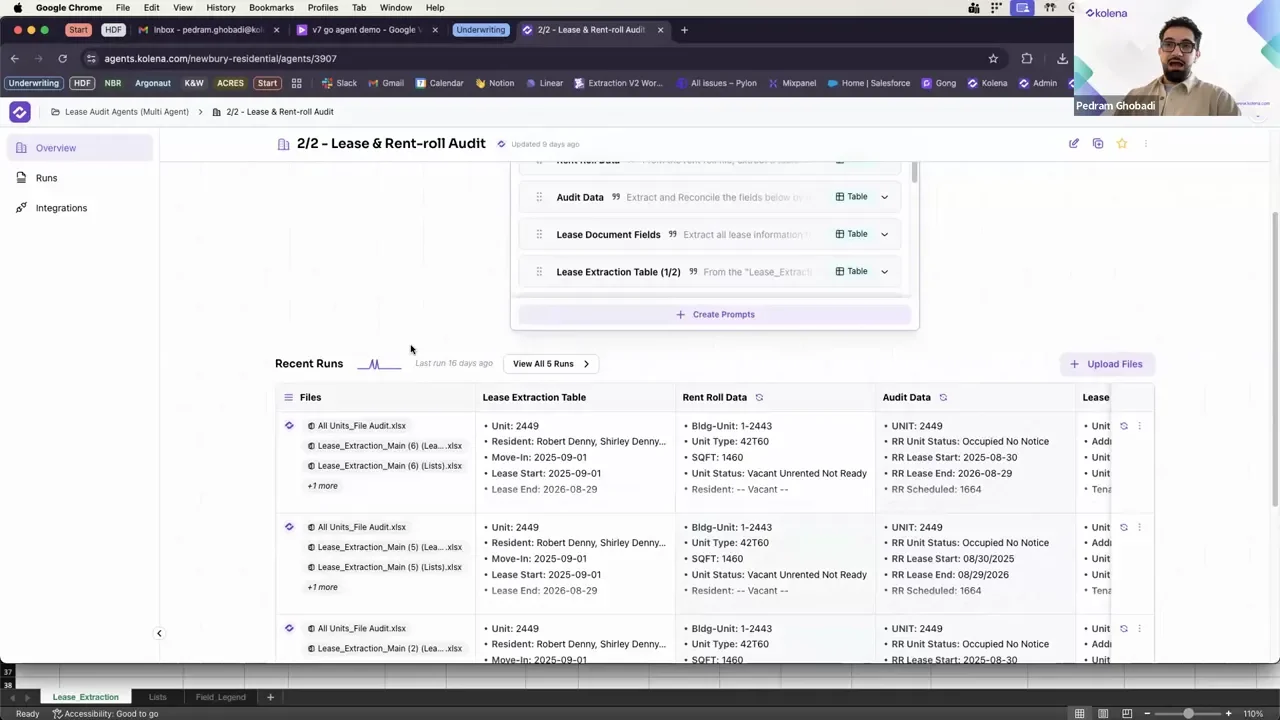
Kolena is an AI platform that automates document-heavy workflows across real estate, insurance, banking, and finance, including lease abstraction and lease review. For lease work, it ingests leases, amendments, and exhibits together, automatically detects the document type, and extracts the fields a team needs into a structured abstract.
Every extracted value carries a confidence score, a source-page citation, and a plain explanation of how the AI reached it. The platform applies business rules and cross-checks to validate fields and flag anomalies, and returns results in the team's own template so they flow into existing systems.
Key features include:
Document understanding: Parses PDFs, spreadsheets, emails, scans, and audio, automatically detecting the document type and extracting the relevant fields from leases and amendments.
Batch ingestion of related documents: Handles leases, amendments, and exhibits together as a related set rather than one file at a time.
Validation and anomaly flagging: Applies business rules and cross-checks across fields, flags anomalies, and attaches a confidence score to each extracted value.
Source-page citations and reasoning: Links every extraction back to the exact page and clause and shows the reasoning behind it, so reviewers can verify quickly.
Template intelligence and customization: Maps each field, clause, and rule to a client's template and adapts to different formats, producing structured abstracts such as Realogic-style outputs.
Prebuilt workflows and prompt optimization: Ships prebuilt automations for real estate, insurance, banking, and finance, and rewrites prompts automatically so users do not need prompt engineering.
Integrations and export: Exports to Excel, CRMs, and SharePoint and connects with Yardi, MRI, VTS, Salesforce, Box, and Drive.
Limitations (based on publicly available sources):
Broad, multi-industry scope: The platform spans real estate, insurance, banking, and finance, so teams wanting a single-purpose CRE-only tool configure their own workflows and templates to their use case.
Pricing not published: Full pricing requires contacting Kolena or starting the two-week free trial rather than consulting a public price list.
Language coverage: Publicly available sources list English as the supported language.
Source: Kolena
2. Prophia

Best for: Commercial real estate teams standardizing lease data across a portfolio
Strengths: AI abstracts hyperlinked to source language, backed by expert validation
Things to consider: In-document search can surface irrelevant hits for some users
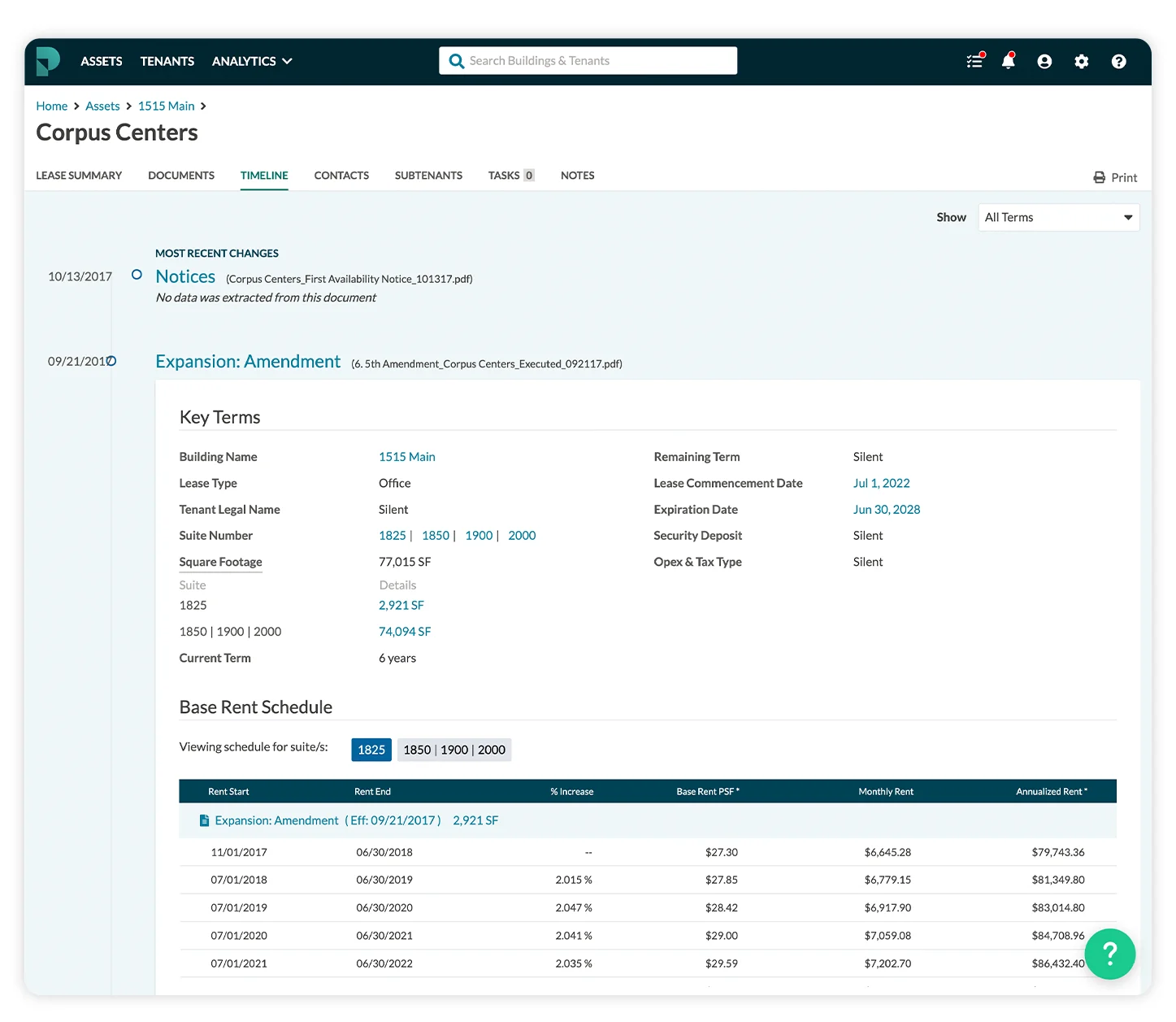
Prophia is an AI-powered lease abstraction and lease intelligence platform built for commercial real estate. It combines AI extraction with expert validation to turn leases into structured, consistent data, and links every abstract back to the original lease language.
The platform is designed to keep lease data usable and current across a portfolio. Uploaded documents interact through document interconnectivity, so amendments and renewals update the data in real time while preserving a historical record of changes.
Key features include:
AI lease abstraction with validation: Extracts key lease terms into structured, consistent abstracts, with CRE experts validating the AI output.
Source hyperlinks: Links each concept in the abstract back to the original language in the lease or amendment, so users can confirm terms without opening a separate document.
In-document search: Adds an AI-annotated layer to each PDF so users can search tenant terms and jump to the exact clause, section, or figure.
Rights and encumbrances tracking: Discovers and flags tenant rights and encumbrances across the portfolio from a single platform.
Document interconnectivity: Links amendments, renewals, and related agreements so uploaded documents update the data in real time and keep a change history.
Broad coverage: Abstracts more than 40 document types and 215 CRE-specific terms.
Limitations (as reported by users on G2):
Search behavior: Some users report that in-document search can navigate away or surface irrelevant results, and wish for a simple find function.
Support and onboarding: A few reviewers feel check-ins and lease-interpretation support are limited and describe training as light.
Bulk export: Users note that downloading all lease files or exporting the stacking plan to Excel is not always straightforward.
Manual upkeep: Some tenant information requires manual updates, and integration setup, such as pushing data to Yardi, can be slowed by initial lease review time.
Source: Prophia
3. MRI Contract Intelligence
Best for: Enterprises abstracting large or multilingual lease and contract portfolios
Strengths: Patented AI and OCR extraction with source links and 25+ languages
Things to consider: Enterprise, sales-led, and strongest inside the MRI suite
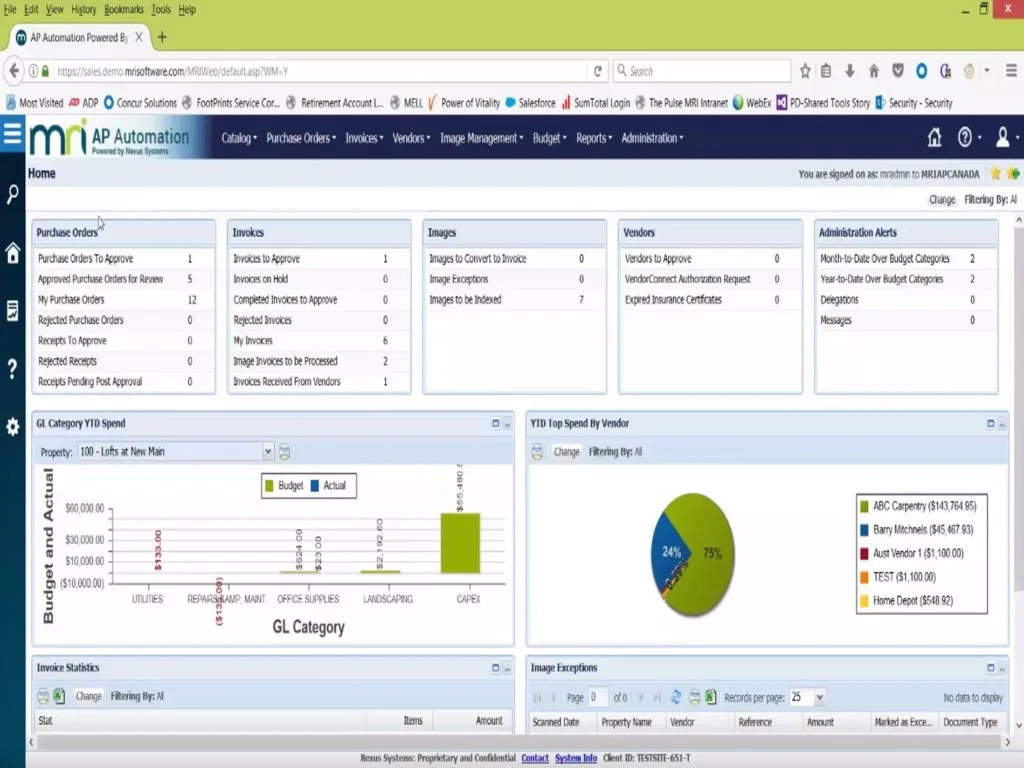
MRI Contract Intelligence, powered by Leverton AI, is an AI and OCR contract data extraction tool used for lease abstraction. It converts contracts into machine-readable text and extracts key dates, dollar amounts, clauses, and terms, with each data point linked back to the source document.
The tool is built for volume and variety, handling real estate leases, asset leases, data center leases, telecom contracts, and loan agreements across more than 25 languages. Extracted data feeds analytics, reminders, and reports, and flows into the wider MRI ecosystem.
Key features include:
AI and OCR extraction engine: A patented AI and OCR engine converts contracts into machine-readable text and extracts key dates, dollars, clauses, and terms.
Source linking: Each extracted data point links directly to its location in the source document for verification and a complete audit trail.
Smart contract analytics: Search by folder, keyword, or structured data, and set critical-date reminders, calendars, and custom reports.
Broad document coverage: Handles real estate leases, asset leases, data center leases, telecom contracts, and loan agreements.
Multilingual support: Processes documents in more than 25 languages, including Chinese, Japanese, Korean, and Russian.
Integration and export: Exports to Excel or CSV and integrates via API with MRI Commercial Management, ProLease, Horizon, and third-party DMS, ERP, or BI systems.
Limitations (based on publicly available sources):
Enterprise deployment: Publicly available analyses describe it as enterprise, sales-led software that typically requires a dedicated implementation team and longer onboarding than cloud-native tools.
Ecosystem fit: Its value is strongest for organizations already on the MRI suite, since its deepest integrations are with MRI products.
Pricing and access: Pricing is quote-based and commonly cited from several thousand dollars per year, which can be hard to justify for smaller teams, and there is no self-serve trial.
Support consistency: Some publicly available accounts of MRI note inconsistent support response times outside premium contracts.
Source: MRI Software
4. Kira

Best for: Legal and diligence teams reviewing high volumes of leases and contracts
Strengths: Multi-layer AI with 1,400+ trained fields and governance controls
Things to consider: Setup and cost are geared to enterprise legal teams
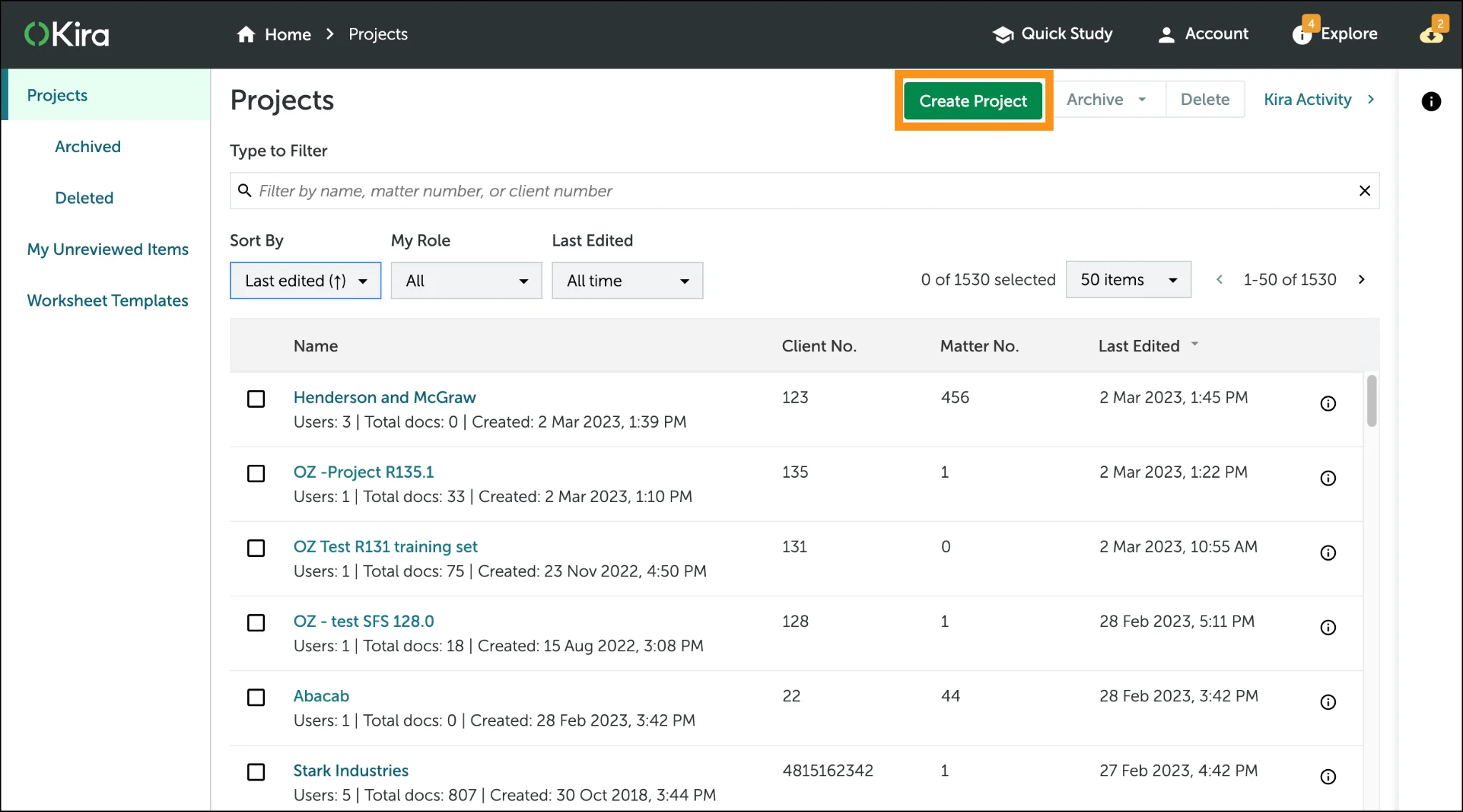
Kira, part of Litera, is an AI contract intelligence platform used for lease abstraction and due diligence. It combines generative AI with proprietary models trained on 45,000 lawyer hours to identify, extract, and summarize clauses and data points from contracts and leases.
Kira ships with a large library of pre-trained fields and adds governance controls that let teams decide where generative AI is used. It is built for high-volume review, with workflows for organizing, comparing, and exporting findings across large document sets.
Key features include:
Multi-layer AI extraction: Combines generative AI with proprietary models trained on 45,000 lawyer hours to identify and extract clauses and data points.
Pre-trained smart fields: Ships more than 1,400 smart fields across 40+ practice areas, including real estate, so common lease provisions are recognized out of the box.
Generative Smart Fields and Concept Search: Create extraction fields from natural-language descriptions, and find a concept across documents from an example phrase without training.
Chat and Smart Summaries: Ask questions in natural language and get cited answers, and generate summaries of clauses and documents for review.
Governance controls: Toggle generative AI on or off per project, with SOC 2 Type II certification and data residency options.
Review workflow and export: Bulk import with deduplication and data-room integrations, classification and tagging, comparison and redlines, and exports to Word, Excel, and PDF.
Limitations (as reported by users on G2):
Mixed-document diligence: Users note that when a review contains many dissimilar agreement types, time savings shrink because each extraction still needs verification.
Handwritten or low-quality text: Reviewers report it does not handle handwritten or less legible content well.
Setup and cost: Publicly reported accounts describe initial setup and data migration as complex and pricing as geared to enterprise budgets.
Jurisdiction coverage: Some users would like clause coverage that spans more global jurisdictions.
Source: Litera
Lease Management and Accounting Platforms with AI Abstraction
5. Visual Lease

Best for: Finance and real estate teams tying abstraction to lease accounting
Strengths: CoStar-backed abstraction with 40+ validations and rent-schedule build
Things to consider: A learning curve, and reporting or archived-lease access frustrate some users
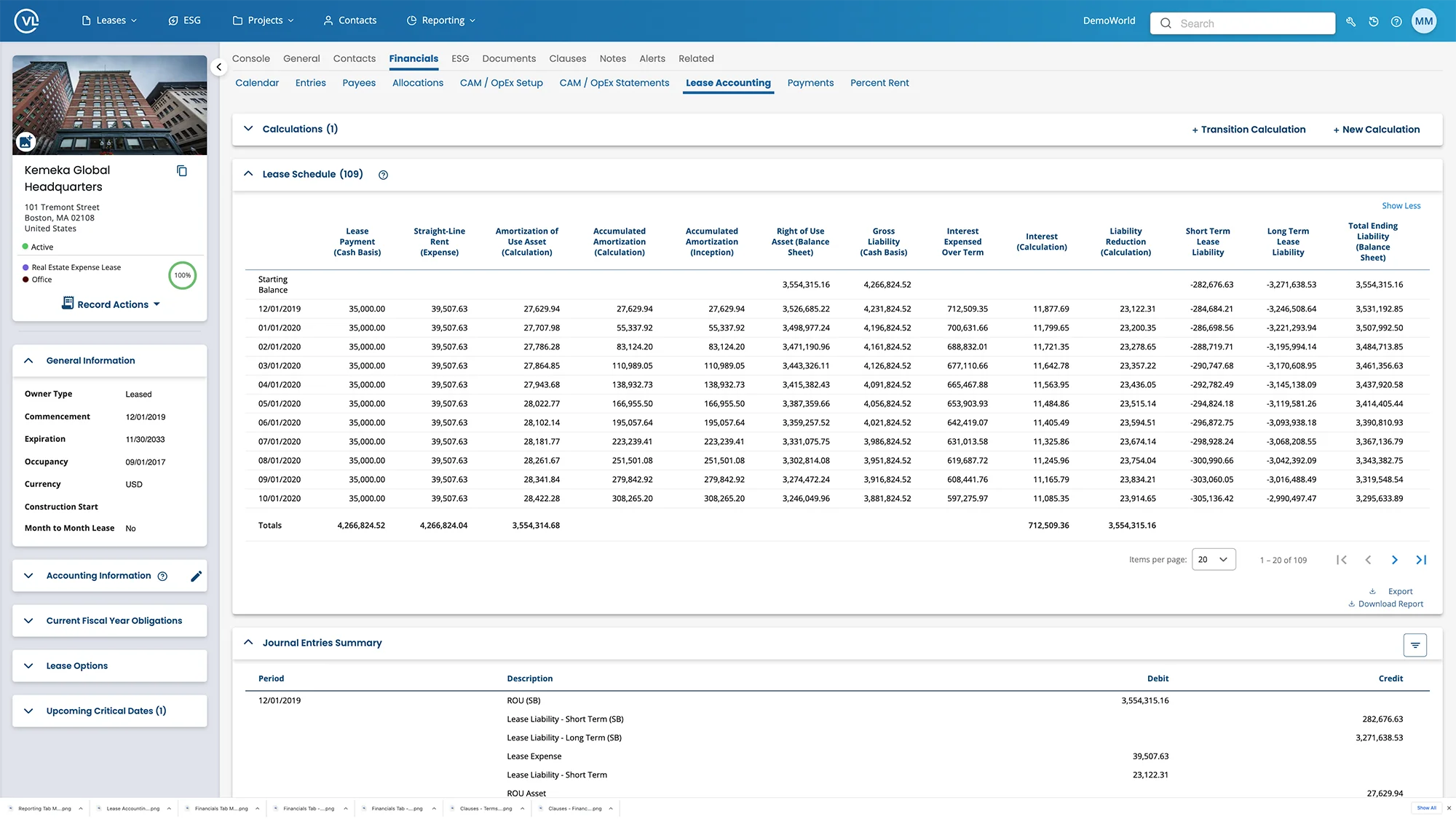
Visual Lease, part of CoStar Group, pairs AI lease abstraction with a lease management and accounting platform. Its abstraction engine is powered by CoStar's lease-specific large language model and validates results against CoStar's market data.
Beyond extraction, the platform drafts the lease record, auto-calculates rent schedules, and ties every field back to the source lease language. That extracted data then feeds Visual Lease's ASC 842, IFRS 16, and GASB reporting and controls.
Key features include:
AI lease scanning: OCR classifies each file and processes tables, strikeouts, and margin notes to capture the full document.
AI summaries with commentary: Produces concise summaries of extracted fields plus supporting context.
Auto-populated records and rent schedules: Drafts the lease record and calculates rent schedules, with fields tied back to the source lease language.
Validation against benchmarks: Runs more than 40 validations per document and checks against CoStar market data to flag rent anomalies, square-footage mismatches, and TI allowances outside industry norms.
Searchable digital leases: Creates a searchable digital version of each lease.
Connected lease accounting: Feeds the broader Visual Lease platform for ASC 842, IFRS 16, and GASB reporting and controls.
Limitations (as reported by users on G2):
Learning curve: Users describe a steep initial learning curve and setup that can require training.
Reporting and customization: Reviewers find reporting and customization options limited, sometimes needing Excel workarounds.
Archived leases: Several note that once a lease moves to historical status, editing or accessing it is cumbersome.
Performance: Some report slow report generation and navigation with large datasets.
Source: Visual Lease
6. Trullion

Best for: Accounting teams automating lease data for ASC 842 and IFRS 16
Strengths: AI extraction with source traceability and version tracking
Things to consider: Extraction accuracy and reporting depth have room to improve
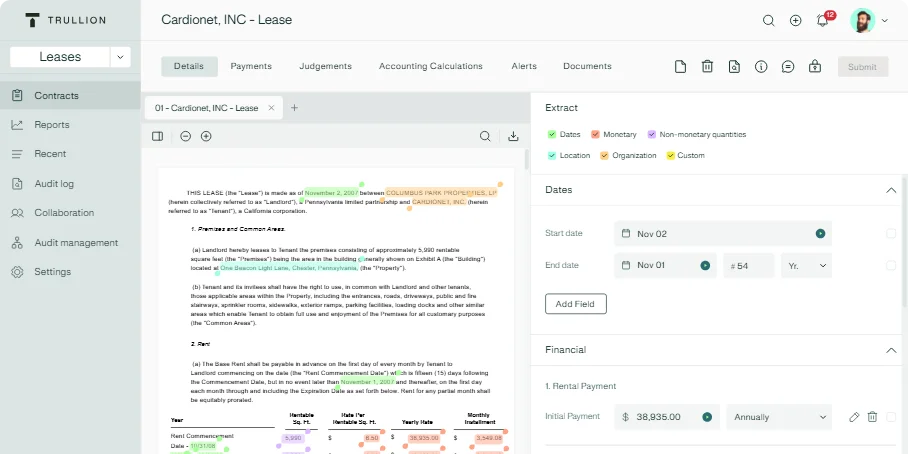
Trullion is an AI-powered accounting platform whose lease abstraction feature extracts data from lease documents down to individual clauses and amendments in minutes. It pairs extraction with built-in validation, source traceability, and version tracking so accounting teams stay audit-ready.
The platform is built around lease accounting standards, feeding ASC 842, IFRS 16, and FRS 102 workflows. Its AI interprets natural-language date phrasing, generates summaries, and lets teams build custom extraction questions for their leases.
Key features include:
AI data extraction: Scans lease PDFs and unstructured data and pulls key data down to individual clauses and amendments in minutes.
Contextual date interpretation: Interprets natural-language phrasing, for example "first day of the last week of January," and outputs exact lease dates.
Validation and traceability: Includes built-in validation, links each data point to its source document, and tracks versions.
Bespoke field extraction: Lets teams create custom questions to extract contract data unique to their leases.
Summaries and translation: Generates summaries and translates documents across English and other languages.
Trulli AI assistant: An embedded generative-AI assistant that answers questions and guides the abstraction workflow.
Limitations (as reported by users on G2):
Extraction accuracy: Some users report the AI extraction has limits on certain document types, such as AR aging, though recent updates have improved it.
Reporting depth: Reviewers note reporting is not always robust, citing the rollforward report being embedded within the disclosure report.
ERP upload: Some would like a direct ERP upload, for example to SAP.
Onboarding: A few note that getting the whole team onboarded takes time.
Source: Trullion
7. Leasecake

Best for: Multi-location retail and franchise operators managing location leases
Strengths: AI abstraction and clause search across leases and amendments
Things to consider: Reporting and customization are limited, with an operations focus
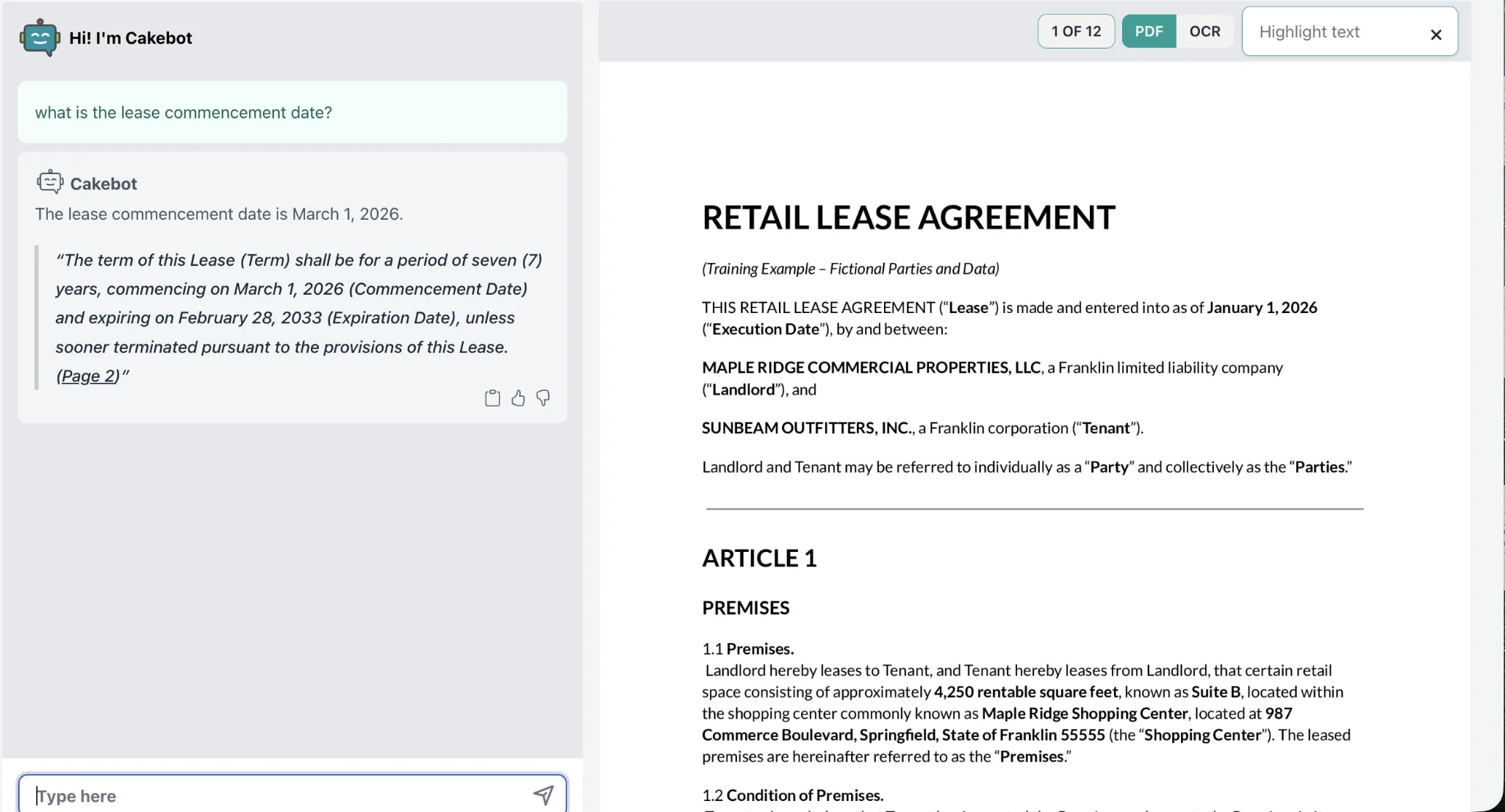
Leasecake is a lease and location management platform for multi-location retail, restaurant, and franchise operators. Its AI assistant, Cakebot, handles lease abstraction, clause search, and risk analysis, extracting key details and summarizing clauses in minutes.
The platform centralizes leases alongside licenses, permits, and other location agreements, then layers on automated critical-date alerts and portfolio risk analysis. Cakebot can search across multiple leases and amendments at once to surface answers.
Key features include:
AI lease abstraction (Cakebot): Extracts key lease details and summarizes clauses in minutes, and can search across multiple leases and amendments at once.
Clause search and risk flagging: Surfaces answers, summarizes clauses, and flags risk automatically across the portfolio.
Critical-date alerts: Automates reminders for renewals, expirations, and other critical dates.
Centralized location record: Stores leases alongside licenses, permits, and other location agreements in one platform.
Cost visibility: Exposes CAM and operating-cost line items to surface overcharges and savings opportunities.
Portfolio risk analysis (LIFT): Analyzes lease data across the portfolio to flag risk, cost exposure, and anomalies.
Limitations (as reported by users on G2):
AI feature: One user found the AI feature confusing and reported it not saving information when creating a new lease.
Reporting: Reviewers note portfolio-wide reporting is limited, with some metrics available only per property and report filters that reset between runs.
Customization and features: Some cite limited customization, no e-signature, and only archiving rather than deleting locations.
Accounting fit: A few find ASC 842 handling could be more user-friendly, since the platform is aimed more at operations than accounting.
Source: Leasecake
8. LeaseAccelerator

Best for: Large enterprises automating lease accounting and lifecycle compliance
Strengths: Full lease sub-ledger with automated validation and ERP integration
Things to consider: Slow performance and reporting, with a steep learning curve reported
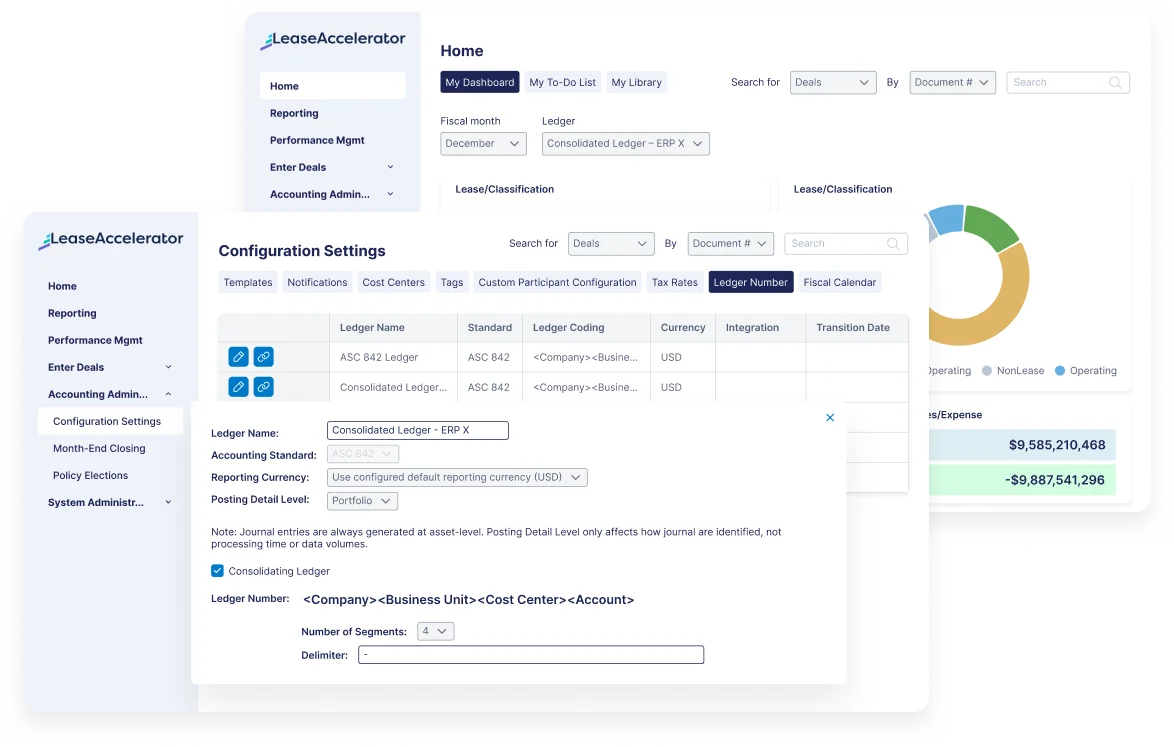
LeaseAccelerator, part of insightsoftware, is an enterprise lease lifecycle automation platform that combines lease accounting, administration, and asset lifecycle intelligence. It centralizes lease data in a full sub-ledger and automates the accounting treatment of lease events.
The platform validates and classifies lease data, generates the underlying accounting, and posts journal entries into the ERP. It adds scenario modeling and roll-forward analytics so finance teams can test decisions and explain period-over-period changes.
Key features include:
Unified lease lifecycle platform: Combines lease accounting, administration, and asset lifecycle intelligence in one system with a full lease sub-ledger.
Automated validation and classification: Validates and classifies lease data and automates the accounting treatment of modifications, remeasurements, renewals, and terminations.
Automated accounting and journal entries: Generates amortization schedules, interest accretion, right-of-use asset balances, and lease liabilities, and posts journal entries into the ERP.
Roll-forward analytics: Provides roll-forward reporting with drill-down transparency for period-over-period changes.
Scenario modeling: Models restructuring, early termination, extensions, and consolidations using real lease and accounting data.
ERP integration and SAP connection: Integrates with most ERP systems, including a direct SAP connection through Process Runner.
Limitations (as reported by users on G2):
Performance: Users frequently report slow report generation and long recalculation times after events such as terminations.
Learning curve: Reviewers describe the system as complex and not always intuitive, with data entry and updates that require training.
Reporting: Some note that assembling the information they need often requires pulling and combining multiple reports.
Release updates: A few report that quarterly updates occasionally introduce errors or change existing leases.
Source: LeaseAccelerator
Related content: Learn why leasing software is essential in modern real estate.
Conclusion
AI lease review platforms help organizations process large lease portfolios faster by automating document classification, clause identification, data extraction, and risk analysis while maintaining human oversight for final decisions. When evaluating a solution, focus on extraction accuracy, traceability to source language, support for complex lease structures and amendments, integration with existing lease management or accounting systems, and the ability to scale across growing portfolios. The right platform can reduce manual effort, improve consistency, strengthen compliance, and provide better visibility into lease obligations and financial commitments throughout the lease lifecycle.