You can abstract 100 commercial leases in an afternoon with AI by loading the full PDF portfolio — base leases and all amendments — applying your firm's abstract template, and letting AI agents return structured, citation-backed abstracts that your team verifies rather than builds from scratch. What used to take one analyst roughly ten weeks becomes a single working session, because the AI reads and structures the documents in parallel and your people only review the output.
This is a practical walkthrough for acquisitions teams, asset managers, and property managers running due diligence on a large portfolio against a deadline. The 100-leases-in-an-afternoon premise is the actual value proposition, not a metaphor — here's how it works.
This is part of a series of articles about Lease Abstraction.
The Math That Makes "An Afternoon" Possible
Manual abstraction runs about four hours per lease for a typical commercial lease. On 100 leases that's roughly 400 analyst-hours — about ten working weeks for one full-time reviewer, or a scramble across a team that still blows past a 30–45 day diligence window. AI inverts the ratio: it processes the documents in minutes and leaves your team with verification, not data entry.
| Step | Manual (100 leases) | AI (100 leases) |
|---|---|---|
| Reading & extraction | ~400 analyst-hours | Minutes, run in parallel |
| Human verification | Included in the 400 hours | A few hours of spot-checking flagged items |
| Calendar time | ~10 weeks for one FTE | An afternoon |
| Output | Hand-built abstracts, formats vary | Structured abstracts on your template, each field cited |
Documented deployments back the ratio: one private-equity real estate manager cut per-lease internal review from about two hours to 17 minutes — an 85% reduction — and another commercial real estate firm captured about $100,000 in efficiency gains across 58 leases.
Try our AI-powered lease abstraction tool
Step 1 — What to Prepare
You need two things. First, the document set: the full PDF portfolio, including every amendment, exhibit, and rent schedule. Don't strip out amendments — the AI needs them to determine the currently effective terms. Scanned PDFs are fine; OCR is handled for you. Second, your abstract template: the exact fields and format your team uses downstream, whether that's a Yardi or MRI import layout, an acquisitions-model tab, or your standard abstract schema. Configuring the template once means every one of the 100 abstracts comes back in the format you actually use.
Step 2 — What the AI Does
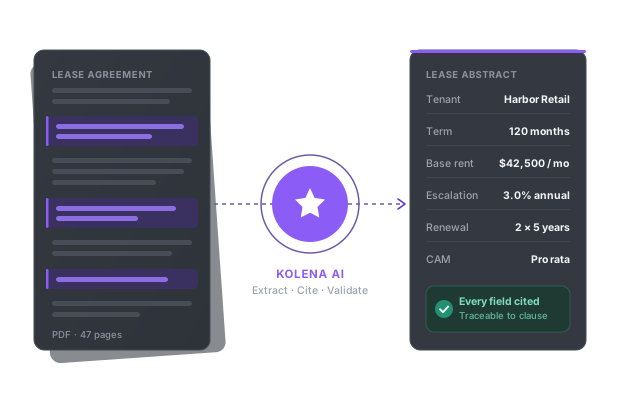
The AI ingests the full set as related documents, not isolated files. For each lease it chains the base document and its amendments to the currently effective value of every term — the rent after the 2021 amendment, not the original 2014 figure — reads rent and escalation tables natively rather than flattening them to text, applies your template, and returns a structured abstract with field-level citations linking each value back to the exact page and clause. It runs the 100 leases in parallel, so wall-clock time is minutes, not the sum of 100 sequential reviews.
Step 3 — What Comes Out
You get 100 structured abstracts in your template, ready to flow into Yardi, MRI, or a financial model without reformatting, each value carrying a citation so verification is a glance at the source rather than a re-read. Items the AI flags as unusual or ambiguous are surfaced for human attention instead of being silently guessed. Your afternoon is spent confirming the flagged minority, not abstracting the whole portfolio.
Related articles: leasing software and lease abstraction software.
Learn more about lease abstraction software.
Learn more about AI Lease Abstraction Software.
What to Watch For
AI does the heavy lifting, but a few things still warrant a human eye. Multi-amendment stacks: leases with five to ten amendments are exactly where consolidation matters most — review the AI's effective-term logic on the deepest stacks first. Co-tenancy and other trigger clauses: co-tenancy, go-dark, and percentage-rent provisions carry conditional logic worth confirming. Non-standard clauses: heavily negotiated or unusual language is where accuracy varies and human judgment earns its keep. The right posture is verification of flagged items, not blind trust — which is precisely why field-level citations matter: they make each check fast.
When 100-in-an-Afternoon Is the Wrong Goal
If you have a handful of genuinely one-off leases that turn on deep legal interpretation, slow and manual is fine — speed isn't the constraint there. The afternoon workflow is built for volume against a deadline: acquisition due diligence, portfolio audits, onboarding a newly acquired book. That's where compressing ten weeks into an afternoon changes what your team can take on.
How Kolena Works
Kolena is an AI document automation platform built for CRE acquisitions, asset management, and property management teams. A PDF portfolio — base leases, amendments, exhibits — and your abstract template go in; 100 structured abstracts with the amendment chain resolved and every field cited come out in a single session.
It reads any format, runs the portfolio in parallel, and pushes structured output into Yardi, MRI, RealPage, SharePoint, or your acquisitions model, with flagged items routed to your team for review. Every run produces a full audit trail: not just what was extracted, but the specific clause, line, or figure that justified each data point. SOC 2 Type II certified, onshore processing, no training on customer data.