Insurance agencies, MGAs, and carriers looking for a Patra alternative in 2026 are mostly asking the same question: is there a way to get the same back-office output without the staffing model underneath it?
The short answer is yes — and the shift from a BPO contract to an AI platform is happening faster than most organizations expected.
What Patra Does
Patra is a BPO and software services company focused on the insurance back office. Their core services cover the document-intensive workflows that agencies, MGAs, wholesalers, and carriers need to run but don't want to staff internally: certificate of insurance (COI) processing, policy checking, endorsements, renewals, claims support, and accounting. They serve 880+ insurance organizations and have built their business on delivering these workflows through a combination of offshore staff and, since December 2024, AI-augmented processing through their Patra AI product.
For many organizations, Patra has been the default answer to the question: how do we scale document ops without hiring? It works — until the economics of offshore staffing shift, or until you need something the BPO model structurally can't deliver.
Nine free AI document tools — pick your workflow
The Structural Limit of the BPO Model
The December 2024 Patra AI announcement signals the company recognizes the direction the market is moving. But an AI layer on top of a BPO contract is a different thing than a pure AI platform that replaces the BPO layer entirely. The distinction matters in three specific ways.
CAT events and surge. Insurance back-office volume isn't flat — it spikes. When a CAT event hits, certificate requests, claims intake, and endorsement volume can multiply overnight. A staffing-based model deploys backup teams; there's inherent latency in that response. An AI platform has no capacity ceiling. Volume doubles, processing time stays the same.
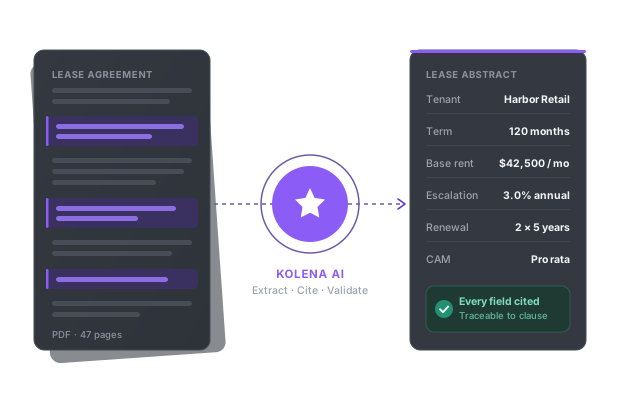
Audit trail depth. A BPO workflow produces outputs: a processed COI, a checked policy, a completed endorsement. An AI document agent produces outputs with citations — every extracted field links back to the exact clause in the source document where it was read. For MGAs building compliance infrastructure, or carriers with state regulatory requirements around document audit trails, the difference between "we processed it" and "here's the exact line we read to generate this field" is increasingly non-negotiable.
Data residency. Patra processes documents offshore, primarily through operations in India and the Philippines. For organizations with data residency requirements, carrier agreements that restrict offshore processing, or state regulatory frameworks around policyholder data, that's a material consideration. An onshore AI platform eliminates it.
How They Compare
Patra (BPO model) | Pure AI platform | |
|---|---|---|
Processing speed | 24–48 hours typical | Minutes |
Pricing structure | Staffing-based; cost runs regardless of volume | Subscription/platform; scales with usage |
Audit trail | Workflow-level tracking | Field-level citations to exact source document location |
CAT / surge handling | Backup staff deployment; inherent latency | Scales automatically; no capacity ceiling |
Data processing location | Offshore (India, Philippines) | Onshore |
Training on your data | Check contract terms | No training on customer data |
SOC 2 | Verify current certification | SOC 2 Type II |
Vertical scope | Insurance-specific | Insurance, commercial RE, banking, financial services |
What Changes With a Pure AI Platform
An AI document agent doesn't have shift changes, doesn't bill for idle capacity, and doesn't need backup staff for a CAT event. Every extracted field — policy number, coverage limit, exclusion clause, effective date — is linked to the exact location in the source document where it was read.
For COI processing specifically, that means a COI request that takes 24–48 hours through a BPO team can be returned in minutes, with a citation for every data point pulled from the underlying policy. For policy checking, AI agents apply the same rubric to every document without the variance that comes from rotating offshore staff. For endorsement processing, the output includes the source clause that justified every change — audit-ready from the moment it's produced.
How the Transition Works
Most organizations don't replace Patra in one move. The practical path:
Run a parallel POC on one workflow. COI processing or policy checking are the cleanest starting points — high volume, well-defined inputs and outputs, easy to compare accuracy side-by-side.
Compare on the metrics that matter. Turnaround time, error rate, audit trail depth, and cost per document — not just whether the AI "passed" a demo.
Decide at contract renewal. Patra contracts have renewal dates. The POC gives you the data to make a commercial decision before the next renewal, without a forced transition under time pressure.
Setup for a focused AI workflow runs in days. The risk of a parallel run is low; the downside of staying locked into a staffing contract when AI can do the same work faster, with a better audit trail, onshore, is no longer marginal.
Frequently Asked Questions
What is the difference between Patra AI and a pure AI platform like Kolena?
Patra AI is an AI layer added to Patra's existing BPO and staffing model. The underlying delivery infrastructure is still staffing-based — offshore teams, backup staff for surge, staffing-based billing. A pure AI platform replaces the staffing layer entirely: no offshore team, no backup staff deployment, no idle billing. The processing, citations, and audit trail are generated by the AI agent directly.
Is AI more accurate than Patra for COI processing and policy checking?
For structured extraction tasks — pulling coverage limits, effective dates, exclusions, and named insureds from standard policy documents — a well-configured AI agent with field-level citations is typically as accurate or more consistent than a rotating offshore team, because it applies the same rubric every time without variance. On unusual or highly non-standard documents, human review is still the right backstop. Most organizations run AI as the primary pass and escalate exceptions to human review — which is a smaller category than it might initially seem.
How much does it cost to replace Patra with an AI platform?
The comparison isn't a flat rate — it depends on your current Patra contract structure and document volume. The economic case is strongest for organizations processing high volumes of standard document types (COIs, endorsements, renewals) where the per-document cost of the BPO model is high relative to a platform subscription. A scoped POC is the fastest way to model the actual numbers against your current spend.
How long does it take to switch from Patra to an AI platform?
For a single well-defined workflow, a proof of concept runs in days. Production deployment with integrations to your AMS or CRM typically takes two to four weeks. Most organizations run parallel for one contract cycle, then make the switch at renewal rather than mid-contract.
How Kolena Works
Kolena is an AI document automation platform built for the document-heavy workflows that insurance organizations currently send to BPO teams. Rather than staffing a team to process your certificates, policies, endorsements, and claims documents, Kolena deploys AI agents that read your documents, apply your specific rubric or extraction template, and return structured outputs — with every field cited to its exact location in the source document.
The platform handles any document format: PDFs, scans, emails, spreadsheets, images. It integrates directly with the AMS, CRM, and data systems your team already uses, so output doesn't require manual re-entry. Every run produces a full audit trail — not just what was extracted, but the specific reasoning and source location behind each data point.
For insurance specifically, Kolena agents are configured for the workflows where BPO contracts are most expensive and most brittle: COI processing, policy checking, endorsements, renewals, FNOL intake, and submission review for MGAs. The same agent that processes a routine COI handles CAT-event surge volume without redeployment or additional cost. And because Kolena is SOC 2 Type II certified, processes data onshore, and never trains on customer data, it satisfies the data residency and audit requirements that make offshore BPO models problematic for regulated insurers.