What CRM data enrichment means in commercial real estate
CRM enrichment generally means appending data to records you already have — filling in a missing industry code, adding a company size, attaching a LinkedIn profile. Vendors sell this as a subscription, matching your contacts against a maintained database.
In commercial real estate the problem is shaped differently, and the standard tools fit it badly. The records that need enriching are properties, deals, and ownership entities, and the authoritative information about them is not in a contact database. It is in documents: offering memoranda, rent rolls, lease abstracts, broker proposals, loan files, appraisals.
Those documents sit in email, in deal folders, in a shared drive organized by whoever set it up. The data inside them is what a CRE CRM record actually needs — square footage, in-place rent, lease expirations, ownership structure, debt terms — and none of it is available from an enrichment vendor, because it is transaction-specific and frequently confidential.
Try AI lease abstraction on your own lease
Why CRE CRMs decay
A CRE CRM degrades through ordinary use rather than neglect. The common patterns:
Deal data entered once, never updated. A property record created during a 2023 underwrite still shows 2023 rents and a 2023 rent roll. Nobody updated it because the deal didn't close and nobody owned the record afterward.
Ownership entities that don't reconcile. The same sponsor appears as four records — the operating company, two single-purpose entities, and a misspelling — because each was created from a different document by a different person.
Documents attached but not extracted. The OM is in the record as a PDF. The twelve data points inside it that anyone would actually filter or report on are not.
Contacts without transaction context. You know who the broker is. You don't know which three deals they brought you, at what price points, or how those closed.
The result is a system that is technically populated and practically unsearchable. Teams fall back on asking whoever worked the deal, which is exactly the dependency a CRM exists to remove.
Enrichment from documents, not databases
The alternative is to treat the deal documents as the enrichment source. The data is already there, in a form that is authoritative because it came from the transaction itself rather than a third-party aggregator.
What that looks like in practice, for an offering memorandum:
Property identifiers — address, parcel, year built, square footage, unit count
Financial summary — asking price, in-place NOI, cap rate, T-12 highlights
Tenancy — major tenants, lease expirations, occupancy, WALT
Transaction parties — broker, seller entity, contact details
Debt assumptions where disclosed
Each of those maps to a CRM field. The extraction is mechanical once the document is read correctly, and reading the document correctly is the hard part — OMs are designed as marketing material, with the numbers distributed across narrative, tables, and footnotes rather than arranged for a parser.
The proposal side
The same documents feed the outbound direction. A broker proposal or pitch book draws on comparable transactions, market data, and prior deal history — material that lives in the same folders and gets reassembled by hand each time.
Teams that produce proposals frequently end up maintaining a parallel system: a spreadsheet of comps, a folder of prior decks, an analyst who knows where everything is. It works until that analyst is on another deal.
Enrichment and proposal generation are the same problem viewed from opposite ends. Both depend on structured, queryable data about past transactions. Build the first and the second becomes substantially cheaper.
What to extract first
Not everything in a document is worth a CRM field. A useful filter: extract what someone would filter, sort, or report on.
Address and square footage pass that test — people search by them. A narrative description of the submarket does not; it will be read once if at all, and it belongs in the attached document rather than a field.
A practical starting set for most CRE teams is twelve to twenty fields per property record, drawn from whichever document type is most common in their pipeline. Starting narrow and expanding is considerably easier than deciding later that half the extracted fields were never used.
Keeping it current
A one-time enrichment pass produces a snapshot that begins decaying immediately. The durable version runs when documents arrive.
That means the extraction has to be triggered by the document rather than by someone remembering to run it — a new OM lands in the deal folder, the extraction runs, the CRM record updates, and a reviewer sees what changed rather than entering it.
The review step matters. Extraction that writes directly to the CRM without a human seeing the diff will eventually overwrite a correct manual entry with an incorrect extracted one, and nobody will notice until a number is wrong in a report.
Where this fits
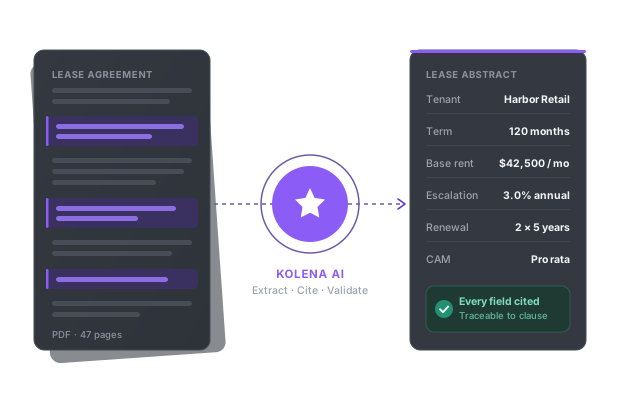
Kolena's CRE Proposal & CRM Enrichment agent reads deal documents as they arrive and returns structured fields mapped to CRM records, with each value cited to the page it was taken from. The citation is what makes the review step fast — a reviewer confirming an extracted cap rate can see the page it came from rather than reopening the document to find it.
The related extraction work sits alongside it: lease abstraction for the tenancy detail, rent roll analysis for the unit-level picture, and offering memorandum analysis for the deal summary. Each produces data the CRM record needs, from documents the team already receives.