What Is AI for Commercial Real Estate?
Artificial intelligence (AI) for commercial real estate refers to the application of machine learning, natural language processing, and data analytics to automate, optimize, and improve processes within the industry. These technologies enable real estate professionals to extract insights from large datasets, predict market trends, automate repetitive tasks, and make data-driven decisions efficiently.
The scope of AI in commercial real estate covers tasks such as underwriting, lease abstraction, property management, and market analysis. AI-driven tools can process and interpret unstructured documents, automate workflows, and provide predictive analytics for investment decisions. As the volume of available data increases and the industry becomes more digitized, AI's role is expanding from basic automation to decision-making across the property lifecycle.
This is part of a series of articles about AI for Real Estate.
Try AI lease abstraction on your own lease
Benefits of AI Tools in Commercial Real Estate
AI tools provide measurable improvements across core commercial real estate workflows. The main value comes from reducing manual effort, improving data accuracy, and enabling faster, informed decisions at scale.
Faster data processing and analysis: AI can process large volumes of structured and unstructured data in seconds, including leases, financial reports, and market data.
Improved accuracy and reduced errors: Machine learning models minimize human errors in tasks like lease abstraction and underwriting.
Better investment decision-making: Predictive analytics helps identify trends, forecast property performance, and assess risk.
Automation of repetitive tasks: Routine tasks such as document review, data entry, and reporting can be automated.
Enhanced market insights: AI tools aggregate and analyze market signals from multiple sources.
Scalability of operations: Teams can handle more properties and transactions without proportional increases in headcount.
Improved tenant and asset management: AI can support tenant communication, maintenance prediction, and occupancy optimization.
Faster deal execution: Automated underwriting and document analysis reduce deal cycle times.
Key Use Cases of AI Tools for Commercial Real Estate
Investment and Underwriting
AI is transforming investment and underwriting by enabling faster and more accurate analysis of property and market data. Algorithms can process large volumes of structured and unstructured information, such as historical transaction records, market trends, and financial documents, to assess asset value and risk. This reduces the time required for due diligence, allowing investors and underwriters to evaluate more opportunities with fewer resources.
AI models can also identify patterns and correlations that are not easily detected by traditional methods, improving the accuracy of forecasts and risk assessments. By factoring in a wider array of variables, including economic indicators, demographic shifts, and local events, AI helps firms make more informed investment decisions and respond to market changes.
Lease Abstraction and Document Processing
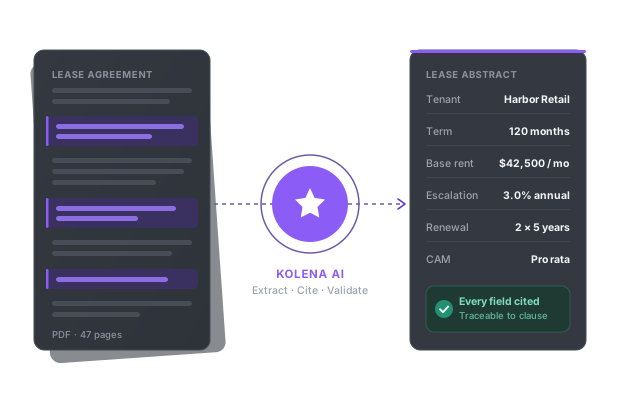
Lease abstraction and document processing are traditionally labor-intensive and prone to error due to the complexity and volume of documents involved. AI tools can automatically extract key terms, clauses, and data points from leases and other legal documents, reducing manual effort. Natural language processing algorithms identify and summarize information such as rent escalation clauses, renewal options, and tenant obligations, providing structured output for further analysis or system integration.
This automation accelerates onboarding of new properties and tenants and improves compliance and accuracy. With AI, organizations can identify discrepancies, track obligations, and ensure that lease data is consistently updated across systems. This reduces risk and improves transparency.
Learn more in our detailed guide to AI lease abstraction
Property Management and Operations
AI applications in property management improve building operations and tenant experiences. Machine learning algorithms analyze sensor data, maintenance logs, and tenant feedback to predict equipment failures, recommend preventive maintenance, and optimize resource usage. This lowers operating costs and reduces downtime.
AI-driven platforms can also automate tenant communications, streamline service requests, and personalize amenities. Predictive analytics help property managers anticipate tenant needs, manage energy consumption, and comply with regulatory requirements.
Market Intelligence and Data Platforms
AI-powered market intelligence platforms aggregate and analyze real estate data, delivering insights to investors, brokers, and owners. These platforms use machine learning to detect market trends, forecast pricing, and evaluate competitive landscapes. By integrating data from public records, listings, transactions, and economic indicators, AI tools provide a broad view of the market in real time.
With this intelligence, users can identify opportunities, benchmark performance, and adjust investment strategies. AI-driven analytics also support scenario modeling, stress testing, and portfolio optimization, allowing firms to make evidence-based decisions in changing markets.
Generative AI and Content Automation
Generative AI is used to automate the creation of marketing content, reports, and property listings. By analyzing existing data and documents, generative models can produce customized brochures, summaries, and investment memos tailored to specific audiences. This reduces the time and cost involved in content production while maintaining consistency and accuracy across communications.
Generative AI can also assist with internal documentation, training materials, and client proposals. Automated content generation helps real estate professionals respond quickly to client inquiries and market changes without relying heavily on manual drafting or design resources.
Notable AI Tools in Commercial Real Estate
Document Processing and Workflow Automation AI
1. Kolena

Kolena is an AI document workflow automation platform that builds specialized agents to automate complex, document-heavy processes in commercial real estate. It applies user-defined evaluation rubrics to extract, analyze, and validate information across leases, rent rolls, loan packages, and other unstructured documents, mirroring the judgment of an underwriter or analyst while automating the most time-consuming review work.
Key features include:
Custom agent creation: Build agents in natural language to execute specific checks and extraction tasks tailored to a team's workflow, from lease abstraction to loan underwriting review
Source citations and traceability: Links every extracted data point to its exact location in the source document, with full reasoning and an audit trail for each automated run
Cross-document comparison: Reconciles information across multiple documents, such as comparing lease terms against rent rolls to flag discrepancies, missed escalations, and expired concessions
Multi-format document processing: Handles PDFs, scanned images, spreadsheets, emails, and audio or video files through built-in OCR, with no additional configuration
Structured, exportable outputs: Produces underwriter-ready summaries and structured data that integrate with existing systems such as PMS platforms and CRMs
2. LeaseLens

LeaseLens is an AI-powered lease analysis tool that automates the review of lease documents by extracting, evaluating, and explaining key terms. It processes uploaded files and uses natural language processing to interpret legal language, identify risky clauses, and compare terms against local regulations.
Key features include:
Illegal clause detection: Scans lease documents and cross-references clauses against local laws to flag terms that violate tenant protection regulations, such as excessive fees or waived rights
Plain-language summaries: Converts complex legal sections into simple explanations of obligations, fees, and liabilities
Risk scoring system: Assigns a score (0–100) based on how the lease compares to similar agreements in the same geographic area
Hidden fee identification: Detects additional costs embedded in the lease, including late fees, deposits, and other charges
Multi-format document support: Accepts PDF and Word files
3. Docsumo

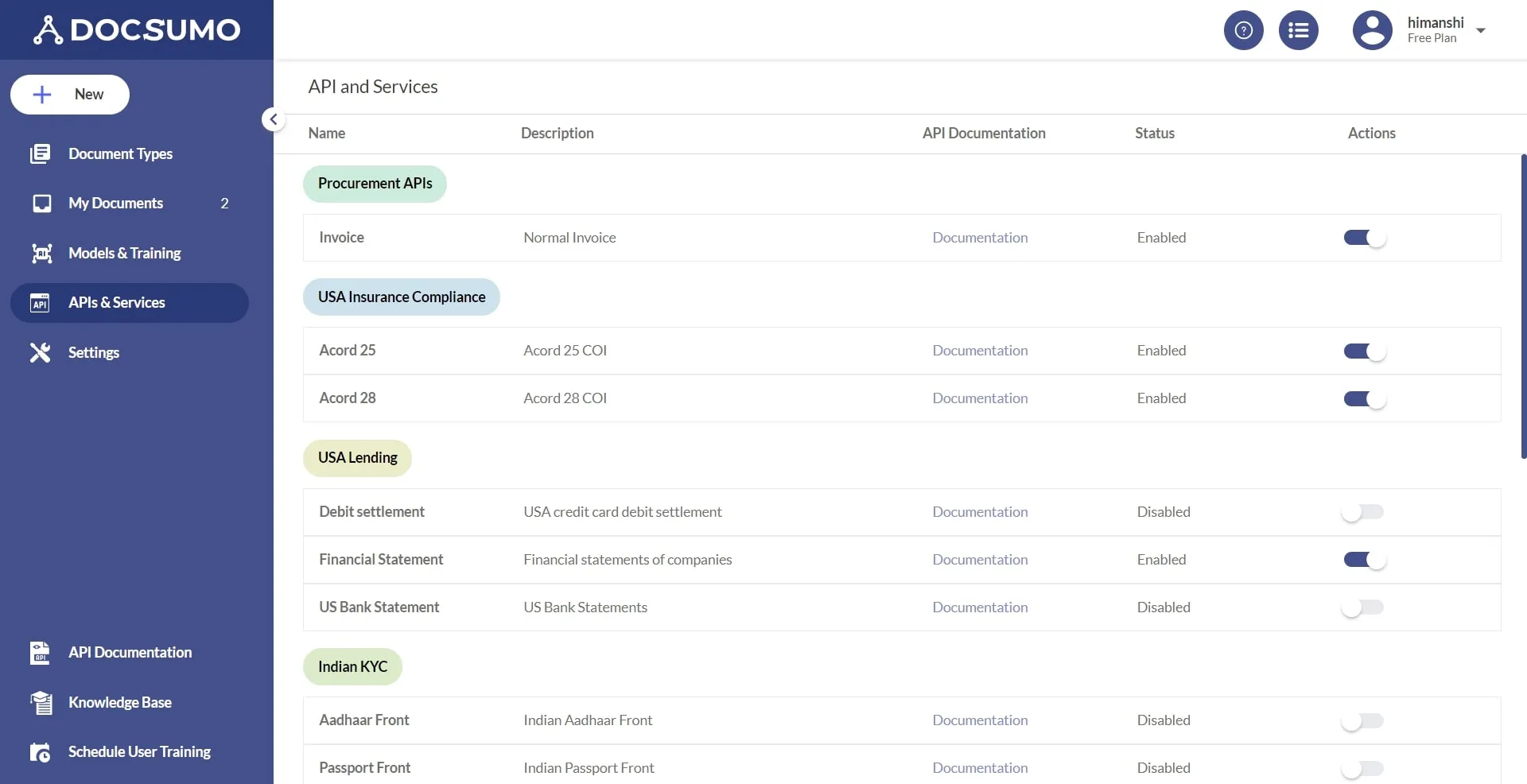
Docsumo is an AI-powered document processing platform that automates workflows for unstructured data. It enables enterprises to ingest documents from multiple sources, classify and extract key information, validate outputs, and trigger downstream actions within integrated systems.
Key features include:
Multi-source data ingestion: Imports documents from emails, APIs, shared folders, or manual uploads
Automated classification and splitting: Identifies document types and separates files into structured categories
AI data extraction: Extracts key data fields from unstructured documents
Data enrichment and categorization: Organizes and tags extracted data for use in analytics and operations
Validation and cross-checking: Applies automated validation rules and cross-document checks
Source: Docsumo
Investment, Data and Property Operations AI
4. Cherre

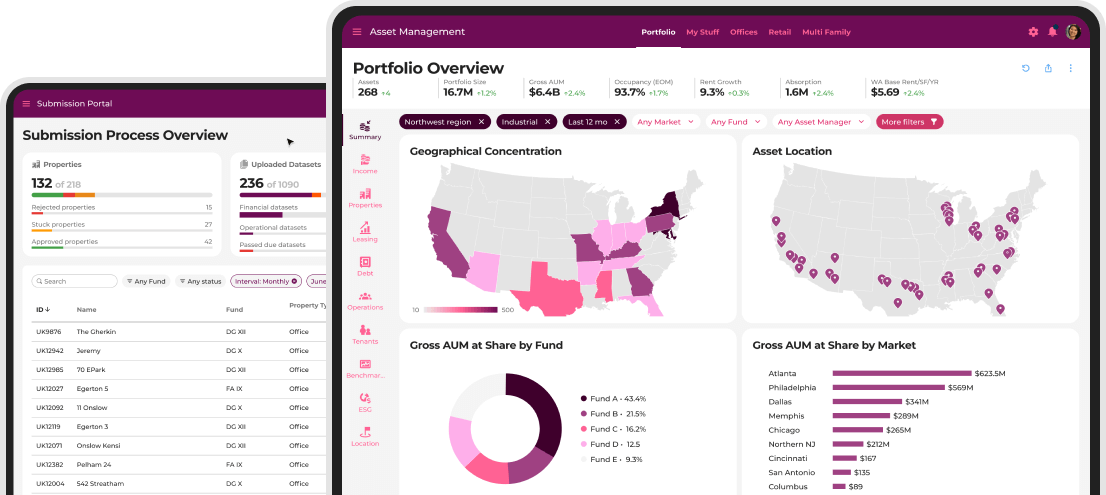
Cherre is a data management and analytics platform built for commercial real estate that focuses on connecting fragmented datasets into a unified data layer. It enables organizations to ingest data from internal and external sources, standardize and map it into a consistent format, and link it through a centralized data fabric.
Key features include:
Flexible data ingestion: Supports direct connectors, file uploads, APIs, and secure SFTP
Pre-built data connectors: Integrates with real estate applications such as ERP systems, leasing platforms, and deal management tools
Standardized data model: Transforms disparate datasets into a consistent schema
Data fabric and knowledge graph: Connects data across 3.3+ billion addresses using a real estate data graph that includes property, valuation, tax, demographic, and geospatial data
Advanced data mapping engine: Enables flexible mapping between source systems and target schemas
Source: Cherre
5. EliseAI

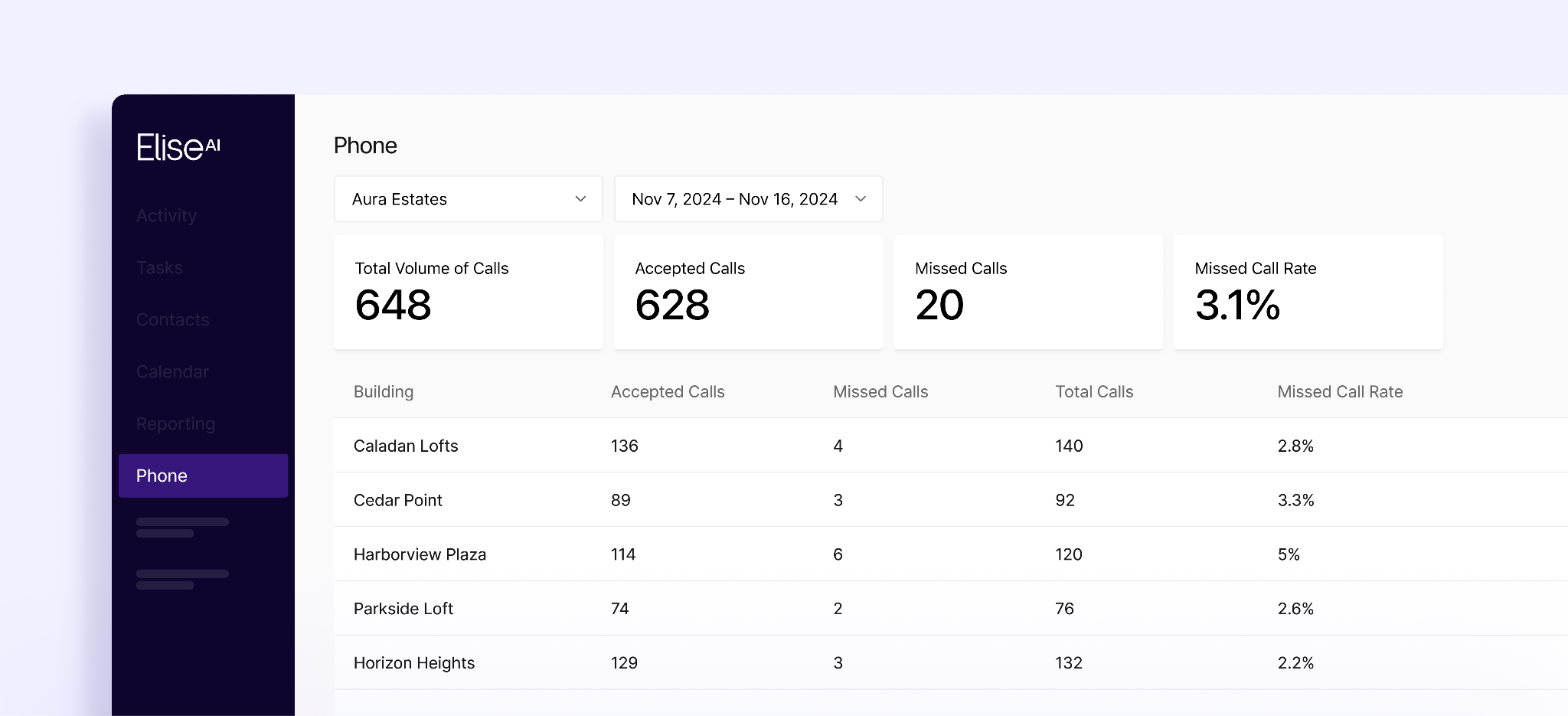
EliseAI is an AI-powered property management platform that automates leasing, resident communication, and operational workflows across the resident lifecycle. It uses conversational AI and workflow automation to handle interactions across multiple channels, manage leads, coordinate tours, and streamline tenant engagement.
Key features include:
Omnichannel communication automation: Manages conversations across email, text, chat, and voice
AI-powered prospect management: Automates lead qualification, follow-ups, and tour scheduling
AI-guided tours: Supports automated property tours based on prospect preferences and availability
Voice AI capabilities: Handles inbound and outbound calls with automated responses
Centralized CRM platform (EliseCRM): Consolidates renter interactions, communication history, and operational data
Source: EliseAI
6. CoreLogic

CoreLogic is a property data and analytics platform that aggregates, connects, and analyzes real estate datasets to deliver insights across the property ecosystem. It combines property, market, climate, and risk data with machine learning models to help organizations understand asset values, forecast trends, and assess risk.
Key features include:
Comprehensive property data coverage: Provides access to billions of property records with historical data
Multi-dataset integration: Combines property, market, customer, climate, and risk data into a unified dataset
AI and machine learning models: Uses models to analyze relationships, forecast trends, and generate predictions
Unique property identification system: Matches and links property records across datasets using integrated identifiers
Large-scale data processing: Handles millions of new data points monthly
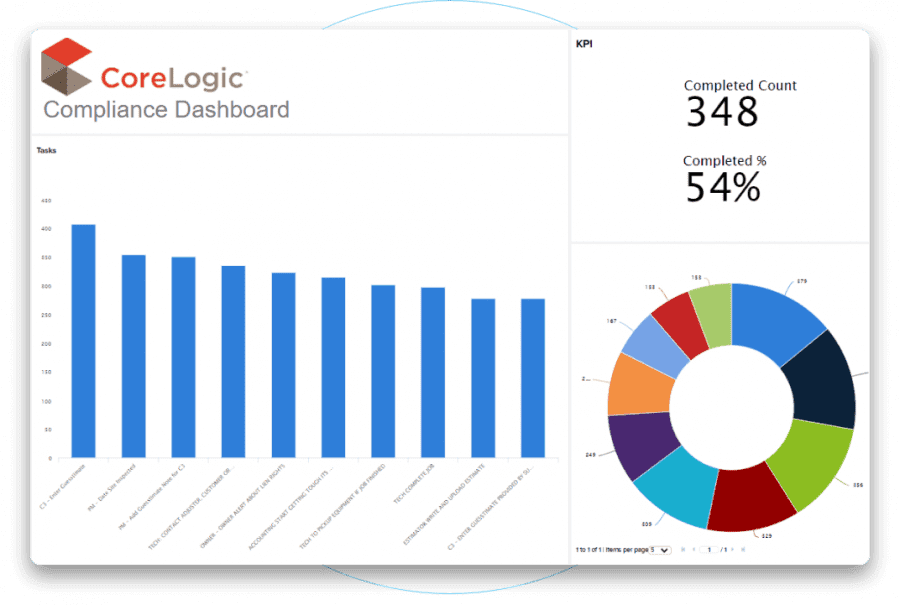
Source: CoreLogic
Learn more about best ai tools for real estate investors.
How to Choose the Right AI Tools for Commercial Real Estate
Choosing the right AI tools requires aligning capabilities with business needs, data maturity, and operational workflows. Not all tools deliver value immediately, so careful evaluation is needed to ensure long-term impact and scalability.
Define clear use cases: Start with specific problems such as lease abstraction, underwriting, or tenant communication.
Data availability and quality: Assess whether internal data is accessible, consistent, and sufficient to support the tool.
Integration with existing systems: Ensure the tool can connect with current systems such as CRM, ERP, or property management platforms.
Accuracy and model performance: Evaluate how well the tool performs on real-world data.
Scalability and flexibility: Choose tools that can handle increasing data volumes and adapt to new use cases.
Workflow compatibility: The tool should fit into existing processes without requiring major operational changes.
Compliance and data security: Review how the tool handles sensitive data, especially lease and financial information.
Cost vs. ROI: Compare pricing with expected efficiency gains, time savings, and error reduction.
Vendor support and reliability: Evaluate the vendor’s onboarding, documentation, and ongoing support.
Customization and control: Some tools allow configuration of models, rules, or outputs to align with business requirements.
Conclusion
AI is reshaping the commercial real estate landscape by driving data-driven decision-making and improving accuracy and scalability in core workflows. Successful integration requires carefully aligning these new capabilities with specific business needs and existing systems. By embracing these advancements, firms can secure a significant competitive edge in an increasingly digitized market.