AI now automates nearly every document-heavy workflow in commercial real estate — lease abstraction, rent roll reconciliation, acquisition due diligence, loan underwriting review, lease auditing, and environmental report review — by reading documents of any format, extracting structured data with field-level citations, and returning it to the systems CRE teams already use. The result is days of analyst work compressed into minutes, with every figure traceable to its source.
This guide is a reference for CRE operators, acquisitions teams, asset managers, property managers, and private lenders. Each section below covers one major CRE document workflow: the pain that makes it slow and error-prone, and what AI actually delivers. Across all of them, the pattern is the same — AI handles the reading and structuring at portfolio scale, and your team keeps the judgment.
This is part of a series of articles about AI for Real Estate.
Why CRE Runs on Documents — and Why That's the Bottleneck
A single CRE deal can generate thousands of pages: leases and amendments, rent rolls, operating statements, appraisals, environmental reports, entity documents, and loan files. Historically the only options were manual review (slow, and the work analysts most cite as why they leave) or offshore outsourcing (cheaper per document but slower to turn around and inconsistent). Offshore lease abstraction, for example, typically runs roughly $5–$100 per lease with a 2–5 day turnaround, and per-document cost rises as India wage inflation holds near 9.5% a year while non-voice BPO attrition of 15–30% turns over knowledge of your templates roughly quarterly. AI changes the structure of the problem: it reads at machine speed, applies your rubric identically every time, and cites each value to its source. MIT's Project NANDA study (Aug 2025) found firms eliminating $2–10M in annual BPO spend after deploying AI — one saved about $8M a year after spending roughly $8,000 on an AI tool.
Try AI lease abstraction on your own lease
Lease Abstraction
Lease abstraction is the canonical CRE document problem. A commercial lease is rarely one file — it's a base lease plus a stack of amendments executed over years, with rent economics buried in tables. Manual abstraction runs 3–8 hours per lease, and the question that matters for underwriting isn't what the original lease said but what the currently effective term is after every amendment. Older tools either processed each document in isolation or consolidated amendments unreliably.
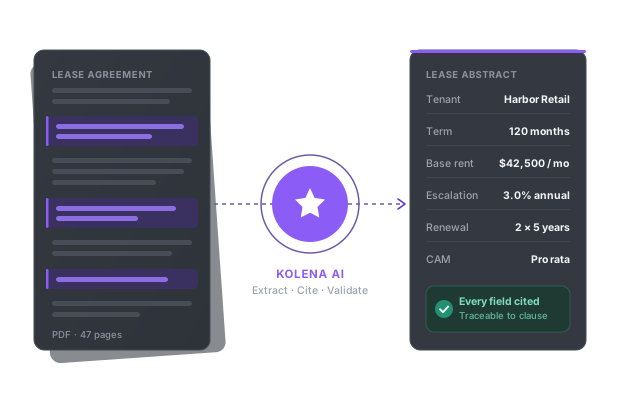
AI ingests the full document set — base lease, amendments, exhibits — as one related package, reconciles the amendment chain to the currently effective values, reads rent tables natively, and cites every field to its source clause. Documented deployments report per-lease review time dropping about 85% (from roughly two hours to 17 minutes) with 95%+ accuracy on standard fields. One private-equity real estate manager reached that result only after a dozen-plus other tools failed on amendment consolidation and rent-table parsing; one commercial real estate firm captured about $100,000 in efficiency gains across just 58 leases.
Rent Roll Reconciliation
Lease abstracts feed the rent roll, and when the two drift apart the gap shows up as cash-flow error: escalations not applied, concessions that should have expired, incorrect lease dates. Reconciling a lease against the rent roll manually means opening the lease PDF, extracting the rent terms, comparing them line by line to the Yardi, RealPage, or Entrata export, and correcting the system — 10–20 minutes per unit, which is why most teams skip it and absorb the leakage.
AI extracts the lease terms and cross-checks them against the rent roll automatically, surfacing only the discrepancies that need attention — no manual side-by-side. Across a large portfolio, catching even a fraction of a percent of misapplied rent recovers real money, and because every flag is cited to the lease clause behind it, property managers can correct the system of record with confidence.
Acquisition Due Diligence
Between LOI and close, the acquisitions team has to read the data room — historical leases, prior appraisals, environmental reports, financial statements, entity documents — on a 30–45 day clock. On a 100-lease portfolio at four hours per lease, manual abstraction alone consumes roughly 400 analyst-hours, about ten working weeks of one reviewer, which simply doesn't fit a competitive bid window.
AI ingests the full data room, cross-references documents against each other, flags assumption mismatches and missing items, and produces a structured diligence summary with every figure cited to its source. The effect is deal-velocity: a four-to-seven-day diligence pass instead of two-to-three weeks lets teams bid more competitively and reduces the risk of a post-close surprise that a rushed manual review would miss.
Related articles: ai in commercial real estate and best ai tools for real estate investors.
Loan Underwriting Document Review
For private and balance-sheet CRE lenders, the underwriting file is a package of borrower financials, rent rolls, T12s, entity documents, appraisals, and environmental reports that must be reconciled against each other — the rent roll against the T12, the appraisal against the actuals — on a credit-committee deadline. Offshore support processes these documents in isolation and runs a 24–48 hour queue, so the cross-checks that catch problems happen late, back with your underwriters.
AI reads the whole file as one connected package, performs the cross-references, and returns an underwriter-ready output with every figure cited to its source document — in hours, against the committee date. One private-lending customer cut UCC filing review labor by 96% and took loan-file turnaround from about five days to hours. The credit decision stays with the underwriters; AI just gets them a clean, sourced file faster.
Lease Auditing
Lease auditing — verifying that what's being billed and paid matches what the lease actually says, especially on CAM, operating-expense recoveries, and percentage rent — is high-value but tedious, so it's often done on a sample rather than the full portfolio. The miss rate on the unaudited remainder is where recoverable dollars and overpayments hide.
AI makes full-portfolio auditing practical: it extracts the controlling lease terms, compares them against billed and recovered amounts, and flags variances with a citation to the exact clause, so the audit moves from spot-check to comprehensive. Because the same rubric is applied to every lease, the analysis is consistent in a way a rotating manual or offshore team can't match.
Environmental and Appraisal Report Review
Phase I environmental site assessments (ESAs) and appraisal reports are long, semi-structured PDFs whose key findings — recognized environmental conditions, recommendations, valuation conclusions, comparables — are buried in dense narrative. Reading them carefully under a diligence deadline is slow, and skimming them is how material findings get missed.
AI reads ESA and appraisal reports and extracts the findings that matter into a structured summary — flagged conditions, recommended actions, valuation figures and the comps behind them — each cited to its page and section. That gives the deal team a fast, sourced read on environmental and valuation risk without re-reading hundreds of pages per asset.
What Makes AI Trustworthy on CRE Documents
Speed only matters if the output holds up, and three things separate production-grade AI from an impressive demo. The first is field-level citation: every extracted value links back to the exact page and clause it came from, which turns verification into a glance rather than a re-read and gives auditors, lenders, and investment committees a defensible source for each number. The second is amendment and table handling — reconciling a base document and its amendments to the currently effective term, and reading rent and escalation tables as tables rather than flattening them to text. These are the two failure modes that defeated earlier tools, and they are where accuracy is won or lost on real CRE documents. The third is human-in-the-loop by design: rather than silently guessing on ambiguous or heavily negotiated language, AI flags those items for review, so your team spends its attention where judgment actually adds value. Documented deployments report 95%+ accuracy on standard fields with this approach — high enough to trust at scale, transparent enough to check where it counts.
Underpinning all of it is data handling: confidential CRE documents stay onshore, the platform is SOC 2 Type II certified, and customer data is never used to train models — so adopting AI doesn't trade speed for exposure.
Manual vs. Offshore vs. AI Across CRE Workflows
The trade-offs are consistent across every workflow above.
| Factor | Manual in-house | Offshore outsourcing | AI (Kolena) |
|---|---|---|---|
| Turnaround | Hours to weeks | 2–5 days per batch | Minutes to hours |
| Cost trajectory | Analyst time; scales with headcount | Per-document; rises ~9.5%/yr with wages | Software cost; flat as volume scales |
| Consistency | Varies by analyst | Varies; 15–30% attrition | Same rubric every run |
| Citations | Manual, if any | Values without source references | Field-level citation to each source |
| Surge capacity | Limited by headcount | Limited by staffed bench | No fixed ceiling |
| Data residency | Onshore | Offshore | Onshore, SOC 2 Type II |
Offshore and manual review still fit genuinely low, sporadic volume or one-off leases requiring deep legal judgment. For recurring, portfolio-scale document work on a deadline, AI wins on speed, consistency, and auditability.
How Kolena Works
Kolena is an AI document automation platform built for commercial real estate teams. Leases and amendments, rent rolls, operating statements, appraisals, environmental reports, loan files, and entity documents go in; structured, citation-backed data against your own template comes out, in minutes.
It reads any format — PDFs, scans, emails, spreadsheets — and pushes structured output into Yardi, MRI, RealPage, CoStar, SharePoint, and your data warehouse, so abstracts, reconciliations, and diligence summaries flow into the systems you already run. Every run produces a full audit trail: not just what was extracted, but the specific clause, line, or figure that justified each data point. SOC 2 Type II certified, onshore processing, no training on customer data.