Claude can compare a single lease against its corresponding rent roll line and catch a real discrepancy — a missed escalation, an expired concession still being applied, a rent amount that doesn't match. What it isn't handed automatically is the fact that a 500-unit portfolio isn't two documents to compare. It's five hundred lease-to-rent-roll pairs, and reconciliation only means something if all five hundred get checked the same way, on the same cycle, not just the ones someone happened to pull.
That's the gap between "Claude can catch this discrepancy" and "our rent roll reconciliation process works," and it's where reconciliation workflows built directly on a general assistant tend to run into trouble once they move past a sample.
What Claude Does Well for Rent Roll Reconciliation
Claude has real, verifiable capability that applies directly to reconciliation work.
- A 1M-token context window, standard on current frontier Claude models per Anthropic's documentation, can hold a lease with its full amendment history alongside a rent roll export in a single pass, useful for comparing a specific unit's terms in depth.
- Claude Skills can encode what counts as a discrepancy worth flagging — a rent variance above a set threshold, an expired concession still showing as active, a lease-end date mismatch — as reusable comparison logic.
- Connectors, including Anthropic's Microsoft 365 connector, can pull lease files and rent roll exports directly from SharePoint or a shared mailbox under the analyst's existing permissions.
- Claude Cowork can run a multi-step task comparing a batch of leases against a rent roll export, producing a first-pass discrepancy list while an analyst does something else.
Generate your first rent roll in minutes with AI
Where Five Hundred Pairs Break What Two Documents Never Would
The failure pattern isn't Claude missing an obvious discrepancy on a single pair — it's what happens once the comparison has to run consistently across a whole rent roll, cycle after cycle.
- By pair 50, the rent roll export's unit-numbering convention doesn't quite match how a handful of leases reference the same units — a suite renumbered after a build-out, an internal code versus a marketing name — and pairs that should match silently don't get compared at all.
- By pair 150, a concession that expired two months ago is still reflected in the rent roll for one unit. It gets caught. Whether the same lag exists for other units whose concessions expired around the same time isn't something the process checks by default — someone has to think to ask.
- By pair 300, the analyst who tuned the comparison thresholds — how large a rent variance has to be before it's worth flagging, which lease amendments override which rent roll entries — moves to a different portfolio. The next reconciliation cycle runs on the saved instructions, minus the judgment calls that shaped them.
- At pair 500, an owner preparing for a refinance asks for a reconciliation report covering the full portfolio, with a record of what was checked, what was flagged, and what was resolved last quarter. The most recent cycle's output exists. A defensible record of full portfolio coverage, cycle over cycle, does not.
None of this is a comprehension failure. It's that reconciling one lease against one rent roll line and reconciling a portfolio, reliably, every cycle, are different scales of the same problem.
Why Full-Portfolio Coverage Is the Real Requirement, Not Any One Comparison
The value of rent roll reconciliation comes entirely from doing it exhaustively — a discrepancy on a unit nobody checked is exactly as costly as one nobody caught. A process that reconciles the pairs someone happened to sample isn't meaningfully different from not reconciling at all on the units it missed.
Confirming that every unit in a 500-unit rent roll was actually compared against its lease, on a defined cycle, with a record of what was flagged and resolved, requires more than a comparison prompt that works well on the pairs it's tested against. It requires a process that guarantees coverage and keeps a record of that coverage — neither of which is something a general assistant tracks on its own.
Who Owns the Comparison Rules, the Coverage Record, and the Re-Validation
The thresholds and matching rules that define what counts as a discrepancy are the actual logic of a reconciliation workflow, and in a self-built deployment they typically live in a prompt or Skill with no record of which version flagged which discrepancy on which cycle.
Two consequences follow. First, without a coverage record, nobody can confirm after the fact that all five hundred units were actually checked in a given cycle rather than a subset. Second, when the underlying model version changes, or the rent roll export format shifts after a PMS migration, re-confirming that the comparison logic still works correctly across the full portfolio is work someone has to schedule — and at portfolio scale, that re-validation is exactly the kind of maintenance that gets deferred until a discrepancy is discovered the hard way.
Claude-Based Rent Roll Reconciliation Compared With a Purpose-Built Platform
Both approaches can catch a discrepancy on an individual lease-to-rent-roll pair; the table below shows who owns full-portfolio coverage, the version record, and re-validation at scale.
| Requirement | Self-Built on Claude | Purpose-Built Platform |
|---|---|---|
| Catches a discrepancy on an individual pair | Yes | Yes |
| Guarantees every unit in the portfolio was checked | Not by design | Yes, by design |
| Handles unit-numbering mismatches between systems | You build the mapping logic | Built with you, applied consistently |
| Field-level citation to source lease clause | Instructed, not enforced | Enforced on every field |
| Coverage record for a specific reconciliation cycle | You build it | Built in |
| Recurring cycle without manual re-running | You schedule and maintain it | Built in |
| Re-validation when the model version changes | Your team | Vendor benchmarks and validates |
| Structured discrepancy report into existing systems | Manual export | Structured push into existing systems |
| Audit record for a refinance or lender diligence request | You build it | Built in |
| Who owns the accuracy of the outcome | Your team | Shared with the vendor |
When Using Claude Directly for Rent Roll Reconciliation Is the Right Choice
Claude, used directly, is a good fit for reconciliation work that stays occasional, small-scale, or fully reviewed line by line.
- Spot-checking a handful of units. Comparing a specific tenant's lease against its rent roll entry ahead of a renewal conversation is exactly what Claude handles well.
- A small portfolio reviewed by one person. A property manager reconciling a few dozen units personally, checking every flagged discrepancy themselves, doesn't need portfolio-wide coverage infrastructure.
- Testing new comparison thresholds. Trying out a revised discrepancy threshold against a sample of units before rolling it out portfolio-wide is a reasonable use of a Claude Skill.
- Low volume. Below a few hundred units, or for an ad hoc one-time reconciliation rather than a recurring cycle, the infrastructure a purpose-built platform adds may cost more than it saves.
The dividing line isn't whether Claude can catch a specific discrepancy — it can. It's whether the process has to prove, cycle after cycle, that every unit in the portfolio was actually checked.
How Kolena Works
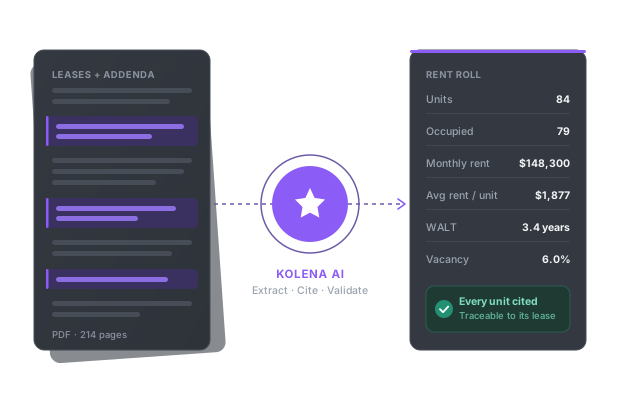
Kolena is an AI document automation platform built for property managers, owners, and asset managers who need lease-to-rent-roll reconciliation to cover a full portfolio, every cycle, not a sample. Kolena's agents extract base rent, escalation schedules, concessions, deposits, and lease dates from every lease in the portfolio, then automatically cross-check each figure against the corresponding rent roll entry — flagging rent discrepancies, missed escalations, expired concessions still applied, and date mismatches with every finding cited to its exact source location.
Kolena produces a full coverage record for each reconciliation cycle — what was checked, what was flagged, what was resolved — and pushes structured output into the systems teams already use. Kolena also benchmarks leading models against real document tasks and routes each step to the best performer, so a model version change is validated before it reaches your reconciliation workflow. Kolena is SOC 2 Type II certified, processes onshore, and does not train on customer data.
One private equity customer uses Kolena this way as part of acquisition and asset-management due diligence, reconciling lease terms against rent rolls across full portfolios rather than the sample a manual review would typically cover.