TL;DR: Automated rent roll software extracts, standardizes, and tracks rental income data without manual entry. PRODA leads for CRE data standardization, AppFolio and Buildium for full-service residential management, and redIQ for multifamily underwriting workflows.
What Is Automated Rent Roll Software?
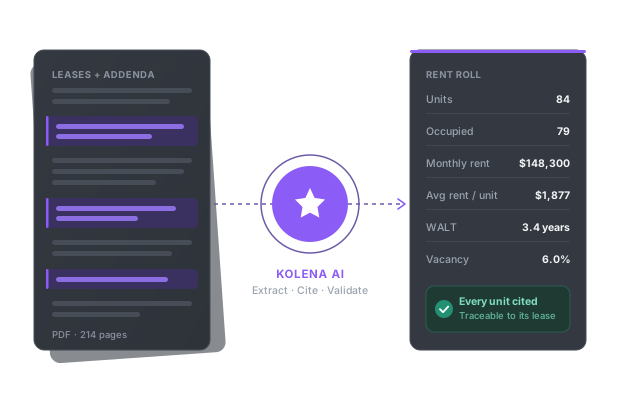
Automated rent roll solutions use AI and OCR technology to instantly extract, standardize, and analyze tenant data from PDFs, Excel, or property management systems. These tools eliminate manual data entry, reduce errors, and provide real-time insights into lease renewals, occupancy, and revenue risks.
These automated solutions replace manual data entry with software that can capture, organize, and update rent roll data from various sources, providing a centralized and always up-to-date view of rental income, tenant status, lease terms, and other key metrics.
Automated rent roll platforms are built to integrate with property management systems, accounting tools, and other databases, ensuring that all relevant information is collected and synchronized without the need for repetitive manual work. By automating data extraction, validation, and reporting, automated rent roll software minimizes human error, speeds up financial analysis, and improves the accuracy of rent-related documentation.
Generate your first rent roll in minutes with AI
Why Property Managers Need Automation
Property managers face increasing demands for efficiency, accuracy, and transparency in their operations. Manual rent roll management is time-consuming and error-prone, requiring constant attention to data entry, updates, and reconciliation across multiple sources. As property portfolios grow, the complexity of tracking lease expirations, rent payments, and tenant changes increases, making it difficult to maintain accurate and timely records using traditional methods. Automation addresses these challenges by reducing repetitive tasks, consolidating information, and providing instant access to current data, allowing property managers to focus on tenant relations and planning.
In addition to improving operational efficiency, automation helps property managers reduce risk and support compliance. Automated systems can flag inconsistencies, missed payments, or lease anomalies as soon as they occur, enabling faster resolution and reducing the likelihood of financial losses or legal issues. Automated rent roll software also provides audit trails and standardized reporting, which support transparency with property owners, investors, and regulatory bodies. As the property management industry continues to digitize, automation has become necessary to maintain competitiveness and deliver a high level of service.
Key Features of Automated Rent Roll Software
Automated Data Extraction
Automated data extraction enables rent roll software to pull information from sources such as lease documents, accounting systems, and property management platforms without manual intervention. This feature uses technologies like optical character recognition (OCR) and machine learning to read and interpret data from scanned documents, PDFs, and emails, ensuring that lease terms, rent amounts, payment histories, and other details are captured accurately. By removing manual data entry, automated extraction saves time and reduces the risk of human error that can result in discrepancies.
Automated data extraction also supports scalability, allowing property managers to handle increasing volumes of leases and transactions without increasing administrative workload. In environments with diverse data formats and sources, automated extraction ensures that relevant information is consistently included in the rent roll, providing a complete view of portfolio performance. This capability supports organizations seeking to modernize operations and gain insights from property data.
Real-Time Data Sync
Real-time data sync ensures that information across systems and stakeholders is current and consistent. When tenant payments are made, leases are updated, or new properties are added, these changes are reflected across the platform and integrated tools. This eliminates the lag and potential errors associated with manual updates, allowing property managers and owners to make decisions based on current data.
Real-time synchronization also improves collaboration between property managers, owners, accountants, and other stakeholders by providing a single source of truth. With real-time sync, there is less confusion about which version of the rent roll is correct, and discrepancies can be identified and resolved quickly. This transparency is important for organizations managing large or geographically dispersed portfolios, where timely and accurate data is critical for performance tracking and compliance.
Tenant and Lease Tracking
Tenant and lease tracking capabilities provide detailed records of each tenant, including lease terms, start and end dates, rent amounts, and renewal options. The system updates tenant statuses, flags upcoming lease expirations, and tracks historical changes such as rent increases or amendments. This tracking enables property managers to anticipate vacancies, plan renewals, and address issues like delinquent payments or expiring leases.
Accurate tenant and lease tracking supports portfolio performance and risk management. With automated systems, property managers can generate up-to-date reports, analyze occupancy trends, and identify opportunities for rent adjustments or lease restructuring. These insights inform decisions such as marketing vacant units or negotiating lease extensions and support communication with owners and investors. By centralizing lease and tenant information, automated rent roll software reduces the risk of overlooked details and helps property managers prepare for upcoming changes.
Payment Tracking and Alerts
Payment tracking and alerts help maintain cash flow and reduce delinquencies. Automated rent roll software monitors rent payments in real time, recording when payments are received, missed, or late. The system can generate alerts for overdue payments, upcoming due dates, or discrepancies in payment amounts, enabling property managers to act quickly. This replaces manual tracking and follow-up, reducing administrative workload and supporting collection rates.
The alert system is customizable, allowing property managers to set thresholds and triggers for different types of notifications. For example, alerts can be sent when a payment is late by a specific number of days or when a lease is approaching expiration. These notifications help property managers address potential problems, maintain tenant relationships, and avoid legal actions. By automating payment tracking and alerts, rent roll software supports financial management and revenue consistency.
Error Detection and Validation
Error detection and validation features identify inconsistencies, missing data, or anomalies in lease and payment records. The system scans for issues such as overlapping leases, incorrect rent amounts, or mismatched payment histories, flagging them for review before they affect financial reporting or compliance. This reduces the risk of mistakes and helps keep rent roll data accurate.
Validation tools can enforce business rules, such as requiring certain fields to be completed or checking that rent increases comply with legal limits. By automating these checks, property managers can ensure that rent rolls follow internal policies and external regulations. This oversight is important for large portfolios or organizations subject to audits. Automated error detection and validation improve data quality and support accountability for property managers and stakeholders.
Who Uses Automated Rent Roll Systems?
Property Managers
Property managers use automated rent roll software to oversee multiple properties and tenants without relying on manual data entry and updates. The software consolidates lease, payment, and tenant data into a single dashboard, allowing managers to monitor occupancy rates, track rent payments, and schedule lease renewals. Automated alerts and reporting support daily operations, allowing property managers to focus on tenant relations and property maintenance rather than administrative tasks.
With automation, property managers can identify trends or issues across their portfolio, such as delinquency rates or upcoming lease expirations, and respond proactively. This reduces errors and supports service quality for tenants and property owners. Automated rent roll solutions also simplify generating accurate reports for owners, investors, or regulatory bodies.
Real Estate Investors
Real estate investors rely on accurate rent roll data to assess the performance and value of their property holdings. Automated rent roll software provides visibility into occupancy rates, rental income, lease terms, and tenant stability, enabling data-driven investment decisions. By automating the collection and analysis of this information, investors can evaluate the health of properties or portfolios, identify underperforming assets, and spot opportunities for value creation or risk reduction.
Investors also benefit from standardized reporting and data integration, which simplify portfolio reviews and support due diligence during acquisitions or sales. Automated rent roll solutions ensure that relevant information is accessible and presented in a consistent format, reducing the risk of oversight or misinterpretation.
Asset Managers
Asset managers are responsible for improving the financial performance and long-term value of property portfolios. Automated rent roll software provides tools to monitor metrics such as net operating income, rent collection rates, and lease expirations in real time. By centralizing and automating data collection, the software enables asset managers to identify trends, forecast cash flow, and make decisions about property improvements, lease negotiations, or portfolio rebalancing.
Automated rent roll solutions also support reporting to stakeholders such as property owners, investors, or board members. The ability to generate accurate and customizable reports improves transparency. Automated error detection and validation features help asset managers maintain data integrity and comply with internal policies and industry regulations.
Lenders and Analysts
Lenders and financial analysts use automated rent roll software to assess the financial stability and risk profile of properties during underwriting and ongoing monitoring. The software provides a standardized view of rental income, lease terms, occupancy rates, and tenant quality, which are key inputs for evaluating loan eligibility and structuring financing. Access to real-time, validated data reduces reliance on manually prepared documents and lowers the risk of errors or misrepresentation during due diligence.
For analysts, automated rent rolls enable faster financial modeling and portfolio analysis. They can identify trends such as declining occupancy, tenant concentration risk, or upcoming lease expirations that may affect cash flow. Integration with other financial systems allows data to flow into valuation models and reporting tools, supporting decision-making in lending, investment analysis, and risk management.
Types of Automated Rent Roll Solutions
AI-powered rent roll solutions use technologies such as optical character recognition (OCR), machine learning, and natural language processing (NLP) to automatically extract, standardize, and analyze rent roll data from a range of sources. These systems can process lease agreements, scanned PDFs, spreadsheets, emails, and property management system exports without requiring a fixed template. AI models identify key fields such as tenant names, lease dates, rent amounts, security deposits, and occupancy status, even when document formats vary significantly. Many platforms also include anomaly detection, automated validation, and predictive analytics to identify risks.
Traditional rent roll solutions rely on structured data entry and predefined workflows to manage lease and tenant information. Data is typically entered manually by property managers or imported from standardized spreadsheets and property management systems. These solutions provide core capabilities such as tenant tracking, rent collection reporting, lease management, and occupancy monitoring, but they generally require users to maintain data quality and consistency through manual processes.
Related content: Compare the best rent roll reporting software options.
Notable Automated Rent Roll Software
Automated Rent Roll Solutions At a Glance
The table below summarizes the key differences between the solutions covered in this guide. Each is explored in more detail in the sections that follow.
Category | Solution | Best For | Key Strengths | Things to Consider |
AI-Powered | Kolena | CRE lease administrators, acquisitions teams, and property managers automating rent roll generation and lease abstraction from unstructured documents | No-code AI agents configured with natural language instructions; source-cited extractions for auditability; processes leases, amendments, PDFs, spreadsheets, emails, and scanned documents | General-purpose document automation platform rather than a dedicated CRE analytics solution; pricing not publicly listed; newer entrant compared to established rent roll specialists |
AI-Powered | PRODA | CRE asset managers and lenders processing rent rolls from multiple sources | Handles any format, language, or currency; 100+ automated error checks; API export | Focused on CRE data processing, not a full property management platform |
AI-Powered | Nanonets | Teams needing flexible OCR automation across document types | Pre-trained rent roll model; API-first integration; broad industry coverage | General-purpose platform; not built exclusively for CRE rent roll workflows |
AI-Powered | Docsumo | CRE lenders and underwriters processing rent rolls and T12s | Field-level confidence thresholds; human-in-the-loop validation; 30+ pre-built AI models | Requires some model training for non-standard document layouts |
AI-Powered | DDee.ai | CRE acquisitions teams needing integrated due diligence | Combines rent roll extraction with T12 cross-validation and tenant credit scoring | Newer platform; pricing not publicly listed |
Traditional | AppFolio | Mid-to-large residential and mixed portfolios | Agentic AI (Realm-X); unified platform from leasing to accounting; strong mobile experience | Reporting customization can be limited; QuickBooks integration is restricted |
Traditional | Buildium | Residential and mixed portfolios up to enterprise scale | Automated rent roll generation from lease data; Lumina AI; strong reporting suite | Pricing increases at higher tiers; commercial features less developed than residential |
Traditional | Yardi Breeze | Small-to-mid portfolios across residential, commercial, and HOA | Covers multiple property types in one platform; Yardi Smart AP; RentCafe integration | Ledger sorting requires Excel export; monthly accounting period process can be cumbersome |
Traditional | MRI Software | Large enterprise portfolios with complex commercial needs | Highly configurable; PMX back-office strength; open API partner ecosystem | Steep learning curve; background settings difficult to navigate |
Traditional | RealPage | Enterprise multifamily and commercial operators | AI Operations Agent for rent roll accuracy; revenue management (DemandX); 24M+ units managed | Outdated OneSite GUI; support quality criticized; per-feature pricing adds up |
How we selected these solutions: We shortlisted automated rent roll solutions based on data extraction capabilities, lease and tenant tracking, real-time synchronization, error detection, reporting depth, and integration with property management and accounting systems.
AI-Powered Rent Roll Solutions
1. Kolena

Best for: CRE lease administrators, acquisitions teams, and property managers who need to automate rent roll generation and lease abstraction from unstructured documents without coding.
Strengths: No-code AI agents configured with natural language instructions; every extracted value is source-cited back to the original document; SOC 2 Type II and HIPAA compliant.
Things to consider: A general-purpose document automation platform serving multiple industries; pricing is not publicly listed; newer entrant compared to more established CRE-specific tools.
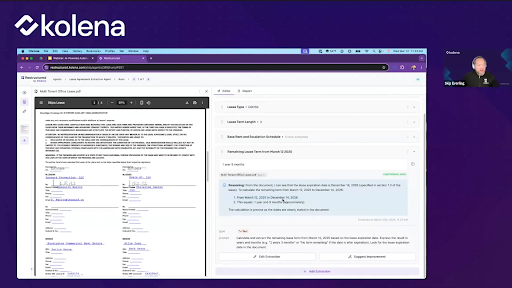
Kolena is an AI-powered document workflow automation platform that enables real estate teams to extract and structure rent roll data from leases, amendments, and supporting documents using configurable AI agents. Rather than relying on fixed templates or coded extraction rules, Kolena allows users to define what data to extract by writing natural language instructions, which the platform then applies consistently to all uploaded documents. The system processes PDFs, spreadsheets, scanned images, emails, and audio files across any document format or complexity.
Key features include:
AI agent-based rent roll extraction: Users create a rent roll extraction agent by entering natural language instructions describing the data to extract.
Multi-document processing: Kolena can ingest and process multiple document types in a single workflow, including leases, lease amendments, rent roll spreadsheets, and financial records.
Source-cited outputs: Every data point extracted by a Kolena agent is linked back to the exact location in the source document where it was found.
No-code workflow configuration: Agents are built and customized through a user interface that requires no programming. Instructions can be updated or new extraction fields added at any time.
Connections and integrations: Kolena supports connections between data sources and destinations, allowing documents dropped into a source location to be automatically processed and the structured output delivered to a downstream system.
Free rent roll tool: Kolena offers a publicly accessible rent roll generation tool at kolena.com/free-rent-roll where users can upload a CRE lease and receive a downloadable rent roll spreadsheet via email. The tool operates under SOC 2 Type II compliance with no AI training on user data.
Limitations (based on publicly available sources):
General-purpose platform: Kolena serves multiple industries including financial services, insurance, and banking alongside real estate. Teams requiring purpose-built CRE analytics such as T12 cross-validation, tenant credit scoring, or multifamily benchmarking will need to pair it with additional tools.
Pricing not publicly listed: Kolena does not publish pricing on its website. Enterprise plans require direct contact, which adds friction for teams comparing multiple solutions. A two-week free trial is available, but full cost visibility requires a sales conversation.
Newer market entrant: Kolena is a newer platform compared to established CRE-specific tools like PRODA or redIQ. Teams that prioritize long track records, large documented user bases, or deep CRE domain specialization may prefer those alternatives.
Source: Kolena
2. PRODA

Best for: CRE asset managers and lenders processing rent rolls across multiple formats and geographies.
Strengths: Handles any format, language, or currency with automated error checks.
Things to consider: Focused on CRE data processing rather than full property management operations.
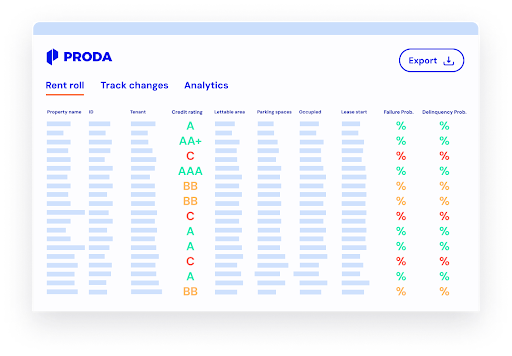
PRODA is a commercial real estate data platform that automates the collection, extraction, standardization, and error-checking of rent roll data. The platform processes rent roll files from any source, including Excel spreadsheets, PDFs generated by property management systems such as Yardi, MRI, RealPage OneSite, and SAP, and direct system integrations. Rather than requiring users to map data to a fixed template, PRODA applies machine learning to interpret varying document layouts and map the extracted data into a unified schema.
Key features include:
Multi-format data extraction: PRODA extracts rent roll data from Excel, PDF, and property management system exports regardless of layout, structure, or country of origin.
Automated standardization: Once extracted, data is mapped into a consistent schema across all properties in a portfolio.
100+ automated error checks: The platform runs over one hundred data quality checks on each rent roll to identify potential errors and inconsistencies such as missing fields, date anomalies, and implausible rent amounts.
Change tracking and portfolio monitoring: PRODA tracks changes to rent roll data at the individual data-point level, allowing users to identify what has changed between reporting periods across their entire portfolio.
Analysis and reporting tools: The PRODA Assistant module enables users to query rent roll data and generate analysis and reports using natural language prompts.
API and export options: Standardized data can be exported to Excel, copied to clipboard, or pushed to other systems via the PRODA API.
Limitations (based on publicly available sources):
Pricing opacity: PRODA does not publish pricing on its website. Prospective users must contact the team for a quote, which can slow evaluation timelines for teams comparing multiple options.
Narrow use case scope: PRODA is purpose-built for rent roll data processing and standardization. It does not include property management, lease administration, accounting, or tenant-facing capabilities, so it operates alongside rather than replacing existing platforms.
CRE orientation: The platform is primarily designed for institutional commercial real estate contexts. Residential property managers with straightforward single-format rent rolls may find the platform's capabilities exceed their requirements.
Source: PRODA
3. Nanonets

Best for: Teams needing flexible, API-first document automation for rent roll processing as part of broader property management workflows.
Strengths: Pre-trained rent roll OCR model; strong API capabilities; covers a wide range of document types beyond rent rolls.
Things to consider: A general-purpose intelligent document processing platform rather than a purpose-built CRE tool.
Nanonets is a document processing platform that automates data extraction from structured and unstructured documents using AI and OCR. The platform includes a pre-trained model specifically for rent roll processing, which extracts predefined fields from rent roll documents and delivers the data in structured formats. Nanonets is used across industries including banking, logistics, and commercial real estate.
Key features include:
Pre-trained rent roll OCR model: Nanonets provides a purpose-built rent roll extraction model that identifies and extracts predefined fields from rent roll documents without requiring users to build extraction logic from scratch.
AI-powered data capture: The platform uses OCR combined with AI models to read and interpret rent roll documents regardless of format, extracting tenant names, lease dates, rent amounts, deposit information, and occupancy status.
Multi-source document ingestion: Documents can be imported into Nanonets from email inboxes, scanners, cloud storage, and other document management systems.
Human-in-the-loop validation: The platform includes a review interface that surfaces low-confidence extractions and data discrepancies for human review before data is finalized and exported.
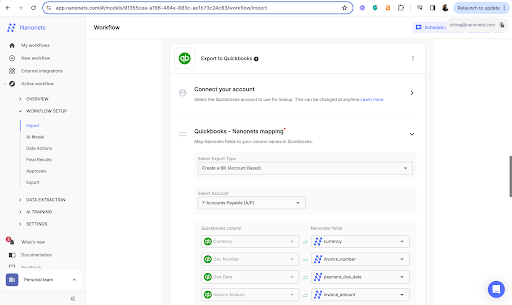
Workflow automation: Nanonets can trigger downstream actions based on extracted data, including routing documents, sending notifications, updating records in connected systems, and escalating exceptions.
API and integrations: The platform exposes REST APIs for embedding extraction capabilities into existing workflows and connecting to downstream systems.
Limitations (based on publicly available sources):
General-purpose orientation: Nanonets is designed for document automation across many industries and document types. Teams requiring deep CRE-specific analytics, cross-validation against T12s, or tenant credit analysis will need to complement it with additional tools.
Pricing at scale: Nanonets pricing is consumption-based and can become costly at high document volumes. Enterprise plans require custom negotiation, and pricing details are not fully transparent on the website.
Setup complexity for non-standard documents: While the pre-trained rent roll model handles standard formats well, unusual or highly variable rent roll layouts may require model training or manual field definition to reach acceptable extraction accuracy.
Source: Nanonets
4. Docsumo

Best for: CRE lenders and underwriting teams that process rent rolls, T12s, and income statements as part of commercial loan origination.
Strengths: Field-level confidence thresholds; human-in-the-loop validation; over 30 pre-built AI models for real estate documents.
Things to consider: Requires model training for non-standard document layouts to achieve optimal accuracy.
Docsumo is a document processing platform with capabilities for commercial real estate underwriting. The platform automates data extraction from rent rolls, trailing twelve-month operating statements, income statements, and other CRE documents, and feeds the extracted data into downstream underwriting systems. The platform is used by lenders and servicing operations teams to reduce manual data entry in commercial loan underwriting workflows.
Key features include:
AI-powered rent roll and T12 extraction: Docsumo extracts real estate-specific data fields including occupancy rates, rent amounts, square footage, premiums, deductibles, and lease start and end dates from rent rolls and operating statements.
Field-level confidence thresholds: Users can configure confidence thresholds at the individual field level. Extractions that fall below a defined confidence score are automatically flagged for human review rather than passed through to downstream systems.
Human-in-the-loop review screen: The platform includes a validation interface where reviewers can assess flagged extractions, correct errors, and approve data before it is finalized.
Document classification and splitting: Docsumo can classify and split multi-document packages into their component parts and route each to the appropriate extraction model automatically.
30+ pre-built AI models: The platform ships with over thirty pre-trained models for common real estate and financial document types, including rent rolls, ACORD forms, bank statements, and invoices.
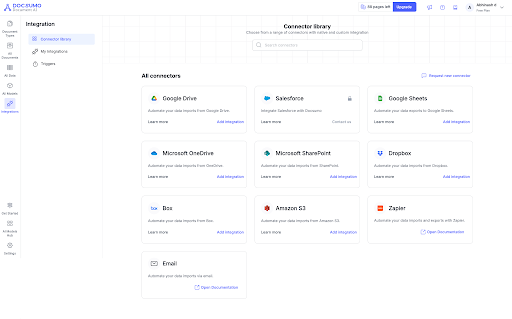
Downstream integrations: Extracted and validated data can be pushed to CRMs, ERPs, accounting systems, and custom underwriting platforms via API.
Limitations (based on publicly available sources):
Training requirement for non-standard layouts: While Docsumo's AI handles common rent roll formats well, non-standard or highly customized documents may require users to train a custom model, adding time to initial setup.
Primarily a lending-workflow tool: Docsumo is oriented toward lenders and underwriting teams rather than property managers performing ongoing rent roll tracking. It does not include lease administration, payment tracking, or tenant management capabilities.
Pricing by document volume: Docsumo's pricing scales with document volume. Teams with high-throughput origination pipelines will need to evaluate cost at production scale, as per-document fees can accumulate.
Source: Docsumo
5. DDee.ai

Best for: CRE acquisitions teams, brokers, and lenders that need rent roll extraction integrated with broader due diligence analysis.
Strengths: Combines rent roll extraction with T12 cross-validation, lease abstraction, and tenant credit scoring in a single due diligence platform.
Things to consider: A newer platform with pricing available by quote only; not a standalone rent roll tool.
DDee.ai is a commercial real estate due diligence platform that includes rent roll extraction and analysis as one of nine integrated modules. Rather than offering rent roll processing as a standalone tool, DDee.ai combines it with financial statement analysis, lease abstraction, tenant credit scoring, and red flag detection to deliver a unified view of a property for acquisitions and lending decisions.
Key features include:
Multi-format rent roll extraction: DDee.ai's AI extracts unit-level data, lease terms, escalation schedules, and vacancy status from rent rolls regardless of format or source.
T12 and lease cross-validation: The platform automatically cross-references extracted rent roll data against operating statements and lease documents. It verifies that T12 revenue lines reconcile with rent roll totals and confirms that rent amounts and terms match lease provisions.
Tenant credit scoring and default probability: DDee.ai adds a credit layer to rent roll analysis by scoring every tenant on the rent roll for creditworthiness and calculating default probability estimates.
Red flag detection: The platform's AI identifies patterns in rent roll data that indicate potential risks, including below-market rents that may reflect side agreements.
Complete due diligence integration: Rent roll data feeds directly into DDee.ai's other modules, including financial analysis, ARGUS file audit, document inventory, and IC-ready report generation.
Lease abstract packages: For brokers, DDee.ai can generate lease abstract packages from the rent roll and underlying lease documents, ready for distribution to buyers or lenders as part of the data room preparation process.
Limitations (based on publicly available sources):
Not a standalone tool: DDee.ai is a due diligence platform rather than a standalone rent roll solution. Teams that only need rent roll extraction without the broader due diligence modules may find the platform broader than their immediate requirements.
Pricing requires a quote: DDee.ai does not publish pricing. Teams evaluating it alongside other solutions will need to book a demo to receive pricing information, which adds friction to the evaluation process.
Newer entrant: DDee.ai is a newer platform compared to established competitors like PRODA or redIQ. Teams with long track records as evaluation criteria may prefer platforms with larger documented user bases.
Traditional Rent Roll Solutions
6. AppFolio

Best for: Growing and enterprise residential property management businesses seeking an AI-native unified platform.
Strengths: Agentic AI (Realm-X) embedded across workflows; unified data model from leasing through accounting; strong mobile capabilities.
Things to consider: Reporting customization has limits; QuickBooks Online integration is restricted; pricing scales with unit count.
AppFolio is a cloud-based property management platform for residential, multifamily, commercial, student housing, affordable housing, and community association portfolios. The platform offers a unified data architecture where leasing, maintenance, accounting, and communications share a single system of record. AppFolio's Realm-X suite of agentic AI tools handles routine tasks including rent collection reminders, maintenance intake and coordination, and resident communications without manual intervention.
Key features include:
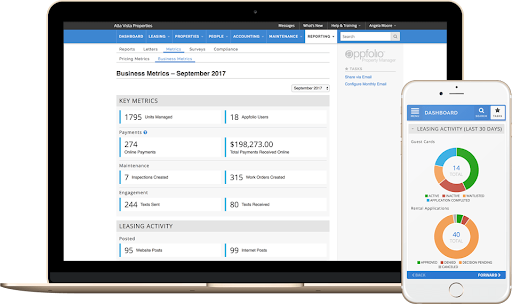
Automated rent roll and financial reporting: AppFolio generates real-time rent roll reports that reflect current lease data, payment status, vacancies, and delinquencies across the portfolio.
Accounting and general ledger: The platform includes a secure, unified accounting system that handles accounts payable, accounts receivable, bank reconciliation, and trust accounting.
Realm-X agentic AI: AppFolio's Realm-X tools automate workflows such as maintenance request triage, lease renewal outreach, vendor coordination, and resident communication.
Lease and tenant management: The platform tracks lease terms, renewal dates, rent escalation schedules, and tenant contact information across all properties.
Marketing and leasing: AppFolio includes tools for listing syndication, online applications, tenant screening, digital lease execution, and move-in coordination.
Investment management integration: For portfolios with investor reporting requirements, AppFolio Investment Manager integrates directly with the property management platform.
Limitations (as reported by users on G2):
Reporting customization constraints: Users report that rent roll and delinquency reports can lack the level of detail and customization needed for specific portfolio scenarios, and that the platform does not always support custom data fields effectively.
Limited QuickBooks Online integration: Several users note that AppFolio's integration with QuickBooks Online is restricted, which complicates workflows for teams that rely on external accounting systems alongside the platform.
Customer support responsiveness: Multiple users describe difficulty reaching knowledgeable support representatives for complex issues, with some reporting long resolution timelines for accounting-related problems.
Source: AppFolio
7. Buildium

Best for: Residential and mixed-portfolio property managers who need rent roll automation tightly integrated with accounting and tenant management.
Strengths: Rent rolls are automatically generated from lease and payment data; Lumina AI; strong financial reporting across property types.
Things to consider: Pricing increases significantly at higher tiers; commercial property features are less developed than residential capabilities.
Buildium is a property management platform for residential, mixed-use, commercial, student housing, and community association portfolios. The platform automatically generates rent rolls from the lease and payment data entered into the system, keeping the rent roll current without requiring manual updates. Buildium's Lumina AI suite provides embedded AI capabilities including an AI assistant, automated property description generation, and AI-assisted lease document tools.
Key features include:
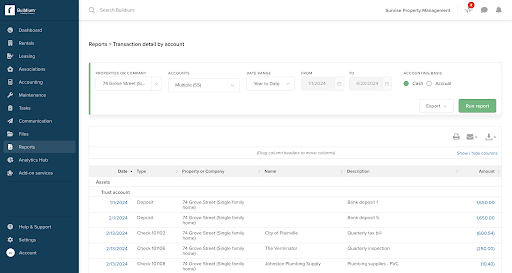
Automated rent roll generation: Buildium creates and maintains a rent roll automatically by combining lease data, tenant records, and payment history stored in the platform.
Financial reporting suite: The platform includes a comprehensive set of financial reports covering rent rolls, profit and loss statements, balance sheets, accounts receivable aging, and cash flow statements.
Online rent collection and payment tracking: Buildium automates rent collection through ACH, credit card, and cash payment options via its PayNearMe integration.
Lease and tenant management: The platform tracks lease terms, renewal dates, and rent escalation schedules across all properties.
Lumina AI: Buildium's AI suite includes an AI assistant that provides contextual help within the platform, an AI-powered property description generator for rental listings, and automated tools for generating communications and lease content from prompts.
Owner and resident portals: Buildium includes separate portals for property owners and residents. Owners can access real-time financial reports, rent roll summaries, and maintenance updates. Residents can pay rent, submit maintenance requests, review their lease, and communicate with property management from the portal or mobile app.
Limitations (as reported by users on G2):
Limited reporting customization: Users note that generating specific reports can require excessive navigation, and that some standard report formats lack the flexibility needed for more complex portfolio analysis.
Vendor integration restrictions: Several users report that Buildium promotes preferred third-party vendors and places friction on integrations with competing tools they prefer to use.
Alert and notification gaps: Users describe issues with alert notifications for emails and texts, noting that improvements are needed for audible notifications and better message visibility in tenant portals.
Source: Buildium
8. Yardi Breeze

Best for: Small-to-mid portfolios across residential, commercial, affordable housing, HOA, manufactured housing, and self-storage property types.
Strengths: Single platform for multiple property types; Yardi Smart AP AI invoice processing; RentCafe portal and resident app integration.
Things to consider: Ledger sorting requires export to Excel; monthly accounting period management is less flexible than some alternatives; per-unit pricing increases for non-profit and smaller operators.
Yardi Breeze is a cloud-based property management platform for small to mid-sized portfolios across multiple property types. Yardi Breeze and its more advanced version, Breeze Premier, handle residential, commercial, affordable housing, manufactured housing, community associations, and self-storage from a single system. The platform is part of the broader Yardi ecosystem and integrates with RentCafe for resident-facing portal and listing functions, and with CommercialCafe for commercial tenant engagement.
Key features include:
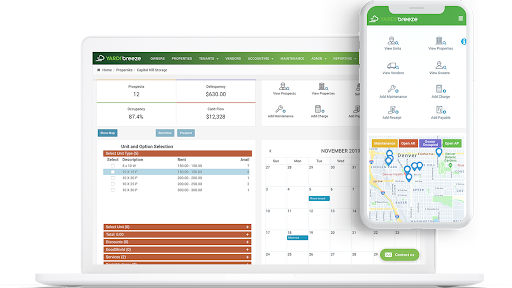
Integrated financial reporting and rent roll: Yardi Breeze generates financial reports including rent rolls, general ledger summaries, balance sheets, and profit and loss statements in real time.
Online rent collection and tenant portals: Residents can pay rent online through the RentCafe portal or mobile app using bank transfer, credit card, or check scanning.
Lease management and escalation tracking: Breeze maintains lease terms, renewal options, CAM charges, and rent escalation schedules for each tenant.
Yardi Smart AP: Available to Breeze Premier clients, Smart AP is an AI-powered invoice processing tool that uses OCR to scan and enter vendor invoices into the system for review and approval.
Multi-type portfolio management: Yardi Breeze handles multiple property types, including commercial (with CAM reconciliations and overage charge calculations), residential, HOA/condo, manufactured housing, affordable housing, and self-storage.
Job costing and capital expenditure tracking: Breeze Premier includes job costing functionality that tracks labor costs, material expenses, and vendor charges on renovation and maintenance projects.
Limitations (as reported by users on G2):
Ledger sorting requires export: Users note that sorting vendor or tenant ledgers within the system is limited, requiring export to Excel to apply custom sorting, which adds steps to reconciliation and audit workflows.
Monthly accounting period constraints: Several users describe the monthly accounting period process as cumbersome, with limited options for managing or adjusting time periods once periods are closed, creating friction at month-end.
Pricing increases for smaller organizations: Users from non-profit organizations note that recent per-unit price increases have made Breeze less cost-effective for their portfolios, and that the cost structure may not suit operators at the smaller end of the platform's target range.
Source: Yardi Breeze
9. MRI Software
Best for: Large enterprise organizations managing complex commercial, residential, and mixed-use portfolios that require deep customization and an open integration ecosystem.
Strengths: Highly configurable PMX back-office; open API partner ecosystem; covers commercial, multifamily, affordable housing, and facilities management.
Things to consider: Steep learning curve; background settings can be difficult to navigate; implementation and customization can require consultant engagement.
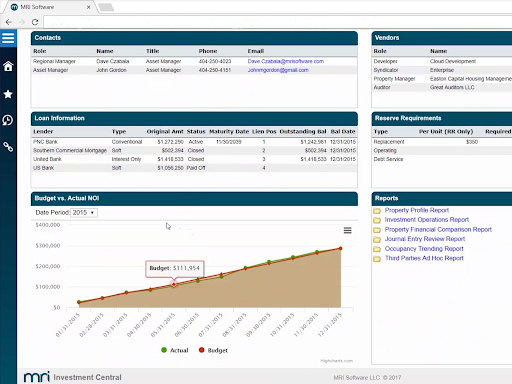
MRI Software is an enterprise real estate platform that combines property management, financial accounting, lease administration, investment management, and facilities management in a connected ecosystem. The platform's core property management and accounting module, PMX, is used by commercial and residential operators for back-office functions including general ledger management, accounts payable and receivable, and financial reporting.
Key features include:
PMX property management and accounting: The PMX module handles rent posting, lease billing, accounts payable, accounts receivable, bank reconciliation, and financial reporting for commercial and residential portfolios.
Commercial lease administration: MRI supports complex commercial lease structures including CAM reconciliations, CPI-based escalations, percentage rent calculations, and lease abstracting.
MRI Agora Intelligence dashboards: MRI's intelligence layer provides AI-driven dashboards and reporting tools that surface cross-portfolio KPIs, operational insights, and financial analytics.
Multifamily resident management: For residential portfolios, MRI's Engage product suite manages the full lead-to-lease process through a CRM, supports online applications, digital lease execution, resident portals, and automated rent collection across multiple payment channels.
Open API and partner ecosystem: MRI's Partner Connect program provides an extensive ecosystem of pre-built integrations with third-party proptech solutions covering maintenance, leasing, marketing, payments, and analytics.
Investment management and modeling: MRI Investment Management provides financial modeling, portfolio performance tracking, and investor reporting for real estate investment firms.
Limitations (as reported by users on G2 and Capterra):
Difficult navigation of background settings: Users describe background configuration areas as hard to locate and navigate, with many useful settings and capabilities requiring awareness of non-obvious menu paths before they can be accessed or enabled.
Steep learning curve: Multiple reviewers note that MRI requires significant time investment to learn, particularly for back-office and reporting configuration, and that user guides and self-service documentation do not always cover real-world workflow questions in sufficient detail.
Slow reporting performance: Some users report that the reporting module can be slow to run, and that certain standard report templates are absent, requiring custom report development to fill gaps in standard financial output.
Source: MRI Software
10. RealPage

Best for: Enterprise multifamily and commercial operators managing large, complex portfolios requiring integrated revenue management and AI-driven operations.
Strengths: AI Operations Agent maintains rent roll accuracy; DemandX revenue management; manages over 24 million units globally.
Things to consider: OneSite GUI is considered outdated by users; support quality is frequently cited as a weakness; pricing is enterprise-level and involves per-feature fees.
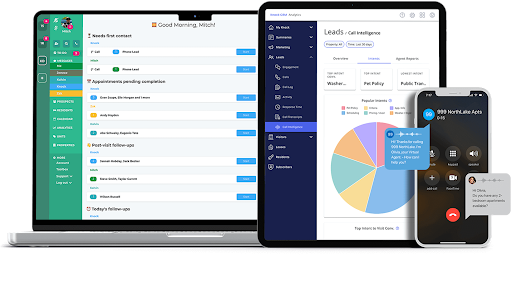
RealPage is a large-scale property management and data analytics platform used by multifamily, commercial, student, affordable, military, and senior housing operators. Its property management system, OneSite, handles the full resident lifecycle including leasing, rent collection, maintenance, and financial reporting. The platform is organized around a connected operating system with four pillars: Demand Operations, Resident Experience, Property Operations, and Portfolio Intelligence.
Key features include:
OneSite property management: OneSite covers leasing, rent collection, maintenance management, tenant screening, and document management for multifamily portfolios.
AI Operations Agent: The AI Operations Agent scans leases against the property management system ledger to detect missed revenue, charge discrepancies, and compliance risks.
DemandX revenue management: RealPage's revenue management tools use AI algorithms to generate pricing recommendations for new and renewal leases based on demand signals, market data, and portfolio strategy.
RealPage Financial Suite: The accounting module handles property-level and portfolio-level financial management including budgeting, CAM reconciliations, purchase order tracking, capital expenditure management, and vendor payments.
Commercial property management: RealPage's commercial module supports CAM recoveries, CPI and straight-line rent escalations, percentage rent calculations, and a tenant portal for online payments, maintenance requests, and sales reporting.
Market Analytics: The Market Analytics module provides submarket-level data on rent trends, occupancy, concessions, new supply, and competitor performance.
Limitations (as reported by users on G2 and Capterra):
Outdated OneSite interface: Users consistently describe the core OneSite GUI as outdated and not user-friendly. The transition to the newer interface, called New Experience, has been slow and the rollout has introduced errors that create friction during migration.
Single-property navigation: Users note that OneSite requires leaving one property to access another, making it impossible to have two properties open simultaneously, which creates workflow friction for operators managing large multi-property portfolios.
Customer support quality: Support is described as one of RealPage's most documented weaknesses across reviews, with users citing inconsistent responsiveness and difficulty escalating complex issues to knowledgeable representatives.
Source: RealPage
Conclusion
Automated rent roll solutions leverage intelligent document processing to transform raw lease data into standardized, real-time datasets. This fundamental shift eliminates manual data entry and drastically reduces errors, providing a single, accurate source of truth for portfolio performance. Ultimately, adopting these systems supports property managers, investors, and analysts in strategic decision-making, financial accuracy, and risk mitigation. Automation is now necessary to maintain efficiency and transparency across the real estate industry.