What is Rent Roll Reporting Software?
Rent roll reporting software is a digital tool designed to organize, manage, and present key data related to rental properties. It automates the process of compiling information on tenants, lease terms, payment histories, unit occupancy, and revenue streams into a single, easily accessible report. These platforms eliminate the need for manual spreadsheets, reducing errors and saving time for property managers, landlords, and real estate professionals. Rent roll reporting software is particularly valuable for those handling multiple properties or complex portfolios, where the volume of data can become unwieldy without automation.
The core function of rent roll software is to centralize property data and present it in a standardized format that supports decision-making. Users can quickly assess the performance of a property, identify trends in occupancy or income, and prepare reports for lenders, investors, or auditors. Many solutions also integrate with accounting and property management platforms, further streamlining workflows. By providing real-time, up-to-date insights, rent roll reporting software enables more efficient property operations and enhances transparency for all stakeholders.
This is part of a series of articles about Rent Roll.
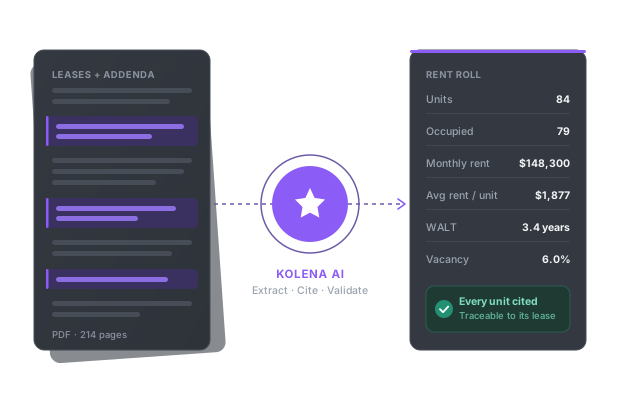
Generate your first rent roll in minutes with AI
The Benefits of Rent Roll Reporting Software
Rent roll reporting software provides operational and financial advantages for property managers and owners. By replacing manual processes with automated workflows, it improves accuracy, visibility, and speed across reporting tasks.
Reduced manual work: Automates data collection and report generation. Removes the need for spreadsheets and repetitive data entry.
Improved data accuracy: Pulls data directly from source systems. Reduces human error and ensures consistent reporting.
Real-time portfolio visibility: Provides up-to-date metrics on occupancy, rent collection, and lease status.
Faster reporting cycles: Generates standardized reports in seconds.
Better decision-making: Highlights trends in revenue, vacancies, and tenant behavior.
Centralized data management: Consolidates property, tenant, and financial data in one place.
Integration with other systems: Connects with accounting and property management tools.
Related content: Read our guide to rent roll software
Key Features of Rent Roll Reporting Software
Automated Data Extraction
Automated data extraction distinguishes rent roll reporting software from manual processes. This capability uses technologies like OCR (optical character recognition) and AI to pull relevant information from leases, payment records, and other documents. It removes manual data entry, which is time-consuming and prone to human error. By automating this task, property managers can keep databases accurate and up to date without dedicating extensive resources to routine data input.
Automated data extraction also supports scalability and consistency across large portfolios. When managing multiple properties or hundreds of leases, manual entry increases the risk of inconsistencies. Automated extraction simplifies onboarding new properties, integrates with existing data sources, and updates records in real time as new documents are processed. This also supports compliance by maintaining a clear, auditable trail of data changes.
Real-Time Reporting Dashboards
Real-time reporting dashboards provide a view of key performance indicators related to property management. These dashboards aggregate data from various sources and present it visually, enabling users to assess occupancy rates, rent collections, upcoming lease expirations, and more. Access to current data supports proactive decision-making, allowing property managers to identify issues and opportunities as they arise rather than after the fact.
Real-time dashboards also support customization to fit the needs of different users or organizations. Property owners, managers, and investors may require different metrics or visualizations, and rent roll software allows tailored views. This ensures stakeholders receive relevant information without unnecessary detail, supporting clear communication and property management planning.
Lease and Tenant Management
Lease and tenant management features provide tools to track lease terms, renewal dates, rent escalations, and tenant contact details. These modules centralize lease-related data, making it easier to monitor compliance, anticipate renewals, and manage notices or rent increases. Automated reminders and alerts help prevent missed deadlines, reducing the risk of vacancies or legal issues due to expired leases.
Lease and tenant management tools often include document storage and communication capabilities. Property managers can upload signed leases, correspondence, and notices directly to tenant records, ensuring information is retrievable. This centralized approach reduces paperwork, supports regulatory compliance, and improves response times to inquiries or maintenance requests.
Custom Report Generation
Custom report generation allows users to create reports that meet the needs of their organization or stakeholders. Rather than relying only on pre-built templates, property managers can select relevant data points, timeframes, and formats. This supports internal analysis, investor updates, or lender compliance.
Users can also automate recurring reports, reducing manual intervention and ensuring consistent delivery of information. Advanced filtering and segmentation options enable deeper analysis, such as identifying underperforming units or tracking trends across property types. These capabilities support data-driven decisions and clear reporting.
Integrations
Integrations allow rent roll reporting software to function within a broader property management technology ecosystem. By connecting with accounting platforms, CRM systems, maintenance software, and document management tools, rent roll solutions reduce data silos and support connected workflows. Integrations ensure that information entered in one system updates across connected platforms, reducing duplication and manual reconciliation.
Integrations also support scalability. As property management needs change, organizations can add new tools or upgrade systems without disrupting core workflows. APIs and pre-built connectors make it easier to adapt to regulatory changes, adopt new technologies, or expand to new markets. This interoperability supports agility when managing complex property portfolios.
Types of Rent Roll Reporting Software
AI-Powered Rent Roll and Document Automation Software
AI-powered rent roll and document automation software uses artificial intelligence and machine learning to extract, process, and organize data from leases and other property documents. These platforms can read scanned documents, identify relevant fields such as rent amounts or lease terms, and populate digital rent rolls. This reduces manual data entry, accelerates onboarding for new properties, and maintains accuracy when handling complex or nonstandard document formats.
AI in rent roll software also supports analytics, such as predicting lease renewals, identifying risks in tenant portfolios, or flagging unusual payment patterns. These insights help property managers make proactive decisions, reduce vacancies, and improve tenant retention. As property data grows in volume and complexity, AI-powered solutions provide a scalable way to maintain accurate records while reducing administrative workload.
Property Management Platforms
Property management platforms provide tools that go beyond rent roll reporting. These platforms typically include accounting, maintenance tracking, communication, marketing, and tenant screening modules within a single system. Rent roll reporting is one component, allowing users to generate reports on occupancy, income, and lease terms alongside other operational data.
Using a property management platform consolidates property-related functions in one place. This reduces the need for multiple software subscriptions and supports consistency across operations. For organizations managing multiple properties or formalizing their operations, these platforms provide reporting capabilities while supporting each stage of the property lifecycle.
Learn more about rent ledger.
Notable Rent Roll Reporting Software
AI-Powered Rent Roll and Document Automation Software
1. Kolena
Kolena is an AI-powered document automation platform that extracts and structures rent roll data from leases, amendments, and financial documents. Using flexible, agent-based workflows, it enables teams to automate rent roll creation without rigid templates, adapting to varied document formats like PDFs and images. Users define extraction logic with natural language, allowing fast iteration and customization. By supporting end-to-end workflows—from document ingestion to structured reporting—Kolena helps real estate teams process large portfolios efficiently while improving accuracy and auditability.
AI agent-based data extraction: Create customizable agents to extract rent roll data from leases and supporting documents
Multi-document processing: Analyze leases, amendments, and financial records in a single workflow
Scalable rent roll automation: Generate structured rent rolls across large portfolios quickly
Source-linked outputs: Maintain traceability by linking extracted data back to original documents
Workflow automation: Process entire data rooms and export structured outputs for reporting or analysis
2. DDee.ai

DDee.ai is an AI-powered rent roll and due diligence platform built for commercial real estate teams handling large transactions. It automates the analysis of leases, financials, and supporting documents by extracting data and organizing outputs into structured reports. Users upload full data rooms, and the platform classifies documents, flags missing files, and runs analysis in one workflow.
Key features include:
Automated lease abstraction: Extracts over 50 structured data points from each lease, including rent terms, durations, and obligations
End-to-end due diligence automation: Runs lease analysis, financial review, legal checks, and risk detection in a single workflow
Rent roll reconciliation: Compares extracted lease data against financial statements to identify inconsistencies and validate reported income
Document classification and organization: Categorizes uploaded files (PDFs, Excel, Word, images) and structures them into a navigable data room
Missing document detection: Flags incomplete data rooms by identifying absent or required documents early in the diligence process
3. Prophia
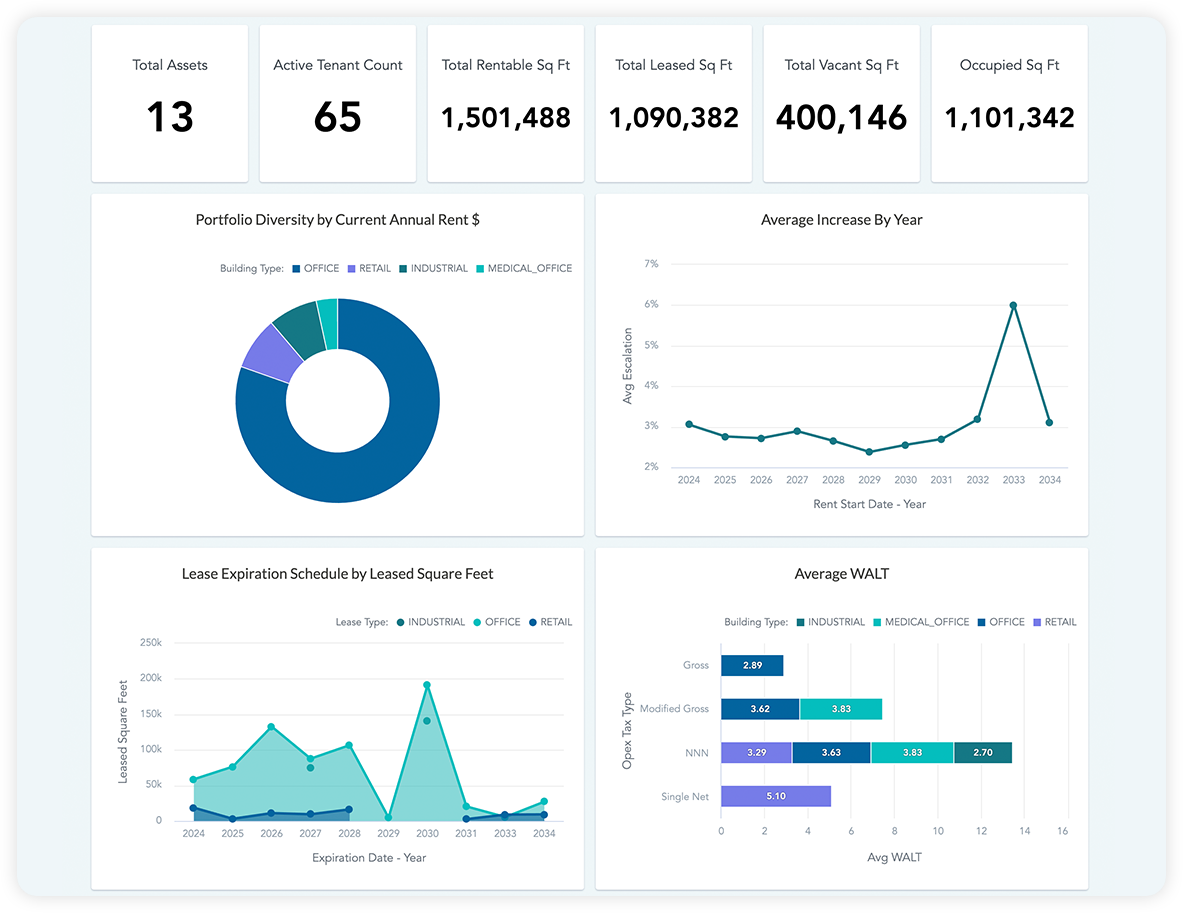
Prophia is an AI-powered rent roll automation platform that creates a real-time, continuously updated view of lease and revenue data across a property portfolio. It ingests leases, amendments, and supporting documents, then extracts and structures financial and operational data into a dynamic rent roll. Each data point links back to its source document for verification and transparency.
Key features include:
Dynamic real-time rent roll: Continuously updates rent roll data as new leases or amendments are added
AI-powered data extraction: Pulls lease details such as rent amounts, escalation terms, and financial clauses from uploaded documents
Source-linked verification: Connects each data point to the original lease or document for validation and audit transparency
Automated rent escalation tracking: Monitors rent steps and increases across leases
Critical date monitoring: Tracks lease start and end dates
Source: Prophia
Traditional Property Management Platforms
4. Buildium

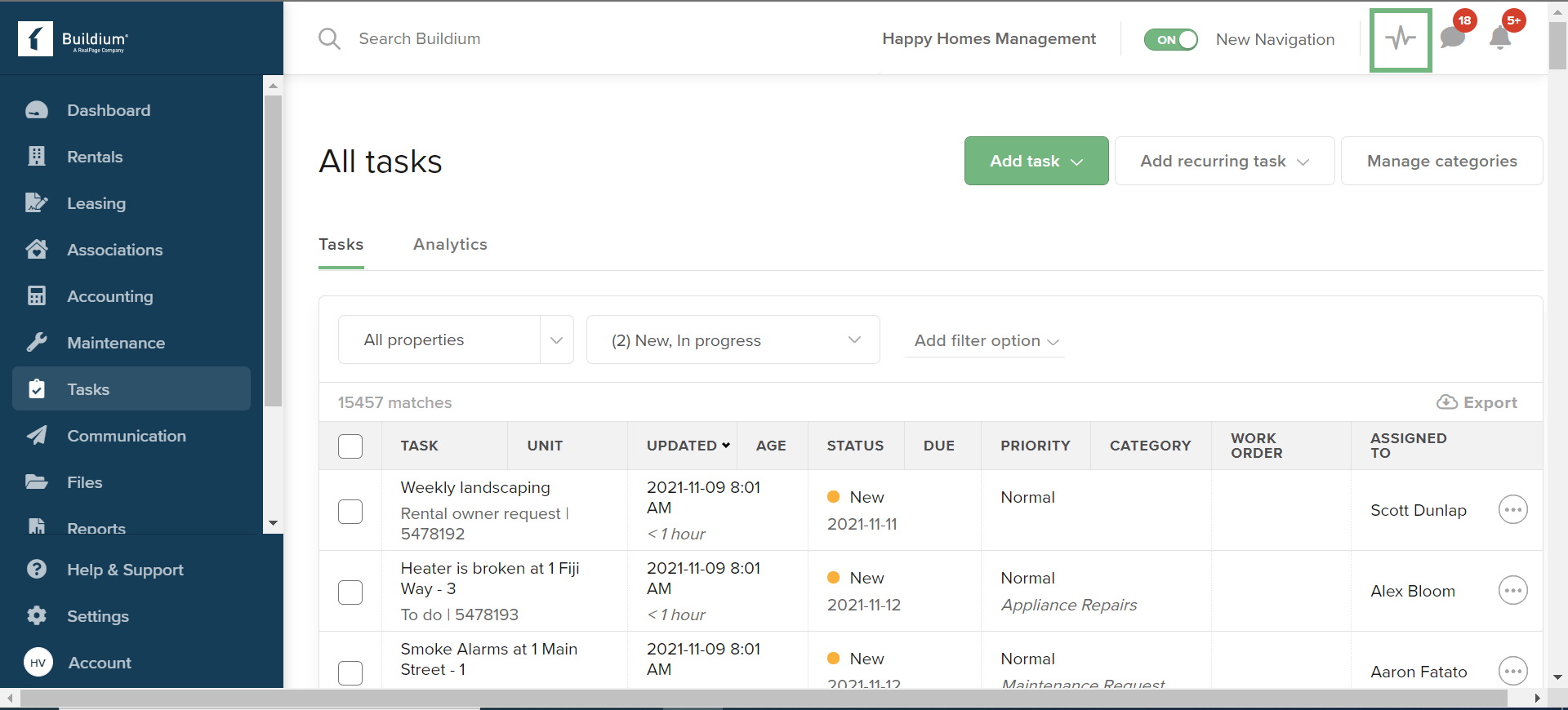
Buildium is a property management platform that combines rent roll reporting with accounting, leasing, payments, and maintenance in a single system. It centralizes property and tenant data while using automation and AI to handle tasks such as rent collection, financial tracking, and reporting. The platform supports the property lifecycle, from listing and tenant screening to ongoing operations and financial management.
Key features include:
All-in-one property management platform: Combines accounting, rent collection, leasing, maintenance, and reporting into a single system
Property-specific financial reporting: Generates financial reports at the property level, supporting rent roll analysis and performance tracking
Automated bank reconciliation: Matches transactions automatically
Online rent collection: Enables tenants to pay rent and fees via ACH or credit card, with automatic fund transfers
Integrated payments system: Handles payments for residents, owners, and vendors within the same platform
Source: Buildium
5. AppFolio
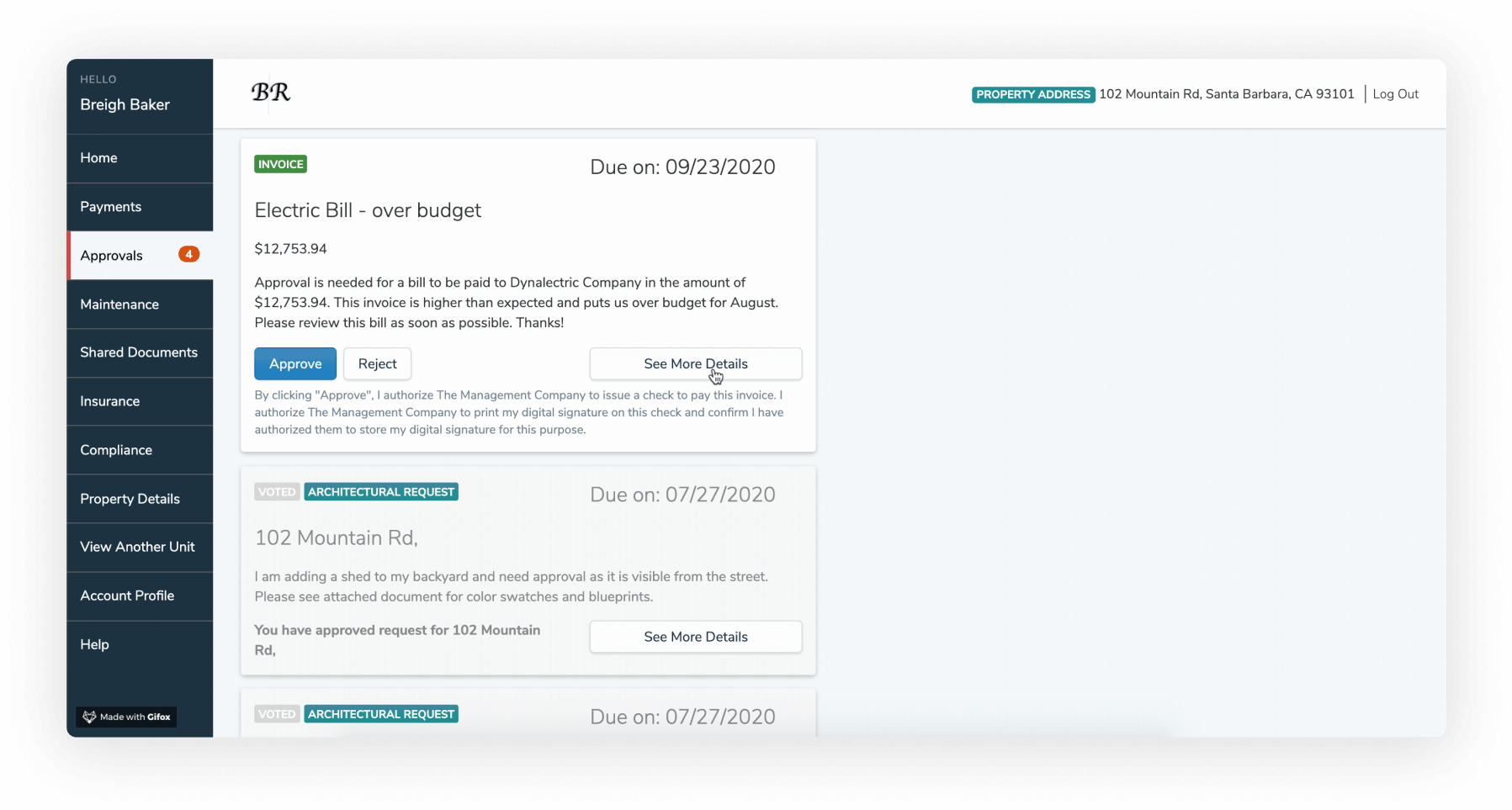
AppFolio is a property management platform that combines rent roll reporting, accounting, operations, and communication into a single AI-driven system. It uses a unified data model to capture property and financial activity in one place, enabling real-time reporting and analysis without duplicate data entry. The platform applies built-in AI and automation to handle routine tasks, while tools like Report Builder allow users to customize rent roll and performance reports.
Key features include:
Unified property management platform: Brings accounting, reporting, maintenance, and communication into a single system
AI-native automation: Uses built-in AI to handle repetitive operational tasks
Real-time accounting and reporting: Maintains a single source of truth for transactions
Custom report builder: Allows users to create tailored reports by combining rent roll data with other datasets
Rent roll customization: Enables modification of standard rent roll reports by adding fields such as tenant contact details or other operational data
Source: AppFolio
6. TenantCloud
TenantCloud is a property management platform focused on rent collection, financial tracking, and reporting for landlords and small property managers. It automates the payment lifecycle, from invoicing and reminders to receipts and tax reporting, while maintaining a centralized record of lease and tenant data.
Key features include:
Online rent collection automation: Enables tenants to pay rent digitally via ACH, with automated processing and direct bank transfers
Autopay and payment scheduling: Allows recurring payments
Built-in financial reporting: Generates reports such as 1099s and Schedule E
Real-time rent roll reporting: Provides a live view of rental income, tenant balances, and occupancy status
Customizable rent roll filters: Allows filtering by property, unit, owner, occupancy status, and outstanding balances
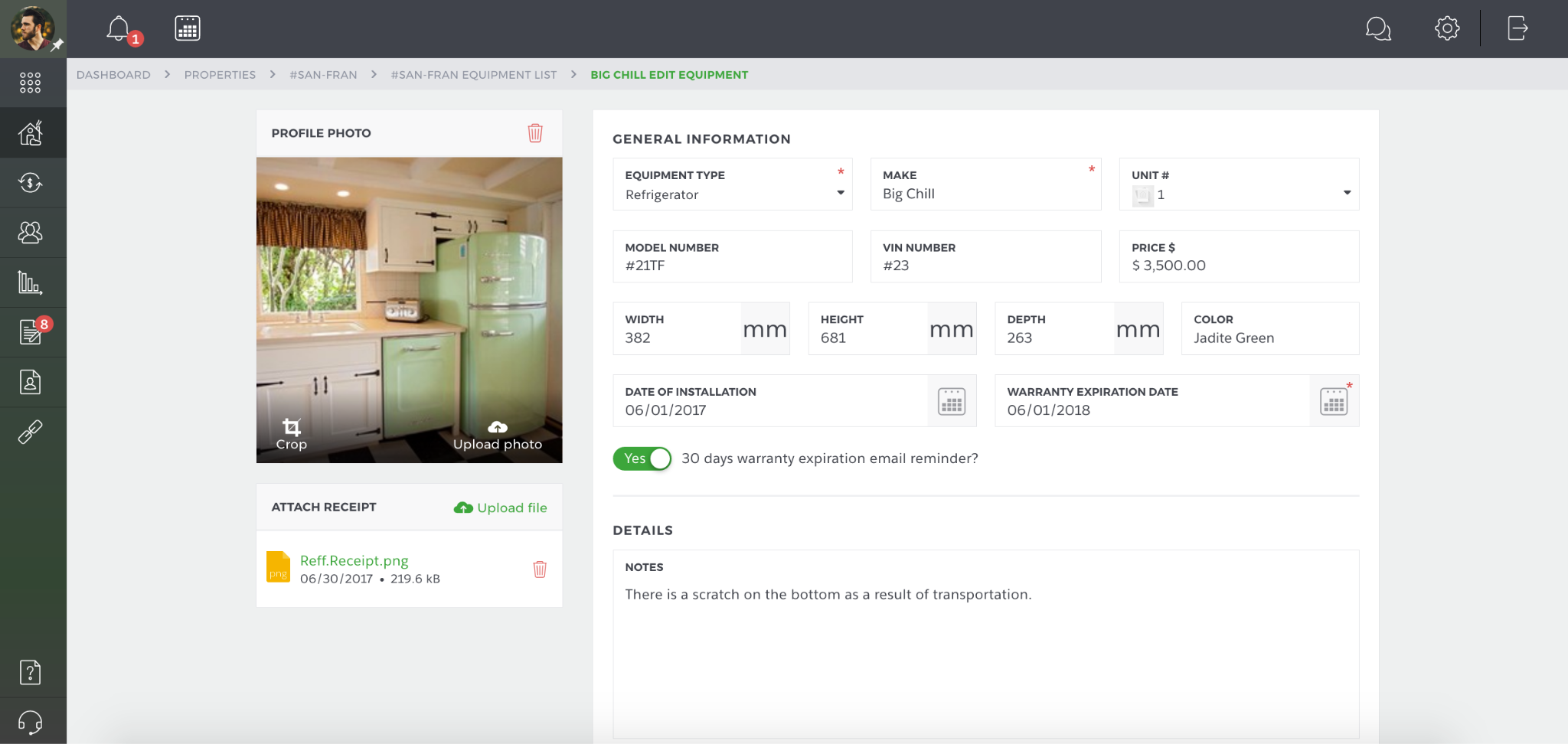
Source: TenantCloud
Conclusion
Rent roll reporting software is a vital digital solution that centralizes property data and automates time-consuming manual tasks. These systems, including advanced options leveraging AI, provide real-time, accurate reporting dashboards and customizable insights. By integrating with existing workflows, they enhance financial transparency and support proactive decision-making for complex property portfolios.