What Is Rental Income Management Software?
Rental income management software is a category of digital tools that automate and simplify the financial operations associated with rental properties. It centralizes tasks such as rent collection, expense tracking, tenant invoicing, and financial reporting into one platform. By digitizing these processes, the software reduces manual errors and administrative overhead for property owners, managers, and real estate professionals. This technology supports both residential and commercial portfolios, allowing users to handle financial transactions and maintain accurate records.
Beyond basic accounting, rental income management software often includes lease management, automated reminders, and document storage, ensuring all aspects of rental income are handled in compliance with legal and regulatory standards. It is typically cloud based, enabling remote access and real-time data updates for multiple stakeholders. Adoption of this software is increasing as the rental market grows and property management becomes more complex, requiring precise oversight of income streams and financial obligations.
This is part of a series of articles about Rent Roll
Generate your first rent roll in minutes with AI
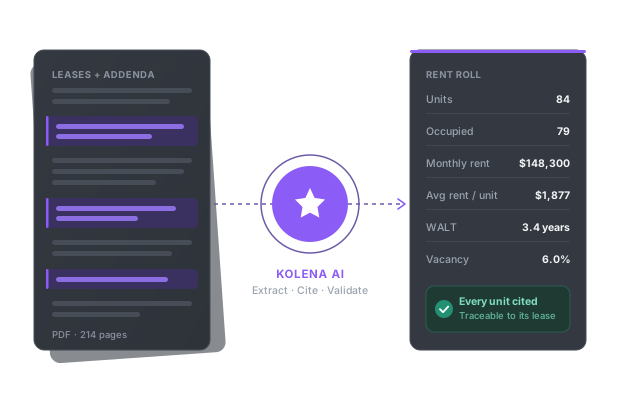
Why Rental Income Management Software Matters
A growing number of property owners are moving away from manual processes due to increasing complexity in rental operations. Managing multiple income streams, tracking expenses, and staying compliant with regulations can quickly become inefficient without dedicated tools. Rental income management software addresses these challenges by providing structure, accuracy, and automation.
Reduces manual errors: Automates calculations, invoicing, and record-keeping, lowering the risk of human error in financial data.
Improves cash flow visibility: Provides real-time insights into rental income, overdue payments, and expenses.
Saves time on administrative tasks: Eliminates repetitive work such as manual rent tracking, payment reminders, and report generation.
Enhances tenant payment experience: Enables online payments, automated receipts, and reminders.
Supports compliance and record keeping: Maintains organized financial records and documentation required for audits, taxes, and legal purposes.
Scales with portfolio growth: Handles increasing numbers of properties and tenants without a proportional increase in workload.
Centralizes financial data: Consolidates all income and expense information in one platform, reducing the need for multiple tools or spreadsheets.
Improves decision-making: Offers reporting and analytics to identify trends, adjust pricing, and control costs.
Learn more in our detailed guide to rent roll software
Key Features of Rental Income Management Software
Financial and Accounting Capabilities
Financial and accounting capabilities are at the core of rental income management software. These systems automate rent collection, track payments, and manage expenses, ensuring that all financial transactions are recorded and reconciled. Users can generate invoices, monitor outstanding balances, and set up recurring billing cycles to reduce late payments. The software typically includes tools for managing security deposits, tracking maintenance costs, and handling other property-related expenditures, which helps maintain a clear financial picture.
These platforms often provide bank reconciliation, tax preparation support, and integration with external accounting systems. Real-time dashboards and automated alerts keep property managers informed of discrepancies or overdue payments. Financial reporting features enable users to analyze cash flow, profitability, and expense trends, supporting informed decision-making and financial audits.
Tenant and Lease Management
Tenant and lease management features centralize tenant information, including contact details, lease agreements, and payment histories. The software simplifies onboarding by allowing property managers to create digital leases, collect electronic signatures, and store documents in the cloud. Automated reminders for lease renewals, rent due dates, and policy updates help maintain compliance and reduce administrative workload.
These tools also support tenant communication through integrated messaging systems, helping teams respond to maintenance requests and inquiries. By maintaining a tenant database, property managers can access information, track lease expirations, and manage renewals or terminations. This reduces the risk of vacancies and supports stable rental income streams.
Automation and Workflow Management
Automation and workflow management capabilities reduce repetitive manual tasks and standardize property management processes. The software automates rent reminders, late fee assessments, and payment processing, ensuring consistency and timeliness in financial operations. Automated workflows can also handle routine communications, such as notifying tenants of upcoming maintenance or lease expirations.
These features allow property managers to configure rules and triggers that initiate specific actions based on set criteria, such as escalating unresolved issues or generating financial reports at regular intervals. Workflow automation improves operational efficiency and reduces the likelihood of errors.
Reporting and Analytics
Reporting and analytics tools provide insights into property performance, financial health, and operational efficiency. Users can generate reports on income, expenses, occupancy rates, and arrears to support budgeting, forecasting, and compliance. The ability to visualize trends over time helps property managers identify areas for improvement and adjust rental strategies.
Some platforms include benchmarking against market data, predictive modeling for vacancy rates, and scenario analysis for investment decisions. These tools support data-driven decisions, investor transparency, and audit preparation. Reporting features ensure that financial and operational metrics are accessible.
Integrations and Data Infrastructure
Modern rental income management software integrates with external systems, including accounting platforms, payment gateways, and customer relationship management tools. These integrations enable data exchange, reduce duplicate data entry, and support consistency across operations. Open APIs and standardized data formats support interoperability with other real estate and financial applications.
Data infrastructure supports secure storage, backup, and access to information. Cloud-based architectures provide scalability and remote access, while compliance with data protection standards safeguards tenant and financial data. Integrations and data infrastructure support business continuity and data integrity.
Types of Rental Income Management Software
AI-Driven Data Extraction and Financial Intelligence Platforms
AI-driven data extraction and financial intelligence platforms use machine learning and automation to process financial documents, extract key data points, and generate insights. These tools analyze rent rolls, bank statements, invoices, and other documents to automate data entry and reconciliation. By reducing manual intervention, they reduce errors and speed up financial reporting and audits.
Beyond data extraction, these platforms provide analytics such as cash flow forecasting, anomaly detection, and performance benchmarking. They integrate with property management and accounting systems, allowing users to consolidate financial data across multiple sources. This approach provides real-time visibility and supports decision-making, especially in large or complex portfolios.
Property Management Software
Property management software provides end-to-end solutions for managing rental properties, including financial management, tenant relations, maintenance tracking, and lease administration. These platforms support portfolios ranging from single-family homes to multiunit complexes. They centralize property management activities in a single dashboard, improving workflow coordination.
This software often includes portals for tenants and owners, enabling self-service payments, maintenance requests, and document access. Automated communication tools keep parties informed, while reporting features support compliance and planning.
Learn more about rent ledger.
Notable Rental Income Management Software
AI-Driven Data Extraction and Financial Intelligence Platforms
1. Kolena
Kolena is an AI-powered rental income data platform that extracts and structures financial and lease information from property documents. It enables real estate teams to automate the collection of rental income data from leases, amendments, and financial records, reducing manual entry and improving consistency. By using AI-driven workflows, Kolena converts unstructured files such as PDFs and scans into standardized outputs for reporting, analysis, and due diligence.
Key features include:
AI-powered data extraction
Extracts rental income, lease terms, and tenant details from unstructured documents using AI.Support for unstructured documents
Processes PDFs, scans, and other non-standard file types without manual formatting.Source-linked data validation
Links extracted data back to original documents for transparency and auditability.Flexible workflow configuration
Allows users to define extraction logic using natural language inputs.Scalable portfolio processing
Handles large volumes of documents for portfolio management and due diligence.
2. Baselane
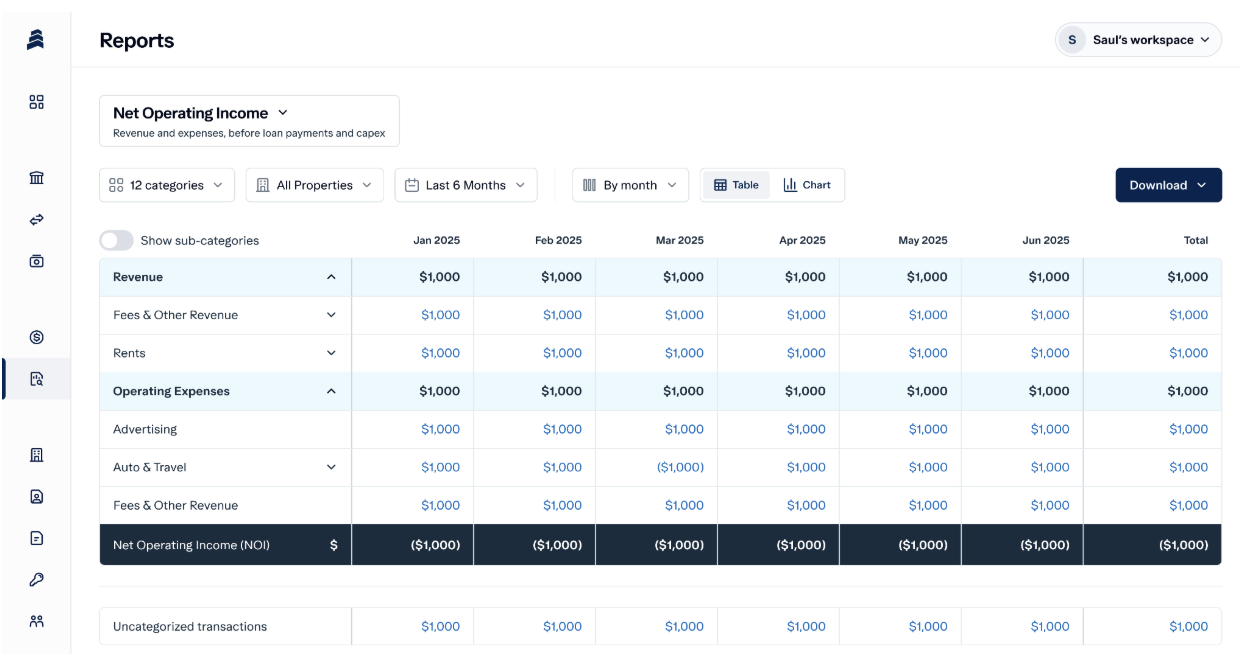
Baselane is a rental income management platform that combines banking, bookkeeping, and payment automation in a single system for property owners. It allows users to manage multiple properties by assigning dedicated accounts, automatically tracking transactions, and syncing rent payments with financial records. The platform uses automation and AI to categorize income and expenses, generate reports, and maintain up-to-date financial data.
Key features include:
Property-specific banking accounts
Users can create separate bank accounts for each property or entity, making it easier to track income and allocate funds.AI-powered bookkeeping automation
The platform automatically categorizes transactions by property and tax category using AI.Real-time cash flow visibility
Baselane provides insight into income, expenses, and balances across properties.Automated rent collection and invoicing
Rent invoices, reminders, and late fees are generated and sent automatically.Fast and trackable payment processing
Rent payments are typically deposited within two days, and users can track payment status in real time.
Source: Baselane
3. TenantCloud
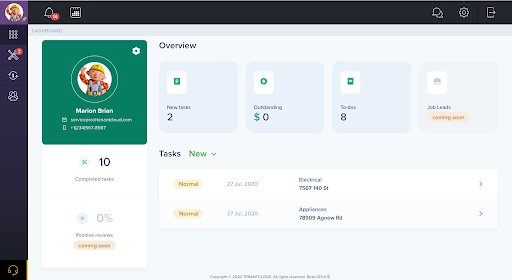
TenantCloud is a property management platform for leasing, accounting, rent collection, and tenant management in a single system. It centralizes the rental lifecycle, from listing properties and screening applicants to collecting rent and generating financial reports. The platform supports portfolio growth with scalable features, real-time data visibility, and integrations with third-party services.
Key features include:
Online rent collection and payment flexibility
Tenants can pay rent using credit cards, debit cards, ACH transfers, cash, or checks.Automated invoicing and payment tracking
The system generates invoices and tracks completed and overdue payments.Tenant screening and application management
Landlords can collect applications, set pre-screening criteria, and run background and credit checks.End-to-end leasing workflow automation
Users can manage applications, approvals, and lease agreements within a single interface.Real-time accounting and financial reporting
Built-in accounting tools provide insights into cash flow, income, and expenses.
Source: Tenant Cloud
Property Management Software
4. Yardi Breeze
Yardi Breeze is a property management platform for accounting, leasing, rent collection, maintenance, and owner reporting in a single system. It provides a centralized environment where property managers can oversee operations, track financials, and communicate with tenants and owners from any device. The platform includes workflow automation and financial tracking tools for larger portfolios.
Key features include:
Centralized property management dashboard
Manage properties, tasks, and activities from a single interface with built-in calendars.Role-based access and security controls
Administrators can restrict data access by user role or property level.Integrated marketing and leasing tools
Supports property listings, online applications, tenant screening, and lease execution.Online rent collection and payment options
Tenants can view balances and pay rent online using debit cards, credit cards, or ACH.Delinquency and collections management
Track overdue payments, manage collections, and enforce rent controls.
5. Buildium
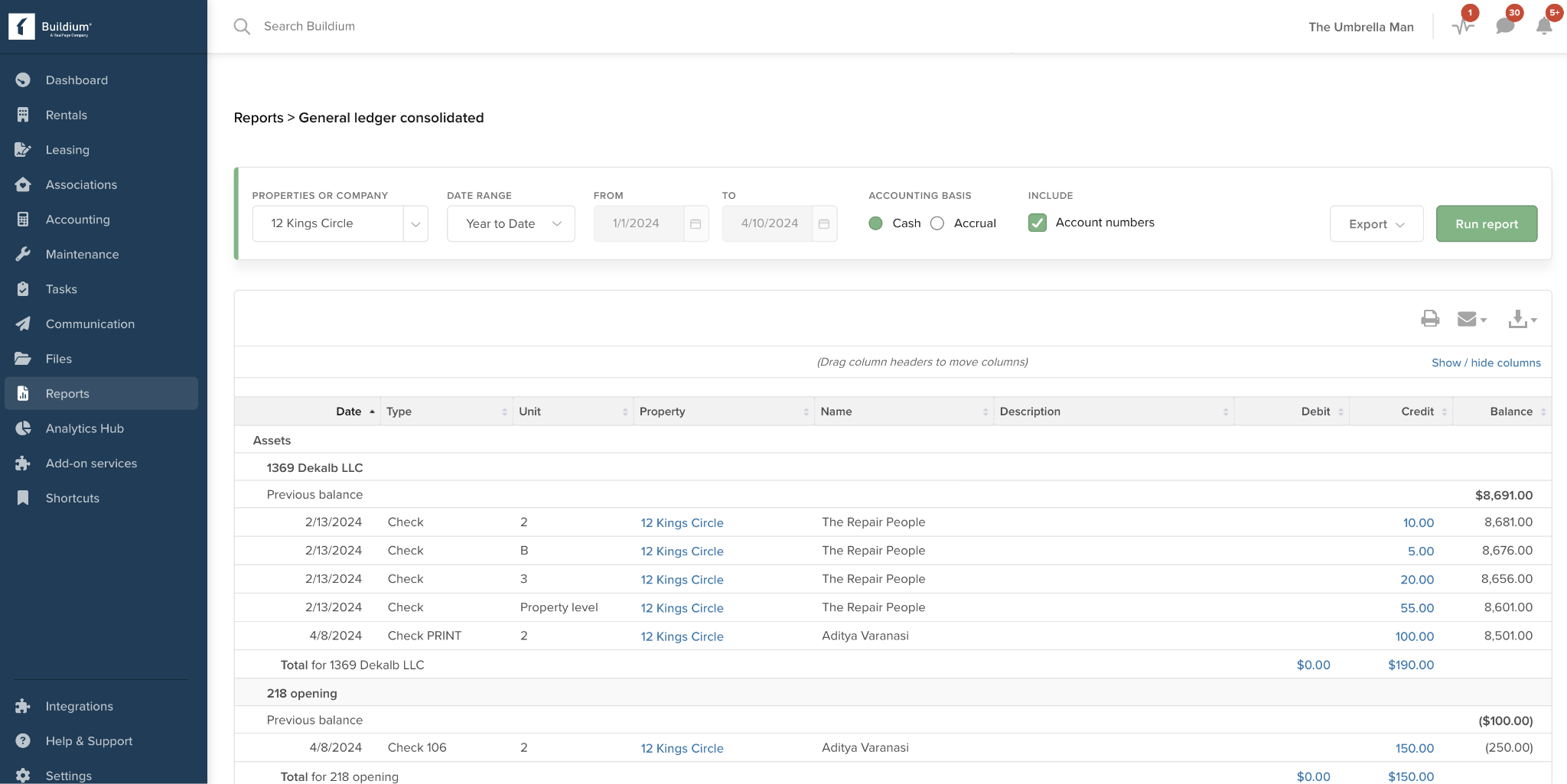
Buildium is a property management platform focused on automating rent collection, financial tracking, and payment workflows for rental portfolios. It centralizes payment processing, accounting, and resident interactions in one system, reducing reliance on paper checks and separate banking tools. By automating rent collection, tracking transactions in real time, and integrating accounting functions, Buildium helps property managers maintain accurate financial records and payment consistency.
Key features include:
Automated online rent and fee collection
Landlords can collect rent, association fees, and other charges through online payments.Recurring payments and autopay setup
Tenants can schedule recurring payments through the resident center.Faster payment processing and deposits
Online payments are transferred directly to the landlord’s bank account.Integrated property management accounting
Built-in accounting tools automatically track rent, fees, and expenses by property.Real-time payment tracking and visibility
Users receive updates when payments are made.
Source: Buildium
6. AppFolio

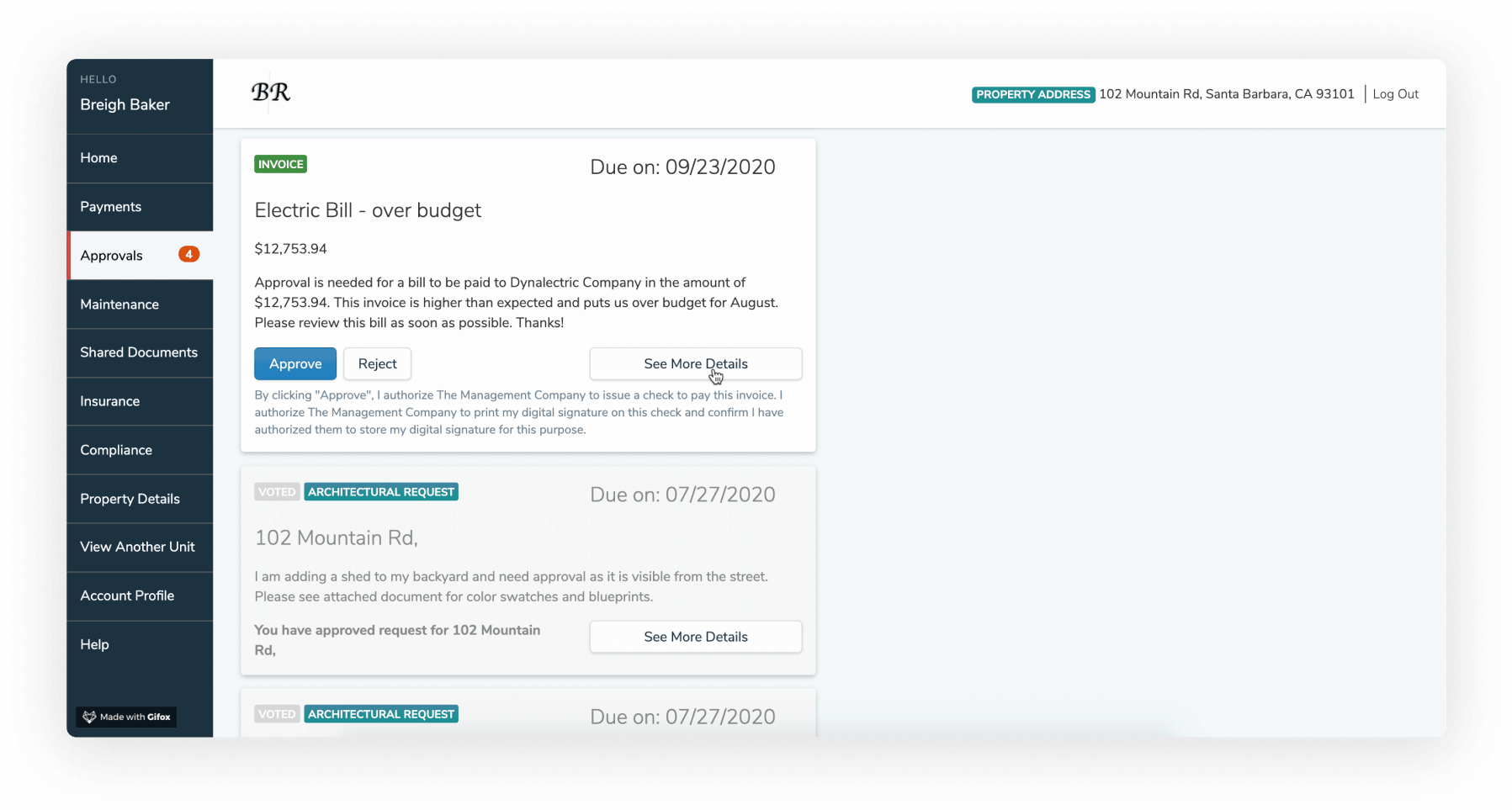
AppFolio is a property management platform that combines accounting, operations, communication, and leasing in a single system. It uses automated workflows to handle routine work and centralizes data, processes, and communication, providing real-time visibility into performance. With features for accounting, maintenance, leasing, and collaboration, AppFolio supports property management operations.
Key features include:
Unified platform with single login
Users can access accounting, leasing, and operations in one interface.Real-time accounting and financial reporting
The centralized accounting system captures transactions and supports custom reporting.Integrated online payments and bank reconciliation
Supports online rent payments and automates bank reconciliation.Multi-channel communication tools
Includes email, SMS templates, and a unified inbox.
Source: AppFolio
Conclusion
Rental income management software provides a centralized framework for automating financial oversight and tenant operations. By integrating rent collection, expense tracking, and reporting, these tools enhance cash flow visibility and administrative efficiency. Utilizing such technology allows property professionals to reduce manual errors, maintain compliance, and make data-driven decisions to scale their portfolios effectively.