If you work at a bank or credit union, you already know how painful credit card statement compliance can be.
The usual process is painfully manual. Someone pulls up the statement template, opens the CFPB rulebook, scrolls through the relevant clauses, and checks line by line whether the statement includes the right disclosures in the right format.
And it is never a one-time exercise.
Different credit card products use different statement templates. Those templates change for promotions, seasonal campaigns, layout updates, and other design adjustments. Every change creates another opportunity for compliance risk, and every review consumes more time from already stretched teams.
This is exactly the problem Kolena’s CFPB compliance agent is built to solve.
The goal is simple: replace repetitive manual statement reviews with an automated, repeatable process that checks credit card statements against CFPB requirements and gives compliance teams a clear, auditable report.
Why manual credit card statement review breaks down
Manual compliance review sounds manageable until you look at what is actually required.
Teams are not just checking whether a disclosure exists. They are checking whether the right information appears in the right place, with the right formatting, and in alignment with the right regulatory requirements for that specific statement.
That gets complicated fast when you are dealing with:
Multiple credit card products
Different statement templates across products
Promotional or seasonal variations
Ongoing layout and design changes
Internal review processes that need defensible documentation
When this work stays manual, two things happen. First, reviews take a lot of time. Second, coverage is limited, which creates blind spots.
Kolena frames the issue clearly: the cost of staying manual is staggering. Manual reconciliation is highly prone to non-compliance errors, and sampling only a small percentage of statements is no longer good enough when the stakes are this high.
What the CFPB compliance agent does
Kolena's CFPB compliance agent automates credit card statement compliance review.
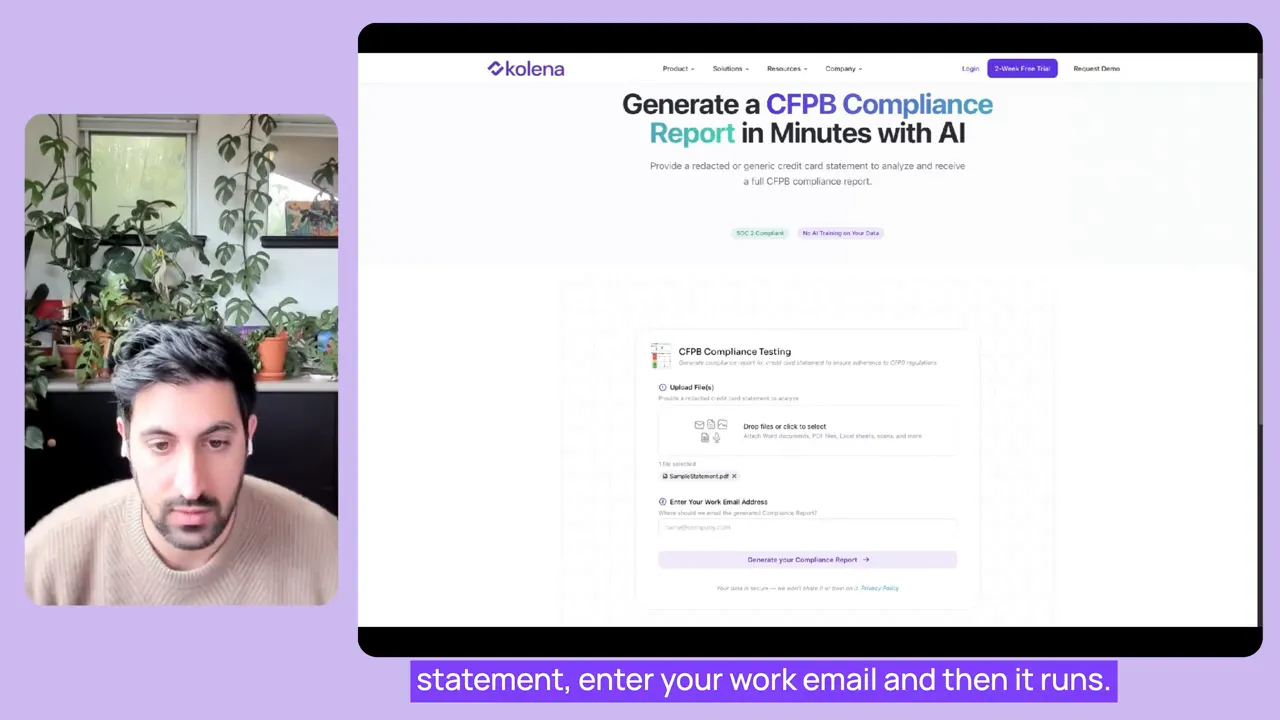
The workflow is straightforward. You upload a credit card statement, enter your work email, and the system runs a set of compliance checks mapped to CFPB requirements. After processing, you receive a compliance report by email and can also download it directly.
The report is designed to answer the questions compliance teams actually care about:
What is compliant?
What is not compliant?
Why did the system reach that conclusion?
What should the team do next?
In the example shown, the agent runs 12 compliance checks mapped to CFPB requirements. The output is not just a pass/fail screen. It includes a structured report that helps teams understand risk and act on it quickly.
What you get in the compliance report
Once the statement is processed, the output gives a much clearer picture than a checklist ever could.
The report includes:
An executive summary highlighting the areas that need attention
Compliance results by reference code so you can pinpoint the exact requirement involved
A compliance percentage tied to specific reference points
Reasoning for each determination
Recommended next steps that teams can use to remediate issues faster
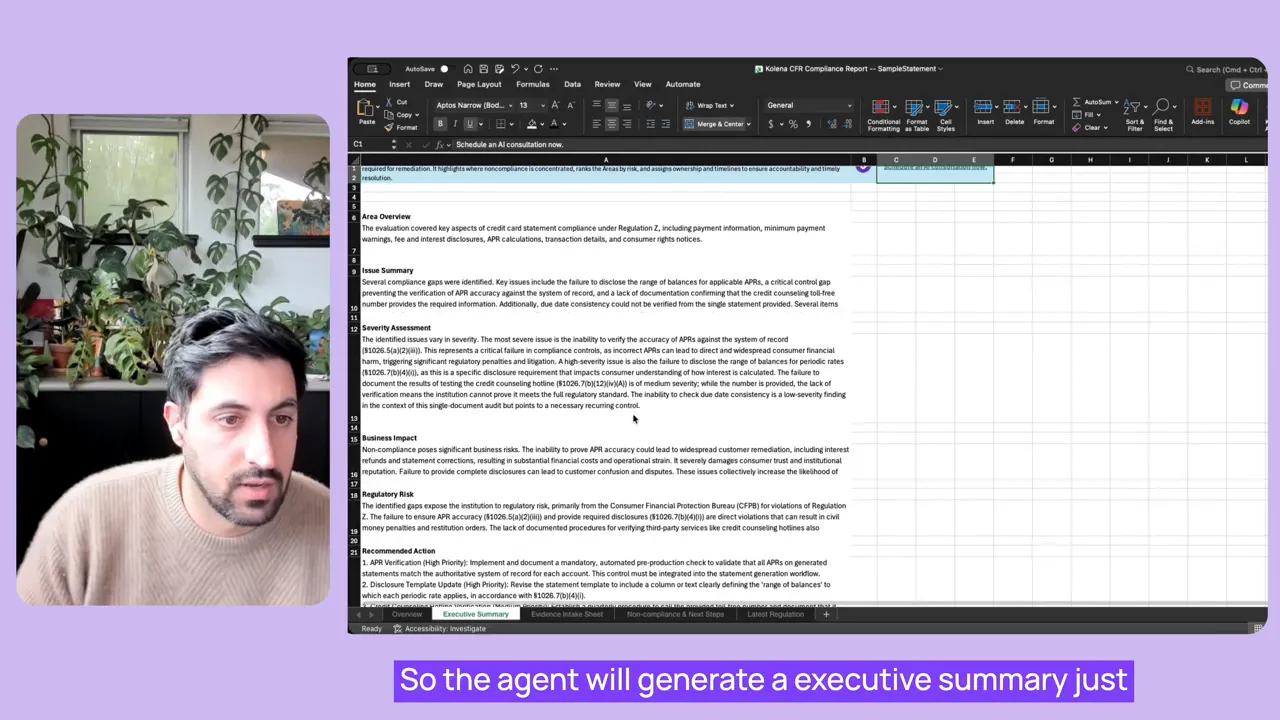
This structure matters because compliance work is rarely done by one person in isolation. Findings need to be shared across legal, operations, product, and audit teams. A report that clearly identifies what needs attention and what action to take next can dramatically speed up internal coordination.
How the platform works behind the scenes
What makes this useful is that Kolena is not simply extracting text from a PDF and presenting it back to you.
The platform cross-references the uploaded document against internal business rules and relevant regulations such as Regulation Z. In other words, it is evaluating the content in context, not just reading it.
The process starts with dropping in a document such as a credit card statement. Once processed, the platform runs through a series of prompts that extract the relevant data points from the statement.
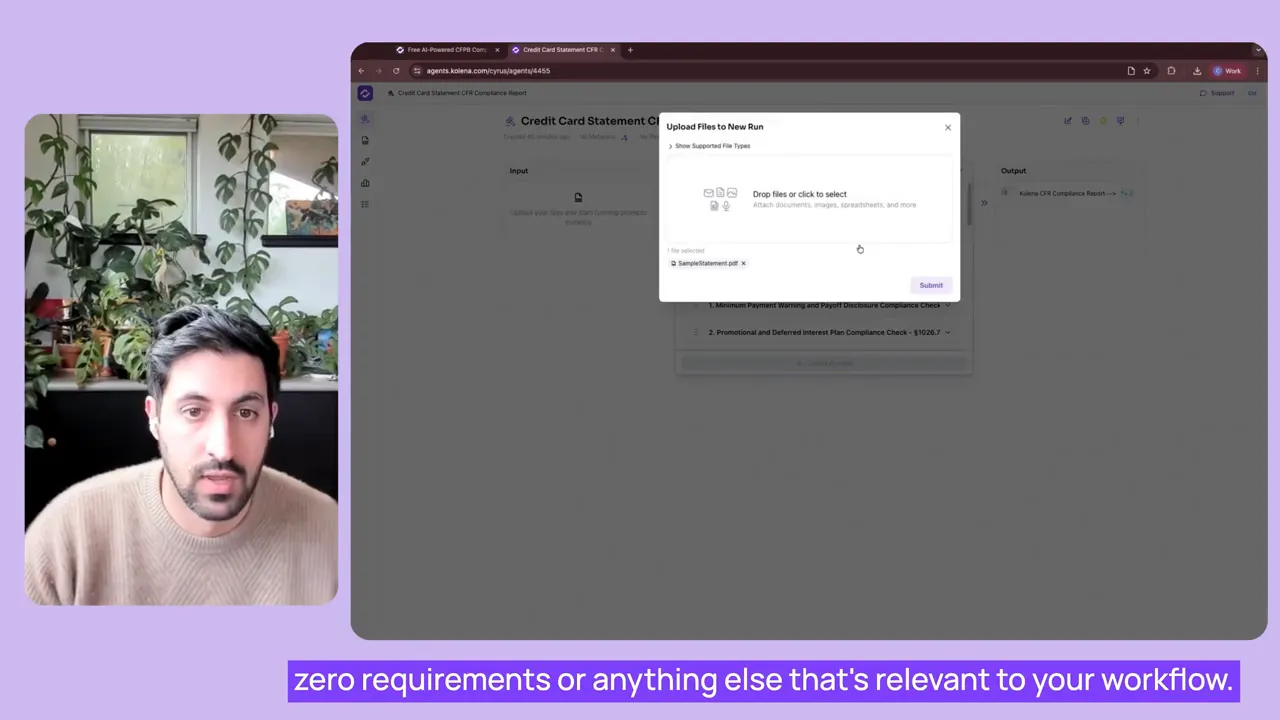
From there, the system organizes the extracted information into segments that align with the compliance output. This allows teams to inspect the results at a granular level and understand how each part of the statement was evaluated.
That level of structure is important for one reason above all: trust.
Why reasoning and source citations matter
AI in compliance only works if the results can stand up to scrutiny.
That is why one of the most important sections in the platform is the reasoning layer. Every extraction includes direct source citations along with an explanation for why the selected data was chosen.
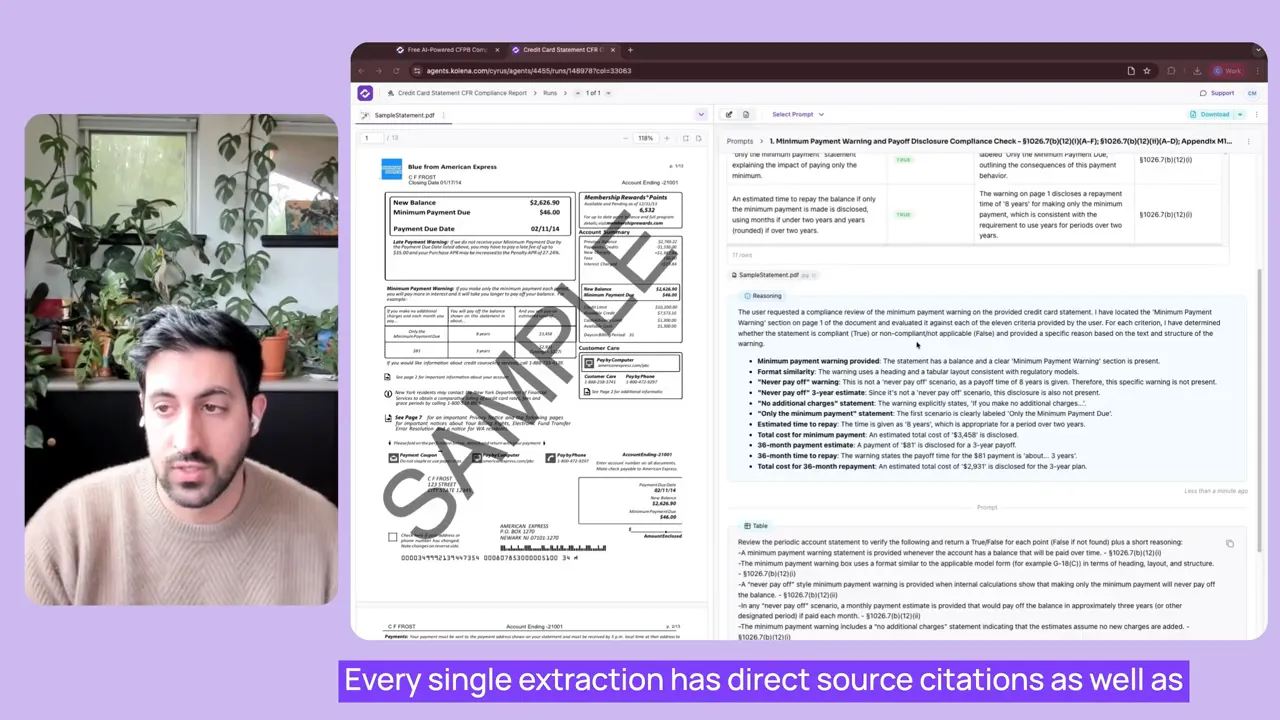
If a rule requires business logic or inference based on what appears in the statement, that logic is surfaced as well. You do not have to guess why the system pulled a field, flagged an issue, or determined that a requirement was met or missed.
Clicking a reference takes you back to the relevant source document, creating a traceable path from conclusion to evidence.
Kolena refers to this as decision-grade AI. That phrase captures an important distinction. There is a big difference between a black-box answer and an audit trail that your compliance, legal, or internal audit teams can actually defend.
From black box to audit trail
For regulated workflows, “the AI said so” is not good enough.
What teams need is a system that can show:
What data was extracted
Where it came from
What rule was applied
How the conclusion was reached
That is the difference between a tool that is interesting in a demo and one that is useful in production.
When compliance reviews are tied to explicit citations and reasoning, teams can move faster without sacrificing defensibility. That is especially important when findings may be reviewed by audit teams or when compliance teams need confidence that the system is making consistent decisions across high volumes of statements.
Why sampling is no longer enough
One of the clearest arguments for automation is coverage.
Manual teams typically audit only a tiny fraction of statements. Kolena points to a common reality: many teams review only about 1% of statements. That leaves an enormous blind spot, especially in large credit card portfolios where template changes and edge cases can easily slip through.
At the same time, regulatory pressure is real. The CFPB has already ordered more than $19 billion in consumer relief to date. In that environment, relying on limited manual sampling is a risky strategy.
Automation changes the equation by making 100% coverage possible.
Instead of testing a tiny sample and hoping it represents the whole population, teams can run repeatable compliance reviews every time a statement template changes.
The operational impact of automating statement compliance
The value here is not just better accuracy. It is also a much more efficient compliance pipeline.
According to Kolena, the platform can:
Provide 100% coverage instead of limited sampling
Reduce manual effort by up to 80%
Catch errors that people often miss after hours of repetitive review
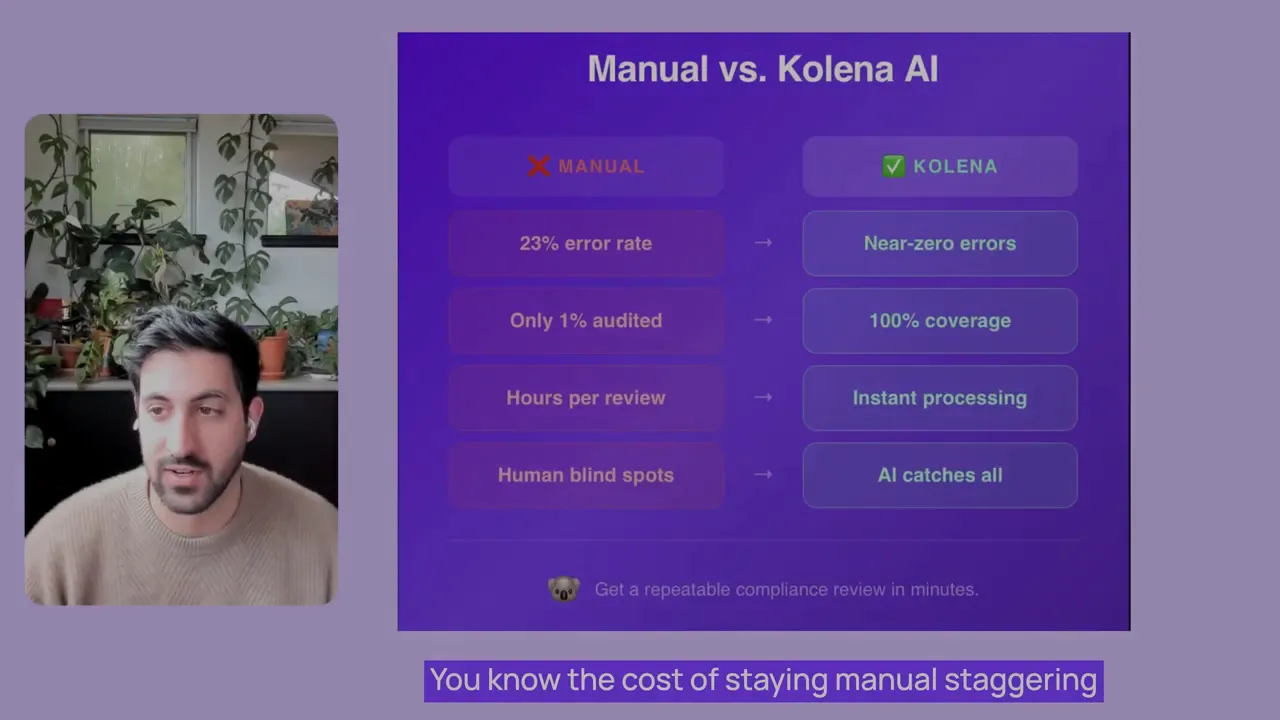
Anyone who has spent hours comparing statements against rules knows how real that last point is. Fatigue creates errors. Repetition creates inconsistency. Even strong teams miss things when the process depends on sustained manual attention.
Automating the repetitive parts of the review allows teams to spend less time flipping through the rulebook and more time on higher-value work: resolving issues, improving templates, and strengthening controls.
What a better compliance workflow looks like
When this process is automated well, the workflow becomes much cleaner:
Upload the credit card statement
Run CFPB-mapped compliance checks
Review the executive summary and detailed findings
Inspect citations, reasoning, and business logic
Share recommended next steps with the right teams
Repeat the process anytime a template changes
That kind of repeatability is what compliance teams need. Not a one-off analysis. Not a manually maintained checklist. A process that can be run consistently across products, templates, and revisions.
Automating certainty instead of sampling risk
The core message is simple: stop treating statement compliance as a periodic manual exercise and start treating it like an automated control.
Credit card statement templates are not static. Regulations do not get simpler. Audit expectations do not get lighter. If your process still depends on sampling and manual review, the risk compounds every time a template changes.
Automating CFPB compliance reviews gives teams a way to increase coverage, reduce manual effort, and create an audit trail strong enough to support real-world scrutiny.
That is the shift Kolena is pushing toward: stop sampling your risk, start automating your certainty.
See the workflow in action
The public agent can be run for free by uploading a credit card statement and using a work email. For institutions managing major credit card portfolios, it offers a practical look at what an automated compliance pipeline can do when it is built for regulated operations rather than generic document analysis.
If the challenge is hardening statement compliance reviews, the combination of automated checks, source-backed reasoning, and full-document coverage is a compelling place to start.