Google has made Gemini one of the most ambitious general-purpose AI offerings on the market. A two-million-token context window, making it the largest of any mainstream model—native multimodal reasoning across text, image, audio, and video. Workspace Intelligence gives Gemini continuous awareness across Gmail, Drive, Calendar, Docs, Sheets, and Slides without requiring the user to feed context for every request. The newly rebranded Gemini Enterprise Agent Platform (formerly Vertex AI), with Gems, Skills, Agent Studio, and a Deep Research Agent. And cost-per-token pricing is well below the competition. For a user who lives inside Google Workspace and wants their AI to live there too, Gemini is a compelling story.
But for the work most enterprises actually need to be automated, such as running document-heavy operational workflows every single day, in regulated environments, against the document types and storage systems the business actually uses, Gemini is solving a different problem.
Kolena is built for exactly that. Kolena’s purpose-built AI agents run lease abstraction, loss run analysis, loan diligence, appraisal extraction, CFPB compliance reviews, UCC lien analysis, rent roll processing, and dozens of other document workflows end to end, automatically, with no per-task instructions, with field-level validation, with source-page citations, inside an enterprise security perimeter built from day one, and crucially, without requiring your business to live inside any single vendor’s ecosystem.
This article walks through why, for the operational work an enterprise actually runs, Kolena is the better fit, even when Google Gemini’s most advanced offerings (Workspace Intelligence, Gems, Skills, the Gemini Enterprise Agent Platform) are on the table.
Gemini Is Built to Live Inside Workspace. Kolena Is Built to Run the Workflow.
Google’s bet with Gemini is that AI compounds in value when it lives where your work already happens. Workspace Intelligence, launched in April 2026, makes that bet explicit by giving Gemini default, continuous awareness across Gmail, Drive, Calendar, Docs, Sheets, and Slides. For Workspace-native organizations doing knowledge work, that is genuinely powerful. For regulated enterprises running document workflows, it is the wrong shape of problem on two fronts: The documents live in SharePoint, Box, claims platforms, LOS, and broker portal, not Workspace. Workspace Intelligence's broad, default-on access to personal and business data is the opposite of what regulated extraction requires.
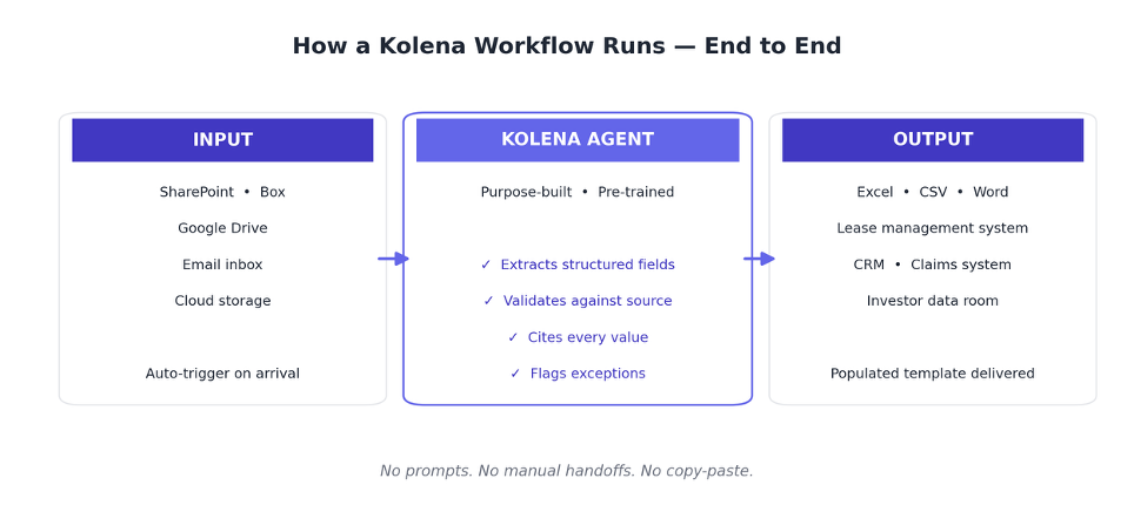
Kolena was designed for the opposite shape of the problem. Instead of asking the business to consolidate into one ecosystem so the AI can read everywhere, Kolena meets the business where it already operates — pulling documents from Google Drive, SharePoint, Box, email, and enterprise cloud storage, running purpose-built agents against them, and delivering structured outputs to whatever destination the workflow needs, whether that is an Excel rent roll, a CSV import for a lease management platform, a Word investor memo, or a row in a claims system. The platform is ecosystem-agnostic on both ends. Each agent is scoped tightly to the workflow it was built for, defined input, defined output, defined audit trail, and runs automatically the moment a document arrives. The work runs because the workflow runs, not because the AI happens to be reading everything in someone’s inbox.
“That is the difference between an AI that follows you into your apps and an AI that runs your business.”
Nine free AI document tools — pick your workflow
What About Gemini Enterprise Agent Platform, Gems, and Skills?
This is the right question, and it deserves a direct answer. At Google Cloud Next 2026, Google rebranded Vertex AI to the Gemini Enterprise Agent Platform and consolidated Agentspace into a unified product. It now includes Agent Studio for building custom agents, the Agent Development Kit (ADK) for developers, Skills for workflow automation, Gems for custom assistants, and a Deep Research Agent for long-running synthesis. On paper, these overlap meaningfully with what Kolena does.
In practice, they are tools to build with unfinished workflows. The Agent Studio and ADK assume your team will design the agent, configure the data sources, define the output schema, write the prompts, build the validation layer, and maintain the stack as documents evolve. Skills can automate simple patterns like invoice comparison, but they require someone to define them, train them, and own them as the workflow changes. Gems are persistent assistants, but they are still chat-based experiences; a user asks for help, not agents that run a workflow autonomously every time a new document arrives.
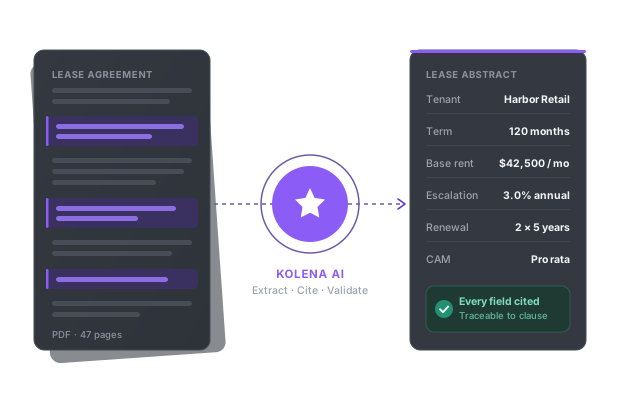
Kolena is the inverse of a toolkit. The agents for lease abstraction, loss run analysis, loan file diligence, appraisal extraction, CFPB compliance review, UCC lien analysis, REIT investment memo generation, and rent roll processing are some examples that are already built, already tuned, already validated against thousands of real-world documents in production. Your team does not assemble them from primitives. They run from day one. And when customization is needed, Kolena’s no-code agent builder lets the operations team itself extend or adapt an agent, such as by adding a field, changing a template, adjusting a validation rule, etc., without an SDK or a single line of code.
Massive Context Is Not a Substitute for Structured Workflow
Gemini’s two-million-token context window is, on paper, a remarkable capability. It can hold roughly 2,800 pages of text, an entire loan file, a stack of carrier loss runs, and a multi-year lease history in a single session. For analysts doing ad-hoc exploration of a large document set, that is a genuinely useful tool.
But context window size is not the bottleneck in production document workflows. The bottleneck is repeatability, accuracy, validation, and downstream delivery. Throwing a 200-page lease into a 2M-token context and asking Gemini to "extract the key fields" returns a different shape of output every time the prompt changes, every time the lease format changes, and every time the model is updated. Independent benchmarks of Gemini against purpose-built tools on complex commercial documents have called Gemini "adequate but less thorough," and Google’s own documentation notes that large-context queries at scale become "prohibitively expensive" without aggressive context caching. The capability is real. The fit for repeatable production workflows is not.
Kolena does not ask the model to "read the whole document and figure it out." It runs a coordinated multi-agent workflow: specialized extraction agents pull the fields the workflow requires, validation agents check those fields against the source, quality-checking models flag anomalies, citation agents anchor every value to its source page, and a delivery agent populates the firm’s template and routes it to its destination. Every step is deterministic in shape, every output is structured, every value is auditable, and the workflow runs the same way on the first document and the thousandth.
The Time Difference Is Transformational
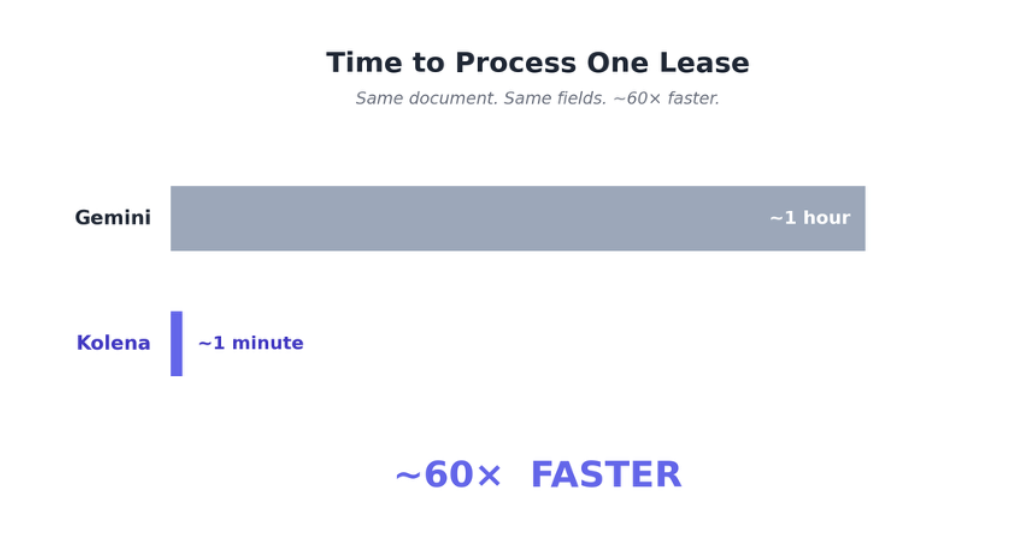
In a Gemini workflow, even one built carefully on Skills or Agent Studio, a single lease abstraction typically takes an hour or more once you factor in agent setup, prompt tuning, schema correction, edge-case handling, manual validation against the source, and exporting the result into the firm’s template.
With Kolena, the same lease takes roughly one minute. Industry benchmarks suggest AI-driven abstraction reduces labor by 70–90%, with accuracy rates above 95%, and Kolena routinely processes thousands of files in seconds.
The difference is that Kolena runs the workflow end-to-end. No prompt tweaking. No agent rebuilding. No manual validation pass. No copy-paste. Documents come in, structured outputs go out, source-page citations attach automatically, exceptions flag automatically, and the result lands in the firm’s exact template.
Built to Fit Your Workflow, Not Your Ecosystem
The most important word in "Workspace Intelligence" is "Workspace." Gemini’s deepest value is unlocked when an organization commits to running its work inside Google’s ecosystem. For organizations that already do, that is a strength. For organizations that do not and for the many that run on a mix of SharePoint, Box, and Google Drive simultaneously, it is a structural limitation that no amount of model capability can solve.
Kolena was designed from the start to be storage-agnostic on intake and destination-agnostic on output. Documents flow in from Google Drive, Microsoft SharePoint, Box, email, and enterprise cloud storage, the agent runs, and structured results flow out to wherever the workflow requires, back to the same storage system, into a customer-specific Excel template, as a CSV import for a downstream platform, or directly into a CRM or asset management system. There is no ecosystem lock-in to navigate and no integration tax to pay.
Accuracy You Can Actually Defend
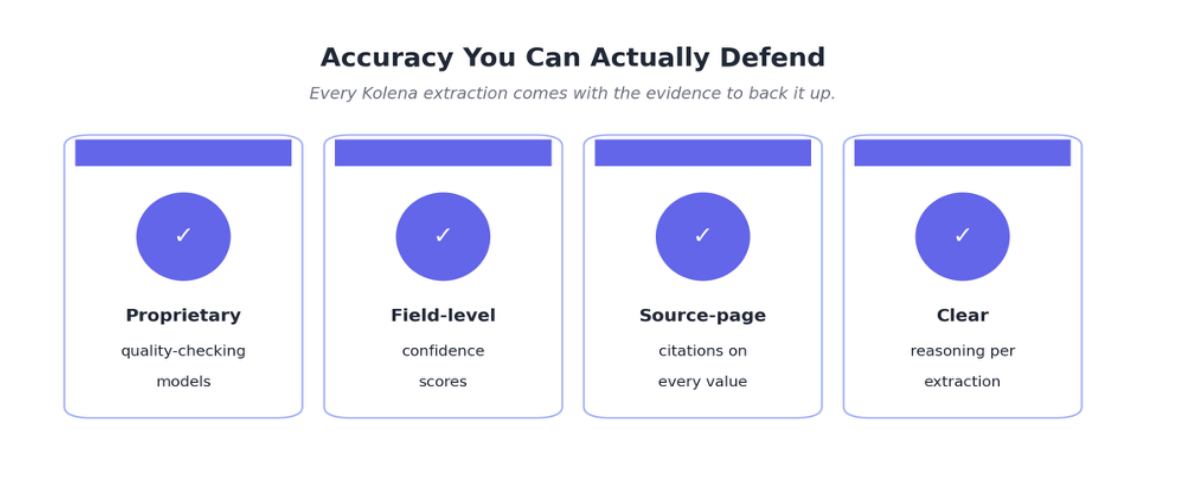
Kolena is built for decision-grade AI. Accuracy and traceability are foundational, not optional. Every Kolena workflow is backed by proprietary quality-checking models trained specifically on the document types and field schemas of each vertical, automated validation layers that prevent hallucinated fields, field-level confidence scores on every extracted value, source-page citations linking every value back to the exact page in the original document, and clear reasoning explaining how the agent interpreted complex clauses. When an extracted number does not look right, an underwriter clicks the citation, lands on the exact page where the value was sourced, and verifies it in seconds.
Gemini provides structured output capabilities, and Gemini 3 Flash in particular has posted meaningful benchmark improvements on field-level extraction. But independent analyses of Gemini across complex enterprise documents consistently note the same set of limitations: "hallucinations, non-deterministic outputs, and limited audit trails without extra controls." Schema compliance does not equal semantic correctness; accuracy varies significantly across digital versus scanned PDFs, and the model still requires the customer to build the validation, citation, and audit layers on top. Anthropic, OpenAI, and Google all push that work onto the customer. Kolena builds it in.
This is why teams trust Kolena with high-impact workflows. We are AI you can trust.
Agent Building and Prompting Are Hidden Costs Kolena Eliminates
Every general-purpose AI pushes the same set of costs onto the customer. Someone has to define the Skills, configure the Gems, write the Agent Studio prompts, define the schemas, wire the connectors, validate the outputs, and maintain all of it as document formats change, as new investor guidelines come into play, as carriers update their loss run templates, and as a CFPB rule revision drops. The cheaper per-token pricing Gemini offers is irrelevant when the workflow itself requires months of internal build and an ongoing engineering footprint to maintain.
Kolena removes that burden entirely. Customers describe what they want in natural language. The platform handles agent construction, prompt optimization, model routing, and quality validation behind the scenes. Kolena’s team owns the maintenance as document patterns evolve. No AI engineering team required. No prompt engineers on payroll. No Agent Studio expertise required. The total cost of running a Kolena workflow is dramatically lower than the total cost of building and maintaining the same workflow on top of any foundation model, and the time to production is hours, not months.
Your Workflow Partner, Not a Cloud Vendor
Google is, fundamentally, a cloud and productivity vendor. Gemini is a feature in a much larger platform strategy. That is the right model for Google, and it produces a strong general-purpose AI. But Google is not in the business of running your lease portfolio, abstracting your loss runs, reconciling your loan files, or running your CFPB compliance reviews. Gemini, the Agent Platform, Gems, and Skills give your team the tools to attempt that work. The work itself remains yours.
Kolena is a workflow partner. Every customer receives:
• Dedicated AI architects who design and tune agents to the firm’s specific workflows
• Hands-on implementation support from intake to production
• Training on how operations teams can build and customize agents themselves, no engineering required
• A dedicated account manager and ongoing operational support
• Maintenance of the agent stack as documents and regulations evolve
Google provides intelligence and infrastructure. Kolena provides outcomes. We deploy with you, tune with you, and scale with you.
Enterprise Security and Data Privacy: Built for Regulated Industries from the Ground Up
On compliance certifications, both Google Cloud and Kolena have invested seriously, and the comparison is closer than most. Google holds SOC 2, ISO 27001/27017/27018, PCI DSS, FedRAMP, and offers HIPAA Business Associate Agreements for Gemini in Workspace and the Gemini app when the "regulated-data" flag is enabled at the project level. Customer content is not used to train Google’s models without permission, and Workspace prompts and responses are ephemeral by default.
Kolena’s posture is similarly strong, with two practical advantages that matter to regulated buyers. The first is the configuration burden. Gemini’s HIPAA coverage requires specific features to be covered by the BAA, the regulated-data flag to be enabled per project, and ongoing risk management to govern the configuration. Kolena’s compliance posture, SOC 2 Type II, HIPAA, and PCI, applies to the entire platform out of the box. There is no per-project flag to remember to enable, no version of the product that sits outside the compliance perimeter.
The second is scope. Workspace Intelligence is, by design, a broad-context system that reads across a user’s Gmail, Drive, Calendar, Chat, Docs, Sheets, and Slides to assemble responses. For a regulated firm, that breadth is a friction point in the security review, even when the underlying controls are sound. Kolena runs the opposite way; each workflow operates against a scoped, defined set of documents, with full audit logs, role-based access, single sign-on, and centralized data governance. The blast radius of any single workflow is limited to what that workflow needs.
Customer data is never used to train Kolena’s models. Zero data retention policies are enforced. Every action is logged, every output is auditable, and every workflow is administered centrally. Your data remains yours, always.
Kolena vs. Gemini at a Glance
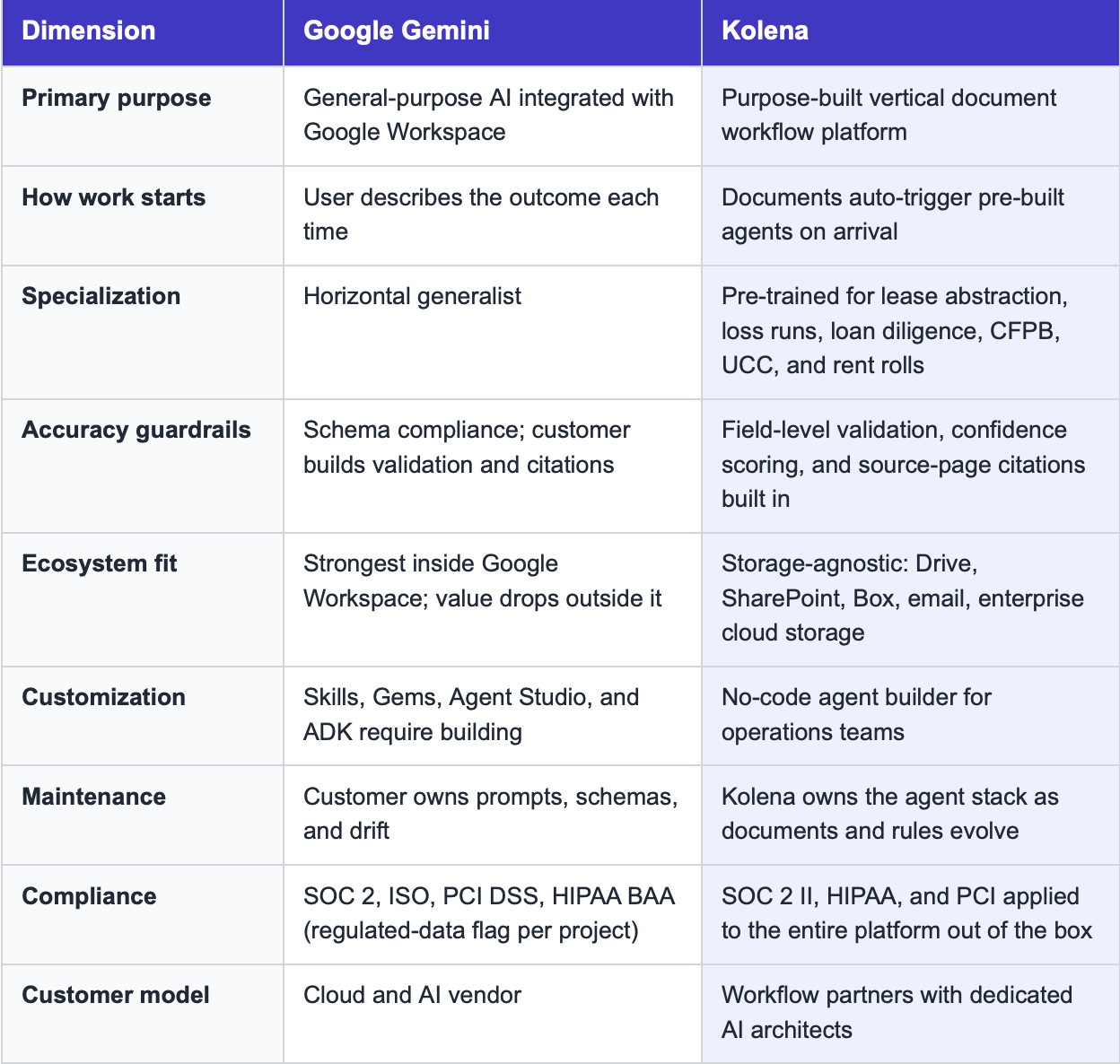
Why Kolena Wins on Production Document Work
Gemini is one of the most capable general-purpose AI offerings on the market, and its integration with Google Workspace is genuinely best-in-class for Workspace-native organizations doing knowledge work.
But the work that defines a regulated enterprise, such as abstracting every new lease, normalizing every new loss run, reviewing every new loan file, scoring every new offering memorandum, processing every new compliance disclosure, doing it every day, automatically, against the document storage and downstream systems the business actually runs on, is not the work Gemini was built for.
It is the work Kolena was built for.
Purpose-built vertical agents. Zero per-task instructions. End-to-end automation from intake to delivery. Field-level validation. Source-page citations. No prompt engineering, no Agent Studio builds, no developer-team dependencies. PCI, HIPAA, and SOC 2 Type II certified across the entire platform. Zero data retention. Full audit logs. Centralized admin control. Ecosystem-agnostic on intake and delivery. A workflow partner that owns the agent stack with you.
“If your operation is document-heavy, accuracy-critical, regulated, and built for repeatable production work, Kolena is the better fit, and it is not close.”