What Is AI Property Management?
AI property management refers to the use of artificial intelligence technologies to automate, optimize, and improve tasks in property management. This can include everything from tenant screening and rent collection to maintenance scheduling and financial reporting. By integrating AI-driven software into existing workflows, property managers can reduce manual work, improve decision-making, and deliver faster responses to tenants and property owners.
AI property management systems use data from multiple sources, such as rental histories, market trends, and tenant communications, to provide insights and automate repetitive processes. These systems can handle complex data analysis, identify patterns, and predict outcomes, allowing property managers to focus on higher-value tasks. The adoption of AI in property management is changing the industry by enabling data-driven operations and improving efficiency.
This is part of a series of articles about property management software
Generate your first rent roll in minutes with AI
Benefits of AI in Property Management Software
AI introduces measurable improvements across daily operations in property management. Instead of replacing existing workflows, it improves them by reducing manual effort, improving accuracy, and enabling faster decision-making. The benefits are most visible in areas where repetitive tasks, large datasets, and time-sensitive interactions are common.
Reduced manual workload: AI automates routine tasks such as rent reminders, lease tracking, and data entry.
Faster tenant screening: AI analyzes applications, credit data, and rental history in seconds while maintaining consistent evaluation criteria.
Improved maintenance management: Systems automatically log requests, prioritize issues, and predict maintenance needs based on historical data.
Better financial insights: AI tools analyze income, expenses, and market trends to generate forecasts and reports.
Enhanced tenant experience: Chatbots and automated messaging provide quick responses to tenant inquiries.
Data-driven decision making: AI identifies patterns in occupancy rates, pricing trends, and tenant behavior to support pricing strategies and investment decisions.
Scalability of operations: With AI handling repetitive processes, property managers can oversee more units without increasing staff proportionally.
Related content: Read our guide to commercial real estate property management software
Key Use Cases of AI in Property Management
1. AI-Powered Tenant Screening and Onboarding
AI speeds up tenant evaluation by analyzing financial records, rental history, and public data in a single pass. It produces a structured risk assessment that highlights reliability, payment behavior, and potential risks. This replaces manual reviews with a consistent process.
The system can process large volumes of applications at once. This is useful for high-demand properties where speed matters. By applying the same criteria to every applicant, it reduces inconsistencies that appear in manual screening.
In onboarding, AI streamlines document collection and verification. It ensures required information is complete before moving forward. This reduces back-and-forth communication and shortens the time between application and move-in.
The result is faster approvals, fewer errors, and more reliable tenant selection. It also lowers the risk of fraud and helps fill vacancies.
2. Intelligent and Automated Maintenance Requests
AI simplifies how maintenance requests are captured, categorized, and resolved. Tenants submit issues through a portal or chatbot, where the system collects details such as issue type, urgency, and location.
The AI can ask follow-up questions to clarify the problem. In some cases, it guides tenants through basic troubleshooting steps, which reduces unnecessary service calls. This is useful for common issues that do not require on-site intervention.
When a request needs attention, the system creates a work order with relevant information, including problem description, priority level, and prior history. Maintenance teams receive clear instructions without manual input from property managers.
This approach improves response times and ensures issues are handled consistently. It also helps prioritize urgent problems and allocate resources efficiently.
3. Dynamic Pricing and Revenue Management
AI-driven pricing systems evaluate market conditions to recommend rental rates. They analyze competitor pricing, demand fluctuations, seasonal patterns, and unit-specific factors.
Instead of relying on static pricing or manual adjustments, the system updates recommendations based on real-time data. This allows property managers to react quickly to changes in supply and demand.
The pricing model balances two goals: rental income and occupancy. For example, it may suggest lowering prices to reduce vacancy periods or increasing rates when demand is strong.
This approach reduces guesswork and improves consistency across units. It also supports pricing strategies at scale, especially for large portfolios with diverse property types.
4. Predictive Analytics for Strategic Decision-Making
AI uses historical data and market trends to generate forecasts that support long-term planning. It can estimate future occupancy rates, identify tenants likely to renew, and detect patterns that signal potential issues.
These predictions allow property managers to act before problems occur. For example, if the system flags a higher risk of vacancy, managers can adjust pricing or marketing efforts early.
AI can also highlight investment opportunities by analyzing performance across properties and comparing them to market trends. This helps identify underperforming assets or areas with growth potential.
By turning data into insights, predictive analytics shifts decision-making from reactive to proactive. Property managers gain a clearer view of future performance and can plan strategies with more confidence.
Related content: Read our guide to property AI
Challenges and Limitations of AI in Property Management
Adopting AI in property management presents several significant challenges that require careful navigation. These limitations range from ensuring the security of sensitive data to overcoming technical hurdles when integrating AI tools with legacy systems, alongside adhering to a complex and evolving landscape of legal and regulatory compliance.
Property managers must address these concerns proactively to realize the full value of their AI investments and maintain trust with tenants and owners:
Data privacy and security: AI systems rely on large volumes of sensitive tenant and financial data, necessitating strong safeguards to comply with data protection regulations and prevent breaches, which could lead to legal liabilities and reputational damage.
Integration with existing systems: Connecting new AI solutions to older, often incompatible property management software can be complex and costly, requiring investments in data cleansing and standardization to ensure data flows correctly and prevent operational bottlenecks.
Legal and regulatory considerations: Automated decision-making must comply with fair housing laws and evolving data protection statutes. Property managers must regularly audit AI algorithms for potential bias or discrimination to prevent legal challenges and harm.
Best Practices for Using AI for Property Management
Begin with High-Impact, Low-Risk Use Cases
Start with applications that are simple to deploy and do not require major changes to existing systems. Tasks like automated rent reminders, basic tenant communication, and maintenance request categorization are good entry points. These areas rely on structured data and repetitive workflows.
Early use helps teams understand how AI behaves in real scenarios. It also builds internal trust and reduces resistance to adoption. Teams can learn how to monitor outputs, handle exceptions, and refine workflows without exposing critical operations to risk.
Once these systems are stable, expand gradually into more complex use cases such as pricing optimization or predictive analytics. A phased approach reduces disruption and ensures each step delivers measurable value before moving forward.
Focus on Tenant Experience
AI should improve the speed and quality of tenant interactions, not make them feel impersonal. Fast response times are important, but clarity and accuracy matter as well. Systems should provide useful answers, not just quick replies.
Use AI to handle high-frequency, low-complexity interactions such as payment confirmations, lease details, and maintenance updates. For more complex or sensitive issues, ensure there is a clear path to human support.
Monitor how tenants interact with AI systems. Track response satisfaction, escalation rates, and unresolved issues. Frequent bypassing or abandonment of automated systems may indicate gaps in design or functionality.
Track Performance with Clear Metrics
AI adoption should be tied to measurable outcomes. Define specific metrics before implementation so performance can be evaluated objectively. For example, track time saved on administrative work, maintenance resolution times, or vacancy rate changes.
Use baseline measurements to compare performance before and after AI adoption. This helps isolate the impact of AI rather than relying on assumptions. Review metrics regularly to identify areas where the system underperforms or produces inconsistent results.
Dashboards and reporting tools can help visualize trends and detect issues early. Over time, these insights can guide further optimization, such as refining AI models, adjusting workflows, or reallocating resources.
Keep Humans in the Loop
AI systems can process data and generate recommendations, but they lack context in complex or sensitive situations. Human oversight is necessary to validate decisions, especially in areas like tenant screening, pricing adjustments, or dispute resolution.
Design workflows so that AI handles initial processing while humans review critical outputs. For example, AI can flag high-risk tenant applications, but final approval should remain with a property manager. This reduces errors and ensures accountability.
Human feedback also improves AI performance over time. When managers correct or override AI decisions, that information can refine models and improve accuracy.
Prioritize Data Privacy and Compliance
AI systems depend on large volumes of data, much of which is sensitive, including personal tenant information, payment records, and behavioral data. Protecting this data requires technical safeguards and clear internal policies.
Implement encryption, access controls, and audit logs to prevent unauthorized access. Limit data access based on roles so employees only see what they need. Regularly review data storage and processing practices to ensure they meet regulatory standards.
Compliance also supports tenant trust. Tenants should understand how their data is used and have confidence that it is handled responsibly. Choosing vendors with transparent data practices and built-in compliance features can reduce risk and simplify management.
AI-Driven Property Management with Kolena
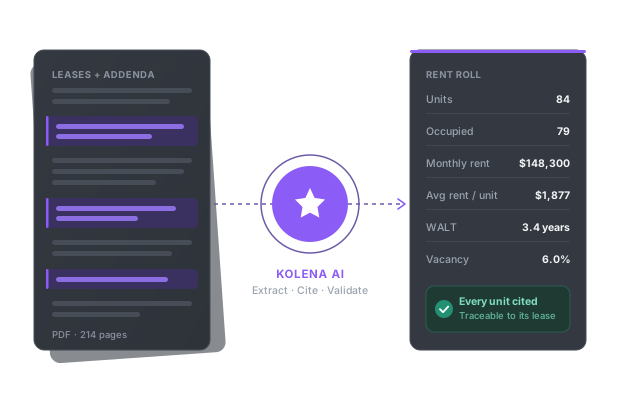
AI property management delivers the most value when it can be tailored to the specific workflows of a portfolio—whether that’s tenant screening, lease analysis, or maintenance coordination. Kolena enables this flexibility through customizable AI agents that can process unstructured data from leases, applications, invoices, and communications, turning it into structured outputs that integrate directly into existing property management software. This allows teams to automate high-volume, document-heavy processes without disrupting their current systems or workflows.
Unlike rigid, single-purpose tools, Kolena’s approach to AI in property management focuses on adaptability and transparency. Property managers can define exactly what data to extract, validate outputs with built-in reasoning and citations, and continuously refine performance based on real-world feedback. The result is a more reliable and scalable foundation for AI property management—one that improves operational efficiency while maintaining control over critical decisions.