What Is AI in Financial Services?
Artificial intelligence (AI) in finance automates routine tasks, accelerates data analysis, and powers predictive forecasting. Ranging from natural language assistants that parse earnings to machine learning models that detect fraud, AI augments both corporate finance teams and personal money management.
Use cases for AI in financial services include:
Corporate finance and analytics: For finance professionals in FP&A (Financial Planning and Analysis), investment banking, and equity research, AI acts as a research co-pilot and productivity multiplier. Examples include financial reporting and pitch books, research and analysis, and workflow orchestration.
Personal finance: For individuals, AI acts as an automated, 24/7 financial advisor. Examples include account aggregation, goal setting and forecasting, and credit and debt management.
Institutional and banking use cases: At the enterprise level, AI transforms the core infrastructure of banks, insurance companies, and fintechs. Examples include AML and KYC automation, algorithmic trading, and credit scoring.
Insurance and claims: AI makes it easier to process insurance claims and documentation. Examples include claims document review, loss analysis, and compliance and audit.
Workflow orchestration: AI helps financial institutions to automate and simplify workloads. For example, automated document intake and classification; data extraction from PDFs, scans, emails, and spreadsheets; and CRM, dashboard, and spreadsheet integration.
Due diligence and deal review: Organizations use AI to ensure faster and more thorough review processes. Examples include loan package review, M&A diligence document analysis, and contract and agreement review.
Cybersecurity: Security can be improved using various AI-enabled technologies. Examples include account takeover prevention, synthetic identity detection, and deepfake voice and video fraud detection.
This is part of a series of articles about AI for Finance
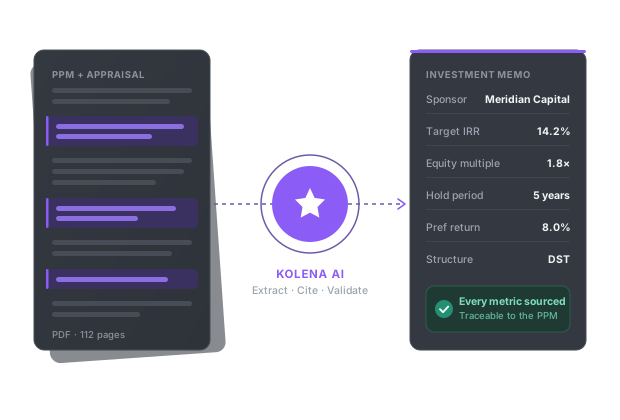
Draft your first investment memo in minutes with AI
Benefits of AI in Financial Services
AI helps financial institutions improve efficiency, accuracy, and customer experience across operations. By automating repetitive tasks, analyzing large datasets, and supporting faster decision-making, AI enables organizations to reduce costs, manage risks, and deliver personalized services. As adoption grows, AI provides operational and strategic advantages across the financial sector:
Improved fraud detection: AI analyzes transactions in real time and identifies unusual patterns that may indicate fraud.
Faster credit and risk assessment: Machine learning models evaluate financial and behavioral data to assess creditworthiness and risk.
Enhanced customer service: AI-powered chatbots and virtual assistants provide 24/7 support and handle routine tasks.
Greater operational efficiency: AI automates processes such as data entry, document processing, and compliance checks.
Personalized financial recommendations: AI analyzes customer behavior, financial goals, and spending patterns to deliver tailored recommendations.
Better investment decisions: AI analyzes market trends, news, and historical data to support investment decisions.
Stronger regulatory compliance: AI monitors transactions, detects compliance issues, and automates reporting processes.
Reduced costs: AI automates routine tasks and improves process efficiency.
Real-time data insights: AI systems process large volumes of data and provide timely insights.
Improved customer retention: AI supports personalized experiences and proactive service delivery.
AI Use Cases in Financial Services
1. Corporate Finance and Analytics
Financial Reporting and Pitch Books
AI automates the generation of financial reports and pitch books by extracting data from multiple sources and assembling it into standardized formats. This reduces the time analysts spend on manual data gathering and formatting, allowing them to focus on tasks such as strategic analysis and client engagement. AI tools also help ensure consistency and accuracy in the presentation of financial information.
The ability to update pitch books with the latest market data and financial metrics enables banks and advisory firms to deliver timely information to clients. AI-powered platforms tailor content for specific audiences, highlight key trends, and generate visualizations that make complex data more accessible.
Example:
An investment banking team is preparing a pitch book for a potential acquisition. AI gathers financial data from company filings, earnings reports, and market databases, updates valuation models, and generates charts and summaries. Analysts spend their time refining recommendations instead of manually assembling presentation materials.
Research and Analysis
AI accelerates financial research by scanning news, filings, earnings reports, and market data to surface relevant insights. Natural language processing (NLP) algorithms summarize unstructured text, identify sentiment, and highlight potential risks or opportunities. This enables analysts to cover more ground and make informed recommendations. Machine learning models detect correlations and anomalies in data that might be missed by traditional analysis.
Example:
An equity research firm uses AI to review hundreds of earnings transcripts, analyst reports, and news articles each day. The system identifies changes in management sentiment, highlights emerging risks, and summarizes key developments, helping analysts quickly prioritize companies for deeper review.
Workflow Orchestration
AI simplifies workflow orchestration by automating the routing, approval, and monitoring of financial processes. Systems assign tasks based on workload, urgency, and staff expertise, helping workflows progress efficiently and reducing bottlenecks. Automated notifications and status tracking keep teams aligned and reduce manual follow-ups.
These tools enhance compliance by enforcing process controls and maintaining audit trails. Integration with other enterprise systems, such as document management and CRM platforms, enables data flow and reduces duplication of effort.
Example:
A corporate finance department uses AI to manage budget approval workflows. The system automatically routes requests to the appropriate managers, tracks approval status, sends reminders for overdue reviews, and maintains a complete audit trail for compliance purposes.
2. Personal Finance
Account Aggregation
AI-driven account aggregation platforms consolidate data from multiple financial accounts, providing users with a unified view of assets, liabilities, and transactions. By categorizing and reconciling data from banks, investment accounts, and credit cards, AI simplifies personal financial management and helps users understand their financial position.
These tools detect unusual spending patterns, alert users to potential fraud, and provide budgeting recommendations. Machine learning analyzes spending behaviors and trends to support informed decisions.
Example:
A consumer uses a personal finance app that connects checking accounts, credit cards, loans, and investment accounts. AI categorizes transactions, identifies recurring expenses, and provides a consolidated view of net worth, helping the user manage finances from a single dashboard.
Goal Setting and Forecasting
AI enhances goal setting and forecasting by using predictive analytics to project future income, expenses, and savings based on historical data and user inputs. These systems simulate different financial scenarios, helping users set goals for retirement, education, or major purchases. Recommendations enable users to adjust plans as circumstances change.
AI-powered tools track progress toward goals and provide alerts when users are at risk of falling short. By monitoring financial activity and recalibrating forecasts, these platforms help individuals adjust their plans.
Example:
A young professional wants to save for a home purchase within five years. An AI-powered planning tool analyzes income, spending, and savings patterns, projects future account balances, and recommends monthly savings targets to help achieve the goal on schedule.
Credit and Debt Management
AI assists in credit and debt management by analyzing credit reports, payment histories, and spending patterns to generate insights. These systems suggest strategies for improving credit scores, such as prioritizing certain payments or consolidating debts.
Reminders and alerts help users avoid late fees and manage repayment schedules. AI also identifies opportunities to refinance loans or negotiate better terms using market data and predictive models to assess potential savings.
Example:
A consumer carrying balances across several credit cards uses an AI-powered financial assistant. The system recommends a repayment strategy, identifies opportunities to refinance debt, and sends alerts when upcoming payments could affect the user's credit score.
3. Institutional and Banking
AML and KYC Automation
AI simplifies anti-money laundering (AML) and know your customer (KYC) processes by automating identity verification, risk assessments, and transaction monitoring. Machine learning algorithms analyze customer behavior and flag suspicious activities in real time. This reduces manual workload and accelerates onboarding while improving compliance. AI models learn from new data and adapt to emerging threats and regulatory changes. Automated document verification and data extraction improve process efficiency.
Example:
A bank uses AI during customer onboarding to verify identification documents, screen applicants against sanctions lists, and assess risk levels. The system automatically flags unusual activity after account opening, allowing compliance teams to focus on higher-risk cases.
Algorithmic Trading
Algorithmic trading systems use AI to analyze market data, identify trading opportunities, and execute orders at optimal times. These platforms use machine learning models to detect patterns, forecast price movements, and adapt to changing market conditions. AI systems adjust trading strategies in response to market volatility or unexpected events. Backtesting and continuous learning allow these algorithms to evolve over time.
Example:
A hedge fund deploys AI models that analyze market prices, economic indicators, and breaking news. When the models detect a trading opportunity that meets predefined criteria, orders are automatically executed within seconds to capitalize on short-term market movements.
Credit Scoring
AI-powered credit scoring models analyze a broader range of data than traditional methods, including transaction histories and alternative data sources. This allows for more accurate assessments of creditworthiness, especially for individuals and businesses with limited credit histories. Machine learning algorithms identify risk factors and correlations that standard scoring models might miss. Automated credit decisions speed up loan approvals and reduce bias by relying on data-driven criteria.
Example:
A digital lender evaluates small business loan applications using AI. In addition to traditional credit information, the system reviews transaction histories and cash flow patterns to assess risk, allowing qualified borrowers to receive decisions within minutes.
Related content: Learn how bank compliance software automates AML and KYC workflows.
4. Insurance and Claims
Claims Document Review
AI automates claims document review by extracting and analyzing information from forms, images, and supporting documents. Natural language processing enables systems to interpret unstructured text, while computer vision assesses damage in photos or scans. This accelerates claims processing and reduces human error. Automated checks for policy compliance, fraud indicators, and completeness ensure that claims are processed consistently.
Example:
After a vehicle accident, a policyholder submits claim forms, repair estimates, and photographs through a mobile app. AI extracts relevant information, verifies policy coverage, and flags inconsistencies, allowing straightforward claims to be processed more quickly.
Loss Analysis
AI enhances loss analysis by aggregating and examining data from claims, weather reports, sensor networks, and other sources. Machine learning models identify patterns and root causes of losses, supporting pricing, reserving, and risk assessment. Real-time analytics enable insurers to respond to emerging risks and loss events. Predictive models forecast future losses based on historical data and external factors, helping insurers set premiums and reserves.
Example:
An insurance company analyzes property claims following a major storm. AI combines claims data with weather information and geographic data to identify loss patterns, helping actuaries update risk models and improve future pricing decisions.
Compliance and Audit
AI assists with compliance and audit tasks by monitoring transactions, communications, and internal processes for adherence to regulatory requirements. Automated systems flag anomalies, generate audit trails, and provide reporting, reducing manual effort. Machine learning algorithms adapt to changes in regulations and organizational policies, supporting ongoing compliance.
Example:
An insurer uses AI to monitor claims processing activities and regulatory reporting requirements. The system automatically identifies missing documentation, tracks policy exceptions, and generates audit reports for internal and external reviews.
Related content: Explore the top use cases for AI in insurance.
5. Workflow Orchestration
Automated Document Intake and Classification
AI-driven systems automate the intake and classification of documents by recognizing formats, extracting metadata, and sorting content into categories. This eliminates manual sorting and speeds up document processing. Optical character recognition (OCR) and natural language processing enable handling of structured forms and unstructured text. Automated classification routes documents to the appropriate workflows and supports compliance with retention policies and audit requirements.
Example:
A financial institution receives thousands of customer documents each week through email, online portals, and branch locations. AI automatically identifies whether each document is a loan application, tax form, bank statement, or identity document and routes it to the appropriate workflow.
Data Extraction From PDFs, Scans, Emails, and Spreadsheets
AI automates the extraction of data from document formats, including PDFs, scanned documents, emails, spreadsheets, and attachments. Using OCR, natural language processing, and machine learning, these systems identify key fields such as account numbers, transaction details, customer information, and financial metrics without manual data entry. Extracted data can be validated, standardized, and transferred into downstream systems such as loan processing platforms, accounting software, and compliance tools.
Example:
A mortgage lender uses AI to extract borrower information, income figures, and account balances from uploaded tax returns, bank statements, and spreadsheets. The data is automatically entered into underwriting systems, reducing manual entry and processing delays.
CRM, Dashboard, and Spreadsheet Integration
AI enhances CRM, dashboard, and spreadsheet workflows by synchronizing data across systems and keeping information current. Customer interactions, financial records, and operational metrics are consolidated from multiple sources to create a unified view for employees and decision-makers. AI generates summaries, identifies trends, and surfaces insights within CRM platforms and reporting dashboards. Automated spreadsheet analysis reduces the effort required to maintain reports and financial models.
Example:
A wealth management firm uses AI to synchronize customer interactions, portfolio performance data, and advisor notes across CRM systems and dashboards. Advisors receive automated summaries before client meetings, improving preparation and service quality.
6. Due Diligence and Deal Review
Loan Package Review
AI simplifies loan package review by analyzing financial statements, tax returns, bank records, credit reports, and supporting documents submitted during the lending process. Systems extract key information, verify document completeness, and identify inconsistencies or missing data before applications move forward. This accelerates underwriting and reduces the burden on lending teams. Machine learning models assess risk indicators and highlight areas that require additional review.
Example:
A commercial lender receives a loan application containing financial statements, tax returns, and bank records. AI reviews the package, identifies missing documents, extracts key financial metrics, and highlights areas that require additional underwriting review.
M&A Diligence Document Analysis
AI supports mergers and acquisitions by reviewing diligence materials, including financial statements, contracts, regulatory filings, corporate records, and operational reports. Natural language processing identifies important clauses, obligations, liabilities, and risks that require manual review. AI categorizes documents, summarizes findings, and flags potential issues for further investigation. This reduces the time required to analyze data rooms and supports risk assessment.
Example:
A private equity firm evaluates an acquisition target with thousands of documents in a virtual data room. AI categorizes contracts, summarizes financial information, and flags potential liabilities, helping the deal team focus on the highest-risk areas.
Contract and Agreement Review
AI automates contract review by analyzing legal agreements to identify key terms, obligations, deadlines, and potential risks. Financial institutions use these systems to review loan agreements, vendor contracts, insurance policies, and regulatory documents. Automated extraction of critical clauses helps teams locate relevant information. Machine learning models detect deviations from standard language, flag unusual provisions, and support compliance checks.
Example:
A regional bank reviews hundreds of vendor agreements before renewing contracts. AI extracts renewal dates, termination clauses, and pricing terms, allowing legal and procurement teams to identify agreements that require negotiation or review.
7. Cybersecurity
Account Takeover Prevention
AI helps prevent account takeover attacks by monitoring login activity, device information, transaction behavior, and user interactions in real time. Machine learning models establish behavioral baselines for customers and detect unusual access patterns that may indicate compromised credentials. Suspicious activity can trigger additional authentication requirements or account restrictions. These systems adapt to evolving attack techniques and help reduce unauthorized access.
Example:
A retail bank uses AI to monitor customer login activity. When a user attempts to access an account from an unfamiliar device and location while initiating a large transfer, the system requires additional authentication and temporarily restricts the transaction.
Synthetic Identity Detection
AI is used to detect synthetic identities created by combining real and fabricated personal information to open fraudulent accounts. Machine learning models analyze application data, identity attributes, transaction histories, and behavioral patterns to identify inconsistencies that may indicate fraud. By connecting signals across multiple data sources, AI can uncover hidden relationships and suspicious account networks.
Example:
A credit card issuer uses AI to analyze new account applications. The system detects that several applicants share overlapping contact information and behavioral patterns despite having different identities, helping investigators uncover a synthetic identity fraud scheme.
Deepfake Voice and Video Fraud Detection
AI helps financial institutions defend against deepfake-based fraud by analyzing voice recordings, video content, and communication patterns for signs of manipulation. Detection models identify inconsistencies in facial movements, audio characteristics, speech patterns, and digital artifacts that are difficult for humans to recognize. Financial organizations use these tools to protect customer authentication processes, executive communications, and high-value transaction approvals.
Example:
A corporate treasury department receives a video call from someone appearing to be a senior executive requesting an urgent wire transfer. AI-powered verification software detects anomalies in facial movements and audio characteristics, flagging the communication as a potential deepfake before funds are sent.
Related articles: ai earnings call analysis and Banking Compliance Automation.
Conclusion
AI is transforming financial services by helping organizations automate manual work, improve decision-making, strengthen risk management, and deliver better customer experiences. From fraud detection and compliance to investment research and document review, AI enables financial institutions to process larger volumes of data with greater speed and consistency. As adoption continues to grow, organizations that combine AI capabilities with strong governance and human oversight will be best positioned to improve efficiency, manage risk, and remain competitive.