AI automates portfolio monitoring by reading every holding's quarterly document package — board packs, management accounts, covenant compliance reports, KPI dashboards, and portfolio-company updates — extracting the key metrics, flagging variance from plan, and producing a normalized portfolio dashboard with every figure cited to its source, without manual extraction. The investment team stops chasing and keying data and starts analyzing it.
This is for PE portfolio operations teams, family office investment managers, fund-of-funds, and any investment manager tracking performance across multiple holdings.
This is part of a series of articles about AI for Finance.
The Pain: Reading, Every Holding, Every Quarter
Portfolio monitoring is fundamentally a reading problem at scale. Each quarter, a finance associate or VP emails every portfolio-company CFO for the latest management accounts, KPI scorecard, and narrative update, then hand-aggregates what comes back — in inconsistent formats — into spreadsheets. The process creates lags between when a number exists and when the firm sees it, scales linearly with the number of holdings, and relies on emails and siloed spreadsheets for metrics the firm needs to act on. The more the portfolio grows, the more analyst hours the same quarterly cycle consumes.
Draft your first investment memo in minutes with AI
How AI Handles It
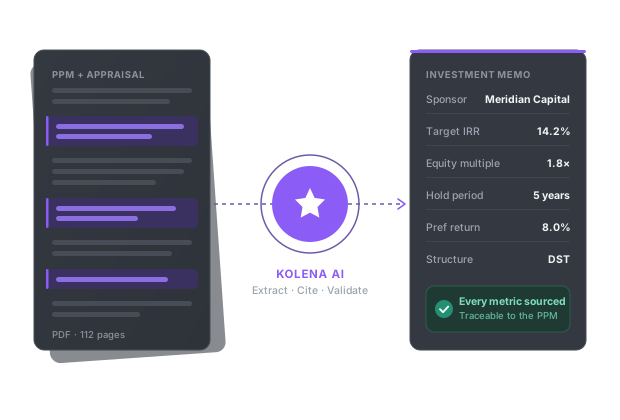
AI reads each document package as it arrives and extracts the metrics that matter — revenue, EBITDA, cash, headcount, covenant status — regardless of how a given portfolio company formats its reporting. It flags variance from plan and prior quarter, surfaces risk signals (a covenant trending toward breach, cash burn accelerating), and normalizes everything into a single dashboard. Every figure is cited back to the board pack or management account it came from, so a partner can drill from the dashboard to the source in one step.
| Step | Manual monitoring | AI monitoring |
|---|---|---|
| Data collection | Email each CFO, chase responses | Read each package automatically |
| Extraction | Hand-keyed into spreadsheets | Metrics extracted, each cited |
| Normalization | Reconcile inconsistent formats | Normalized across all holdings |
| Variance & risk | Spotted if someone looks | Flagged against plan and prior quarter |
| Scaling | Linear with holdings | Flat as the portfolio grows |
What goes in is the quarterly document set; what comes out is a normalized, cited portfolio dashboard — produced without the manual extraction step that used to define the quarter.
What Changes for the Investment Team
The shift is from extracting data to analyzing it. When the dashboard assembles itself from the source documents, the associate who spent the first weeks of each quarter chasing CFOs and keying spreadsheets instead spends that time on what the numbers mean — which holdings are off plan, which covenants are tightening, where to intervene. Reporting lags shrink because extraction is immediate, and because every metric is cited, the quarterly LP report and board materials rest on a traceable basis rather than a re-keyed spreadsheet.
Who Should Adopt This — and Who Shouldn't
Adopt it when you hold enough portfolio companies that manual quarterly aggregation is a real time sink, or when reporting lags and inconsistent formats undermine your visibility. A manager with one or two holdings and simple reporting may not need it. As always, AI extracts and normalizes the data; the judgment about what to do with an off-plan holding stays with the investment team.
Related articles: ai earnings call analysis and ai data room due diligence.
How Kolena Works
Kolena is an AI document automation platform built for PE portfolio operations, family offices, and fund-of-funds. Board packages, management accounts, covenant compliance reports, and KPI updates from every holding go in; a normalized portfolio dashboard — revenue, EBITDA, cash, headcount, covenant status, variance flags — comes out, each metric cited to its source.
It reads any format and reporting style across holdings and pushes structured output into your monitoring and reporting stack, so the quarterly dashboard assembles itself from the source documents. Every run produces a full audit trail: not just what was extracted, but the specific line, figure, or passage that justified each data point. SOC 2 Type II certified, onshore processing, no training on customer data.