What Is AI in Finance?
Artificial intelligence (AI) in finance automates routine tasks, accelerates data analysis, and powers predictive forecasting. Ranging from natural language assistants that parse earnings to machine learning models that detect fraud, AI augments both corporate finance teams and personal money management.
Read about ai earnings call analysis.
The scope of AI in finance is broad, impacting areas like banking, insurance, investment management, and financial technology (fintech). AI-driven tools are used to automate manual tasks, simplify compliance, personalize customer experiences, and enable real-time decision-making.
As financial data volumes and regulatory demands increase, AI helps institutions remain competitive and efficient by reducing errors, enhancing productivity, and uncovering new business opportunities.
Read about ai portfolio monitoring.
Draft your first investment memo in minutes with AI
How AI Is Changing Finance
AI is changing finance by shifting financial institutions from reactive, manual processes to faster, data-driven, and automated operations. Banks, insurers, asset managers, and fintech companies use AI to analyze transactions, assess creditworthiness, detect suspicious activity, and identify market trends in real time. This allows financial teams to make decisions more quickly, reduce operational costs, and improve accuracy in areas where traditional systems struggle with large or complex datasets.
One of the biggest changes is the automation of routine and time-consuming work. AI can review documents, process claims, monitor compliance requirements, generate reports, and support customer service through chatbots and virtual assistants. This frees employees to focus on higher-value tasks such as strategy, relationship management, and complex risk analysis. In customer-facing services, AI enables more personalized financial recommendations, faster onboarding, and more responsive support across digital channels.
AI is also reshaping risk management and fraud prevention. Financial institutions use machine learning models to detect unusual behavior, flag potential fraud, and respond to threats more quickly than rule-based systems. As financial crime becomes more sophisticated, AI helps organizations monitor patterns across accounts, devices, transactions, and communication channels. At the same time, the use of AI introduces new challenges, including data privacy concerns, model bias, cybersecurity risks, and the need for stronger governance and human oversight.
Benefits of AI in Finance
AI delivers value across financial operations by improving efficiency, accuracy, risk management, and customer experience. As organizations handle growing volumes of data and increasing regulatory requirements, AI helps them process information faster and make more informed decisions at scale:
Improved operational efficiency: AI automates repetitive tasks such as data entry, document processing, transaction monitoring, and report generation.
Faster decision-making: AI systems can analyze large datasets in real time, helping financial institutions make quicker decisions related to lending, investments, risk assessment, and customer service.
Enhanced fraud detection: Machine learning models identify unusual transaction patterns and suspicious behavior that may indicate fraud.
Better risk management: AI helps organizations evaluate credit risk, market risk, and operational risk by analyzing historical and real-time data.
Personalized customer experiences: Financial institutions use AI to deliver tailored product recommendations, customized investment advice, and more relevant customer interactions based on individual preferences and behavior.
Reduced costs: By automating processes and improving resource allocation, AI helps lower operational expenses.
Stronger regulatory compliance: AI monitors transactions, reviews documents, and identifies compliance issues more efficiently.
More accurate forecasting and analytics: AI models uncover patterns in financial data that may not be visible through traditional analysis methods.
Improved customer support: AI-powered chatbots and virtual assistants provide round-the-clock support, answer common questions, and assist customers with routine requests.
AI in Finance by Sector
AI in Banking
Banks use AI to change both customer-facing and back-office operations. Chatbots and virtual assistants handle routine inquiries, balance checks, and payment requests, offering 24/7 support with reduced wait times. On the backend, AI-driven analytics flag suspicious transactions, improve compliance with anti-money laundering (AML) regulations, and automate credit risk assessments.
AI is also used in predictive modeling for loan approvals, analyzing applicants’ financial histories and behavioral data to support lending decisions. Banks use AI to personalize product recommendations, optimize marketing efforts, and forecast demand for financial products. These applications help banks reduce costs, improve customer satisfaction, and compete in a changing market.
AI in Insurance
The insurance sector uses AI to improve claims processing, fraud detection, and policy underwriting. AI-driven systems analyze claims documents, assess damage from images, and cross-check information against databases to validate claims. This reduces processing times and the risk of human error or fraud.
Insurers also apply AI to improve risk assessment and pricing models. By analyzing large datasets, including social, economic, and behavioral data, AI helps insurers understand individual risk profiles and tailor policy offerings. This supports competitive pricing, risk management, and new product development.
AI in Investment Management
Investment management firms use AI to support portfolio management, trading strategies, and client advisory services. AI-powered algorithms analyze market data, news, and alternative data sources to generate investment insights and automate trading decisions. This allows firms to respond to market movements and manage risk.
Read about ai investment due diligence.
AI also supports personalized investment recommendations based on clients' goals, risk tolerances, and financial situations. Robo-advisors use AI to build and rebalance portfolios automatically, providing cost-effective investment solutions for a broad range of clients. These tools expand access to investment strategies and improve the consistency of investment advice.
AI in Fintech
Fintech companies often lead in adopting AI, using it to challenge traditional financial services. AI powers alternative credit scoring, peer-to-peer lending platforms, and real-time payment fraud detection. These solutions use non-traditional data sources, such as social media activity or mobile phone usage, to assess creditworthiness and detect anomalies.
AI also supports digital financial assistants, automated compliance tools, and customer service platforms. These technologies allow fintech firms to deliver personalized experiences, reduce operational costs, and adapt to regulatory changes. As a result, AI is a key driver of fintech innovation and market growth.
Related articles: Banking Compliance Automation, ai data room due diligence, ai comparable company analysis, and AI Use Cases in Financial Services.
Examples of AI in Finance
1. AI for Financial Document Review and Validation
Financial institutions process large volumes of documents, including loan packages, financial statements, contracts, compliance records, and investment materials. AI can extract key information, validate figures, cross-check data across multiple documents, and identify inconsistencies that require further review.
By reducing manual document analysis, AI helps teams complete due diligence faster and improve accuracy. It can also generate structured summaries and standardized outputs, making it easier for analysts, auditors, and compliance teams to review information and make decisions based on verified data.
Example:
A regional bank receives a commercial lending application that includes financial statements, tax returns, cash flow reports, and supporting contracts. An AI system extracts key financial metrics, validates figures across documents, and flags inconsistencies between reported revenue and tax filings. The lending team receives a structured summary and focuses its review on the flagged issues rather than manually checking every document.
2. AI for Loan Underwriting
AI supports loan underwriting by reviewing borrower documents, extracting relevant financial information, and assessing risk factors. Instead of manually reviewing large application packages, lenders use AI to analyze income statements, financial records, supporting documentation, and other underwriting materials more quickly.
AI can identify missing information, flag unusual data points, and organize information into standardized formats for underwriters. This allows lending teams to process applications more efficiently and focus on complex cases that require human judgment.
Example:
A mortgage lender processes hundreds of applications each week. AI reviews income documentation, bank statements, employment records, and credit information, then organizes the data into a standardized underwriting package. The system identifies missing pay stubs and flags unusually large deposits for review, allowing underwriters to make decisions more quickly.
3. AI for Insurance Claims Processing
Insurance providers use AI to automate stages of the claims process. AI systems review claims documents, extract relevant details, validate information against supporting records, and identify discrepancies that may indicate errors or potential fraud.
This automation reduces processing times and helps insurers handle larger claim volumes. Faster document review and validation can improve the customer experience by accelerating claim decisions while maintaining accuracy and compliance with internal procedures.
Example:
After a severe storm, an insurance provider receives thousands of property damage claims. AI analyzes claim forms, photographs, repair estimates, and policy documents to verify coverage and identify discrepancies. Claims with complete and consistent information are routed for fast approval, while potentially fraudulent claims are escalated for further investigation.
4. AI for Lease and Real Estate Finance Review
Real estate and finance teams spend significant time reviewing leases, amendments, rent rolls, and due diligence documents. AI can extract lease terms such as rent schedules, expiration dates, renewal options, tenant obligations, and other financial details from agreements.
AI can compare information across multiple files, identify discrepancies, and flag unusual clauses for review. This helps accelerate due diligence, support financial modeling, and analyze large property portfolios while reducing the risk of missed information.
Example:
A real estate investment firm acquires a portfolio of office buildings containing hundreds of lease agreements. AI extracts rent schedules, lease expiration dates, renewal options, and tenant obligations from each contract. The finance team uses the structured data to build cash flow projections and quickly identify leases with unusual terms that could affect property valuation.
5. AI for Accounts Payable and Invoice Reconciliation
Accounts payable teams manage large volumes of invoices, payment records, and supporting documentation. AI can extract invoice data, validate amounts against contracts or purchase records, and identify mismatches that require investigation.
By reducing manual reconciliation work, AI helps organizations process invoices more quickly and accurately. It can also generate structured records for accounting systems and improve visibility into payment obligations.
Example:
A manufacturing company receives thousands of supplier invoices every month. AI extracts invoice details, compares them against purchase orders and delivery records, and identifies mismatches in quantities or pricing. Routine invoices are automatically approved for payment, while exceptions are routed to the accounts payable team for review.
Challenges and Risks of AI in Finance
Data Privacy and Cybersecurity
AI systems in finance handle sensitive personal and financial data, making them targets for cyberattacks and data breaches. Ensuring data privacy requires encryption, secure data storage, and strict access controls. Financial institutions must comply with regulations such as GDPR and CCPA, which mandate transparency and customer consent in data processing. Cybersecurity risks increase as AI systems become more interconnected and reliant on external data sources.
Lack of Explainability
Many AI models, especially deep learning systems, operate as "black boxes," making it difficult to explain their decision-making processes. This lack of transparency creates challenges for regulatory compliance, as financial institutions must justify decisions related to lending, insurance, or trading. Customers and regulators increasingly demand clear explanations for AI-driven outcomes.
Model Risk and Reliability
AI models are only as reliable as the data, assumptions, and methodologies used to build them. Inaccurate, incomplete, or outdated data can lead to poor predictions and flawed decisions in areas such as credit scoring, fraud detection, and investment management. Model drift is another concern. Over time, changes in economic conditions or transaction patterns can reduce a model’s effectiveness, causing predictions to become less accurate.
Best Practices for Implementing AI in Finance
Here are some of the ways that organizations can ensure the safest and most effective use of AI in finance.
1. Start with Document-Heavy, High-Value Workflows
Organizations often achieve the fastest return on investment by applying AI to processes that involve large volumes of documents and repetitive reviews. Examples include loan applications, insurance claims, lease agreements, compliance documentation, customer onboarding forms, and accounts payable invoices. These workflows require significant manual effort and are prone to delays and human error.
Document-heavy processes provide structured opportunities to measure success. Financial institutions can track improvements in processing speed, accuracy, operational costs, and compliance outcomes. Starting with clearly defined use cases helps teams gain experience with AI while limiting implementation risk and disruption to core operations.
How to implement:
Identify processes with high document volumes and repetitive review tasks.
Prioritize workflows with measurable costs, delays, or compliance risks.
Start with a limited pilot before expanding to additional departments.
Define success metrics such as processing time, accuracy, and cost reduction.
Integrate AI with existing document repositories and business systems.
2. Focus on Workflow Automation, Not Just AI Adoption
Successful AI initiatives are built around business processes rather than standalone AI models. The goal is to automate end-to-end workflows, including data collection, document processing, validation, decision support, routing, and reporting. AI delivers the most value when integrated into existing operational systems and procedures.
Many organizations focus on model development but overlook process redesign. As a result, employees may still perform manual handoffs, duplicate reviews, or data transfers. By combining AI with workflow automation, institutions can reduce bottlenecks and improve consistency across departments.
How to implement:
Map the full workflow before introducing AI capabilities.
Automate data collection, validation, routing, and reporting steps.
Integrate AI with core financial, compliance, and operational systems.
Eliminate unnecessary manual handoffs and duplicate reviews.
Measure outcomes based on business performance, not model performance alone.
3. Keep Humans in the Loop for High-Risk Cases
AI can support decision-making, but high-impact financial decisions should involve human review. Lending approvals, fraud investigations, insurance claim denials, regulatory matters, and large investment decisions require contextual judgment that automated systems cannot fully provide. Human oversight helps identify edge cases, validate recommendations, and prevent mistakes.
A common approach is to allow AI to handle routine, low-risk cases while escalating complex or uncertain situations to qualified professionals. This hybrid model balances efficiency with accountability and supports customer trust while meeting regulatory expectations.
How to implement:
Define clear thresholds for when human review is required.
Route complex, high-value, or low-confidence cases to specialists.
Allow employees to approve, reject, or modify AI recommendations.
Train staff on how to evaluate AI-generated outputs.
Monitor escalation patterns to identify areas for improvement.
4. Build Review and Approval Steps into the Workflow
AI-generated outputs should pass through structured review and approval processes before final actions are taken. Whether reviewing extracted document data, compliance findings, risk assessments, or financial recommendations, organizations should establish checkpoints where employees can verify accuracy and address exceptions.
Review processes are particularly important during early deployment when models are still being refined. Regular validation helps identify performance issues, uncover process gaps, and improve model accuracy over time. Well-designed approval workflows reduce operational risk and support responsible AI adoption.
How to implement:
Establish approval checkpoints for critical decisions and transactions.
Validate AI outputs against source documents and business rules.
Create exception-handling processes for unusual or incomplete cases.
Track review outcomes to improve models and workflows over time.
Use role-based approvals for sensitive financial and compliance activities.
5. Make Auditability a Business Requirement
Financial institutions operate in regulated environments where decisions must be documented and explained. AI systems should maintain records of inputs, outputs, model versions, user actions, and approval decisions. These audit trails help organizations demonstrate compliance, investigate issues, and respond to regulatory inquiries.
Auditability also improves internal governance and risk management. When decisions can be traced and reviewed, organizations gain visibility into how AI systems are performing and where controls are needed. Building audit capabilities into AI workflows from the beginning is more effective than adding them after deployment.
How to implement:
Maintain detailed records of AI inputs, outputs, and decisions.
Log user actions, approvals, overrides, and workflow changes.
Store model version information for future review and validation.
Generate audit-ready reports for compliance and regulatory requirements.
Conduct regular audits to evaluate AI performance and governance controls.
How Kolena Automates Document-Heavy Finance Workflows
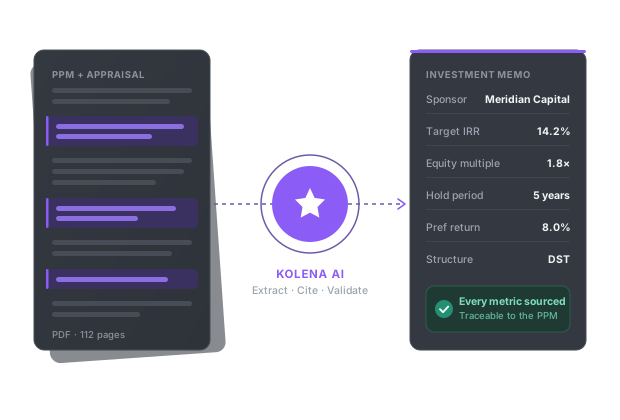
Kolena is an AI-powered document automation platform that helps financial institutions analyze deals faster, reduce risk, and stay audit-ready. Instead of spending weeks manually reviewing PPMs, regulatory filings, leases, and financial packages, finance teams use Kolena to automatically read documents of any format, apply their own review rubric, reason across related documents, and return structured data with field-level source citations. The result is faster investment analysis and compliance testing with greater accuracy and full transparency.
Key capabilities of Kolena:
Investment memo generation: Summarize PPMs, legal documents, appraisals, and reports into professional-grade memos automatically, and generate investor updates and quarterly reports from templates.
Compliance testing: Review disclosures, statements, and advertisements against regulations automatically, accelerating internal audit and compliance checks.
Deal due diligence: Extract key data across entire deal packages to support investment analysis and decision-making.
Portfolio reporting: Aggregate data from multiple sources into structured portfolio updates and risk dashboards.
Source-cited accuracy: Every output includes confidence scoring and source citations, so results are traceable and verifiable.
Audit readiness: Reasoning logs, audit trails, encryption, and governance architecture keep outputs regulator-compliant and enterprise-secure.
Scale without added headcount: Process hundreds of documents in parallel with the same team, cutting turnaround times by 95%+.
Financial institutions like Milestone Bank and SFA Partners use Kolena to consolidate time-consuming workflows into a single automation, turning multi-day reviews into hours. Learn more about Kolena for Financial Services.