AI automates the document-reading that sits underneath every investment decision — data room due diligence, comparable company analysis, portfolio monitoring, earnings call analysis, and IC memo support — by reading documents of any format, extracting the figures that matter, and returning structured output with every value cited to its source. The throughline is simple: investment decisions are only as good as the information behind them, and AI closes the gap between what's buried in the documents and what actually reaches the decision-maker — cited, consistent, and fast.
This guide is for PE firms, real estate investment managers, family offices, fund-of-funds, and hedge funds running structured investment analysis at volume. Each section covers one workflow: the document bottleneck that slows it, and what AI changes. Across all of them, AI does the reading and extraction; the investment judgment stays with your team, working from a faster, fully sourced base.
This is part of a series of articles about AI for Finance.
Data Room Due Diligence
A data room is hundreds of documents — CIMs, financial models, historical financials, legal agreements, customer contracts, HR records, IP documentation — and reading it is the bottleneck between LOI and close. Diligence commonly runs a fixed 30–45 business days (six to eight weeks for full scope), and on a large portfolio manual review swamps that window, dictating both deal velocity and how many deals each analyst can carry.
AI ingests the full data room, cross-references documents against each other, flags assumption mismatches and missing items, and returns a structured diligence summary with every figure cited to its source. The payoff is real: compressing diligence by three to five weeks can save $75,000–$250,000 in advisory fees on a mid-market deal, and one PE customer uses Kolena for data-room due diligence and deal analysis, reducing manual review time and improving consistency across investment reports.
The capacity effect compounds beyond any single deal. When data-room review stops consuming an associate's first two weeks on every opportunity, the team can run diligence on more targets in parallel, bid more competitively on time-sensitive processes, and walk away from weak deals faster — because the cost of looking has dropped. Diligence stops being the rate limiter on how many opportunities the firm can seriously evaluate in a quarter.
Draft your first investment memo in minutes with AI
Comparable Company Analysis
Building a comps table means reading 10-Ks, 10-Qs, earnings transcripts, press releases, and analyst reports for each comparable — pulling revenue, EBITDA, margins, growth rates, multiples, and guidance — and across ten to fifteen companies that is days of analyst work, repeated every time a comparable reports.
AI reads each filing, extracts the relevant line items with citations, normalizes them across companies, and populates a structured comps table in which every figure links to its source filing. When a comparable reports new results, the table updates from the new filing rather than requiring a manual re-read — and a comps table built from cited, AI-extracted figures is more defensible in an IC presentation than one built from memory or manual transcription.
Portfolio Monitoring
Monitoring a portfolio means reading, every quarter, across every holding: board packages, management accounts, covenant compliance reports, KPI dashboards, and portfolio-company updates. The manual version is a finance associate emailing each portfolio-company CFO for the latest accounts and scorecard, then hand-aggregating it into spreadsheets — a process that creates lags and scales linearly with the number of holdings.
AI reads each document package, extracts the key metrics — revenue, EBITDA, cash, headcount, covenant status — flags variance from plan, and surfaces risk signals, producing a normalized portfolio dashboard with every figure cited to its source. The team shifts from chasing and extracting data to analyzing it.
Earnings Call Analysis
Earnings call transcripts carry more than the headline number: management guidance, tone signals, analyst question patterns, and language that shifts quarter over quarter in ways that signal confidence or concern. Reading them across a coverage universe is slow and inconsistent — a buy-side analyst covering 15–25 names can spend two to three hours per company, 50–75 hours across an earnings season.
AI reads each transcript and extracts the signal: key guidance figures, topics management struggled to answer, language changes from the prior quarter, analyst concerns ranked by frequency, and non-GAAP reconciliation mentions — with every quote cited to its place in the transcript. It surfaces pattern changes across quarters and topic clusters across analyst questions that manual reading misses, so the analyst reads the summary first and digs into the full transcript only where it's flagged.
Learn more about Banking Compliance Automation.
IC Memo Support
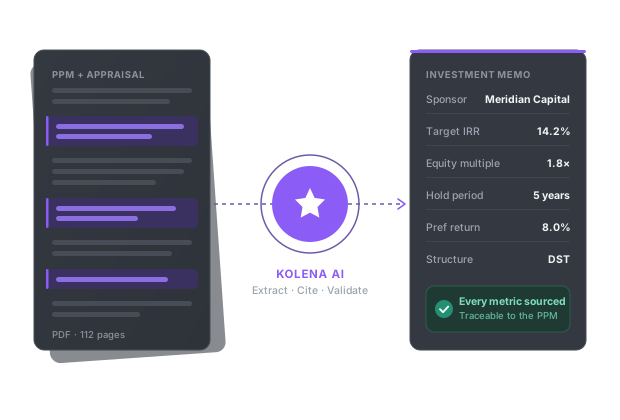
The investment committee memo is where all of this comes together — and where unsourced figures cost the most. A number in an IC memo that can't be traced to a source document gets re-verified by hand before anyone will rely on it, which erases the time the analysis was supposed to save and introduces risk if the re-verification is skipped.
AI drafts the supporting analysis with every figure cited to its source — the data-room document, the filing, the transcript — so the memo that reaches the committee shows sourced numbers rather than conclusions someone has to defend from memory. One PE customer uses Kolena for exactly this, improving consistency across investment reports while cutting the manual effort behind each one. The consistency matters as much as the speed: when every memo is built from the same cited extraction process, the committee compares opportunities on a level basis rather than on whichever analyst happened to dig deepest, and the audit trail behind each figure survives long after the deal closes.
Why Citations and Onshore Processing Matter in Investing
Two features decide whether document AI is usable for investment work. The first is field-level citation: every extracted value links to the exact line, figure, or passage it came from, so an analyst verifies in seconds and the IC sees sourced numbers rather than assertions. The second is data handling: data-room and portfolio documents contain highly confidential, often NDA-bound deal data, and routing them offshore creates data-residency and confidentiality exposure. Processing onshore, under SOC 2 Type II, with no training on customer data, removes that exposure — which is why it matters as much as speed.
There's a third feature that separates usable investment AI from a demo: human-in-the-loop by design. A platform that confidently returns a plausible figure that isn't in the document is more dangerous in investing than one that flags uncertainty, because a wrong input quietly propagates into a model, a memo, and a decision. The right behavior is to flag low-confidence extractions for review rather than guess, and the citation is what makes that review fast — an analyst confirms the flagged value against its source in seconds instead of re-reading the document. Speed, citations, onshore processing, and honest uncertainty handling are a package; a tool that delivers three of the four isn't yet enterprise-ready for investment work.
Where to Start: Sequencing Adoption
Firms rarely automate every workflow at once, and they don't need to. The pattern that works is to start where the document load is heaviest and most repeatable, prove the output against your own sourcing standards, then expand. For most deal teams that first step is data room due diligence or comps, because the time savings are immediate and easy to measure against a live deal or a current comp set. Portfolio monitoring and earnings analysis follow naturally because they reuse the same extraction-and-citation foundation on a recurring cadence rather than a one-off deal clock. Because one platform spans all five workflows, each new use case is a configuration — a new rubric and output template — rather than a new vendor, so the team builds trust in the cited output one workflow at a time before leaning on the speed.
Manual vs. AI Across Investment Workflows
| Workflow | Manual | AI (Kolena) |
|---|---|---|
| Data room review | Weeks; bottleneck to close | Days; cited diligence summary |
| Comps table | Days across 10–15 companies | Populated and cited; updates from new filings |
| Portfolio monitoring | Email chases, spreadsheet lag | Normalized cited dashboard each quarter |
| Earnings calls | 2–3 hours per company | Cited summary; read full text only where flagged |
| IC memos | Figures re-verified by hand | Every figure cited to its source |
The common thread: the document is the bottleneck, not the judgment. AI removes the reading-and-extraction constraint without touching the decision, which is why one platform pays off across all five workflows rather than solving just one.
How Kolena Works
Kolena is an AI document automation platform built for PE firms, investment managers, family offices, and funds. Data rooms, filings, transcripts, board packages, and management accounts go in; structured, cited output — diligence summaries, comps tables, portfolio dashboards, earnings summaries, IC-memo support — comes out, with low-confidence items flagged for review.
It reads any format inside your secure environment, reasons across related documents, and pushes structured output into your models, reporting stack, and data warehouse, with every figure cited to its source. Every run produces a full audit trail: not just what was extracted, but the specific line, figure, or passage that justified each data point. SOC 2 Type II certified, onshore processing, no training on customer data.